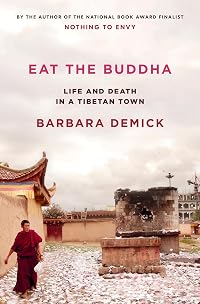
Eat the Buddha: Life and Death in a Tibetan Town
by Barbara Demick
On This Page
Description
"Set in Aba, a town perched at 12,000 feet on the Tibetan plateau in the far western reaches of China that has been the engine of Tibetan resistance for decades, Eat the Buddha tells the story of a nation through the lives of ordinary people living in the throes of this conflict. Award-winning journalist Barbara Demick illuminates a part of China and the aggressions of this superpower that have been largely off limits to Westerners who have long romanticized Tibetans as a deeply spiritual, show more peaceful people. She tells a sweeping story that spans decades through the lives of her subjects, among them a princess whose family lost everything in the Cultural Revolution; a young student from a nomadic family who becomes radicalized in the storied monastery of Kirta; an upwardly mobile shopkeeper who falls in love with a Chinese woman; a poet and intellectual who risks everything to voice his resistance. Demick paints a broad canvas through an intimate view of these lives, depicting the tradition of resistance that results in the shocking acts of self-immolation, the vibrant, enduring power of Tibetan Buddhism, and the clash of modernity with ancient ways of life. Her depiction is nuanced, unvarnished, and at times shocking"-- show lessTags
Recommendations














Member Reviews
These were fascinating stories and Demick is a fantastic storyteller. Sadly, there was no attempt to write with even the barest illusion of impartiality. This was pure propaganda. I lived in China, have spent a good deal of time in cities close to Tibet (though only about 10 days in actually in Tibet) and met Tibetan and Uyghur people who told tales that left me with no doubt that the Chinese government has brutally repressed many ethnic minorities, and have been most brutal with respect to these two groups. There is no way to tell this story where the Chinese government does not show itself to be violent and intolerant of difference -- the blood of many drips from their hands. Given that it is hard to see why Demick chose to gild the show more lily to make the government look even worse My biggest issue? She writes of Tibet under monarchy as a veritable paradise where people joyfully served their gods-given rulers. That is simply not true. I am sure ordinary Tibetan people see the feudal system through a haze of nostalgia. I am sure that haze is helped along by the fact that the monarchy was followed by the despotic rule and ritual torture of the Communist Party. But that does not change the fact that during the monarchy Tibet was a very had place for most of its citizens. Those commoners went hungry while their crops were taken by the royals. Those commoners toiled in poverty as the royals lived in relative splendor. Were the serfs loyal to their overlords? I am sure some were. Apart from the horrors perpetrated on Tibetans by the Maoists making the monarchs look like pussycats, this happens with freed slaves all the time. There were plenty of slaves who refused to leave their plantations after the American Civil War. Uncertainty can be worse than slavery, and generations of seeing yourself through the lens of caste does a number on people. I am not justifying the Chinese government's actions to crush Tibet under its bootheel, nor am I turning a blind eye to the irony of a government built on a foundation of anti-imperialism showing themselves to be the most deadly imperialists of all. I am however saying that it is foolish to ignore the fact that a government based on progeniture (as Tibet's was) is antithetical to freedom and equality, which are supposed to be values we in the West embrace. The Chinese had legitimate reasons to dismantle that government. How it was done, the ongoing oppression of the Tibetan people, the Atheist/Marxist jihad on faith, those are all crimes against humanity -- just tell that story. Still happy I read this, much of it was edifying and fascinating. show less
The title got me into the book, and the interesting history lesson kept me going. Focusing on a group of Tibetans who live in Sichuan, an area where many Tibetans have set themselves on fire protesting China’s rule. Demick sets out to find out why 156 Buddhists have set themselves on fire, even swallowing gasoline to make sure they burn from the inside. By looking back at the history of the Tibetan uprising and the humiliating way the Chinese stripped these Tibetans of everything, even killing their yaks, Demick has a very pessimistic outlook for the future. It’s a challenging book to read, but well worth it if you are interested in the future of Tibet and Tibetan Buddhism.
Fascinating. I've read other books about Tibet but they've all been focused on the Dalai Lama or other religious leaders. This book follows a handful of people from different walks of life and gives a much more well-rounded and new-to-me window into Tibetan history and culture. I did get briefly confused a few times as to who was who, but the author did a good job of referencing earlier information about the individual to connect things. I would definitely read this author again.
Exhaustively researched, with lots of human-interest stories of individuals from an ethnically Tibetan town, Ngaba (or Aba) in western Sichuan, and how the Chinese government's relentless cultural and political repression over the past 60 years has affected them. It's a sad story, but full of detail and context and history. It's also a necessary story; what the Chinese government has been doing for decades in ethnically Tibetan areas has been practice for rolling out the same policies and techniques in Xinjiang, Inner Mongolia and Hong Kong, and perhaps next in Taiwan. Great book!!
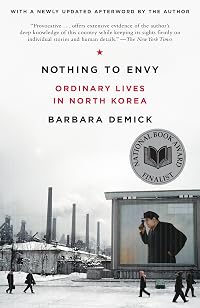
I learned a lot about Tibet- an area of the world I know little about. But for some reason I cannot quite put my finger on, this book did not grab me as well as Demick's book about North Korea. Still worth reading- it really illustrates the horrors of authoritarianism.
Excellent book. Well-researched and written.
Ratings
Members
- Recently Added By
Published Reviews
“Eat the Buddha” is Demick’s third book, all of them told in rotating perspectives — a model inspired by John Hersey’s “Hiroshima,” and one she has made her own....In her latest, the masterly “Eat the Buddha,” she profiles a group of Tibetans with roots in Ngaba County, in the Chinese province of Sichuan, which bears the gory distinction of being the “undisputed world show more capital of self-immolations.” ...This mystery hooked Demick, who arrived in China in 2007 as the Beijing bureau chief of The Los Angeles Times.... Those who self-immolate today are the grandchildren of those who participated in the early uprisings, Demick writes. Having imbibed the Dalai Lama’s teachings of nonviolence, they can only bear to hurt themselves. They bear the scars of the “Democratic Reforms” in eastern Tibet that began in 1958... Demick covers an awe-inspiring breadth of history — from the heyday of the Tibetan empire, which could compete with those of the Turks and Arabs, to the present day, as the movement for Tibetan independence has faltered and transformed into an effort at cultural and spiritual survival....If the spectacular horror of the self-immolations first attracted her interest, she finds, at least among her sources, demands that sound surprisingly modest. They want only the rights enjoyed by the Han Chinese, she writes — to travel, hold a passport, to study their own language, to educate their children abroad if they wish....Her forecast is pessimistic. Only in North Korea has she witnessed such smothering surveillance and high levels of fear. show less
added by Lemeritus
In this heartbreaking and doggedly reported account, journalist Demick (Nothing to Envy) views the tragic history of Tibet under Chinese rule through the stories of people with roots in Ngaba County, the site of the Mei kingdom in the remote reaches of Sichuan province....“For the most part,” Demick writes, “they were regular people who hoped to live normal, happy lives in China’s show more Tibet without having to make impossible choices between their faith, family, and their country.” Demick captures her subjects’ trials and sacrifices with superb reporting and razor-sharp prose. This poignant history could do much to refocus attention on the situation in Tibet. show less
added by Lemeritus
A portrait of one town reveals Tibet's tragic past. Demick, a reporter for the Los Angeles Times who served as its bureau chief in Beijing and Seoul, offers a vibrant, often heartbreaking history of Tibet, centered on Ngaba, which sits at 11,000 feet on the plateau where Tibet collides with China....Although many Tibetans are grateful for the economic growth and technology that the Chinese show more have brought, the loss has been tremendous. “I have everything I might possibly want in life,” one Tibetan businessman told Demick, “but my freedom.” Memorable voices inform a penetrating, absorbing history. show less
added by Lemeritus
Lists

Economist Books of the Year 2020
41 works; 5 members

Non-Fiction Worth Reading
1,015 works; 261 members

Best Travel Writing - Non-Fiction
110 works; 6 members

Books Read in 2022
5,168 works; 114 members

Club Read's Recommended Nonfiction Written by Women
618 works; 30 members

China / Hong Kong / Taiwan
25 works; 1 member
Author Information

7 Works 4,478 Members
Awards and Honors
Awards
Distinctions
Notable Lists
Common Knowledge
- Canonical title
- Eat the Buddha: Life and Death in a Tibetan Town
- Original publication date
- 2020
- Important places
- Ngawa; Sichuan Province, China; Tibet
- First words
- For centuries, Tibet was known as a hermit kingdom. Its charms were hidden by the natural barrier of The Himalayas and by a reclusive theocratic government ruled by a succession of Dalai Lamas, each believed to be the reincar... (show all)nation of his predecessor. -Author's Note
Gonpo could smell the smoke before she could see what was happening. Although she was just seven years old and not well versed in the politics of the day, it confirmed a nagging feeling she'd had for weeks that something was ... (show all)amiss. -Chapter 1, 1958 - Original language
- English
- Canonical DDC/MDS
- 951.38
- Canonical LCC
- DS797.A63
Classifications
Statistics
- Members
- 395
- Popularity
- 78,986
- Reviews
- 6
- Rating
- (4.14)
- Languages
- 6 — Dutch, English, Finnish, French, Italian, Spanish
- Media
- Paper, Audiobook, Ebook
- ISBNs
- 20
- ASINs
- 5