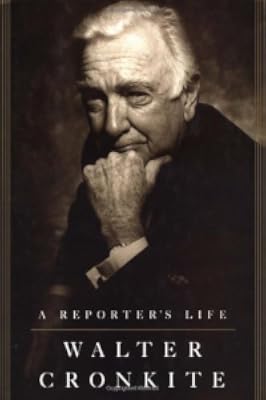
A Reporter's Life
by Walter Cronkite
On This Page
Description
Overview: He has been called the most trusted man in America. His 60-year-long journalistic career has spanned the Great Depression, several wars, and the extraordinary changes that have engulfed our nation over the last two-thirds of the 20th century. When Walter Cronkite advised his television audience in 1968 that the war in Vietnam could not be won, President Lyndon B. Johnson said: "If I've lost Cronkite, I've lost middle America." Now, at the age of eighty, Cronkite has written his show more life story-the personal and professional odyssey of the original "anchorman" for whom that very word was coined. As a witness to the crucial events of this century-first for the Houston Press, then for the United Press wire service, and finally for CBS in the fledgling medium of television-Cronkite set a standard for integrity, objectivity, enthusiasm, compassion, and insight that is difficult to surpass. He is an overflowing vessel of history, and a direct link with the people and places that have defined our nation and established its unique role in the world. But Walter Cronkite is also the man who loved to drive race cars "for the same reason that others do exhibitionist, dangerous stunts. It sets us apart from the average man; puts us, in our own minds, on a level just a little above the chap who doesn't race." He is also the man whose "softheartedness knows no rational bounds" and who always had "great problems at the theater, tearing up at the slightest offense against animals and people, notably the very old or the very young." He is the man who could barely refrain from spitting on the defendants at the Nuremberg Trials, and who could barely announce President Kennedy's assassination over the air for the sobs in his throat. Walter Cronkite helped launch the juggernaut of television, and tried to imbue it with his own respect for quality and ethics; but now he occupies a ringside seat during the decline of his profession and the ascent of the lowest common denominator. As he aptly observes, "They'd rewrite Exodus to include a car chase." Still, the American people know the difference. They know that for decades they have had the privilege of getting their news from a gentleman of the highest caliber. And they will immensely enjoy A Reporter's Life. show lessTags
Recommendations

















Member Recommendations

Member Reviews
I grew up getting a good portion of my news from Walter Cronkite. The chief impression one gets from his on-air style is one of trust: You want to believe that he's telling you what he knows to be true. To the extent that you can believe an autobiography, that impression is borne out here, although he does admit to a couple of peccadilloes in the early days of his radio career that would get any newbie fired nowadays. "Uncle Walter" comes across here as an earnest man who takes journalism and its responsibilities seriously. The self-deprecating style here shows an occasional amusement that middle America takes him just as seriously. Of most interest to me was Cronkite's recollections of the major stories that he and his team informed show more America about, many of which I remember seeing him report. Being in elementary school, I missed his announcement of JFK's death; now I'll have to find it online. Cronkite wasn't above using his influence to shape the news. His negative comments about the course of the Vietnam war helped influence LBJ's decision not to seek re-election. And he was instrumental in getting Anwar Sadat to sit down and talk peace with Menachim Begin. Cronkite was a giant of American electronic journalism who contributed, albeit with regret, to the dominance of TV news over newspaper reporting. And he seems like a genuinely decent man, worthy of the trust that America bestowed upon him every night for years. show less
Walter Cronkite’s autobiography fascinates on at least two levels: 1. the storied life of a well-traveled and internationally acclaimed television journalist; 2. the prominent figures that played a part in his life due to his position and popularity.
One anecdote involves the discovery of shady dealings. He worked for a newspaper and made the mistake of changing something on a page he didn’t usually work on. The firestorm that followed shocked him, until he learned that the numbers on the page were communicating the winning numbers in the Mafia’s Numbers Racket.
Cronkite was a radio announcer and was famous for being able to fill in details when the communications went down during a football game. He could make up plays and then show more smoothly dovetail his made up events with the actual progress when the communications came back online.
One of Cronkite’s first brushes with celebrity was the coronation of Queen Elizabeth II in 1953. Due to the limitations of technology at the time, some of the interesting anecdotes involve the ways they had to improvise to get film from the live event to the studio in time to show footage during the evening broadcast. This was especially challenging getting footage from England to New York on the same day.
TV made Cronkite the famous figure that he became. So it is with some irony that he marks the end of democracy with the beginning of TV. Politicians and political conventions suddenly became sanitized and dishonest when cameras were trained on them. The exposure of the democratic process could appear ugly to the untrained eye. It’s like some dishes, they are excellent, but it’s not a good idea to watch the chef create it.
By sanitizing the process itself, the end product became sanitized. The end product is the political reality today. The goal was to look polished for the camera, not to honestly work the process to the best possible outcome. “The conventions were reduced to marketing tools. From that day forward, the image on the tube has been the most important aspect of a political campaign, and politics and television have gone skipping hand in hand down this primrose path” (182–183).
Despite the demise of democracy, Cronkite remained an optimistic personality and a revered leader, or at least an accurate reflection, of mainstream American public values. His many decades of journalistic writing gave him a way with words that shows in the present autobiography. It’s an exciting travelogue through the figures and events of the twentieth century, which he covered so well for the CBS Evening News. show less
One anecdote involves the discovery of shady dealings. He worked for a newspaper and made the mistake of changing something on a page he didn’t usually work on. The firestorm that followed shocked him, until he learned that the numbers on the page were communicating the winning numbers in the Mafia’s Numbers Racket.
Cronkite was a radio announcer and was famous for being able to fill in details when the communications went down during a football game. He could make up plays and then show more smoothly dovetail his made up events with the actual progress when the communications came back online.
One of Cronkite’s first brushes with celebrity was the coronation of Queen Elizabeth II in 1953. Due to the limitations of technology at the time, some of the interesting anecdotes involve the ways they had to improvise to get film from the live event to the studio in time to show footage during the evening broadcast. This was especially challenging getting footage from England to New York on the same day.
TV made Cronkite the famous figure that he became. So it is with some irony that he marks the end of democracy with the beginning of TV. Politicians and political conventions suddenly became sanitized and dishonest when cameras were trained on them. The exposure of the democratic process could appear ugly to the untrained eye. It’s like some dishes, they are excellent, but it’s not a good idea to watch the chef create it.
By sanitizing the process itself, the end product became sanitized. The end product is the political reality today. The goal was to look polished for the camera, not to honestly work the process to the best possible outcome. “The conventions were reduced to marketing tools. From that day forward, the image on the tube has been the most important aspect of a political campaign, and politics and television have gone skipping hand in hand down this primrose path” (182–183).
Despite the demise of democracy, Cronkite remained an optimistic personality and a revered leader, or at least an accurate reflection, of mainstream American public values. His many decades of journalistic writing gave him a way with words that shows in the present autobiography. It’s an exciting travelogue through the figures and events of the twentieth century, which he covered so well for the CBS Evening News. show less
An inside look at the US from the 1920's to the end of the twentieth century, and great insight into what made Walter Cronkite the most trusted man in the country in the 1960's and 1970's. I thoroughly enjoyed this story and that surprised me, as I thought I would be reading another somewhat boring "look at me" type of book. His time overlaps my time, having grown up in the sixties, so I am sure I have a bias here. It is one of the few books of the thousands that I have read that I would revisit. Excellent writing style, very engaging.
Walter Cronkite’s life chronicles the rise and fall of news reporting, in my opinion. He started as a delivery and errand boy, then news gatherer and writer, then into radio news and the wire services and finally into TV in its infancy. He loved being a newspaperman and always considered himself that even when he was an anchor. He says he tried to keep the news he presented factual and impartial, whatever his personal opinion. I grew up with his broadcasts and admired his integrity. His book covers most of the major stories of his career, but I found his retirement and subsequent overview of the news industry to be a profound look at what is happening. His kind of news philosophy is sadly gone. We must gleen our information from sound show more bites and photo ops or miniscule newspaper reports from conglomerate news chains interested in the bottom line. Great book from a major representative of a bygone era. show less
Breezy and conversational, if not actually chatty. It's a whirlwind tour of the life of a newsman the likes of which we have never more desperately needed than we do right now.
The only flaw is that there were several events in his career that he seemed to touch on briefly that I would have liked to have seen expanded on, particularly his coverage of the space program, of which he was an unabashed admirer.
All in all, though, a fast and fascinating read.
The only flaw is that there were several events in his career that he seemed to touch on briefly that I would have liked to have seen expanded on, particularly his coverage of the space program, of which he was an unabashed admirer.
All in all, though, a fast and fascinating read.
I read this twice to really take it in because Cronkite skips around a lot. This is not arranged in clear chronological order. However the second read was worth it. Cronkite's life spanned the introduction of radio, television and finally the Internet. He had an opportunity to have sometimes very long interviews with most of the presidents since Roosevelt and gives good opinions of them. Two observations really grabbed me that are well worth repeating (as this book has no index).
Today looking at Afghanistan his observations on the Vietnam War are worth repeating
When not to send troops
page 265 Ballentine Books paperback
"A corrupt, incompetent, unpopular government that we were committeed to support"
"An allied army that often preferred show more not to fight"
"A resourceful dedicated enemy resolved to struggle on regardless of casualties"
then there is also an early view of Cheney's attitude toward disclosure of vital information to the press
page 267
"Richard Cheney delayed tghe press call-up with full knowledge as he put it until it was too late to cover the crucial five hours of the invasion (Grenada).
In summary I would say this is a vital book to an understanding of the presidency in the last half of the 20th century as well as a vital history of the development of communications during that period.
Much of what even in 1996 the author has to say about the decline of responsible journalism in all forms (he speaks of one newspaper readings, of the move from information to entertainment)that is now increasing. show less
Today looking at Afghanistan his observations on the Vietnam War are worth repeating
When not to send troops
page 265 Ballentine Books paperback
"A corrupt, incompetent, unpopular government that we were committeed to support"
"An allied army that often preferred show more not to fight"
"A resourceful dedicated enemy resolved to struggle on regardless of casualties"
then there is also an early view of Cheney's attitude toward disclosure of vital information to the press
page 267
"Richard Cheney delayed tghe press call-up with full knowledge as he put it until it was too late to cover the crucial five hours of the invasion (Grenada).
In summary I would say this is a vital book to an understanding of the presidency in the last half of the 20th century as well as a vital history of the development of communications during that period.
Much of what even in 1996 the author has to say about the decline of responsible journalism in all forms (he speaks of one newspaper readings, of the move from information to entertainment)that is now increasing. show less
Absolutely brilliant. Clear, lucid prose recounting some of the great turning points in history by a man who was there. Fare thee well, Walter; your kind is not seen but once in a generation.
Members
- Recently Added By
Lists

al.vick-parents books
301 works; 1 member
Author Information

82+ Works 2,209 Members
Walter Cronkite was born in St. Louis, Missouri on November 4, 1916. As a teenager, he got a job with The Houston Post as a copy boy and cub reporter. In college, he worked part-time for the Houston Press, a paper he joined full-time after leaving the University of Texas in 1935. From 1940 to 1949, he reported for the United Press wire service. show more One of the first journalists accredited to cover World War II, Cronkite accompanied Allied forces into North Africa, reported on the Normandy invasion and the Battle of the Bulge. At the end of the war, he became UP's bureau chief in Moscow and then its chief correspondent at the Nuremburg war crimes trials. After returning to the United States in 1948, he covered Washington, D.C., for a group of radio stations before joining CBS, where he remained for the rest of his career, first working on various news programs and then, in 1962, becoming anchor of the CBS Evening News. Over the years, Cronkite covered such events as the assassination of President John F. Kennedy, the moon landing of Apollo II (staying on the air 24 hours to do so), the Vietnam War, and the Watergate scandal. He twice visited Vietnam during the war, and, after the Tet offensive in 1968, candidly questioned the rationale for American involvement and the U.S. military's prospects for victory. He won numerous awards including several Emmy Awards, the Peabody Award in 1962, the William A. White Journalism Award in 1969, the George Polk Award in 1971, and the Presidential Medal of Freedom in 1981. After his retirement in 1981, Cronkite continued to work on special projects for CBS and wrote his autobiography A Reporter's Life in 1996. He died from was complications of dementia on July 17, 2009 at the age of 92. (Bowker Author Biography) show less
Awards and Honors
Distinctions
Work Relationships
Common Knowledge
- Canonical title
- A Reporter's Life
- Original publication date
- 1996
- People/Characters
- Walter Cronkite
- Dedication
- For the 22 million who were there Monday through Friday . . .
And for Betsy, who has been there every night
And for the children and grandchildren, who h... (show all)ave made something very special of a reporter's life:
Nancy
Kathy and Bill, and their William and Jack
Chip and Deborah, and their Walter IV and Peter - First words
- If, as they say, the threat of the hangman's noose has a powerful way of focusing one's attention, the same can be said of pregnancy.
- Last words
- (Click to show. Warning: May contain spoilers.)I expect to watch all of this from a perch yet to be determined. I just hope that wherever that is, folks will still stop me, as they do today, and ask: "Didn't you used to be Walter Cronkite?"
- Canonical DDC/MDS
- 070.92
- Canonical LCC
- PN4874.C84
Classifications
- Genres
- Biography & Memoir, Nonfiction, General Nonfiction, History
- DDC/MDS
- 070.92 — Computer science, information & general works News media, journalism & publishing Documentary media, educational media, news media; journalism; publishing Biography And History Biographies
- LCC
- PN4874 .C84 — Language and Literature Literature (General) Literature (General) Journalism. The periodical press, etc. By region or country
- BISAC
Statistics
- Members
- 1,636
- Popularity
- 13,845
- Reviews
- 14
- Rating
- (3.75)
- Languages
- English
- Media
- Paper, Audiobook
- ISBNs
- 9
- ASINs
- 7