
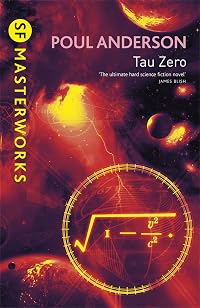
Tau Zero
by Poul Anderson
On This Page
Description
Aboard the spacecraft Leonora Christine, fifty crewmembers, half men and half women, have embarked on a journey of discovery like no other to a planet thirty light-years away. Since their ship is not capable of traveling faster than light, the crew will be subject to the effects of time dilation and relativity. They will age five years on board the ship before reaching their destination, but thirty-three years will pass on Earth. Experienced scientists and researchers, they have come to show more terms with the time conditions of their space travel. U the Leonora Christine passes through an uncharted nebula, which damages the engine, making it impossible to decelerate the ship on the second half of their trip. To survive, the crewmembers have no choice but to bypass their destination and continue to accelerate toward the speed of light. But how will they keep hope alive and maintain order as they hurtle deeper into space with time passing more and more rapidly, and their ultimate fate unknown? show lessTags
Recommendations













Member Recommendations

Member Reviews
There are obvious dangers serving on a colony ship headed for a potentially habitable planet. Will the crew manage the effects of isolation, zero g, and continuous existential crisis? What about the time dilation effects due to travelling at near light speed - can people cope with the fact that the planet they're leaving will experience decades of change in their 5 year journey? What if the planet can't actually sustain life - can you imagine having to go back? Even more practically: will you even survive the journey?
Tau Zero explores all these types of questions before grinning mischievously and throwing one last monkey wrench into the equation: what if the ship is damaged en route - not in a life-threatening way - and now can no show more longer stop? In fact, it can no longer even slow down; its crew is able to survive indefinitely, but time is dilating further as minutes on board the ship become centuries outside. They can't land, call back to home, or even make repairs, and the stars and planets and galaxies they're able to see outside their windows are looking ever stranger and out of reach.
It's a really cool idea. Tau Zero is a hard science (well, for 1970) sci-fi book first and foremost, but at many points throughout it feels closer to a post-apocalypse story. After the aforementioned disaster strikes, the crew of the Leonora Christine become survivors of a very personal apocalypse. The world they knew is gone in every sense of the word, and they themselves have become ghosts without a home or purpose.
The book excels when it explores these ideas, or when it dips into the poetic to describe cosmic phenomena, or when dives into paragraphs of big, crunchy technical jargon for the all the science work being done. It's wonderful scifi writing.
The problem is everything else.
A book detailing a disaster really needs to get the human element right. People should respond to it believably, which might mean some acting irrationally, others rising to heroics, still others falling into depravity or doom or hysterics. The drama and tension naturally arise from people overcoming their weaknesses, making tough decisions, and so forth.
But Tau Zero's characters aren't really people; they're barely even 2D cardboard cutouts. They wander from scene to scene expositing dialogue at each other, or saying their internal monologues out loud to advance a thread, or suddenly acting out of character because it's convenient for the plot at the time. There's very little conflict (the most physical it gets is a single fistfight over cards) and drama is often resolved with a handwave.
The dialogue is especially embarrassing. There are some scenes early on where characters are literally just stating their backstories to one another intermixed with current world history that would surely be obvious to them. It's the type of thing that'd get you in trouble with your 9th grade English teacher.
The worst by far is the protagonist. He's a military man, a cop-esque figure on the ship. But also he knows everything about space and astrophysics and chemistry and planetary colonization and can stand toe-to-toe with experts in their field in any scientific discussion. His arguments are always correct, and those who doubt him eventually regret their words and deeds. He's a better captain than the captain. He's a master manipulator, with networks of deputies and secret deputies and spies. He can pilot star ships better than anyone. He's the best melee fighter, the best at navigating zero-g, and the only one with a gun. He's also naturally handsome, rugged, and is worshipped by at least two women.
He's absolutely ridiculous.
It's such a shame, because I love so much else about this book. Though the science never really rang true to me, I still suspended my disbelief because it's explained so well. The premise is excellent, equal parts terrifying and exhilarating, and the tension it weaves throughout the book left my palms sweaty.
All it needed was a handful of characters who behaved like humans. Instead, we get these weirdos. You get the sense that Anderson viewed humans as an unfortunate necessity to write about a cool spaceship flight. I wish he hadn't even bothered and made the Leonora Christine an unmanned expedition. show less
Tau Zero explores all these types of questions before grinning mischievously and throwing one last monkey wrench into the equation: what if the ship is damaged en route - not in a life-threatening way - and now can no show more longer stop? In fact, it can no longer even slow down; its crew is able to survive indefinitely, but time is dilating further as minutes on board the ship become centuries outside. They can't land, call back to home, or even make repairs, and the stars and planets and galaxies they're able to see outside their windows are looking ever stranger and out of reach.
It's a really cool idea. Tau Zero is a hard science (well, for 1970) sci-fi book first and foremost, but at many points throughout it feels closer to a post-apocalypse story. After the aforementioned disaster strikes, the crew of the Leonora Christine become survivors of a very personal apocalypse. The world they knew is gone in every sense of the word, and they themselves have become ghosts without a home or purpose.
The book excels when it explores these ideas, or when it dips into the poetic to describe cosmic phenomena, or when dives into paragraphs of big, crunchy technical jargon for the all the science work being done. It's wonderful scifi writing.
The problem is everything else.
A book detailing a disaster really needs to get the human element right. People should respond to it believably, which might mean some acting irrationally, others rising to heroics, still others falling into depravity or doom or hysterics. The drama and tension naturally arise from people overcoming their weaknesses, making tough decisions, and so forth.
But Tau Zero's characters aren't really people; they're barely even 2D cardboard cutouts. They wander from scene to scene expositing dialogue at each other, or saying their internal monologues out loud to advance a thread, or suddenly acting out of character because it's convenient for the plot at the time. There's very little conflict (the most physical it gets is a single fistfight over cards) and drama is often resolved with a handwave.
The dialogue is especially embarrassing. There are some scenes early on where characters are literally just stating their backstories to one another intermixed with current world history that would surely be obvious to them. It's the type of thing that'd get you in trouble with your 9th grade English teacher.
The worst by far is the protagonist. He's a military man, a cop-esque figure on the ship. But also he knows everything about space and astrophysics and chemistry and planetary colonization and can stand toe-to-toe with experts in their field in any scientific discussion. His arguments are always correct, and those who doubt him eventually regret their words and deeds. He's a better captain than the captain. He's a master manipulator, with networks of deputies and secret deputies and spies. He can pilot star ships better than anyone. He's the best melee fighter, the best at navigating zero-g, and the only one with a gun. He's also naturally handsome, rugged, and is worshipped by at least two women.
He's absolutely ridiculous.
It's such a shame, because I love so much else about this book. Though the science never really rang true to me, I still suspended my disbelief because it's explained so well. The premise is excellent, equal parts terrifying and exhilarating, and the tension it weaves throughout the book left my palms sweaty.
All it needed was a handful of characters who behaved like humans. Instead, we get these weirdos. You get the sense that Anderson viewed humans as an unfortunate necessity to write about a cool spaceship flight. I wish he hadn't even bothered and made the Leonora Christine an unmanned expedition. show less
I know this book is older and a bit dated in some of its concepts around society and women's places but it is refreshing to read a sci-fi book that has interesting science concepts in it and not ignore things like relativity the way many of the big franchises do today. It was a page turner that kept me engrossed in the story. I do think he took the science a bit to the extreme and did not go extreme enough on the mental aspects of the journey, although the book does try but I think falls a bit short on that part. Overall, a very good read.
Here is a highly regarded relatively short science fiction novel from 1970 that impressed me, and repelled me, very literate for the genre, some very sciency hard science fiction, esp considering it is now 55 years old. Most of it was over my head. It reminded me a bit of a book by Kim Stanley Robinson called Aurora that I read in 2016. I liked Aurora better.
There is a problem in the book, one which you will see mentioned repeatedly in reviews. The alpha male in the book is a little bothersome, maybe a lot, to modern sensibilities especially. At the end I think he was called King. When I read books this old I make allowances for different societal norms. Sometimes it can be funny. The male-female interactions in this book are not really show more funny, and this isn't really so much a time shift thing, 1970 to now. Just watch American television. It is all there just the same. So when I got a few pages into the book and the female lead character falls in love with the bully and says "I want you in me again" I almost barfed.
I like some of Poul Anderson's stories. Scandinavian influenced storytelling is how I think of Anderson's works and this one is no exception. This is one more book to check off my Pringle list of the 100 greatest science fiction novels from 1949-1984. I just wish it had been better. There is a rather spectacular idea in the novel that impressed me.
I can see why it is a classic because the formula shown on the cover is used to explain what is happening to the starship. 25 men and 25 women are being sent to colonize a planet on a starship that is constantly accelerating and as it approaches the speed of light it literally flies across and beyond our universe and flies through time, relatively speaking. The end result is awesome and amazing. But much of the story is kind of mush and several characters were unlikeable or repellent to me, balanced with one or two that I liked. It is a strange story. Potentially the rebirth of the human race. show less
There is a problem in the book, one which you will see mentioned repeatedly in reviews. The alpha male in the book is a little bothersome, maybe a lot, to modern sensibilities especially. At the end I think he was called King. When I read books this old I make allowances for different societal norms. Sometimes it can be funny. The male-female interactions in this book are not really show more funny, and this isn't really so much a time shift thing, 1970 to now. Just watch American television. It is all there just the same. So when I got a few pages into the book and the female lead character falls in love with the bully and says "I want you in me again" I almost barfed.
I like some of Poul Anderson's stories. Scandinavian influenced storytelling is how I think of Anderson's works and this one is no exception. This is one more book to check off my Pringle list of the 100 greatest science fiction novels from 1949-1984. I just wish it had been better. There is a rather spectacular idea in the novel that impressed me.
I can see why it is a classic because the formula shown on the cover is used to explain what is happening to the starship. 25 men and 25 women are being sent to colonize a planet on a starship that is constantly accelerating and as it approaches the speed of light it literally flies across and beyond our universe and flies through time, relatively speaking. The end result is awesome and amazing. But much of the story is kind of mush and several characters were unlikeable or repellent to me, balanced with one or two that I liked. It is a strange story. Potentially the rebirth of the human race. show less
A few centuries hence fifty specialists, twenty five of either gender, set out on a journey to the star Beta Virginis to colonise a new planet. Their transport is the Leonora Christine, an interstellar spaceship powered by a Bussard ramjet, capable of accelerating to near light speed. Just before their halfway point, while still accelerating, disaster strikes with damage to the propulsion, meaning that the craft will continue its acceleration and not only miss its target but potentially never stop. How do the crew cope, and do they survive?
James Blish is quoted as having judged this "the ultimate hard science fiction novel", and though we now know that much of the technology, especially the ramjet propulsion, has been either discredited show more or outdated since the book version was published in 1970 (it was based on Anderson's earlier short story called To Outlive Eternity), there is certainly a lot of science in it; not surprising as Anderson was a physics graduate before he turned to fiction. More recently, it's been suggested that in fact Beta Virginis could effectively have exoplanets in orbit around it, so that much of the story is plausible, though the idea of interstellar space containing enough hydrogen to provide propulsion and force-field protection for the ship is now regarded as unfeasible. Still, as a plot device the ramjet and its technical potential provide the main mechanisms to push the story forward.
If the science in this science fiction tale has dated, what of the fiction? The idea of a kind of space ark, boldly going where none have gone before, is a cliché in SF, though these potential settlers (almost going in two by two) have personally volunteered and come through a selection procedure, including psychological profiling, to determine their expertise, physicality and team-building capabilities. A space ark treatment which I recently enjoyed was Ursula Le Guin's novella Paradises Lost, which appeared in her collection The Birthday of the World, and it too explored the social interaction of the crew, though in a more anthropological and impersonal way and over several generations. Anderson preferred to shine the searchlight on the occasionally fraught relationships of some two dozen named individuals, focusing on about a dozen, with special attention given to two: the 'constable' of the ship, Charles Reymont and first officer Ingrid Lindgren. The action revolves around these two, especially Reymont, and as the Constable is given the lion's share of attention it's hard not to assume the man shares many of the author's own characteristics.
We meet Reymont at the opening of the book, and it is clear that this logical, rather cold man, seemingly self-contained and single-minded, is going to be the strong individual who will hold things together when the going gets tough. Though theoretically his specialism on board ship is security, his ability to judge human strengths and weakness and act upon those insights puts him in a dominant position, the de facto captain. For a wordsmith and linguist like Anderson, the choice of names for this slightly unsympathetic hero is significant: Charles is derived from a Germanic root for 'man', while Reymont (more familiar to us in the form Raymond) means counsellor or protector, both of which are roles that Reymont assumes. As rey is Spanish for 'king', it's also clear that Reymont is being touted as monarch apparent if the crew ever make landfall, though given the stresses of the voyage we may wonder if he will abdicate if journey's end is ever reached. The other dozen or so characters are mainly ciphers, weak types who are all too easily manipulated (both mentally and physically) by Reymont over the years. Present-day readers are often put off by Anderson's sidelining of the female crew members, though given that he was writing this novel in the late sixties the surprise is that he gives them any individuality at all. The highest ranking woman officer, the only female officer in fact, is Ingrid Lindgren, Raymont's partner for a significant portion of the book, and even then she mostly sees her role as a human resources manager.
The overarching trope is of course the perilous voyage, and echoes of literary and historic odysseys, implicit and explicit, might make the reader wonder about possible links. Ahab's pursuit of the white whale Moby-Dick is mentioned at one point, though only as a criticism of the futility of journeying on into the unknown. It's tempting to speculate that the name of the vessel, Leonora Christine, may be a deliberate evocation of the Mary Celeste, found abandoned in the Atlantic, though it's equally possible that Leonora is inspired by the heroine of Beethoven's opera Fidelio (who rescues her husband from certain death in prison, along with other political prisoners) and that the name Christine is drawn from the extraordinarily cosmopolitan Queen Christina of Sweden (a choice no doubt reflecting Anderson's own Scandinavian ancestry).
At one point, Arnold Schoenberg's vocal composition Gurrelieder is evoked. This vast and intense Wagnerian work (the score calls for four hundred musicians) centres on the legend of the medieval Danish king Valdemar, torn apart by the murder of his mistress by his wife, who subsequently leads the spectral Wild Hunt around the castle at Gurre until the sun rises. Anderson's evocation of this work is deliberate: like Schoenberg's Waldemar, Reymont is involved with two women, Ingrid and Chi-Yuen Ai-Ling; and like the Danish king Reymont must feel he is leading a wild goose chase around the universe until some cosmic sunrise is reached. Ironically, in view of the Gurrelider's vast instrumental and vocal resources, Ingrid is accompanying herself on medieval lute while she plaintively sings. The incorporation of little details like this gives Anderson's "hard SF novel" a human and cultural depth even as it looks forward to the far future and the unimaginable reaches of the cosmos. A novel of its time, Tau Zero still has the power to impress in the early 21st century.
http://calmgrove.wordpress.com/2013/01/04/tau/ show less
James Blish is quoted as having judged this "the ultimate hard science fiction novel", and though we now know that much of the technology, especially the ramjet propulsion, has been either discredited show more or outdated since the book version was published in 1970 (it was based on Anderson's earlier short story called To Outlive Eternity), there is certainly a lot of science in it; not surprising as Anderson was a physics graduate before he turned to fiction. More recently, it's been suggested that in fact Beta Virginis could effectively have exoplanets in orbit around it, so that much of the story is plausible, though the idea of interstellar space containing enough hydrogen to provide propulsion and force-field protection for the ship is now regarded as unfeasible. Still, as a plot device the ramjet and its technical potential provide the main mechanisms to push the story forward.
If the science in this science fiction tale has dated, what of the fiction? The idea of a kind of space ark, boldly going where none have gone before, is a cliché in SF, though these potential settlers (almost going in two by two) have personally volunteered and come through a selection procedure, including psychological profiling, to determine their expertise, physicality and team-building capabilities. A space ark treatment which I recently enjoyed was Ursula Le Guin's novella Paradises Lost, which appeared in her collection The Birthday of the World, and it too explored the social interaction of the crew, though in a more anthropological and impersonal way and over several generations. Anderson preferred to shine the searchlight on the occasionally fraught relationships of some two dozen named individuals, focusing on about a dozen, with special attention given to two: the 'constable' of the ship, Charles Reymont and first officer Ingrid Lindgren. The action revolves around these two, especially Reymont, and as the Constable is given the lion's share of attention it's hard not to assume the man shares many of the author's own characteristics.
We meet Reymont at the opening of the book, and it is clear that this logical, rather cold man, seemingly self-contained and single-minded, is going to be the strong individual who will hold things together when the going gets tough. Though theoretically his specialism on board ship is security, his ability to judge human strengths and weakness and act upon those insights puts him in a dominant position, the de facto captain. For a wordsmith and linguist like Anderson, the choice of names for this slightly unsympathetic hero is significant: Charles is derived from a Germanic root for 'man', while Reymont (more familiar to us in the form Raymond) means counsellor or protector, both of which are roles that Reymont assumes. As rey is Spanish for 'king', it's also clear that Reymont is being touted as monarch apparent if the crew ever make landfall, though given the stresses of the voyage we may wonder if he will abdicate if journey's end is ever reached. The other dozen or so characters are mainly ciphers, weak types who are all too easily manipulated (both mentally and physically) by Reymont over the years. Present-day readers are often put off by Anderson's sidelining of the female crew members, though given that he was writing this novel in the late sixties the surprise is that he gives them any individuality at all. The highest ranking woman officer, the only female officer in fact, is Ingrid Lindgren, Raymont's partner for a significant portion of the book, and even then she mostly sees her role as a human resources manager.
The overarching trope is of course the perilous voyage, and echoes of literary and historic odysseys, implicit and explicit, might make the reader wonder about possible links. Ahab's pursuit of the white whale Moby-Dick is mentioned at one point, though only as a criticism of the futility of journeying on into the unknown. It's tempting to speculate that the name of the vessel, Leonora Christine, may be a deliberate evocation of the Mary Celeste, found abandoned in the Atlantic, though it's equally possible that Leonora is inspired by the heroine of Beethoven's opera Fidelio (who rescues her husband from certain death in prison, along with other political prisoners) and that the name Christine is drawn from the extraordinarily cosmopolitan Queen Christina of Sweden (a choice no doubt reflecting Anderson's own Scandinavian ancestry).
At one point, Arnold Schoenberg's vocal composition Gurrelieder is evoked. This vast and intense Wagnerian work (the score calls for four hundred musicians) centres on the legend of the medieval Danish king Valdemar, torn apart by the murder of his mistress by his wife, who subsequently leads the spectral Wild Hunt around the castle at Gurre until the sun rises. Anderson's evocation of this work is deliberate: like Schoenberg's Waldemar, Reymont is involved with two women, Ingrid and Chi-Yuen Ai-Ling; and like the Danish king Reymont must feel he is leading a wild goose chase around the universe until some cosmic sunrise is reached. Ironically, in view of the Gurrelider's vast instrumental and vocal resources, Ingrid is accompanying herself on medieval lute while she plaintively sings. The incorporation of little details like this gives Anderson's "hard SF novel" a human and cultural depth even as it looks forward to the far future and the unimaginable reaches of the cosmos. A novel of its time, Tau Zero still has the power to impress in the early 21st century.
http://calmgrove.wordpress.com/2013/01/04/tau/ show less
Tau zero
Poul Anderson is a writer's writer, David Brin, Vernor Vinge and others swear by him and Vinge even dedicated his epic [b:A Deepness in the Sky|226004|A Deepness in the Sky (Zones of Thought #2)|Vernor Vinge|https://d.gr-assets.com/books/1217218691s/226004.jpg|1270006] to him. His influence on their work is fairly obvious, Anderson knew his science and was able to employ that knowledge to max effect in his fiction. He was also a natural story teller who never neglected the human element in his sf stories.
Tau Zero is - I believe - what veteran sf readers would call "diamond hard sf" where all the fictional science is completely plausible. So no teleportation, snarky robots, or little green men. I have to admit a lot of the show more "interstellar astronautics theory" and other scientific details went whoosh! right over my head, yet somehow Anderson always ensured that the story is never incomprehensible. I also learned a lot about time dilation and relativity that I never knew before, which will undoubtedly make me the life of the next party I go to.
The characters are fairly interesting people, led by a protagonist who is a "pragmatism personified" super stoic constable, but at least he is very articulate, not one of those cliche taciturn hero type. In any case, given the short length of the novel (190 pages) there is not all that much room to develop the characters, a lot of them seem to be defined by their personal quirks.
For some reason this book reminds me of David Bowie's "Space Oddity", not in specifics, as the story follows an entire starship crew not just one Major Tom. However, there is a sense of that "Planet Earth is blue and there's nothing I can do" sort of loneliness and hopelessness among the crew through out most of the novel. Even before the starship went out of control the crew never had any hope of returning home to the people they know due to the time dilation effect. After things go "pear-shaped" the damned thing can no longer decelerate let alone stop, heading to goodness knows where. The final destination turned out to be truly awesome.
A lot of people who ask for sf book recommendations (in Reddit especially) tend to stipulate that they don't want anything pre-70s, or even pre-80s due to the misconception that old sf books are "outdated". Their prerogative of course but it is a shame that they will miss out on older gems like this one.
Now go take your protein pills and put your helmet on. show less
Poul Anderson is a writer's writer, David Brin, Vernor Vinge and others swear by him and Vinge even dedicated his epic [b:A Deepness in the Sky|226004|A Deepness in the Sky (Zones of Thought #2)|Vernor Vinge|https://d.gr-assets.com/books/1217218691s/226004.jpg|1270006] to him. His influence on their work is fairly obvious, Anderson knew his science and was able to employ that knowledge to max effect in his fiction. He was also a natural story teller who never neglected the human element in his sf stories.
Tau Zero is - I believe - what veteran sf readers would call "diamond hard sf" where all the fictional science is completely plausible. So no teleportation, snarky robots, or little green men. I have to admit a lot of the show more "interstellar astronautics theory" and other scientific details went whoosh! right over my head, yet somehow Anderson always ensured that the story is never incomprehensible. I also learned a lot about time dilation and relativity that I never knew before, which will undoubtedly make me the life of the next party I go to.
The characters are fairly interesting people, led by a protagonist who is a "pragmatism personified" super stoic constable, but at least he is very articulate, not one of those cliche taciturn hero type. In any case, given the short length of the novel (190 pages) there is not all that much room to develop the characters, a lot of them seem to be defined by their personal quirks.
For some reason this book reminds me of David Bowie's "Space Oddity", not in specifics, as the story follows an entire starship crew not just one Major Tom. However, there is a sense of that "Planet Earth is blue and there's nothing I can do" sort of loneliness and hopelessness among the crew through out most of the novel. Even before the starship went out of control the crew never had any hope of returning home to the people they know due to the time dilation effect. After things go "pear-shaped" the damned thing can no longer decelerate let alone stop, heading to goodness knows where. The final destination turned out to be truly awesome.
A lot of people who ask for sf book recommendations (in Reddit especially) tend to stipulate that they don't want anything pre-70s, or even pre-80s due to the misconception that old sf books are "outdated". Their prerogative of course but it is a shame that they will miss out on older gems like this one.
Now go take your protein pills and put your helmet on. show less
A group of scientists are in a spaceship bound for a far planet, some thirty light-years away. And while they cannot travel faster than the speed of light, the time dilation considerably shortens their trip. Due to the mechanism driving their speed, separate engines are required for deceleration. When these decelerators are broken after a collision with a rogue nebula, the crew find themselves accelerating faster and faster, while the time difference between them and the rest of the universe continues to grow. This is my first time reading a science fiction novel that really deals with the relativistic effects of space travel, and I found that part of it fascinating. The interactions between crew members, on the other hand, were far show more less interesting. I did notice, however, that when someone in a relationship was unfaithful, it was always the woman. Funny, that. But hey, if you can get past the often dated gender roles, it's a pretty decent story of survival. show less
Amazingly creative 'hard' science fiction. A spaceship experiences mechanical difficulties with its breaking mechanism and is forced to use relativistic effects of time to accelerate and brake at a new world. I don't know anywhere near enough physics to evaluate those aspects of the story but I thoroughly enjoyed this classic of science fiction.
Members
- Recently Added By
Lists

Best Science Fiction Novels
816 works; 430 members

S.F. Masterworks (Complete)
229 works; 15 members

David Pringle's Science Fiction: The 100 Best Novels
101 works; 9 members

SF Masterworks
193 works; 8 members

The 5 Parsec Shelf
50 works; 7 members

Isaac Arthur’s Book Recommendations
98 works; 3 members

Comfort Reads
221 works; 41 members

Published in 1970
58 works; 7 members

Books Read in 2016
4,666 works; 199 members

Hugo Award Winners and Nominees
6 works; 1 member

Books Read in 2022
5,166 works; 114 members

Books Read in 2023
5,547 works; 145 members
Author Information

692+ Works 53,367 Members
Poul Anderson, November 25, 1926 - July 31, 2001 Poul Anderson was born on November 25, 1926 in Bristol, Pennsylvania to parents Anton and Astrid. After his father's death, Poul's mother took them first to Denmark and then to Maryland and Minnesota. He earned his degree in Physics from the University of Minnesota, but chose instead to write show more stories for science fiction magazines, such as "Astounding." Anderson is considered a "hard science fiction" writer, meaning that his books have a basis in scientific fact. To attain this high level of scientific realism, Anderson spent many hours researching his topics with scientists and professors. He liked to write about individual liberty and free will, which was a well known theme in many of his books. He also liked to incorporate his love of Norse mythology into his stories, sometimes causing his modern day characters to find themselves in fantastical worlds, such as in "Three Hearts and Three Lions," published in 1961. Anderson has written over a hundred books, his last novel, "Genesis" won the John W. Campbell Award, one of the three major science fiction awards. He is a former president of the Science Fiction and Fantasy Writers of America and won three Nebula awards and nine Hugo Awards. In 1997, Anderson was named a Grandmaster by the Science Fiction and Fantasy Writers of America and was also inducted into the Science Fiction Fantasy Hall of Fame. Poul Anderson died on July 31, 2001 at the age of 74. (Bowker Author Biography) show less
Some Editions
Awards and Honors
Awards
Notable Lists
Series
Belongs to Publisher Series
VGSF Classics (38)
Work Relationships
Is an expanded version of
Common Knowledge
- Canonical title
- Tau Zero
- Original title
- Tau Zero
- Original publication date
- 1970
- People/Characters
- Carl Reymont; Ingrid Lindgren; Chi-Yuen Ai-Ling
- Important places
- Leonora Christine (Spaceship); Universe
- Dedication
- To Fritz Leiber
- First words
- "Look—there—Rising over the Hand of God. Is it?"
- Last words
- (Click to show. Warning: May contain spoilers.)Then he laughed, and made her laugh with him, and they were merely human.
- Original language
- English
Classifications
Statistics
- Members
- 2,097
- Popularity
- 9,790
- Reviews
- 63
- Rating
- (3.58)
- Languages
- 10 — English, Finnish, French, German, Italian, Lithuanian, Polish, Portuguese, Spanish, Swedish
- Media
- Paper, Audiobook, Ebook
- ISBNs
- 36
- ASINs
- 31