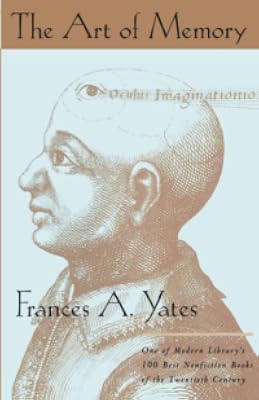
The Art of Memory
by Frances A. Yates
On This Page
Description
This unique and brilliant book is a history of human knowledge. Before the invention of printing, a trained memory was of vital importance. Based on a technique of impressing 'places' and 'images' on the mind, the ancient Greeks created an elaborate memory system which in turn was inherited by the Romans and passed into the European tradition, to be revived, in occult form, during the Renaissance. Frances Yates sheds light on Dante's Divine Comedy, the form of the Shakespearian theatre and show more the history of ancient architecture; The Art of Memoryis an invaluable contribution to aesthetics and psychology, and to the history of philosophy, of science and of literature. show lessTags
Recommendations




Member Recommendations
paradoxosalpha The pseudo-Ciceronian text is a cornerstone of the tradition that Yates traces in her book.
Member Reviews
One thing that is impossible to fully grasp about the past is the fact that hundreds of years ago people had significantly different mental worlds to our own. Popular histories tend to entirely sidestep this in favour of drawing parallels and contrasts with current habits of life, while more academic history often struggles with the unwieldiness of explaining it. ‘The Art of Memory’ confronts the issue head on by telling the story of memory techniques used in classical, Medieval, and Renaissance times. The art of memory essentially consists of teaching systematic ways to improve the performance of recall. What makes this art so hard to grasp now is that memory was the main reference at the time. Before the printing press, books were show more scarcely available and contacting other people very time-consuming. As has been recognised since classical times, the performance of human memory is partially innate (some people have better memories ‘naturally’) and partially a matter of use and training. To veer into anecdata, the memorisation of phone numbers has become a lost art since the advent of mobile phones. If there is no active need to remember strings of eleven numbers, you’re unlikely to do so. Likewise, if you don’t need to remember entire areas of academic knowledge because you can refer to books, why would you? Academic learning in the 21st century is still about memorisation, yes, but also a substantial amount of recalling key names, locations, and signposts. You need to know where to find the details, rather than remembering them all.
By contrast, the classical art of memory involved the use of places (usually buildings) and ‘corporeal similitudes’ (imagined human figures) as shortcuts to the memorisation of knowledge in great detail. The basic idea was to slowly walk around an actual building, transpose it fully into your imagination, and populate this mental construct with a carefully sequenced series of images that were stimulating enough to remember and associate with specific pieces of information. Each image in the sequence could represent a concept or, incredibly, a single word. The latter approach is admittedly acknowledged to be much more difficult. What really amazes the (post?)modern reader, though, is to contemplate the scale of these memory places. They were apparently used by practitioners of the art to memorise speeches, books, legal cases, and the like. This blew my mind in particular because I have a very visual memory. I’ve instinctively used this basic technique of remembering items in a room when doing a memory experiment for someone’s research, and it works. However, all my life I’ve relied on books, and latterly the internet, to elaborate on and confirm what’s in my memory. Having a meticulously arranged library inside your brain seems like it would change your entire mode of thought, in ways I can only speculate on. At times when reading this book I wondered if I waste my visual memory by daydreaming beautiful mansions without making any effort to store information in them. Again, though, is there any need to? There are so many external forms of memory storage these days, both more and less fragile than our brains.
Yates does not broach any of these issues, though, as the book was published in 1966 and concludes with Leibniz in the seventeenth century. It divides the art of memory into three broad eras, the classical, middle ages, and Renaissance. As I’m not at all familiar with the latter two periods, I found them more challenging and the concepts quite complex. Those chapters were richly rewarding, though, and Yates’ writing style is consistently clear and thoughtful. The Medieval and Renaissance manifestations of the memory arts were intertwined with religion and magic in ways subtle and obvious. The differences between the two are neatly summarised as follows:
Perhaps the most striking chapters in the book concern Giordino Bruno’s extremely complex occult-suffused memory systems, which bring this mystical Renaissance tendency to apotheosis. Bruno is described by Yates as ‘the Magus of Memory’ and was eventually burnt at the stake by the Inquisition. In his many books, memory systems are a form of magic. They include concentric wheels with 150 divisions, the full meaning of which Yates believes ‘we shall never understand in detail’. Think about the effort involved in memorising such a thing - not merely as a static view of 150 images, but such that the wheels could spin and allow myriad new combinations. Moreover, the images were not literal, they represented what Bruno believed to be the fundamental elements that reality was made of. About halfway through ‘The Art of Memory’, I put it aside for a few days to read a fantasy novel called [b:A Darker Shade of Magic|22055262|A Darker Shade of Magic (Shades of Magic, #1)|V.E. Schwab|https://images.gr-assets.com/books/1400322851s/22055262.jpg|40098252]. The contrast definitely enhanced my enjoyment of the latter half of this book. Consider, if you will, holding in your memory a complete visual representation of the world’s constitutive parts, which you can rearrange and manipulate at will. Is that not magic? It certainly has a strong air of the fantastical. As Yates puts it:
This fascinating comparison brought to mind how Bruno’s systematisation of knowledge into interconnected categories prefigured the Enlightenment division of academic study into disciplines. These systems also seemed to invoke Borges - he was basically a Magus, so surely he must have been aware of them.
The final chapters then turn to the association between the art of memory and theatres, notably Shakespeare’s Globe. This is especially piquant to read if you’ve visited the rebuilt Globe, which is a beautiful and evocative place. Yates asks how books on memory can help with the reconstruction of the Globe and reviews the evidence of how it looked. As I recall, the layout in the rebuilt version is very close to that arrived at. Here the book intersects with architecture, but it is fundamentally interdisciplinary, as the conclusion emphasises. Theology, pedagogy, and literature are all critical, while psychology underpins it throughout. That is part of what makes the study so elusive yet fascinating, as we can only speculate about how these memory palaces were actually experienced by their builders.
I decided to read ‘The Art of Memory’ after finding an article about it online somewhere and, ironically, can’t remember where. The combination of detailed explanations and well-chosen illustrations makes for a deeply thought-provoking book, well worth lingering over. show less
By contrast, the classical art of memory involved the use of places (usually buildings) and ‘corporeal similitudes’ (imagined human figures) as shortcuts to the memorisation of knowledge in great detail. The basic idea was to slowly walk around an actual building, transpose it fully into your imagination, and populate this mental construct with a carefully sequenced series of images that were stimulating enough to remember and associate with specific pieces of information. Each image in the sequence could represent a concept or, incredibly, a single word. The latter approach is admittedly acknowledged to be much more difficult. What really amazes the (post?)modern reader, though, is to contemplate the scale of these memory places. They were apparently used by practitioners of the art to memorise speeches, books, legal cases, and the like. This blew my mind in particular because I have a very visual memory. I’ve instinctively used this basic technique of remembering items in a room when doing a memory experiment for someone’s research, and it works. However, all my life I’ve relied on books, and latterly the internet, to elaborate on and confirm what’s in my memory. Having a meticulously arranged library inside your brain seems like it would change your entire mode of thought, in ways I can only speculate on. At times when reading this book I wondered if I waste my visual memory by daydreaming beautiful mansions without making any effort to store information in them. Again, though, is there any need to? There are so many external forms of memory storage these days, both more and less fragile than our brains.
Yates does not broach any of these issues, though, as the book was published in 1966 and concludes with Leibniz in the seventeenth century. It divides the art of memory into three broad eras, the classical, middle ages, and Renaissance. As I’m not at all familiar with the latter two periods, I found them more challenging and the concepts quite complex. Those chapters were richly rewarding, though, and Yates’ writing style is consistently clear and thoughtful. The Medieval and Renaissance manifestations of the memory arts were intertwined with religion and magic in ways subtle and obvious. The differences between the two are neatly summarised as follows:
We come back here to that basic difference between the Middle Ages and Renaissance, the change in attitude to the imagination. From a lower power which may be used in memory as a concession to weak man who may use corporeal similitudes because only so can he retain his spiritual intentions to the corporeal world, it has become man’s highest power, by means of which he can grasp the intelligible world beyond appearances through laying hold of significant images.
Perhaps the most striking chapters in the book concern Giordino Bruno’s extremely complex occult-suffused memory systems, which bring this mystical Renaissance tendency to apotheosis. Bruno is described by Yates as ‘the Magus of Memory’ and was eventually burnt at the stake by the Inquisition. In his many books, memory systems are a form of magic. They include concentric wheels with 150 divisions, the full meaning of which Yates believes ‘we shall never understand in detail’. Think about the effort involved in memorising such a thing - not merely as a static view of 150 images, but such that the wheels could spin and allow myriad new combinations. Moreover, the images were not literal, they represented what Bruno believed to be the fundamental elements that reality was made of. About halfway through ‘The Art of Memory’, I put it aside for a few days to read a fantasy novel called [b:A Darker Shade of Magic|22055262|A Darker Shade of Magic (Shades of Magic, #1)|V.E. Schwab|https://images.gr-assets.com/books/1400322851s/22055262.jpg|40098252]. The contrast definitely enhanced my enjoyment of the latter half of this book. Consider, if you will, holding in your memory a complete visual representation of the world’s constitutive parts, which you can rearrange and manipulate at will. Is that not magic? It certainly has a strong air of the fantastical. As Yates puts it:
Did [Bruno] intend that there would be formed in the memory using these ever-changing combinations of astral images some kind of alchemy of the imagination, a philosopher’s stone in the psyche through which every possible arrangement and combination of objects in the lower world - plants, animals, stones - would be perceived and remembered? And that, in accordance with the forming and reforming of the inventor’s images on the central wheel, the whole history of man would be remembered from above, as it were, all his discoveries, thoughts, philosophies, productions? Such a memory would be the memory of a divine man. [...]
Magic assumes laws and forces running through the universe which the operator can use, once he knows how to capture them. [...] The Renaissance conception of an animistic universe, operated by magic, prepared the way for the conception of a mechanistic universe, operated by mathematics.
This fascinating comparison brought to mind how Bruno’s systematisation of knowledge into interconnected categories prefigured the Enlightenment division of academic study into disciplines. These systems also seemed to invoke Borges - he was basically a Magus, so surely he must have been aware of them.
The final chapters then turn to the association between the art of memory and theatres, notably Shakespeare’s Globe. This is especially piquant to read if you’ve visited the rebuilt Globe, which is a beautiful and evocative place. Yates asks how books on memory can help with the reconstruction of the Globe and reviews the evidence of how it looked. As I recall, the layout in the rebuilt version is very close to that arrived at. Here the book intersects with architecture, but it is fundamentally interdisciplinary, as the conclusion emphasises. Theology, pedagogy, and literature are all critical, while psychology underpins it throughout. That is part of what makes the study so elusive yet fascinating, as we can only speculate about how these memory palaces were actually experienced by their builders.
I decided to read ‘The Art of Memory’ after finding an article about it online somewhere and, ironically, can’t remember where. The combination of detailed explanations and well-chosen illustrations makes for a deeply thought-provoking book, well worth lingering over. show less
This book recounts an alternate intellectual history, tracing the surprising long-term influence of mnemonic technique (“art of memory,” as opposed to natural memory) from ancient times to the early modern era, culminating in the effect it had on Francis Bacon and Descartes as they formulated the scientific method and even on Leibniz in his development of infinitesimal calculus and his effort to create a universal calculus, forerunner of symbolic logic.
From its semi-legendary origins with Simonides of Ceos, a poet who flourished around 500 BCE, its adaption by Cicero and the anonymous author of Ad Herennium (long thought to be by Cicero) through its scholastic adaptation by Thomas Aquinas (and subsequent literary use by Dante in his show more Inferno), I was surprised by the art’s pervasive presence, extending even to Shakespeare.
Yates was treading a new path for much of her reconstruction; many of her sources were only available in manuscripts. One reason this history has been marginalized is that many of its chief proponents, from Metrodorus of Scepsis in ancient times to Giordano Bruno in the Renaissance, were condemned for the occult aspects of their work. This may be one reason why no one noticed that an accurate contemporary depiction of the Globe Theater was hidden in plain sight in a book by Robert Fludd.
Through her long work at the Warburg Institute, with its emphasis on iconology, she was well-suited for this research. She coined the term “Warburgian history” for a pan-European and interdisciplinary approach to historiography.
Yates’s sober approach was a plus. She is transparent in her skepticism of the value of the art of memory, with its laborious use of places and images, but believes that “the rational reader, if he is interested in the history of ideas, must be willing to hear about all ideas which in their time have been potent to move men.”
This is a valuable and informative book, but I found it a slow read, particularly in the second half. This despite Yates’s clear, well-reasoned style (unlike much academic writing). She is open about her unanswered questions and generous in her suggestions for profitable future research. Her prose is laid out as if she were presenting a lecture to an audience of interested lay people, regularly summarizing her conclusions. Perhaps the problem is that so much of it was new to me. But I’m glad I persevered to the end.
It turns out that I’m reading her three major works in reverse order. I enjoyed her Rosicrucian Enlightenment many years ago, and I’ve added her biography of Bruno to my long TBR list. If you’re new to her work, you might have an easier time of it if you read them in the order they were written. show less
From its semi-legendary origins with Simonides of Ceos, a poet who flourished around 500 BCE, its adaption by Cicero and the anonymous author of Ad Herennium (long thought to be by Cicero) through its scholastic adaptation by Thomas Aquinas (and subsequent literary use by Dante in his show more Inferno), I was surprised by the art’s pervasive presence, extending even to Shakespeare.
Yates was treading a new path for much of her reconstruction; many of her sources were only available in manuscripts. One reason this history has been marginalized is that many of its chief proponents, from Metrodorus of Scepsis in ancient times to Giordano Bruno in the Renaissance, were condemned for the occult aspects of their work. This may be one reason why no one noticed that an accurate contemporary depiction of the Globe Theater was hidden in plain sight in a book by Robert Fludd.
Through her long work at the Warburg Institute, with its emphasis on iconology, she was well-suited for this research. She coined the term “Warburgian history” for a pan-European and interdisciplinary approach to historiography.
Yates’s sober approach was a plus. She is transparent in her skepticism of the value of the art of memory, with its laborious use of places and images, but believes that “the rational reader, if he is interested in the history of ideas, must be willing to hear about all ideas which in their time have been potent to move men.”
This is a valuable and informative book, but I found it a slow read, particularly in the second half. This despite Yates’s clear, well-reasoned style (unlike much academic writing). She is open about her unanswered questions and generous in her suggestions for profitable future research. Her prose is laid out as if she were presenting a lecture to an audience of interested lay people, regularly summarizing her conclusions. Perhaps the problem is that so much of it was new to me. But I’m glad I persevered to the end.
It turns out that I’m reading her three major works in reverse order. I enjoyed her Rosicrucian Enlightenment many years ago, and I’ve added her biography of Bruno to my long TBR list. If you’re new to her work, you might have an easier time of it if you read them in the order they were written. show less
Yates provides a fascinating account of both how memory systems worked in Classical and Mediaeval times (including an examination of differences between those approaches); and, a consideration of how & why the discipline altered almost to the point of being lost in the Modern era. This work links to two separate efforts: the earlier effort, Aby Warburg's intent to investigate human image-based memory, with special focus on Giordano Bruno; and the later effort being Yates's own prior publication, Giordano Bruno and the Hermetic Tradition (1964). Yates was assisted in her research for The Art of Memory both by Warburg Library holdings, and by Warburg's personal assistant, Gertrud Bing.
Yates argues the flowering of the art of memory show more occurred in Classical era, known today through three primary texts.
● Cicero's De oratore
● the Ad Herrenium, an anonymous document long attributed (but falsely) to Cicero ("Tullius")
● Quintilian's Institutio oratorio
The memory arts changed between the Classical and Mediaeval eras, with much lost in transition (whether through misunderstanding or re-purposing). In effect, the use of memory arts shifts from rhetoric to ethics as part of the Scholastic project to meditate on heaven and avoid hell, a project less concerned with ready recall of massive amounts of specialized information as was useful among Roman Senators or other rhetors. Intriguingly, Yates suggests Dante's Divine Comedy and frescoe paintings may be usefully interpreted with "eyes of memory".
The work is a wondrous example of interdisciplinary scholarship, almost begging the question of how no-one before her pulled the story together, given the myriad clues found in documents familiar to modern scholars and historians. It comes down (as it often does) to the fact the documents were always of interest for other reasons and so the references to memory systems were glossed over, set aside (and never returned to), misinterpreted, or ignored entirely.
//
Emma Willard may have been a 19c practitioner: see her Temple of Ancient History chronographers (infographics).
An abridged reading, from a PDF of the first 4 chapters. Recently found an unabridged PDF, but I should purchase a reading copy and study the full argument. Based on the table of contents, Yates evidently examines one and perhaps two other transformations of mnemotechnics: the adaptation during the Rennaissance as influenced by Hermetic wisdom, and then modern adaptations with perhaps a return to an emphasis on rhetoric or recall from a mass of factual material. show less
Yates argues the flowering of the art of memory show more occurred in Classical era, known today through three primary texts.
● Cicero's De oratore
● the Ad Herrenium, an anonymous document long attributed (but falsely) to Cicero ("Tullius")
● Quintilian's Institutio oratorio
The memory arts changed between the Classical and Mediaeval eras, with much lost in transition (whether through misunderstanding or re-purposing). In effect, the use of memory arts shifts from rhetoric to ethics as part of the Scholastic project to meditate on heaven and avoid hell, a project less concerned with ready recall of massive amounts of specialized information as was useful among Roman Senators or other rhetors. Intriguingly, Yates suggests Dante's Divine Comedy and frescoe paintings may be usefully interpreted with "eyes of memory".
The work is a wondrous example of interdisciplinary scholarship, almost begging the question of how no-one before her pulled the story together, given the myriad clues found in documents familiar to modern scholars and historians. It comes down (as it often does) to the fact the documents were always of interest for other reasons and so the references to memory systems were glossed over, set aside (and never returned to), misinterpreted, or ignored entirely.
//
Emma Willard may have been a 19c practitioner: see her Temple of Ancient History chronographers (infographics).
An abridged reading, from a PDF of the first 4 chapters. Recently found an unabridged PDF, but I should purchase a reading copy and study the full argument. Based on the table of contents, Yates evidently examines one and perhaps two other transformations of mnemotechnics: the adaptation during the Rennaissance as influenced by Hermetic wisdom, and then modern adaptations with perhaps a return to an emphasis on rhetoric or recall from a mass of factual material. show less
You may have heard the story of the ancient Greek poet Simonides who was engaged to give a panegyric honoring the host of a banquet. But said host reneged on the deal, agreeing to pay Simonides only half the amount originally offered because the panegyric included a section praising the twin gods Castor and Pollux, from whom the poet was told to seek payment for the balance. At some point Simonides was called outside and while absent from the banquet hall, the roof caved in killing everyone inside, including the mean spirited host. The identities of the dead were so complete obliterated that mourners who came to claim the bodies were unable to recognize their own kin. But Simonides remembered where everyone was seated and was able to show more assist the families in locating their dead.
It has come down to us that this event was the source of the memory technique which was attributed by the ancients to Simonides. In ancient times before books were commonplace, in those storied times when Homer's epics were passed on by word of mouth, people depended upon memory for the retention and transmission of knowledge to a degree that staggers the imagination today. Apparently there were techniques for retaining prodigious amounts of material beyond the obvious rote memorization. It is those techniques that are the subject of Frances Yates' The Art of Memory.
What we know about these techniques is scanty at best because those whose writings on the subject that have survived only speak about the methods in the broadest terms, under the assumption that every reader would know what they were talking about so widespread was the understanding as recently as the time of Cicero. In fact, Cicero's De Oratore is one of only three ancient Roman sources that talk about the art of memory at all, the other two being an anonymous document known as the Ad Herrenium, which for many centuries was erroneously attributed to Cicero, and a work of Quintilian called Institutio Oratorio.
The technique involved memorizing the architectural details of an existing building, such as a temple, and then affixing ideas that one wanted to commit to memory to specific locations within that building so that they would come to mind in a prescribed order. Cicero speaks in De Oratore about how he memorized important speeches before the Roman senate using this technique.
Similarly, it was reported by Quintilian that a Greek named Metrodorus of Scepsis used the twelve signs of the Zodiac divided into 360 subsections in a similar fashion as a storehouse for memorization. Because Quintilian wrote in less than glowing terms of the art of memory, it fell out of use and was completely lost by the time of Charlemagne. But the ideas were resurrected at some point and names associated with variations on the theme of the art of memory include Ramond Lull, Giulio Camillo, Thomas Aquinas, Giordano Bruno, Robert Fludd, Francis Bacon and ultimately the Enlightenment philosopher Leibnitz, among many others.
The story is astounding of how the relatively simple idea of memorizing by association with a building — whether a temple or in later times a theater — the zodiac, or both, was enlarged upon to such an extent that the idea took on a life of its own. What was at first intended to be a tool for simple memorization of speeches or poetry became under Giordano Bruno and others a superstructure for containing all the world's knowledge. In the course of the Renaissance, it acquired occult attributes which put it in danger from Church authorities with the net effect of driving it almost completely underground. And once again, through the developments that occurred during the Renaissance, it becomes apparent that humanists and Neoplatonists were quite different breeds of cat and not at all on the same page philosophically.
The Art of Memory opens a window on a relativelly unknown aspect of Western intellectual history. The first quarter of the book should be of general historical interest. Beyond that it goes deeper and deeper into abstruse documents, almost none of which have been translated from their original Latin or French or German into English. So in addition to being rather arcane subject matter to begin with, unless one can read five-hundred-year-old texts fluently, there is hardly anywhere to go with this subject for most of us.
Interestingly, memory systems as such are still alive and well. I have a book on my shelves called Stop Forgetting by Dr. Bruno Furst, which was published in 1949. Two approaches to memorization are given, one of which invites you to memorize a list of words ingeniously associated with numbers from, say, one to a hundred which become part of your permanent memory. You are then supposed to associate, for example, items on a grocery list with the assigned numbered words and create an image in your mind linking the two. For example, if the number one is associated with the word "tea" and you need to replenish your supply of Darjeeling at the grocery store, that is an easy association. This is merely a variation on the theme of memory by association that was used by Simonides, Cicero and the rest.
Readers who are interested in ancient, medieval or Renaissance intellectual history will find The Art of Memory to be a storehouse of fascinating information. I am only assigning it three and a half stars because I believe it contains more information than the average reader wants to know, but this is not to detract at all from the quality of writing and clarity of presentation. On the whole, I found it to be an unusually interesting book. show less
It has come down to us that this event was the source of the memory technique which was attributed by the ancients to Simonides. In ancient times before books were commonplace, in those storied times when Homer's epics were passed on by word of mouth, people depended upon memory for the retention and transmission of knowledge to a degree that staggers the imagination today. Apparently there were techniques for retaining prodigious amounts of material beyond the obvious rote memorization. It is those techniques that are the subject of Frances Yates' The Art of Memory.
What we know about these techniques is scanty at best because those whose writings on the subject that have survived only speak about the methods in the broadest terms, under the assumption that every reader would know what they were talking about so widespread was the understanding as recently as the time of Cicero. In fact, Cicero's De Oratore is one of only three ancient Roman sources that talk about the art of memory at all, the other two being an anonymous document known as the Ad Herrenium, which for many centuries was erroneously attributed to Cicero, and a work of Quintilian called Institutio Oratorio.
The technique involved memorizing the architectural details of an existing building, such as a temple, and then affixing ideas that one wanted to commit to memory to specific locations within that building so that they would come to mind in a prescribed order. Cicero speaks in De Oratore about how he memorized important speeches before the Roman senate using this technique.
Similarly, it was reported by Quintilian that a Greek named Metrodorus of Scepsis used the twelve signs of the Zodiac divided into 360 subsections in a similar fashion as a storehouse for memorization. Because Quintilian wrote in less than glowing terms of the art of memory, it fell out of use and was completely lost by the time of Charlemagne. But the ideas were resurrected at some point and names associated with variations on the theme of the art of memory include Ramond Lull, Giulio Camillo, Thomas Aquinas, Giordano Bruno, Robert Fludd, Francis Bacon and ultimately the Enlightenment philosopher Leibnitz, among many others.
The story is astounding of how the relatively simple idea of memorizing by association with a building — whether a temple or in later times a theater — the zodiac, or both, was enlarged upon to such an extent that the idea took on a life of its own. What was at first intended to be a tool for simple memorization of speeches or poetry became under Giordano Bruno and others a superstructure for containing all the world's knowledge. In the course of the Renaissance, it acquired occult attributes which put it in danger from Church authorities with the net effect of driving it almost completely underground. And once again, through the developments that occurred during the Renaissance, it becomes apparent that humanists and Neoplatonists were quite different breeds of cat and not at all on the same page philosophically.
The Art of Memory opens a window on a relativelly unknown aspect of Western intellectual history. The first quarter of the book should be of general historical interest. Beyond that it goes deeper and deeper into abstruse documents, almost none of which have been translated from their original Latin or French or German into English. So in addition to being rather arcane subject matter to begin with, unless one can read five-hundred-year-old texts fluently, there is hardly anywhere to go with this subject for most of us.
Interestingly, memory systems as such are still alive and well. I have a book on my shelves called Stop Forgetting by Dr. Bruno Furst, which was published in 1949. Two approaches to memorization are given, one of which invites you to memorize a list of words ingeniously associated with numbers from, say, one to a hundred which become part of your permanent memory. You are then supposed to associate, for example, items on a grocery list with the assigned numbered words and create an image in your mind linking the two. For example, if the number one is associated with the word "tea" and you need to replenish your supply of Darjeeling at the grocery store, that is an easy association. This is merely a variation on the theme of memory by association that was used by Simonides, Cicero and the rest.
Readers who are interested in ancient, medieval or Renaissance intellectual history will find The Art of Memory to be a storehouse of fascinating information. I am only assigning it three and a half stars because I believe it contains more information than the average reader wants to know, but this is not to detract at all from the quality of writing and clarity of presentation. On the whole, I found it to be an unusually interesting book. show less
There are enough reviews here describing the contents and quality of this book. For me, the best part was the palpable sense of discovery the author conveyed as she began to see how Simonides's artificial memory permeated Renaissance culture and became a hidden strand connecting Thomas Aquinas's Method to Raymond Llull's Art to Giordano Bruno's enigmatic Shadows and Seals and on to Shakespeare's Globe Theatre and Gottfried Wilhelm von Leibniz's invention of infinitesimal calculus.
Warning: Absolutely don't consider this book if you are interested in the Art of Memory (the actual art, not the book) but didn't read other, modern books or learned at least basic memory techniques or you will be let down. The book is a historical inquiry of how those techniques evolved and how they affected population, art, etc., but it is a very blurry since there is not much material and the book that were actually preserved are quite hard to understand and lack examples, therefore absolutely impenetrable for a beginner. What also does not help is the very dry style in which the book is written in - author focuses heavily on names, dates, historical facts which makes some parts quite hard to read.
Warning2: Main focus is on the show more 14-16 century where Art of Memory got mixed with magic and occult stuff and the result is quite uninteresting from the viewpoint of the modern practitioner.
Nevertheless it is still quite interesting reading and provides many valuable historical insights, but because the insights are purely historical and very remote from modern Art of Memory I can recommend it only to those who already know the practical side of this matter.
BTW: The author confesses that she has no practical skills or knowledge of memory techniques and I feel like it really made the book much less useful for me. show less
Warning2: Main focus is on the show more 14-16 century where Art of Memory got mixed with magic and occult stuff and the result is quite uninteresting from the viewpoint of the modern practitioner.
Nevertheless it is still quite interesting reading and provides many valuable historical insights, but because the insights are purely historical and very remote from modern Art of Memory I can recommend it only to those who already know the practical side of this matter.
BTW: The author confesses that she has no practical skills or knowledge of memory techniques and I feel like it really made the book much less useful for me. show less
This was a very interesting book with curious subject matter. It allowed me to broach the subject of "The Art of Memory" and to explore it in depth. It is adequately written and I believe good reading for those interested in intellectual pursuits.
4 stars.
4 stars.
Members
- Recently Added By
Published Reviews
ThingScore 100
Yates was the author of The Art of Memory, a 1966 title that remains oddly obscure despite having been named by the Modern Library as one of the 100 best nonfiction books published in the 20th century. Many well-read people have never even heard of it, yet tendrils of Yates’ ideas are entwined through contemporary culture—not just wrapped around Hannibal Lecter and Sherlock. Those who have show more read The Art of Memory tend to become obsessed with it, and the list of contemporary authors inspired by the book is impressive: Italo Calvino, Carlos Fuentes, Hilary Mantel, Philip Pullman, Penelope Lively, Harold Bloom, and Madison Smartt Bell, to name just a few. John Crowley wrote a four-novel series, Aegypt, based on The Art of Memory. show less
added by elenchus
Lists

Modern Library 100 Best Nonfiction Books
100 works; 8 members

Works cited in Palimpsest: A History of the Written Word by Matthew Battles
79 works; 2 members

Books & Films Referenced by Cal Newport's Deep Work
43 works; 1 member

Club Read's Recommended Nonfiction Written by Women
618 works; 30 members
Author Information

Some Editions
Awards and Honors
Series
Belongs to Publisher Series
Pimlico (64)
ET Tascabili [Einaudi] (155)
Common Knowledge
- Original title
- The Art of Memory
- Original publication date
- 1966
- Blurbers
- Miller, Jonathan; Ratcliffe, Michael
Classifications
- Genres
- History, Nonfiction, General Nonfiction, Philosophy, Religion & Spirituality
- DDC/MDS
- 153.1409 — Philosophy & psychology Psychology Conscious mental processes and intelligence Learning, Memory, And Motivation Memory Improvement
- LCC
- BF381 .Y3 — Philosophy, Psychology and Religion Psychology Psychology Consciousness. Cognition
- BISAC
Statistics
- Members
- 1,669
- Popularity
- 13,377
- Reviews
- 19
- Rating
- (4.00)
- Languages
- 9 — Dutch, English, French, German, Italian, Portuguese, Russian, Spanish, Turkish
- Media
- Paper, Ebook
- ISBNs
- 29
- ASINs
- 13