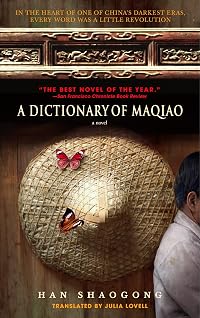
A Dictionary of Maqiao
by Han Shaogong
On This Page
Description
One of the most-talked about works of fiction to emerge from China in recent years, this novel about an urban youth "displaced" to a small village in rural China during the Cultural Revolution is a fictionalized portrait of the author's own experience as a young man. Han Shaogong was one of millions of students relocated from cities and towns to live and work alongside peasant farmers in an effort to create a classless society. Translated into English for the first time, Han's novel is an show more exciting experiment in form--structured as a dictionary of the Maqiao dialect--through which he seeks to understand and translate the local life and customs of his strange new home. Han encounters an upside-down world among the people of Maqiao: a con man dupes his neighbors into thinking that he has found the fountain of youth by convincing them that his father is in fact his son; to be scientific" is to be lazy; time and relationships are understood using the language of food and its preparation; and to die young is considered "sweet," while the aged reckon their lives to be "cheap." As entries build one upon another, Han meditates on the ability of a waidi ren (outsider) to represent the ways of life of another community. In this light, the Communist effort to control the language and history of a people whose words and past are bound together in ineluctably local ways emerges as an often comical, sometimes tragic exercise in miscommunication. show lessTags
Recommendations






Member Reviews
I have given a five-star recommendation to this extraordinary book largely because of its ambition and insight, though I am not sure what its appeal would be to anyone without more than a passing interest in China. What it achieves is, at one level, a marvellous picture of a Chinese village during the first phase of Communist rule – its poverty and superstitions spring out from the pages (despite the lack of a conventional narrative structure) – but, at another level, a profound meditation on the nature of language and its rootedness in human experience in all its astonishing variety. By focusing on the dialect (and the characters who use it) of one small remote village, Han, it seems to me, the writer is making a valuable point show more about the dangers of totalitarian manipulation of language, but also about the futility of such attempts at control. It's also a useful reminder that Chinese is not a single monolithic language in the way Westerners might think of it.
Translating such a work must have been a nightmare, and Julia Lovell is to be congratulated. My only (minor) criticism of the English edition would be that the Chinese characters at the top of each section are not provided with pinyin transliteration, so the reader has no way of knowing how to pronounce the words. show less
Translating such a work must have been a nightmare, and Julia Lovell is to be congratulated. My only (minor) criticism of the English edition would be that the Chinese characters at the top of each section are not provided with pinyin transliteration, so the reader has no way of knowing how to pronounce the words. show less
Having a sense of humour doesn't mean being able to tell jokes. Humour is the ability to play with the expected. Which is never more apparent than when authority tries to tell people what to think.
In 1970, the young intellectual student Han Shaogong was sent to the tiny village of Maqiao, where not much has changed since the emperor's days. But this was the cultural revolution and everything was to be made new: city-dwelling weaklings would become good workers, and in the process help turn the farmers into good socialists. So when he's not working the fields or the mountains, Han gets to teach the farmers to recite Mao quotes in proper, modern Chinese. But of course, to do that he first needs to understand their dialect, which isn't show more easy - you'd think the whole village was speaking backwards! "Awake" means "stupid", "expensive" means "young", "respect" means "punish", "hick" means "city boy", "democracy" means "chaos"... woops, sorry, some of those are modern Chinese. But anyway.
25 years later Han has grown to an accomplished novelist and puts together this fiction about life in Maqiao (any similarity between that name and Macondo is surely a coincidence) before, during and after his visit, in a form he's borrowed from Kundera's The Unbearable Lightness of Being: A dictionary of the Maqiao dialect, where every chapter heading is a different word he needs to explain, at once making up a part of the ongoing story and an explanation for why that particular word has that particular meaning in this particular place. And of course, he doesn't present it all in alphabetical order like a proper dictionary; alphabets - especially the Chinese one, where words can be spelled several different ways, each of which gives them a different meaning - are arbitrary, after all. So instead he arranges them in a different order, to tell a very entertaining story of the people who make up the village, full of serious gallows humour and with an amazing cast of characters - none of which seem to fit neatly into the categories his standardised Maoist vocabulary tells him they belong to. And 25 years later, as a Chinese intellectual with his head full of Western books, he can't help but draw parallels between his outsider status then, and the different but similar one he faces today.
In 1986 I visited an "artists' colony" in Virginia, USA; that is, a center for artistic creation. The word "colony" kept making me uncomfortable. Only later did I realize that many Westerners in countries that used to have a large number of colonies don't associate the word with murder, fires, rape, plunder, opium smuggling and other things that the people in former colonies think about when they hear it. [To them] the colony is an outpost for the noble, a field camp for heroes.
...says the man who was sent to the countryside to teach them how to think in a new age. All words, all concepts, mean different things depending on by whom, when, where and how they're spoken. What starts in a small village in inner China becomes a cross-section of the world where battles are increasingly fought with words and ideologies rather than brute force - defeating someone is one thing, changing their minds is another, even Mao knew that. And as burlesque, angry, sentimental or hilarious the stories of the hicks... sorry, that word doesn't work here... in Maqiao get, the subtext of how we control and are controlled by language runs through everything in a way that's both very similar to and completely different from what a writer like Herta Müller does. Orwell was wrong; Big Brother's doublethink will always, through usage, be knowingly or accidentally subverted into triplethink.
A Dictionary of Maqiao, as a deconstruction of the idea of ideological revolution (whether Maoist or capitalist) imposed from outside, knows better than to offer simple problems or solutions. Instead Han creates a very entertaining chronicle where both the characters and the underlying themes float like a river of rice gruel, blood, sweat and shit, always leaving new layers of sediment and breaking through every attempt to dam it, yet always clear enough to see the bottom and calm enough to reflect the person reading it. show less
In 1970, the young intellectual student Han Shaogong was sent to the tiny village of Maqiao, where not much has changed since the emperor's days. But this was the cultural revolution and everything was to be made new: city-dwelling weaklings would become good workers, and in the process help turn the farmers into good socialists. So when he's not working the fields or the mountains, Han gets to teach the farmers to recite Mao quotes in proper, modern Chinese. But of course, to do that he first needs to understand their dialect, which isn't show more easy - you'd think the whole village was speaking backwards! "Awake" means "stupid", "expensive" means "young", "respect" means "punish", "hick" means "city boy", "democracy" means "chaos"... woops, sorry, some of those are modern Chinese. But anyway.
25 years later Han has grown to an accomplished novelist and puts together this fiction about life in Maqiao (any similarity between that name and Macondo is surely a coincidence) before, during and after his visit, in a form he's borrowed from Kundera's The Unbearable Lightness of Being: A dictionary of the Maqiao dialect, where every chapter heading is a different word he needs to explain, at once making up a part of the ongoing story and an explanation for why that particular word has that particular meaning in this particular place. And of course, he doesn't present it all in alphabetical order like a proper dictionary; alphabets - especially the Chinese one, where words can be spelled several different ways, each of which gives them a different meaning - are arbitrary, after all. So instead he arranges them in a different order, to tell a very entertaining story of the people who make up the village, full of serious gallows humour and with an amazing cast of characters - none of which seem to fit neatly into the categories his standardised Maoist vocabulary tells him they belong to. And 25 years later, as a Chinese intellectual with his head full of Western books, he can't help but draw parallels between his outsider status then, and the different but similar one he faces today.
In 1986 I visited an "artists' colony" in Virginia, USA; that is, a center for artistic creation. The word "colony" kept making me uncomfortable. Only later did I realize that many Westerners in countries that used to have a large number of colonies don't associate the word with murder, fires, rape, plunder, opium smuggling and other things that the people in former colonies think about when they hear it. [To them] the colony is an outpost for the noble, a field camp for heroes.
...says the man who was sent to the countryside to teach them how to think in a new age. All words, all concepts, mean different things depending on by whom, when, where and how they're spoken. What starts in a small village in inner China becomes a cross-section of the world where battles are increasingly fought with words and ideologies rather than brute force - defeating someone is one thing, changing their minds is another, even Mao knew that. And as burlesque, angry, sentimental or hilarious the stories of the hicks... sorry, that word doesn't work here... in Maqiao get, the subtext of how we control and are controlled by language runs through everything in a way that's both very similar to and completely different from what a writer like Herta Müller does. Orwell was wrong; Big Brother's doublethink will always, through usage, be knowingly or accidentally subverted into triplethink.
A Dictionary of Maqiao, as a deconstruction of the idea of ideological revolution (whether Maoist or capitalist) imposed from outside, knows better than to offer simple problems or solutions. Instead Han creates a very entertaining chronicle where both the characters and the underlying themes float like a river of rice gruel, blood, sweat and shit, always leaving new layers of sediment and breaking through every attempt to dam it, yet always clear enough to see the bottom and calm enough to reflect the person reading it. show less
Traditional storytelling overwhelming experimental fiction
"A Dictionary of Maqiao" is a 1996 Chinese novel about a fictional village in the south of China. It takes the form of a dictionary, which is an unusual gambit for a novel. A principal precedent is Milorad Pavić's "Dictionary of the Khazars" (1984). Are there others? There are shorter pieces by Borges, Perec, and Lem, but I am not aware of other book-length dictionaries that ask to be read as novels. The model for the organization of Han's novel was possibly Kundera's "Unbearable Lightness of Being," a novel Han translated (from the English translation, I assume), where each chapter is about a word.
1. "A Dictionary of Maqiao" as experimental fiction
A case could be made that this show more is one of the world's untranslatable novels, because it depends so much on local vocabulary, dialect, and phonetics. The narrator is continuously exploring differences between the Maqiao "dialect"--its pronunciation, and especially its idioms--and Mandarin from "the city." The translator, Julia Lovell, strikes a compromise by giving Chinese characters for each dictionary entry and finding English for everything else. Katherine Wolff's brief "New York Times" review (August 31, 2003) sees the book as "a meditation on the trapdoors of language and on the microhistories buried within words." Many of the stories are explicitly about language, and not character development. The entries are not in the usual Chinese "alphabetical" order, because--as a prefatory note explains--it is easier to follow the book's stories if they are disarranged. Almost all the entries are discontinuous and independent, and the majority are self-contained stories.
For all these reasons--independent pieces of fiction, arbitrarily arranged, the dictionary format, the experiment in language--the book could be read as part of postwar French-influenced European and North American fiction in the general tradition of Oulipo. But I don't think that is an adequate description, because it is overtaken by two other readings.
2. "A Dictionary of Maqiao" as political text
A look at the online reviews in English seems to indicate the book has been mainly received as a political essay. The narrator went to Maqiao as part of the Cultural Revolution, and there are many references to the futility and comedy of attempting to standardize Chinese life.
As "Kirkus Reviews" put it: "The result is a subtle and smashingly effective critique of the futility of totalitarian efforts to suppress language and thought." Or as Danny Yee puts it, the book is "a powerful demonstration of just how different a remote rural village can be—or, for the Western audience of this translation, of the diversity of China." A reader with the screen name Bjorn, on Goodreads, says the novel is "a deconstruction of the idea of ideological revolution (whether Maoist or capitalist) imposed from outside."
In these readings, Han is primarily sending a message to anyone in China who feels minorities can be safely classified and contained by a central administration. I don't think the online reviewers are wrong, and the book can be read as a critique of ideology, with the Maqiao dialect as its principal example.
3. "A Dictionary of Maqiao" as traditional Chinese narration
For me even the political reading is less central than a third reading, which would connect the book to Ming "novels" and earlier texts. Han's dictionary entries are often stories that draw morals, and in that respect they present themselves as variants on traditional sorts of Chinese fables and stories. The "Publisher's Weekly" review does a good job at conjuring this:
"A sharp, sophisticated observer, [Han] narrates... folkloric tales from the vantage point of contemporary China, situating them within a richly informative historical and philosophical framework. Among the stories that deserve mention are those of Wanyu, the village's best singer and reputed Don Juan, who is discovered to lack the male 'dragon'; of 'poisonous' Yanzao, so called both because his aged mother has a reputation as a poisoner and because he is assigned to spread pesticides (and in so doing absorbs such a quantity of toxins that mosquitoes die upon contact with him); and of Tiexiang, the adulterous wife of Party Secretary Benyi, who takes up with Three Ears, so called because of the rudimentary third ear that grows under one of his armpits."
For a while I experimented in adding titles to the dictionary entries, so that instead of single words they had brief discursive titles in the manner of older Chinese narratives. (I was thinking mainly of Cao Xueqin, and also the "Journey to the West.") Here are some examples, Han's dictionary entry first, and then my invented title:
"Tincture of iodine [碘酊]"
On the unexpected accuracy of some rural expressions.
"Sweet [甜]"
In which the narrator draws a simple moral from the observation that impoverished language leads to misunderstandings.
"Same pot [同锅]"
In which a lucky marriage helps fills the stomachs of a young couple from the city.
"Placing the pot"
On a colorful and slightly violent old custom and what it once led to.
"Qingming rain" [清明雨]"
In which the author muses on how rain stirs political memories, lost on the young.
"Rough"
In which a man appears to be a sage in disguise, but the author won't tell us for sure.
The traditionalism of the individual entries that is most prominent source of meaning for me, and it reduces both the political messaging and the linguistic experimentation to examples.
4. A note on the Afterword
The book ends with a three-page Afterword, which proposes two morals. Han begins by regretting that his Mandarin has "standardized" him. "Even the 40,000-odd characters in the Kangxi Dictionary," he writes, "have banished this enormous amount of feeling... beyond the controlling imperial brush and inkstone of scholars." However he hopes that new forms of difference (that's my 21st century term) will emerge:
"Who can say for sure, while people search for and use a broadly standard form of language.. that new dimensions in sound, form, meaning, and regulations aren't emerging at all stages? Aren't psychological processes of nonstandardization or antistandardization constantly, simulatneously in progress?"
It's a lovely and unexpected moral. The second moral is only a single sentence, and it isn't supported by the novel itself: "Providing we don't intend exchange to become a process of mutual neutralization," he writes, "then we must maintain vigilance and resistance toward exchange... this implies, then, that when people speak, everyone needs their own, unique dictionary."
That is fairly astonishing, and if Han had developed it as he wrote, the novel would have been very different.
How, then, to locate this book? According to Wikipedia, Han is influenced by Kafka and Marquez. (It's not clear if that's the encyclopedist's notion, or Han's.) Traces of Kundera's "Unbearable Lightness of Being" are visible throughout. But Han also translated Pessoa's "Book of Disquietude," and I can't begin to guess what he got from that experience: I don't see anything of Pessoa's endless introspection, and only a few traces of his interest in the writing itself. It would be good to know more about what Han read, and whether he imagined this book as a response to postwar experimental writing, from Pavić to Oulipo. show less
"A Dictionary of Maqiao" is a 1996 Chinese novel about a fictional village in the south of China. It takes the form of a dictionary, which is an unusual gambit for a novel. A principal precedent is Milorad Pavić's "Dictionary of the Khazars" (1984). Are there others? There are shorter pieces by Borges, Perec, and Lem, but I am not aware of other book-length dictionaries that ask to be read as novels. The model for the organization of Han's novel was possibly Kundera's "Unbearable Lightness of Being," a novel Han translated (from the English translation, I assume), where each chapter is about a word.
1. "A Dictionary of Maqiao" as experimental fiction
A case could be made that this show more is one of the world's untranslatable novels, because it depends so much on local vocabulary, dialect, and phonetics. The narrator is continuously exploring differences between the Maqiao "dialect"--its pronunciation, and especially its idioms--and Mandarin from "the city." The translator, Julia Lovell, strikes a compromise by giving Chinese characters for each dictionary entry and finding English for everything else. Katherine Wolff's brief "New York Times" review (August 31, 2003) sees the book as "a meditation on the trapdoors of language and on the microhistories buried within words." Many of the stories are explicitly about language, and not character development. The entries are not in the usual Chinese "alphabetical" order, because--as a prefatory note explains--it is easier to follow the book's stories if they are disarranged. Almost all the entries are discontinuous and independent, and the majority are self-contained stories.
For all these reasons--independent pieces of fiction, arbitrarily arranged, the dictionary format, the experiment in language--the book could be read as part of postwar French-influenced European and North American fiction in the general tradition of Oulipo. But I don't think that is an adequate description, because it is overtaken by two other readings.
2. "A Dictionary of Maqiao" as political text
A look at the online reviews in English seems to indicate the book has been mainly received as a political essay. The narrator went to Maqiao as part of the Cultural Revolution, and there are many references to the futility and comedy of attempting to standardize Chinese life.
As "Kirkus Reviews" put it: "The result is a subtle and smashingly effective critique of the futility of totalitarian efforts to suppress language and thought." Or as Danny Yee puts it, the book is "a powerful demonstration of just how different a remote rural village can be—or, for the Western audience of this translation, of the diversity of China." A reader with the screen name Bjorn, on Goodreads, says the novel is "a deconstruction of the idea of ideological revolution (whether Maoist or capitalist) imposed from outside."
In these readings, Han is primarily sending a message to anyone in China who feels minorities can be safely classified and contained by a central administration. I don't think the online reviewers are wrong, and the book can be read as a critique of ideology, with the Maqiao dialect as its principal example.
3. "A Dictionary of Maqiao" as traditional Chinese narration
For me even the political reading is less central than a third reading, which would connect the book to Ming "novels" and earlier texts. Han's dictionary entries are often stories that draw morals, and in that respect they present themselves as variants on traditional sorts of Chinese fables and stories. The "Publisher's Weekly" review does a good job at conjuring this:
"A sharp, sophisticated observer, [Han] narrates... folkloric tales from the vantage point of contemporary China, situating them within a richly informative historical and philosophical framework. Among the stories that deserve mention are those of Wanyu, the village's best singer and reputed Don Juan, who is discovered to lack the male 'dragon'; of 'poisonous' Yanzao, so called both because his aged mother has a reputation as a poisoner and because he is assigned to spread pesticides (and in so doing absorbs such a quantity of toxins that mosquitoes die upon contact with him); and of Tiexiang, the adulterous wife of Party Secretary Benyi, who takes up with Three Ears, so called because of the rudimentary third ear that grows under one of his armpits."
For a while I experimented in adding titles to the dictionary entries, so that instead of single words they had brief discursive titles in the manner of older Chinese narratives. (I was thinking mainly of Cao Xueqin, and also the "Journey to the West.") Here are some examples, Han's dictionary entry first, and then my invented title:
"Tincture of iodine [碘酊]"
On the unexpected accuracy of some rural expressions.
"Sweet [甜]"
In which the narrator draws a simple moral from the observation that impoverished language leads to misunderstandings.
"Same pot [同锅]"
In which a lucky marriage helps fills the stomachs of a young couple from the city.
"Placing the pot"
On a colorful and slightly violent old custom and what it once led to.
"Qingming rain" [清明雨]"
In which the author muses on how rain stirs political memories, lost on the young.
"Rough"
In which a man appears to be a sage in disguise, but the author won't tell us for sure.
The traditionalism of the individual entries that is most prominent source of meaning for me, and it reduces both the political messaging and the linguistic experimentation to examples.
4. A note on the Afterword
The book ends with a three-page Afterword, which proposes two morals. Han begins by regretting that his Mandarin has "standardized" him. "Even the 40,000-odd characters in the Kangxi Dictionary," he writes, "have banished this enormous amount of feeling... beyond the controlling imperial brush and inkstone of scholars." However he hopes that new forms of difference (that's my 21st century term) will emerge:
"Who can say for sure, while people search for and use a broadly standard form of language.. that new dimensions in sound, form, meaning, and regulations aren't emerging at all stages? Aren't psychological processes of nonstandardization or antistandardization constantly, simulatneously in progress?"
It's a lovely and unexpected moral. The second moral is only a single sentence, and it isn't supported by the novel itself: "Providing we don't intend exchange to become a process of mutual neutralization," he writes, "then we must maintain vigilance and resistance toward exchange... this implies, then, that when people speak, everyone needs their own, unique dictionary."
That is fairly astonishing, and if Han had developed it as he wrote, the novel would have been very different.
How, then, to locate this book? According to Wikipedia, Han is influenced by Kafka and Marquez. (It's not clear if that's the encyclopedist's notion, or Han's.) Traces of Kundera's "Unbearable Lightness of Being" are visible throughout. But Han also translated Pessoa's "Book of Disquietude," and I can't begin to guess what he got from that experience: I don't see anything of Pessoa's endless introspection, and only a few traces of his interest in the writing itself. It would be good to know more about what Han read, and whether he imagined this book as a response to postwar experimental writing, from Pavić to Oulipo. show less
作者在文革時期曾經在湖南一個叫馬橋的村子當知青。他統整一切馬橋人特有的詞彙,編了個「馬橋詞典」,每個詞寫一段他在馬橋和這詞與有關的回憶。基本上藉著這本書可以讀到他在馬橋所見識到的人事物、那段時期馬橋農民的生活型態、以及他自己對於各種事物的想法。照作者自己的話說,這是一本專屬於他個人的詞典。馬橋的人和故事都很有趣,我覺得長了見識,我把他常提到的那幾位村民的名字都記起來了。作者自己天馬行空對各種事物的想法我大部分都不怎麼同意,但反正是專屬於他的詞典,ok的 :)
I just finished a fascinating book. It's a novel by Chinese author Han Shaogong, and it's based on his years as an "Educated Youth" (zhiqing were students sent from the cities to work in small villages in the countryside during Mao Zedong's Cultural Revolution).
Shaogong structures the novel as a set of dictionary entries, each one of which illuminates the way a particular word was used in Mandarin and in the local village dialect. A few words had no Mandarin equivalent. As you might imagine, there's little plot, not much in the way of a main character, and no real overriding theme other than the exploration of language. It's more like a series of vignettes that bring to light what life in the village was like.
Though I was interested in show more the details of village life: superstitions, family relationships, diet, work, etc., I was most caught up in the parts of the novel where Shaogong wrote down his thoughts about the nature and fluidity of language, the way it gives power and shapes life itself.
This quote comes from the afterword, but I think it's a great introduction to the book:
Words have lives of their own. They proliferate densely, endlessly transform, gather and scatter for short bursts, drift along without mooring, shift and intermingle, sicken and live on, have personalities and emotions, flourish, decline, even die out. Depending on specific, actual circumstances, they have long or short life spans. For some time now, a number of such words have been caught and imprisoned in my notebook. Over and over, I've elaborated and guessed, probed and investigated, struggled like a detective to discover the stories hidden behind these words; this book is the result.
If you do read this book, make sure you read the translator's preface and note and the author's afterword. There's also a guide to the cast of characters and a pronunciation guide for transliterated Chinese in the back of the book that I found very useful. (I need to be able to "hear" character and place names in my head, or I'm unable to enjoy a book properly. Just a little idiosyncrasy of mine.)
I'm going to include a couple more quotes from the book that I found thought-provoking.
pp. 70-71 . . .but I liked reading and writing fiction less and less--I am, of course, referring to the traditional kind of fiction which has a very strong sense of plot. Main character, main plot, main mood block out all else, dominating the field of vision of both reader and writer, preventing any sidelong glances. Any occasional casual digression is no more than a fragmentary embellishment of the main line, the temporary amnesty of a tyrant. Admittedly, there's nothing to say this kind of fiction can't approach one angle on the truth. But all you have to do is think a little, and you realize that most of the time real life isn't like that, it doesn't fit into one guiding, controlling line of cause and effect. A person often exists in two, three, four, or even more interlocking strands, outside each of which a great many other elements exist, each constituting an indispensable part of our lives. In this multifarious, scattered network of cause and effect, how valid is the domination of one main thread of protagonists, plot, and mood?
p. 169 . . .language isn't something to be sneezed at, it's a dangerous thing we need to defend ourselves against and handle with respect. Language is a kind of incantation, a dictionary is a kind of Pandora's Box capable of releasing a hundred thousand spirits and demons. . .
p. 356 Ever since language has existed in the world, it's led to endless human conflict, arguments, wars, manufactured endless death by language. But I don't for a moment believe this is owing to the magical power of language itself. No, quite the opposite: the instant that certain words take on an aura of incontrovertible sanctity, then immediately, invariably, they lose their original links to reality, and at moments of the greatest, irreconcilable tension between embattled parties, transform themselves into perfectly chiselled symbols, into the abstract simulacra of power, glory, property, and sovereign territory. If, shall we say, language has been instrumental in the advancement and accumulation of culture, then it is precisely this halo of sanctity that strips language of its sense of gravity, turning it into a force harmful to humans.
p. 388 Strictly speaking, what we might term a "common language" will forever remain a distant human objective.
Don't be surprised if it takes a while to get into this book. You have to get used to the pacing, the unusual structure, the episodic nature of the storytelling. But it is worth your time. show less
Shaogong structures the novel as a set of dictionary entries, each one of which illuminates the way a particular word was used in Mandarin and in the local village dialect. A few words had no Mandarin equivalent. As you might imagine, there's little plot, not much in the way of a main character, and no real overriding theme other than the exploration of language. It's more like a series of vignettes that bring to light what life in the village was like.
Though I was interested in show more the details of village life: superstitions, family relationships, diet, work, etc., I was most caught up in the parts of the novel where Shaogong wrote down his thoughts about the nature and fluidity of language, the way it gives power and shapes life itself.
This quote comes from the afterword, but I think it's a great introduction to the book:
Words have lives of their own. They proliferate densely, endlessly transform, gather and scatter for short bursts, drift along without mooring, shift and intermingle, sicken and live on, have personalities and emotions, flourish, decline, even die out. Depending on specific, actual circumstances, they have long or short life spans. For some time now, a number of such words have been caught and imprisoned in my notebook. Over and over, I've elaborated and guessed, probed and investigated, struggled like a detective to discover the stories hidden behind these words; this book is the result.
If you do read this book, make sure you read the translator's preface and note and the author's afterword. There's also a guide to the cast of characters and a pronunciation guide for transliterated Chinese in the back of the book that I found very useful. (I need to be able to "hear" character and place names in my head, or I'm unable to enjoy a book properly. Just a little idiosyncrasy of mine.)
I'm going to include a couple more quotes from the book that I found thought-provoking.
pp. 70-71 . . .but I liked reading and writing fiction less and less--I am, of course, referring to the traditional kind of fiction which has a very strong sense of plot. Main character, main plot, main mood block out all else, dominating the field of vision of both reader and writer, preventing any sidelong glances. Any occasional casual digression is no more than a fragmentary embellishment of the main line, the temporary amnesty of a tyrant. Admittedly, there's nothing to say this kind of fiction can't approach one angle on the truth. But all you have to do is think a little, and you realize that most of the time real life isn't like that, it doesn't fit into one guiding, controlling line of cause and effect. A person often exists in two, three, four, or even more interlocking strands, outside each of which a great many other elements exist, each constituting an indispensable part of our lives. In this multifarious, scattered network of cause and effect, how valid is the domination of one main thread of protagonists, plot, and mood?
p. 169 . . .language isn't something to be sneezed at, it's a dangerous thing we need to defend ourselves against and handle with respect. Language is a kind of incantation, a dictionary is a kind of Pandora's Box capable of releasing a hundred thousand spirits and demons. . .
p. 356 Ever since language has existed in the world, it's led to endless human conflict, arguments, wars, manufactured endless death by language. But I don't for a moment believe this is owing to the magical power of language itself. No, quite the opposite: the instant that certain words take on an aura of incontrovertible sanctity, then immediately, invariably, they lose their original links to reality, and at moments of the greatest, irreconcilable tension between embattled parties, transform themselves into perfectly chiselled symbols, into the abstract simulacra of power, glory, property, and sovereign territory. If, shall we say, language has been instrumental in the advancement and accumulation of culture, then it is precisely this halo of sanctity that strips language of its sense of gravity, turning it into a force harmful to humans.
p. 388 Strictly speaking, what we might term a "common language" will forever remain a distant human objective.
Don't be surprised if it takes a while to get into this book. You have to get used to the pacing, the unusual structure, the episodic nature of the storytelling. But it is worth your time. show less
Here's what I wrote in 2008 about this read: "Quirky and fun. Learned a lot more about the Chinese Cultural Revolution by reading stories based on words in the Maqiao-an dictionary. Lots of superstition! Storyteller was one of the youth sent to remote villages for re-education. Good quotation from amazon.com 'A Dictionary of Maqiao is a novel of bold invention–and a fascinating, comic, deeply moving journey through the dark heart of the Cultural Revolution'. "
This is a novel that is about an educated youth that was sent down to the countryside to work with the peasants. It is set up as dictionary entries of local words and how they are used. Most entries are centered around a story from the village. It was rather interesting and didn't center around a main character and had no actual plot. There is alot to learn about working in a small village in China.
Members
- Recently Added By
Lists

Read These Too
458 works; 9 members

Myth (Reuse and Retelling)
188 works; 24 members

Paul French's Ultimate China Bookshelf
31 works; 1 member
Author Information

19+ Works 273 Members
Some Editions
Awards and Honors
Notable Lists
Series
Belongs to Publisher Series
Common Knowledge
- Canonical title
- A Dictionary of Maqiao
- Original title
- 马桥词典
- Original publication date
- 1996
- Important places
- China
- Important events
- Cultural Revolution
- First words
- The word for river (jiang in Mandarin) is pronounced gang by Maqiao people (in Southern China) and refers not just to vast bodies of water, but to all waterways, including small ditches and streams.
- Last words
- (Click to show. Warning: May contain spoilers.)My heart sank, as I took one step after another into the unknown.
- Original language
- Chinese
Classifications
- Genres
- Fiction and Literature, General Fiction, Historical Fiction
- DDC/MDS
- 895.135 — Literature & rhetoric Literatures of other languages Literatures of East and Southeast Asia Chinese Chinese fiction Modern period 1912–2010
- LCC
- PL2861 .A662 .M3613 — Language and Literature Languages and literatures of Eastern Asia, Africa, Oceania Languages of Eastern Asia, Africa, Oceania Chinese language and literature Chinese literature Individual authors and works
- BISAC
Statistics
- Members
- 232
- Popularity
- 140,476
- Reviews
- 8
- Rating
- (3.74)
- Languages
- Chinese, Dutch, English, Swedish
- Media
- Paper
- ISBNs
- 17
- ASINs
- 1