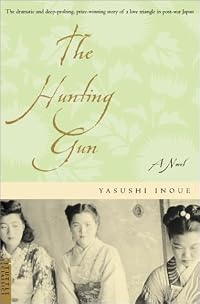
The Hunting Gun
by Yasushi Inoue
On This Page
Description
The Hunting Gun follows the consequences of a tragic love affair. Told from the viewpoints of three different women, this is a story of the psychological impact of illicit love. First viewed through the eyes of Shoko, who learns of the affair through reading her mother's diary, then through the eyes of Midori, who had long known about the affair of her husband with Saiko, and finally through the eyes of Saiko herself. This novella is incredibly powerful, with universal resonance and a true show more modern classic of the 20th century. show lessTags
Recommendations





Member Reviews
Íme egy tipikus japán klisé, képzeljük el mondjuk falfestményként: sápadt gésa áll selyem kimonóban a virágzó cseresznyefák alatt, háttérben magányos hókupolás hegy magasodik*. Ugyanez, ami az irodalmat illeti: szertartásosság, merev formák, finom mondatok, erősen letompított mesélő kedv, valamint lágyan rajzolt természeti képek. Inoue Jaszusi három elbeszélésére mindez igaz, de van bennük valami, ami túlmutat ezen – a szerző ugyanis rábök a falikép bal alsó sarkában egy rejtekajtóra, kitárja azt, és az olvasó betekinthet a külcsín mögé, családi tragédiát talál ott, eltitkolt szerelmet, privát fájdalmakat, amelyek szétfeszítik a festett kép kereteit. Látjuk a fogaskereket, show more miközben a gép mozog. Emlékezetes kis kötet.
A címadó elbeszélés (Utazás a Fudaraku-paradicsomba) pedig nemcsak az egyik legjobb japán írás, amit valaha olvastam, de egyáltalán: az egyik legjobb szöveg, amit a kételyről valaha írtak.
* Vagy mindez haikuban:
Selyem gésa áll
hókupolás hegy előtt
cseresznyevirág. show less
A címadó elbeszélés (Utazás a Fudaraku-paradicsomba) pedig nemcsak az egyik legjobb japán írás, amit valaha olvastam, de egyáltalán: az egyik legjobb szöveg, amit a kételyről valaha írtak.
* Vagy mindez haikuban:
Selyem gésa áll
hókupolás hegy előtt
cseresznyevirág. show less
This novella packs quite a punch. It is set out in a series of letters written to a man from the daughter of his mistress, his wife, and his mistress herself. It explores the deepest emotions we carry as human beings, those of our relationships to the people who we love, or are supposed to love. It is a complicated story of betrayal, of more than a sexual kind. Beautifully written and deeply moving.
Although I was not able to, this can be read in one sitting. Huge thank you to my friend, Lynn, for her marvelous review that brought this to my attention.
Although I was not able to, this can be read in one sitting. Huge thank you to my friend, Lynn, for her marvelous review that brought this to my attention.
This was a beautiful little book that took me by surprise. It is poetry in prose form... touching and sad.
A man is seen walking up a mountain with a pipe in his mouth and a gun strapped across his back. He is seen by the narrator as the personification of loneliness and writes a short poem about him that's published in a hunting magazine. The man recognizes himself in the poem and mails the narrator 3 letters to explain his cloak of emptiness and possibly share his burdens... and the story begins... a story of infidelity, sorrow, and loneliness.
The first letter is from the lonely man's mistress' daughter, the second from his wife, and the third from the mistress.
These three letters are enough to drive anyone up into the mountains on an show more early autumn morning with a gun.
'I and Misugi too will be sinners. And since it is impossible for us not to be sinners, let us be great sinners.' show less
A man is seen walking up a mountain with a pipe in his mouth and a gun strapped across his back. He is seen by the narrator as the personification of loneliness and writes a short poem about him that's published in a hunting magazine. The man recognizes himself in the poem and mails the narrator 3 letters to explain his cloak of emptiness and possibly share his burdens... and the story begins... a story of infidelity, sorrow, and loneliness.
The first letter is from the lonely man's mistress' daughter, the second from his wife, and the third from the mistress.
These three letters are enough to drive anyone up into the mountains on an show more early autumn morning with a gun.
'I and Misugi too will be sinners. And since it is impossible for us not to be sinners, let us be great sinners.' show less
Scrivi Vecchioni, scrivi canzoni... Ma i tuoi versi, poeta, io li ho vissuti e ti racconto le cose come stanno.
Tutto parte da un cacciatore che ispira inconsapevolmente una poesia, casualmente la legge, scientemente decide di scrivere all'autore e allegare tre innocue letterine... ognuna di esse contiene una vita.
Chi cerca sensibilità nipponica qua la trova, bizzarra, profonda, tenue, così lontana da quella occidentale, così vicina a quella di ogni uomo. E il racconto è ben scritto e ben congegnato. Enjoy ;-)
Tutto parte da un cacciatore che ispira inconsapevolmente una poesia, casualmente la legge, scientemente decide di scrivere all'autore e allegare tre innocue letterine... ognuna di esse contiene una vita.
Chi cerca sensibilità nipponica qua la trova, bizzarra, profonda, tenue, così lontana da quella occidentale, così vicina a quella di ogni uomo. E il racconto è ben scritto e ben congegnato. Enjoy ;-)
La felicità di alcuni comporta il dolore di altri? Un amore che nasce e vive nel tradimento è davvero amore o solo colpa?"Da bambina, alla festa del tempio Shōten a Nishinomiya, una volta qualcuno mi comprò un fermacarte, un fiore finto, rosso, in una palla di vetro. Cominciai a camminare tenendolo in mano, ma dopo un poco scoppiai a piangere. Probabilmente allora nessuno capì che cosa mi fosse successo. Avevo pensato alla sensazione dei petali di quel fiore, paralizzati, imprigionati all'interno del vetro freddo, petali che nessun vento di primavera o di autunno avrebbe più fatto tremare, petali crocifissi, è il mio cuore si era riempito di una terribile tristezza. E una tristezza uguale a quella di allora rivive adesso dentro show more di me. Ah, l'amore tra te e la mamma era come quei tristi petali!"
Poetico.
Da leggere e rileggere. show less
Da leggere e rileggere. show less
A book that slowly reveals its charms and hidden emotions. It doesn't seem more impressive than Akutagawa's In The Grove to begin with but by the end I was definitely won over.
The Hunting Gun by Yasushi Inoue (translated by Michael Emmerich) is a tragedy in three letters with a seemingly unrelated narrator in the background. The book makes for a great book club discussion. It is also an example of why I love being in a book club. Many questions and symbols remain unanswered and unexplained in this book, making for a lively conversation surrounding this short book featuring really only four characters.
Read my complete review at http://www.memoriesfrombooks.com/2021/10/the-hunting-gun.html
Read my complete review at http://www.memoriesfrombooks.com/2021/10/the-hunting-gun.html
Members
- Recently Added By
Lists

Japanese Literature
230 works; 40 members

Schwob Nederland
207 works; 2 members

Kirkus Reviews Best Fiction of 2014
100 works; 7 members

Las mejores obras literarias leídas en 2020 -- Magistrales (R. D.)
14 works; 1 member
Author Information

166+ Works 2,641 Members
Inoue Yasushi is considered to be the last of the Japanese masters, heir to the traditions of classical Chinese and Japanese literature. This journalist-turned-novelist writes poetry, historical fiction set in China and old Japan, and novels of modern Japan. His first fiction was published in 1948, and his choice of settings continues to reveal a show more superb feel for other times, places, and peoples. (Bowker Author Biography) show less
Some Editions
Awards and Honors
Notable Lists
Series
Belongs to Publisher Series
Common Knowledge
- Canonical title
- The Hunting Gun
- Original title
- 猟銃
- Original publication date
- 1949
- People/Characters
- Misugi Josoku; Saiko; Midori; Shōku
- First words*
- Un jour, il m'arriva de donner au Compagnon du Chasseur (cette modeste revue publiée par la Société des Chasseurs du Japon) un poème intitulé Le fusil de chasse.
- Last words*
- (Click to show. Warning: May contain spoilers.)Je posai les mains sur l'appui de la fenêtre, et, comme si j'avais eu sous les yeux ce que Misugi appelait son "lit asséché de torrent blême", je laissai mon regard plonger dans l'obscurité qui baignait l'étroit jardin et ses épais buissons, juste au-dessous de moi.
- Original language
- Giapponese
*Some information comes from Common Knowledge in other languages. Click "Edit" for more information.
Classifications
- Genres
- Fiction and Literature, General Fiction
- DDC/MDS
- 895.635 — Literature & rhetoric Literatures of other languages Literatures of East and Southeast Asia Japanese Japanese fiction 1945–2000
- LCC
- PL830 .N63 — Language and Literature Languages and literatures of Eastern Asia, Africa, Oceania Languages of Eastern Asia, Africa, Oceania Japanese language and literature Japanese literature Individual authors and works
- BISAC
Statistics
- Members
- 605
- Popularity
- 47,939
- Reviews
- 22
- Rating
- (3.73)
- Languages
- 10 — Dutch, English, Finnish, French, German, Hungarian, Italian, Portuguese, Spanish, Swedish
- Media
- Paper, Audiobook, Ebook
- ISBNs
- 34
- ASINs
- 12