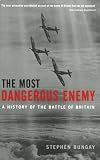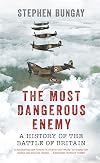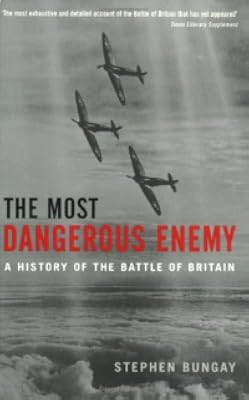
The Most Dangerous Enemy: A History of the Battle of Britain
by Stephen Bungay
On This Page
Description
Stephen Bungay's magisterial history is acclaimed as the account of the Battle of Britain. Unrivalled for its synthesis of all previous historical accounts, for the quality of its strategic analysis and its truly compulsive narrative, this is a book ultimately distinguished by its conclusions - that it was the British in the Battle who displayed all the virtues of efficiency, organisation and even ruthlessness we habitually attribute to the Germans, and they who fell short in their show more amateurism, ill-preparedness, poor engineering and even in their old-fashioned notions of gallantry. An engrossing read for the military scholar and the general reader alike, this is a classic of military history that looks beyond the mythology, to explore all the tragedy and comedy; the brutality and compassion of war. show lessTags
Recommendations


















Member Reviews
The Battle of Britain stands out among the long list of military clashes for a number of reasons. A struggle for air superiority over the skies of southern England, it was the first battle ever waged entirely in the skies. By successfully holding off the Luftwaffe’s aerial onslaught, the British forestalled an invasion in 1940, guaranteeing that the Germans would face a two-front war when Hitler focused the Nazi war machine on the Soviet Union the following year.
Many accounts of the battle have been written, from memoirs by the pilots to narratives from academic historians. In this respect Stephen Bungay’s qualifications stand out; a former business consultant and insurance executive, he brings a different approach to examining the show more conflict. Taking the fall of France as his starting point, he intersperses his narrative of the battle (which is largely free of the management jargon that might be expected given his background) with chapters examining various factors in the struggle, from the performances of the planes deployed to the command structures of the two sides. Here he draws upon both his training and his command of German to provide a more balanced assessment of the two sides. What emerges is a provocative argument that the German effort was hopeless, requiring exhausted pilots to achieve statistically unrealistic ratios of combat victories in conditions that favored their opponents.
Such an unusual conclusion might fly in the face of the mythology surrounding the famous “Few”, yet Bungay’s analysis is persuasive in marshaling the numbers to prove its point. Combined with a thorough summary of the campaign, it makes this book the best overview of the Battle of Britain. If there is a flaw, it lies in Bungay’s rather narrow scope of study, as he only takes into account events from the 1930s onward and largely overlooks the many studies of the “first Battle of Britain” that could have shed light on many of the attitudes participants brought to the campaign. Yet this is a minor flaw in what is otherwise an excellent study of a pivotal struggle of the Second World War. show less
Many accounts of the battle have been written, from memoirs by the pilots to narratives from academic historians. In this respect Stephen Bungay’s qualifications stand out; a former business consultant and insurance executive, he brings a different approach to examining the show more conflict. Taking the fall of France as his starting point, he intersperses his narrative of the battle (which is largely free of the management jargon that might be expected given his background) with chapters examining various factors in the struggle, from the performances of the planes deployed to the command structures of the two sides. Here he draws upon both his training and his command of German to provide a more balanced assessment of the two sides. What emerges is a provocative argument that the German effort was hopeless, requiring exhausted pilots to achieve statistically unrealistic ratios of combat victories in conditions that favored their opponents.
Such an unusual conclusion might fly in the face of the mythology surrounding the famous “Few”, yet Bungay’s analysis is persuasive in marshaling the numbers to prove its point. Combined with a thorough summary of the campaign, it makes this book the best overview of the Battle of Britain. If there is a flaw, it lies in Bungay’s rather narrow scope of study, as he only takes into account events from the 1930s onward and largely overlooks the many studies of the “first Battle of Britain” that could have shed light on many of the attitudes participants brought to the campaign. Yet this is a minor flaw in what is otherwise an excellent study of a pivotal struggle of the Second World War. show less
A terrific book about the summer of 1940 and the air battle that helped determine the course of WWII. Bungay builds the picture from the beginning going back to the mid-30s and slowly advancing the timeline until the confrontation occurs the between the British and German air forces.
The book is as detailed as you would like - whole chapters devoted to the various planes involved in the engagement - but is also strategic enough to get you to understand both British and German thinking as the clash moves inexorably forward.
While occasional British biases show, the author does a commendable job of keeping them to a minimum and describing the action from both sides. He tells about the isolation of Britain during this period and the role show more that Churchill played, the plans of Germany which did not include an invasion of Great Britain. Fascinating stuff.
In the end, he tells of two countries that lost the war - Germany in obvious defeat by allied forces, but also of Great Britain whose role in the world greatly decreased due to the cost of survival.
Highly recommended. show less
The book is as detailed as you would like - whole chapters devoted to the various planes involved in the engagement - but is also strategic enough to get you to understand both British and German thinking as the clash moves inexorably forward.
While occasional British biases show, the author does a commendable job of keeping them to a minimum and describing the action from both sides. He tells about the isolation of Britain during this period and the role show more that Churchill played, the plans of Germany which did not include an invasion of Great Britain. Fascinating stuff.
In the end, he tells of two countries that lost the war - Germany in obvious defeat by allied forces, but also of Great Britain whose role in the world greatly decreased due to the cost of survival.
Highly recommended. show less
This has is the most complete history of the Battle that I have read. It contains complete histories of the development of all aircraft which took part in the Battle including the Boulton-Paul Defiant and the Fairey Battle. Brief biographies of key men from both sides help understand how they arrived at their positions of control. Bungay explains how the Germans lost the Battle and what key plans enabled the British Royal Air Force to win. He lists the ten men who he felt were the reason the British won with the most important individual being Air Vic-Marshall Keith Park, the man who daily made many decisive decisions of when & where the Air Force's resources were deployed.
He concludes that this was the most important battle of the war show more and if the Germans had won, it would have probably led to a Russian overall victory in the end and a very different world. show less
He concludes that this was the most important battle of the war show more and if the Germans had won, it would have probably led to a Russian overall victory in the end and a very different world. show less
A good place to start if you want in-depth info about The Battle of Britain. But be warned, many details but in the good way
Stephen Bungay was interviewed in the programme on the Battle of Britain compared by Ewan McGregor with his RAF pilot brother Colin
Ratings
Members
- Recently Added By
Lists

r/AskHistorians' Recommended Books
1,068 works; 18 members
Author Information

7 Works 475 Members
Stephen Bungay was born in Kent in 1954 and educated at Oxford and Tubingen. He has spent his career working for The Boston Consulting Group in London and Munich and as chief executive of an insurance company. He now works in executive education, specialising in military history and modern management practice
Common Knowledge
- Important events
- World War II (1939 | 1945); Battle of Britain (1940)
Classifications
- Genres
- History, Nonfiction, General Nonfiction
- DDC/MDS
- 940.54211 — History & geography History of Europe History of Europe 1918- Military history of World War II Campaigns and battles by theatre European theatre
- LCC
- D756.5 .B7 .B86 — History of Europe, Asia, Africa and Oceania History (General) World War II (1939-1945)
- BISAC
Statistics
- Members
- 295
- Popularity
- 108,959
- Reviews
- 5
- Rating
- (4.22)
- Languages
- English, Spanish
- Media
- Paper, Ebook
- ISBNs
- 8
- ASINs
- 7