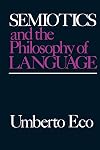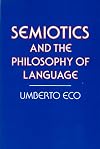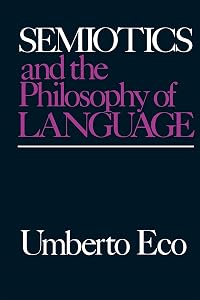
Semiotics and the Philosophy of Language
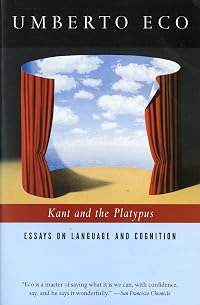
by Umberto Eco
On This Page
Description
"Eco wittily and enchantingly develops themes often touched on in his previous works, but he delves deeper into their complex nature... this collection can be read with pleasure by those unversed in semiotic theory." -- Times Literary SupplementTags
Recommendations




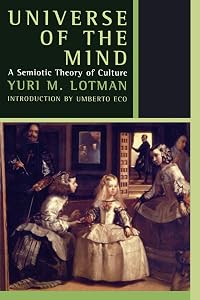
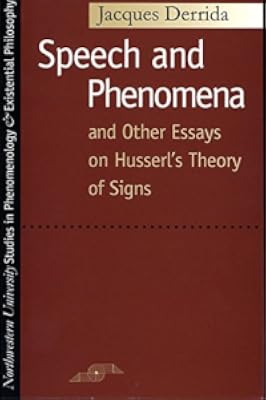
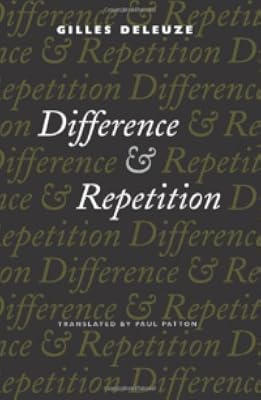
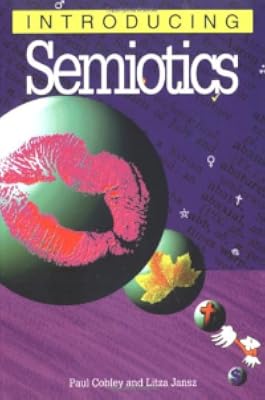

Member Reviews
I am not actually going to review this book. This book has chapters with titles such as "Discursive isotopies within sentences with paradigmatic disjunction". I read every word, I didn't understand every word. I probably understood a tiny fraction of the words.
I wanted to read a book about Semiotics and the library didn't have many to choose from so I picked some from university libraries to borrow but some were unavailable and I ended up with this one.
There was a lot of "food for thought" about metaphors in here! And the last chapter on mirrors (note: mirrors are NOT signs) was very good and understandable to a lay person like me.
What wasn't so understandable (to me) were the quotations in French or Latin with no translation, there show more being an assumption I could read more than just English.
I did like Eco's sense of humor peeking through here and there in the middle of his scientific discourses. In the Mirror chapter, for instance, he talks about how is facing a mirror as he is writing and "before deciding whether the door handle is on the right or on the left. . .in the event I wanted to throw my lighter and hit the handle. . . " Wait? What? He's smoking? Wow.
In the meantime, always remember "Greimas has admitted that the isotopies can take place also on the expression-plan, by accepting a minimal definition according to which isotopy is the iterativity of linguistic units, be it manifested or not at the expression plane, belonging to both expression and content."
I'll keep on reading and I'll get it eventually. show less
I wanted to read a book about Semiotics and the library didn't have many to choose from so I picked some from university libraries to borrow but some were unavailable and I ended up with this one.
There was a lot of "food for thought" about metaphors in here! And the last chapter on mirrors (note: mirrors are NOT signs) was very good and understandable to a lay person like me.
What wasn't so understandable (to me) were the quotations in French or Latin with no translation, there show more being an assumption I could read more than just English.
I did like Eco's sense of humor peeking through here and there in the middle of his scientific discourses. In the Mirror chapter, for instance, he talks about how is facing a mirror as he is writing and "before deciding whether the door handle is on the right or on the left. . .in the event I wanted to throw my lighter and hit the handle. . . " Wait? What? He's smoking? Wow.
In the meantime, always remember "Greimas has admitted that the isotopies can take place also on the expression-plan, by accepting a minimal definition according to which isotopy is the iterativity of linguistic units, be it manifested or not at the expression plane, belonging to both expression and content."
I'll keep on reading and I'll get it eventually. show less
E-3
Sep 27, 2020Catalan
Ratings
Members
- Recently Added By
Author Information

504+ Works 115,269 Members
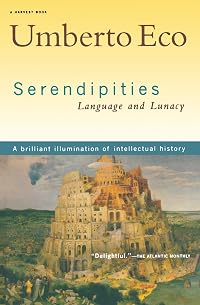
Umberto Eco was born in Alessandria, Italy on January 5, 1932. He received a doctorate of philosophy from the University of Turin in 1954. His first book, Il Problema Estetico in San Tommaso, was an extension of his doctoral thesis on St. Thomas Aquinas and was published in 1956. His first novel, The Name of the Rose, was published in 1980 and won show more the Premio Strega and the Premio Anghiar awards in 1981. In 1986, it was adapted into a movie starring Sean Connery. His other works include Foucault's Pendulum, The Island of the Day Before, Baudolino, The Prague Cemetery, and Numero Zero. He also wrote children's books and more than 20 nonfiction books including Serendipities: Language and Lunacy. He taught philosophy and then semiotics at the University of Bologna. He also wrote weekly columns on popular culture and politics for L'Espresso. He died from cancer on February 19, 2016 at the age of 84. (Bowker Author Biography) show less
Series
Belongs to Publisher Series
Common Knowledge
- Canonical title
- Semiotics and the Philosophy of Language
- Original publication date
- 1984
Classifications
- Genres
- Nonfiction, Philosophy, Literature Studies and Criticism, General Nonfiction
- DDC/MDS
- 401.41 — Language Language Philosophy and theory; international languages Communication; semantics, pragmatics, languages for special purposes Discourse analysis
- LCC
- P99 .E2913 — Language and Literature Philology. Linguistics Semiotics. Signs and symbols
- BISAC
Statistics
- Members
- 452
- Popularity
- 67,587
- Reviews
- 2
- Rating
- (3.59)
- Languages
- 7 — Catalan, English, French, German, Italian, Portuguese, Spanish
- Media
- Paper
- ISBNs
- 17