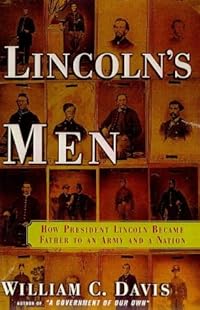
Lincoln's Men: How President Lincoln Became Father to an Army and a Nation
by William C. Davis
On This Page
Description
No American president has enjoyed as intimate a relationship with the soldiers in his army as did the man they called "Father Abraham." In Lincolns Men, historian William C. Davis draws on thousands of unpublished letters and diaries--the voices of the volunteers--to tell the hidden story of how a new and untested president became "Father" throughout both the army and the North as a whole. How did Lincoln inspire the faith and courage of so many shattered men, as they wandered the inferno of show more Shiloh or were entrenched in the siege of Vicksburg? Why did soldiers visiting Washington feel free to stroll into the White House as if it were their own home? In this through and authoritative work, Davis removes layers of mythmaking to recapture the real moods and feelings of an army facing one of historys bloodiest conflicts. Lincolns Men casts a new light on our most famous president and on Americas revolution--on our countrys father and its rebirth. show lessTags
Recommendations









Member Reviews
In "Lincoln's Men" (1999), William C. Davis provides an in depth study of the relationship between President Abraham Lincoln and the men of the Union Army during the War Between the States. Lincoln had an unusually close relationship with his fighting men - one that would sustain the president and his soldiers through even the bleakest periods of the war. Davis makes the case that, had this personal relationship not existed, it would have been much more difficult for the country, civilians and soldiers alike, to find the will to continue to fight a terrible war that seemed to be lasting forever.
That Abraham Lincoln became a father figure to a huge majority of the men fighting on the side of the Union, especially those in the Army of show more the Potomac, is beyond dispute. As his book's subtitle announces ("How President Lincoln Became a Father to an Army and a Nation"), Davis explains here the "how" part of what happened. In order to do that, Davis searched through some 600 manuscript collections to see what the men themselves had to say about Lincoln during various milestones of the war. He quotes extensively (sometimes to excess, in fact) from the letters and diaries of the men who were there.
"Lincoln's Men" is divided into nine chapters, beginning with one on Lincoln's election to the presidency in 1860 and ending with one on his assassination in 1865. Between these bookend chapters are others on creation of the Union army, Lincoln's struggles with the reluctant-to-fight General McClellan, Lincoln's evolving policy on emancipation of the slaves in Southern states, Lincoln's efforts to keep his army armed, fed and paid, and one on Lincoln's liberal pardon policy (perhaps the most revealing chapter in the entire book).
Each of the chapters is peppered with direct quotes from soldier correspondence that show Lincoln's influence and effect on the men he so much respected and admired. Davis does not make the claim that love for Mr. Lincoln was unanimously shared by the army and, in fact, spends a good number of pages quoting from McClellan loyalists who remained in opposition to Lincoln right up to his death. Shockingly enough, some Union soldiers, those who insisted to the end that they had not enlisted to fight to end slavery, were cheered by the news of Lincoln's assassination - and many learned to regret the mistake of expressing those feelings to Lincoln loyalists.
Abraham Lincoln was perhaps the perfect man for his time and his job. It is, of course, impossible to predict what might have happened if America had had no Abraham Lincoln. Lincoln's Men does make clear, however, how much a key element the personality of Lincoln was in holding the Union together long enough for the United States to conclude the war successfully. Without the strong emotional bonding between Lincoln and his men, the War Between the States may have ended very differently.
Rated at: 4.0 show less
That Abraham Lincoln became a father figure to a huge majority of the men fighting on the side of the Union, especially those in the Army of show more the Potomac, is beyond dispute. As his book's subtitle announces ("How President Lincoln Became a Father to an Army and a Nation"), Davis explains here the "how" part of what happened. In order to do that, Davis searched through some 600 manuscript collections to see what the men themselves had to say about Lincoln during various milestones of the war. He quotes extensively (sometimes to excess, in fact) from the letters and diaries of the men who were there.
"Lincoln's Men" is divided into nine chapters, beginning with one on Lincoln's election to the presidency in 1860 and ending with one on his assassination in 1865. Between these bookend chapters are others on creation of the Union army, Lincoln's struggles with the reluctant-to-fight General McClellan, Lincoln's evolving policy on emancipation of the slaves in Southern states, Lincoln's efforts to keep his army armed, fed and paid, and one on Lincoln's liberal pardon policy (perhaps the most revealing chapter in the entire book).
Each of the chapters is peppered with direct quotes from soldier correspondence that show Lincoln's influence and effect on the men he so much respected and admired. Davis does not make the claim that love for Mr. Lincoln was unanimously shared by the army and, in fact, spends a good number of pages quoting from McClellan loyalists who remained in opposition to Lincoln right up to his death. Shockingly enough, some Union soldiers, those who insisted to the end that they had not enlisted to fight to end slavery, were cheered by the news of Lincoln's assassination - and many learned to regret the mistake of expressing those feelings to Lincoln loyalists.
Abraham Lincoln was perhaps the perfect man for his time and his job. It is, of course, impossible to predict what might have happened if America had had no Abraham Lincoln. Lincoln's Men does make clear, however, how much a key element the personality of Lincoln was in holding the Union together long enough for the United States to conclude the war successfully. Without the strong emotional bonding between Lincoln and his men, the War Between the States may have ended very differently.
Rated at: 4.0 show less
Often interesting, but repeditive and stretched. Border notes when reading.
Ratings
Members
- Recently Added By
Author Information

144+ Works 10,229 Members
William C. Davis is a retired history professor who taught at Virginia Tech. An acclaimed expert on the Civil War, he has served on a number of advisory boards, including the Abraham Lincoln Bicentennial Commission; the American Battlefield Trust; the National Museum of the Civil War Soldier in Petersburg, Virginia; the National Park Service; and show more the Lincoln Prize and Pulitzer Prize nominating juries. show less
Awards and Honors
Awards
Common Knowledge
- People/Characters
- Abraham Lincoln
- Important places
- USA
Classifications
- Genres
- History, Nonfiction, General Nonfiction, Biography & Memoir
- DDC/MDS
- 973.7 — History & geography History of North America United States Abraham Lincoln, (1861-1865) Civil War
- LCC
- E457.2 .D33 — History of the United States United States Civil War period, 1861-1865 Lincoln's administrations, 1861-April 15, 1865
- BISAC
Statistics
- Members
- 206
- Popularity
- 158,121
- Reviews
- 2
- Rating
- (3.92)
- Languages
- English
- Media
- Paper, Audiobook, Ebook
- ISBNs
- 6
- ASINs
- 4