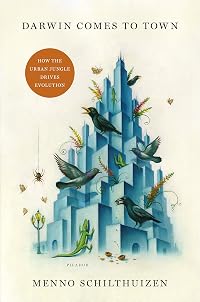
Darwin Comes to Town: How the Urban Jungle Drives Evolution
by Menno Schilthuizen
On This Page
Description
"Menno Schilthuizen is one of a growing number of "urban ecologists" studying how our manmade environments are accelerating and changing the evolution of the animals and plants around us. In Darwin Comes to Town, he takes us around the world for an up-close look at just how stunningly flexible and swift-moving natural selection can be. With human populations growing, we're having an increasing impact on global ecosystems, and nowhere do these impacts overlap as much as they do in cities. The show more urban environment is about as extreme as it gets, and the wild animals and plants that live side-by-side with us need to adapt to a whole suite of challenging conditions: they must manage in the city's hotter climate (the "urban heat island"); they need to be able to live either in the semidesert of the tall, rocky, and cavernous structures we call buildings or in the pocket-like oases of city parks (which pose their own dangers, including smog and free-ranging dogs and cats); traffic causes continuous noise, a mist of fine dust particles, and barriers to movement for any animal that cannot fly or burrow; food sources are mainly human-derived. And yet, as Schilthuizen shows, the wildlife sharing these spaces with us is not just surviving, but evolving ways of thriving. Darwin Comes to Town draws on eye-popping examples of adaptation to share a stunning vision of urban evolution in which humans and wildlife co-exist in a unique harmony. It reveals that evolution can happen far more rapidly than Darwin dreamed, while providing a glimmer of hope that our race toward over population might not take the rest of nature down with us."--Jacket. With human populations growing, we're having an increasing impact on global ecosystems, and nowhere do these impacts overlap as much as they do in cities. "Urban ecologists" study how our manmade environments are changing the evolution of the animals and plants around us. Schilthuizen takes us around the world for an up-close look at just how stunningly flexible and swift-moving natural selection can be. He shows how the wildlife sharing these spaces with us is not just surviving, but evolving ways of thriving. show lessTags
Recommendations














Member Reviews
This is a good popular science book that walks the fine line between being extremely accessible but not dumbing down the thesis or the science supporting it. Schilthuizen presents an interesting overview of urban evolution—how plants, insects, birds, and animals have adapted to manmade/urban environments—in an extremely digestible way that doesn't skirt the fact that this is serious business. The tone tends to default a little onto the side of breeziness, focusing on urban fauna and flora's successful adaptations to issues like noise, light, and chemical pollution and the compartmentalization of cities' green areas without digging into the more disastrous and deleterious effects. Then again, this is not that book, of which there are show more already many. This is, rather, an optimistic—but no less rigorous for that—look at the ways nature (both what we think of as "nature" and the kind touched by human beings) prevails.
Schilthuizen's style is conversational and often very funny, keeping the array of information moving along: why mice in urban pocket parks have developed different DNA; moths whose wing colors changed to provide camouflage on the soot-covered tree trunks of industrial-age England; plants that filter heavy metals; the difference between rural and urban blackbirds, who do in fact sing in the dead of night (to avoid daytime city noises—and that's not the only sly Paul McCartney reference Schilthuizen works in); and the ultimate irony—how the post-Darwin transformation of the Galápagos capital of Santa Cruz into a tourist destination has resulted in enough urban homogenization to slowly reverse the differentiated effects on the bills of "Darwin's" finches, which are what led to its fame to begin with.
Lots to learn here, and it both goes down easily and sticks in the brain—the author presents his information well and usably. Recommended for anyone curious about the subject—and Schilthuizen loves him some citizen scientists, so the book may well achieve his goal of encouraging more folks with general interests to get involved in helping track urban evolution as it marches on. show less
Schilthuizen's style is conversational and often very funny, keeping the array of information moving along: why mice in urban pocket parks have developed different DNA; moths whose wing colors changed to provide camouflage on the soot-covered tree trunks of industrial-age England; plants that filter heavy metals; the difference between rural and urban blackbirds, who do in fact sing in the dead of night (to avoid daytime city noises—and that's not the only sly Paul McCartney reference Schilthuizen works in); and the ultimate irony—how the post-Darwin transformation of the Galápagos capital of Santa Cruz into a tourist destination has resulted in enough urban homogenization to slowly reverse the differentiated effects on the bills of "Darwin's" finches, which are what led to its fame to begin with.
Lots to learn here, and it both goes down easily and sticks in the brain—the author presents his information well and usably. Recommended for anyone curious about the subject—and Schilthuizen loves him some citizen scientists, so the book may well achieve his goal of encouraging more folks with general interests to get involved in helping track urban evolution as it marches on. show less
This is a fascinating account of evolution happening in cities – evolution that is not happening at the rate of slow eons of geological time, but at a quicker almost break neck speed, pushed by man’s ever changing innovations. Bird wings subtly change shape to be able to escape upward more quickly, moths must adapt to the brighter LED lights, blackbirds sing at a higher pitch in order to be heard over traffic noises.
Each chapter recounts a different species adapting to human cities throughout the world. The anecdotes are great, and the writing lively – definitely not a dry, scientific tome on evolution.
Perfect light (non-political!) non-fiction.
Each chapter recounts a different species adapting to human cities throughout the world. The anecdotes are great, and the writing lively – definitely not a dry, scientific tome on evolution.
Perfect light (non-political!) non-fiction.
Not a simple book but an uplifting one. 80% of our biologists live in cities; they STUDY cities and there is a ton of life in cities. Our future cities will also be filled w. life. Dutch author, not a world wide view but also not a U.S view. Nice change. Species are evolving faster in cities than we expect -- will that accelerate?
A book for a serious curious nature lover.
A book for a serious curious nature lover.
'Darwin Comes to Town' is a book about how nature evolves and adapts in the face of adversity, in this case human-cause adversity. How life adapts and evolves in cities.
I morally grappled with this book in multiple ways. Schilthuizen professes to be a nature lover, but there was evidence in support of his claim, as well as what I found was contradictory evidence. There's a LOT to love in this book, but ultimately, it felt like an excuse to destroy nature. And that is NOT what the book is intended to put forth.
If you're writing a book about how life adapts in the city, it doesn't rubberstamp destroying nature, but you know, it also doesn't *not* do that either. So the book is offering hope in a lot of ways, like the urban parakeet show more populations that are thriving while native populations in their native habitats are struggling. But on the flip side, this isn't a condemnation of the illegal trade.
The author is correct that there is little stopping humanity's ongoing destruction of nature, and I can tell he *is* trying to offer a glimmer of hope in the darkness that life can overcome and will find a way.
But when Schilthuizen was growing up, he loved to collect insects. I mean, for me? That means you enjoy *killing* insects just to mount them in your collections. It doesn't feel all that different than trophy hunting. How about just taking a picture and moving on? And if you can't find those insects you're looking for without destroying an ant colony? Well, that's okay. And he kind of betrays some hiding places of some birds that were just trying to live with what had happened to them, even though ultimately, what he wrote in his book may not have made a difference.
Overall, this book has some fabulous information in it, but it just didn't do it for me. Very much worth reading and forming your own opinion. show less
I morally grappled with this book in multiple ways. Schilthuizen professes to be a nature lover, but there was evidence in support of his claim, as well as what I found was contradictory evidence. There's a LOT to love in this book, but ultimately, it felt like an excuse to destroy nature. And that is NOT what the book is intended to put forth.
If you're writing a book about how life adapts in the city, it doesn't rubberstamp destroying nature, but you know, it also doesn't *not* do that either. So the book is offering hope in a lot of ways, like the urban parakeet show more populations that are thriving while native populations in their native habitats are struggling. But on the flip side, this isn't a condemnation of the illegal trade.
The author is correct that there is little stopping humanity's ongoing destruction of nature, and I can tell he *is* trying to offer a glimmer of hope in the darkness that life can overcome and will find a way.
But when Schilthuizen was growing up, he loved to collect insects. I mean, for me? That means you enjoy *killing* insects just to mount them in your collections. It doesn't feel all that different than trophy hunting. How about just taking a picture and moving on? And if you can't find those insects you're looking for without destroying an ant colony? Well, that's okay. And he kind of betrays some hiding places of some birds that were just trying to live with what had happened to them, even though ultimately, what he wrote in his book may not have made a difference.
Overall, this book has some fabulous information in it, but it just didn't do it for me. Very much worth reading and forming your own opinion. show less
Enjoyed this exploration of how animals are responding to human encroachment , in many cases adapting to urban conditions. Of course, in other cases, they are going extinct rather than adapting . The author’s contention seems to be that it is happening and we ought to facilitate those that can adapt. It is controversial, but interesting and thought provoking
As professor that teaches a small unit on evolution in her sophomore Biology course, I thoroughly enjoyed this book. It is not your typical science book. The author has constructed and presented the material with the thought of engaging all levels of science expertise which is fantastic. There is humor brought a subject that most would find dry. It is very well documented and relevant collection of research studies that show the reader how evolution is happening all around you and especially within the urban environment. Ther reader is taken on a journye that is described in detail and places you as the oberver doing the research study he is discussing. I am excited to share many examples with my class and will be recommending this book show more to students who wish to explore this topic. I know of one that already went out and bought it. show less
Menno Schilthuizen geef de lezer een unieke inkijk op stedelijke ecosystemen en hoe dieren en planten zich aanpassen aan deze omgeving. In sommige gevallen kan je zelfs van evolutie spreken als er aantoonbare wijzigingen zijn in het DNA. Het boek beschrijft tal van voorbeelden, de kijk op de tuinen van Tokio is intrigerend. Maar toch is het boek wat langdradig en kon het beknopter. Het blijft echter een prima boek voor de (aankomende) stadsecoloog.
Jan 16, 2019Dutch
Members
- Recently Added By
Lists

Recommended Nature Writing
346 works; 180 members

Top Five Books of 2020
982 works; 350 members

Science
28 works; 1 member

Books Read in 2018
4,360 works; 110 members

Books Read in 2019
4,052 works; 110 members

Habitat Hero books
37 works; 1 member
Author Information

13 Works 557 Members
Awards and Honors
Awards
Distinctions
Notable Lists
Common Knowledge
- Canonical title*
- Darwin in de stad
- Original title
- Darwin comes to town
- Alternate titles*
- How the urban jungle drives evolution
- Original publication date
- 2018
- People/Characters
- Charles Darwin
- Original language*
- Engels
*Some information comes from Common Knowledge in other languages. Click "Edit" for more information.
Classifications
Statistics
- Members
- 330
- Popularity
- 96,534
- Reviews
- 7
- Rating
- (3.81)
- Languages
- 5 — Dutch, English, Italian, Polish, Spanish
- Media
- Paper, Audiobook, Ebook
- ISBNs
- 21
- ASINs
- 5