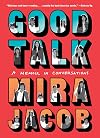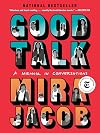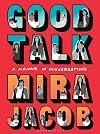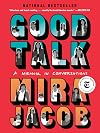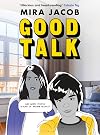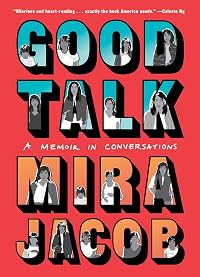
Good Talk: A Memoir in Conversations
by Mira Jacob
On This Page
Description
"Like many six-year-olds, Mira Jacob's half-Jewish, half-Indian son, Z, has questions about everything. At first they are innocuous enough, but as tensions from the 2016 election spread from the media into his own family, they become much, much more complicated. Trying to answer him honestly, Mira has to think back to where she's gotten her own answers: her most formative conversations about race, color, sexuality, and, of course, love. Written with humor and vulnerability, this deeply show more relatable graphic memoir is a love letter to the art of conversation--and to the hope that hovers in our most difficult questions" -- show lessTags
Recommendations






Member Reviews
I just stumbled upon this book on Twitter when the author Mira shared a couple of illustrations from the graphic novel about Indian aunties and I couldn’t stop laughing and I decided that I had to read it. However, I ended up not finding the graphic novel at my library and had to listen to the audiobook which turned out to be totally unexpected and wonderful in its own way.
This memoir is completely heartfelt, witty and hilarious while tackling very complex issues surrounding race in the America of the current president. The author’s own growing up timeline felt familiar, irrespective of the fact that I grew up in India. The relationship she shared with her parents and relatives, their conversations and ideas and values all felt so show more relatable (not always in a good way though). When she talks about the colorism that she faced in India due to being darker toned than her parents and brother, it hit me very hard. Just like her, I too heard a lot growing up that my parents were going to have a tough time finding a guy for me because I wasn’t as fair as I used to be when I was a child. As a young well educated woman, I was constantly told I shouldn’t want to marry an equally highly educated man because neither was I very pretty nor was I rich enough to harbor such dreams. This whole idea of reducing a woman’s self worth to the color of her skin is still far too common in India even years after when the author’s own story takes place.
The other thing the author talks about is the othering she felt both while trying to date (as a bisexual woman of color) and as an aspiring author trying to make it. There are numerous occasions in the story where she encounters little statements or micro aggressions by white people, who are completely tone deaf and clueless as to how racist they come across. As an author, she has to explain to a radio producer that referring to her characters as Asian Indian instead of East Indian just so that Americans can understand it better is so darn ignorant. And all these little things just add up and go on and the author (like many other POC) doesn’t confront or argue with these people because that will not change anything. There is a frustration that is reflected in the author’s narration that I totally empathized with because it’s a reality for many of us.
And the most important and also the most difficult and heartbreaking parts of the book were her conversations with her six year old biracial son. He is an inquisitive little child always asking her lots of questions, which she wants to answer honestly - until he starts listening to the 2016 election campaign rhetoric on the news and wants to know if Trump hates him, if his white Jewish dad will have to give him and his mom up if Trump wins the election and has lots of questions about racism and prejudice and more other issues that affect him profoundly - she doesn’t know how to answer them all in a way he can understand, but can’t avoid them either because they will affect his daily life. When Mira has to explain to him that his Trump supporting republican grandparents still love him, he is truly confused and wants to beg them not to vote for him and it broke her heart along with mine. The line “sometimes the people who love you will choose a world that doesn’t” is still haunting me hours after finishing the book. While she spent the election night with her husband and their friends lamenting on the result (and also not feeling completely surprised by it), I was all alone in my home reeling with what I was seeing on tv - but the thoughts that were running through our head were the same. These conversations that she has with her kid and everything she is grappling with about her son’s future, are the same I think about when I envision having a kid who will probably be born American, but will ultimately always be defined by their skin color.
I have read in other reviews that the author’s illustration style is amazing but the full cast audio (with music and situational background score) is absolutely spectacular and I would highly recommend this format too. This book is very thought provoking and funny and also sad and I think POC readers will find some very relatable experiences in it. Thats not to say others won’t, but I feel people who have lived these experiences will have a unique appreciation for this book. show less
This memoir is completely heartfelt, witty and hilarious while tackling very complex issues surrounding race in the America of the current president. The author’s own growing up timeline felt familiar, irrespective of the fact that I grew up in India. The relationship she shared with her parents and relatives, their conversations and ideas and values all felt so show more relatable (not always in a good way though). When she talks about the colorism that she faced in India due to being darker toned than her parents and brother, it hit me very hard. Just like her, I too heard a lot growing up that my parents were going to have a tough time finding a guy for me because I wasn’t as fair as I used to be when I was a child. As a young well educated woman, I was constantly told I shouldn’t want to marry an equally highly educated man because neither was I very pretty nor was I rich enough to harbor such dreams. This whole idea of reducing a woman’s self worth to the color of her skin is still far too common in India even years after when the author’s own story takes place.
The other thing the author talks about is the othering she felt both while trying to date (as a bisexual woman of color) and as an aspiring author trying to make it. There are numerous occasions in the story where she encounters little statements or micro aggressions by white people, who are completely tone deaf and clueless as to how racist they come across. As an author, she has to explain to a radio producer that referring to her characters as Asian Indian instead of East Indian just so that Americans can understand it better is so darn ignorant. And all these little things just add up and go on and the author (like many other POC) doesn’t confront or argue with these people because that will not change anything. There is a frustration that is reflected in the author’s narration that I totally empathized with because it’s a reality for many of us.
And the most important and also the most difficult and heartbreaking parts of the book were her conversations with her six year old biracial son. He is an inquisitive little child always asking her lots of questions, which she wants to answer honestly - until he starts listening to the 2016 election campaign rhetoric on the news and wants to know if Trump hates him, if his white Jewish dad will have to give him and his mom up if Trump wins the election and has lots of questions about racism and prejudice and more other issues that affect him profoundly - she doesn’t know how to answer them all in a way he can understand, but can’t avoid them either because they will affect his daily life. When Mira has to explain to him that his Trump supporting republican grandparents still love him, he is truly confused and wants to beg them not to vote for him and it broke her heart along with mine. The line “sometimes the people who love you will choose a world that doesn’t” is still haunting me hours after finishing the book. While she spent the election night with her husband and their friends lamenting on the result (and also not feeling completely surprised by it), I was all alone in my home reeling with what I was seeing on tv - but the thoughts that were running through our head were the same. These conversations that she has with her kid and everything she is grappling with about her son’s future, are the same I think about when I envision having a kid who will probably be born American, but will ultimately always be defined by their skin color.
I have read in other reviews that the author’s illustration style is amazing but the full cast audio (with music and situational background score) is absolutely spectacular and I would highly recommend this format too. This book is very thought provoking and funny and also sad and I think POC readers will find some very relatable experiences in it. Thats not to say others won’t, but I feel people who have lived these experiences will have a unique appreciation for this book. show less
Not my usual type of book, but I'm so glad I read it. This graphic novel memoir is in turn heartbreaking, funny, romantic, horrifying, intimate and universal. Mira Jacob is unsparing and honest about her life, from her childhood in New Mexico to her young adulthood as an aspiring writer. She eventually makes her way to New York City, gets married, experiences 9/11, has a child, and watches the rise of Donald Trump with horror and disbelief. She doesn't quite fit in with her traditional Indian parents (and her skin is too dark for her to be considered a good match in an arranged marriage) but she also experiences countless examples of outright prejudice and more subtle microaggressions from white people. The unusual visual style - show more repetitive portraits of the characters superimposed on photographic backgrounds - is distinctive, but I came and stayed for the conversations and Jacob's reflections on life of being a person of color in America. After a party at her in-laws' house where a guest assumes she is "the help," she muses
This book made me even more horrified at the prospect of Trump 2020. When Jacob's 6-year old son asks her if white people are scared of him because he's brown, and then follows that question up by wondering if his white dad is also scared of him...it's hard not to imagine that this complicated situation is only going to get worse if racism is allowed to flourish unchecked. What kind of questions will he ask now that he's 12? show less
Sometimes, you go along with it and pretend nothing happened. Sometimes, you hold your breath until the feeling of wanting to be believed passes. Sometimes, you weigh explaining against staying quiet and know they're both just different kinds of heavy. Sometimes when it's your mother-in-law - a woman you started calling Mom the day you got engaged because you admired the ferocity with which she loved her children, and maybe even wanted some of it for yourself - you look ahead and see all the years of birthdays and graduations and weddings that will be shadowed by things that she can't imagine about your life. Sometimes, you can't hold your breath long enough.
This book made me even more horrified at the prospect of Trump 2020. When Jacob's 6-year old son asks her if white people are scared of him because he's brown, and then follows that question up by wondering if his white dad is also scared of him...it's hard not to imagine that this complicated situation is only going to get worse if racism is allowed to flourish unchecked. What kind of questions will he ask now that he's 12? show less
Mira Jacobs' memoir starts with difficult conversations she has with her six-year-old son about race. Sometimes what she's trying to say gets interrupted by a knock-knock joke, and other days he asks her hard questions such as is his white father afraid of them. In between chapters of the almost-present-day, Mira includes her own family history, beginning with her parents' marriage and immigration from India to New Mexico, and walking through her own experience sometimes being treated as an outsider in her own country.
This fabulous graphic memoir should appeal to a wide audience. Mira and her son Z both have some hard questions and wrestle with being brown in America. By juxtaposing her parental conversations with her lived experience, show more readers experience the tension of living in a country with hope for a better future, and frustration with racial inequities that haven't changed and in some ways have regressed. The artwork is a unique mixed media, with backgrounds of photographs of different locations, and black-and-white drawings of each of the characters superimposed over the photographs. I've never seen anything like it, but it's really effective. show less
This fabulous graphic memoir should appeal to a wide audience. Mira and her son Z both have some hard questions and wrestle with being brown in America. By juxtaposing her parental conversations with her lived experience, show more readers experience the tension of living in a country with hope for a better future, and frustration with racial inequities that haven't changed and in some ways have regressed. The artwork is a unique mixed media, with backgrounds of photographs of different locations, and black-and-white drawings of each of the characters superimposed over the photographs. I've never seen anything like it, but it's really effective. show less
This originally appeared at The Irresponsible Reader.
---
Sometimes, you don't know how confused you are about something important until you try explaiing it to someone else.
WHAT'S GOOD TALK ABOUT?
It's 2014 when the book opens, Mira Jacob's son Z is six and he's asking Mom a lot of questions (because he's six). They start off talking about Michael Jackson—Z is obsessed with him. Z eventually asks about Jackson's skin color—Z is half-Jewish, half-Indian and has several questions about skin color that stem from this (and likely predate this, but what do I know) which leads to questions about race, race relations, and what he sees on the news. Jacob's committed to being open and honest with Z, but struggles knowing how much she should show more say—and how optimistic she should be about the state of the US in terms of Ferguson, MO, and a lot of the rhetoric surrounding the 2016 elections.
The memoir comes in as Jacob recounts several scenes from her childhood/young adulthood that shaped her. Her parents immigrated from India in the 60s (a week before MLK was assassinated) and took up residence in Albuquerque. We get a few scenes from her childhood and teen years before moving to adulthood, dealing with misunderstandings, assumptions, and unintentional rudeness based on her background. Eventually, she finds herself in New York City trying to make it as a freelance writer and dating. This is all told with frankness and humor. The kind of humor that reminded me of Amber Ruffin/Lacey Lamar's You'll Never Believe What Happened to Lacey from last year—you laugh so you don't have to cry.
THE ART
I really don't know how to describe the art here, but this is a graphic memoir, so it's a major component of the book. So I'd better try.
I saw someone on Goodreads use the term "mixed media," and without researching it, I think it's close enough to use as a description (maybe not technically right?). Please note that this is me trying to describe it, not being dismissive as it may sound. It's like Jacob drew nice, but not fantastic, paper dolls of each character (some at different ages, others static) and put them on top of photographs or drawings of various locations and added speech bubbles.
I just saw that she has an Instagram account that uses images from the book (in addition to the regular Instagram stuff), so I figure I can "quote" something to show what I'm talking about:
This is nowhere near the kind of art that appeals to me in graphic novels/memoirs etc. Give me something dynamic, something with some flair, something I can bask in. But...this really worked for me. It helped give this a "documentary" kind of feel (don't ask me to explain this, but it struck me that way). This isn't about the glitz or the pictures jumping off of the page, it's about a woman having tricky conversations with her loved ones—and complete strangers, sometimes. The focus is on the words, but the images help carry you along.
SO, WHAT DID I THINK ABOUT GOOD TALK?
Sometimes, you go along with it and pretend nothing happened. Sometimes, you hold your breath until the feeling of wanting to believed passes. Sometimes, you weigh explaining against staying quiet and know they're both just different kinds of heavy. Sometimes, when it's your mother-in-law—a woman you started calling Mom the day you got engaged because you admired the ferocity with which she loved her children, and maybe even wanted some of it for yourself—you look ahead and see all the years of birthdays and graduations and weddings that will be shadowed by things that she can't imagine about your life. Sometimes, you can't hold your breath long enough.
I typed "I really enjoyed this book", but I'm not sure that's the appropriate response. I don't know that supposed to enjoy this—but her style and humor are really engaging and there's enough hope in there that it feels natural to say. I feel okay saying that this is a good read—it'll make you think, it might make you grin, and it'll definitely make you wince.
Right away, when Jacob goes to visit families in India and they tell her that her skin tone (darker than her parents' or her brother's) marks her out as not as attractive or a good prospect for marriage, you can tell she will pull no punches. And you can understand why she wouldn't want to. It's one of the many, many things that guys like me on Scalzi's Lowest Difficulty Setting don't have to think of. There are many sections of the book that hit the same way—like the chapter where she talks about being mistaken for "the help" at a party her mother-in-law was hosting. The above quotation is part of that—she decides mid-way through the conversation that she's not going to try to explain what happened, nor argue about it. Constantly having to explain your experiences—your life—to people who don't get it has to be a kind of exhausting that I can't imagine.
But there's a lot of humor and hope here, too—not all of it at the expense of clueless white folk saying dumb things. There's the chapter about getting her dad to use marijuana to help the pain of his cancer treatment, for example. It's funny and heart-warming. Until he dies, of course, reminding you that this isn't that the hope is tinged with reality.
I really recommend this book—it's a deceptively easy read, and you shouldn't let the style or format fool you into racing through it. There's a lot to chew on, a lot to reflect on—and a perspective that should be listened to. Even if you can't relate to her struggles, can't agree with her politics, and find the whole discussion unsettling. Maybe especially then. show less
---
Sometimes, you don't know how confused you are about something important until you try explaiing it to someone else.
WHAT'S GOOD TALK ABOUT?
It's 2014 when the book opens, Mira Jacob's son Z is six and he's asking Mom a lot of questions (because he's six). They start off talking about Michael Jackson—Z is obsessed with him. Z eventually asks about Jackson's skin color—Z is half-Jewish, half-Indian and has several questions about skin color that stem from this (and likely predate this, but what do I know) which leads to questions about race, race relations, and what he sees on the news. Jacob's committed to being open and honest with Z, but struggles knowing how much she should show more say—and how optimistic she should be about the state of the US in terms of Ferguson, MO, and a lot of the rhetoric surrounding the 2016 elections.
The memoir comes in as Jacob recounts several scenes from her childhood/young adulthood that shaped her. Her parents immigrated from India in the 60s (a week before MLK was assassinated) and took up residence in Albuquerque. We get a few scenes from her childhood and teen years before moving to adulthood, dealing with misunderstandings, assumptions, and unintentional rudeness based on her background. Eventually, she finds herself in New York City trying to make it as a freelance writer and dating. This is all told with frankness and humor. The kind of humor that reminded me of Amber Ruffin/Lacey Lamar's You'll Never Believe What Happened to Lacey from last year—you laugh so you don't have to cry.
THE ART
I really don't know how to describe the art here, but this is a graphic memoir, so it's a major component of the book. So I'd better try.
I saw someone on Goodreads use the term "mixed media," and without researching it, I think it's close enough to use as a description (maybe not technically right?). Please note that this is me trying to describe it, not being dismissive as it may sound. It's like Jacob drew nice, but not fantastic, paper dolls of each character (some at different ages, others static) and put them on top of photographs or drawings of various locations and added speech bubbles.
I just saw that she has an Instagram account that uses images from the book (in addition to the regular Instagram stuff), so I figure I can "quote" something to show what I'm talking about:
This is nowhere near the kind of art that appeals to me in graphic novels/memoirs etc. Give me something dynamic, something with some flair, something I can bask in. But...this really worked for me. It helped give this a "documentary" kind of feel (don't ask me to explain this, but it struck me that way). This isn't about the glitz or the pictures jumping off of the page, it's about a woman having tricky conversations with her loved ones—and complete strangers, sometimes. The focus is on the words, but the images help carry you along.
SO, WHAT DID I THINK ABOUT GOOD TALK?
Sometimes, you go along with it and pretend nothing happened. Sometimes, you hold your breath until the feeling of wanting to believed passes. Sometimes, you weigh explaining against staying quiet and know they're both just different kinds of heavy. Sometimes, when it's your mother-in-law—a woman you started calling Mom the day you got engaged because you admired the ferocity with which she loved her children, and maybe even wanted some of it for yourself—you look ahead and see all the years of birthdays and graduations and weddings that will be shadowed by things that she can't imagine about your life. Sometimes, you can't hold your breath long enough.
I typed "I really enjoyed this book", but I'm not sure that's the appropriate response. I don't know that supposed to enjoy this—but her style and humor are really engaging and there's enough hope in there that it feels natural to say. I feel okay saying that this is a good read—it'll make you think, it might make you grin, and it'll definitely make you wince.
Right away, when Jacob goes to visit families in India and they tell her that her skin tone (darker than her parents' or her brother's) marks her out as not as attractive or a good prospect for marriage, you can tell she will pull no punches. And you can understand why she wouldn't want to. It's one of the many, many things that guys like me on Scalzi's Lowest Difficulty Setting don't have to think of. There are many sections of the book that hit the same way—like the chapter where she talks about being mistaken for "the help" at a party her mother-in-law was hosting. The above quotation is part of that—she decides mid-way through the conversation that she's not going to try to explain what happened, nor argue about it. Constantly having to explain your experiences—your life—to people who don't get it has to be a kind of exhausting that I can't imagine.
But there's a lot of humor and hope here, too—not all of it at the expense of clueless white folk saying dumb things. There's the chapter about getting her dad to use marijuana to help the pain of his cancer treatment, for example. It's funny and heart-warming. Until he dies, of course, reminding you that this isn't that the hope is tinged with reality.
I really recommend this book—it's a deceptively easy read, and you shouldn't let the style or format fool you into racing through it. There's a lot to chew on, a lot to reflect on—and a perspective that should be listened to. Even if you can't relate to her struggles, can't agree with her politics, and find the whole discussion unsettling. Maybe especially then. show less
Remarkable - A Graphic Novel Capturing Racism in America
It’s all here! The angst of a committed mother trying to answer her mixed race son’s questions. The way even well-meaning white Americans too often lump together anyone with dark skin, making assumptions that demean and marginalize. The hope Barack Obama’s election gave to people of color. The divisiveness of Donald Trump’s campaign, its impact on politically diverse families, and the disturbing concerns that have surfaced since his election.
At the start, I was skeptical that a graphic novel could do justice to such complex topics. But it does. Cleverly, and oh so creatively! Through simple but evocative images and spare text, this book is just as emotional, rich, and show more comprehensive as a more traditional novel. And somehow the style of the artwork actually enhances the message, rather than trivializes.
Mira Jacob skillfully tackles many of the subtle ways racism is manifested in contemporary America, how disturbing it is for her to contemplate all the ways racism will impact her young son as he grows up, and the toll it takes on people of color to simply live every day in our society. Not to mention the tensions that arise between a mixed-raced couple.
This is a quick read. And very compelling. So, don’t miss it! It’s one of the most thoughtful and powerful explorations of racism in contemporary America that I’ve ever read. show less
It’s all here! The angst of a committed mother trying to answer her mixed race son’s questions. The way even well-meaning white Americans too often lump together anyone with dark skin, making assumptions that demean and marginalize. The hope Barack Obama’s election gave to people of color. The divisiveness of Donald Trump’s campaign, its impact on politically diverse families, and the disturbing concerns that have surfaced since his election.
At the start, I was skeptical that a graphic novel could do justice to such complex topics. But it does. Cleverly, and oh so creatively! Through simple but evocative images and spare text, this book is just as emotional, rich, and show more comprehensive as a more traditional novel. And somehow the style of the artwork actually enhances the message, rather than trivializes.
Mira Jacob skillfully tackles many of the subtle ways racism is manifested in contemporary America, how disturbing it is for her to contemplate all the ways racism will impact her young son as he grows up, and the toll it takes on people of color to simply live every day in our society. Not to mention the tensions that arise between a mixed-raced couple.
This is a quick read. And very compelling. So, don’t miss it! It’s one of the most thoughtful and powerful explorations of racism in contemporary America that I’ve ever read. show less
When Mira Jacob's son starts asking questions about race and racism ("Was Michael Jackson brown or was he white?"), she considers how (and how much) to explain to him - especially during the run-up to the 2016 presidential election. Her conversations with her son are depicted here, as are conversations with her white, Jewish husband, her Indian-American parents and brother, other authors of color, and her white, Jewish in-laws. Her thoughts and memories are interspersed as well, sometimes literally between speech bubbles, as something she's thinking but not saying.
This novel in conversations, with pen-and-ink renderings of the speaking characters laid over photographic images of the settings (often New York), is staggeringly effective show more and absolutely necessary; it can and should jump-start many other conversations between families and friends, and improve understanding about the realities of daily life as a minority in the U.S.
Quotes
Sometimes, you don't know how confused you are about something important until you try explaining it to someone else. (20)
There's a particular kind of close you get when you find someone you can trust in a space you don't. (62)
"All that diversity talk is just their way of saying 'Don't ask me to think about how I really feel about you.'" (C, high school boyfriend, 72)
[My brother] turned my exes into country western song titles... "He coulda been your lover if he woulda had a liver." (99)
...And everyone just watched and said nothing and I've never known if it was because it was right after 9/11 or because he was just nuts but I will remember all those faces pretending they saw nothing for the rest of my life. (177)
Sometimes, everything you have ever learned can turn you into someone you don't want to be. (On being mistaken for "the help" at her mother-in-law's "bark mitzvah" for her dog, 257)
Sometimes, you go along with it and pretend nothing happened. Sometimes, you hold your breath until the feeling of wanting to be believed passes. Sometimes, you weigh explaining against staying quiet and know they're both just different kinds of heavy. (Conversation with her MIL, 265)
"Someone - Kiese Laymon I think - said most white people are sleepwalking when it comes to racism in America. They don't see if so they think it doesn't exist anymore. Forcing them to see that it is happening here, now, is like waking up a sleepwalker. They get disoriented. Angry at you instead of about the racism itself." (Conversation with friends who are also authors of color, 286)
"This guy is MY WHOLE LIFE. Me figuring out how to get past this guy is all I ever do!" (Fight with husband about a radio producer, 317) show less
This novel in conversations, with pen-and-ink renderings of the speaking characters laid over photographic images of the settings (often New York), is staggeringly effective show more and absolutely necessary; it can and should jump-start many other conversations between families and friends, and improve understanding about the realities of daily life as a minority in the U.S.
Quotes
Sometimes, you don't know how confused you are about something important until you try explaining it to someone else. (20)
There's a particular kind of close you get when you find someone you can trust in a space you don't. (62)
"All that diversity talk is just their way of saying 'Don't ask me to think about how I really feel about you.'" (C, high school boyfriend, 72)
[My brother] turned my exes into country western song titles... "He coulda been your lover if he woulda had a liver." (99)
...And everyone just watched and said nothing and I've never known if it was because it was right after 9/11 or because he was just nuts but I will remember all those faces pretending they saw nothing for the rest of my life. (177)
Sometimes, everything you have ever learned can turn you into someone you don't want to be. (On being mistaken for "the help" at her mother-in-law's "bark mitzvah" for her dog, 257)
Sometimes, you go along with it and pretend nothing happened. Sometimes, you hold your breath until the feeling of wanting to be believed passes. Sometimes, you weigh explaining against staying quiet and know they're both just different kinds of heavy. (Conversation with her MIL, 265)
"Someone - Kiese Laymon I think - said most white people are sleepwalking when it comes to racism in America. They don't see if so they think it doesn't exist anymore. Forcing them to see that it is happening here, now, is like waking up a sleepwalker. They get disoriented. Angry at you instead of about the racism itself." (Conversation with friends who are also authors of color, 286)
"This guy is MY WHOLE LIFE. Me figuring out how to get past this guy is all I ever do!" (Fight with husband about a radio producer, 317) show less
Remarkable - A Graphic Novel Capturing Racism in America
It’s all here! The angst of a committed mother trying to answer her mixed race son’s questions. The way even well-meaning white Americans too often lump together anyone with dark skin, making assumptions that demean and marginalize. The hope Barack Obama’s election gave to people of color. The divisiveness of Donald Trump’s campaign, its impact on politically diverse families, and the disturbing concerns that have surfaced since his election.
At the start, I was skeptical that a graphic novel could do justice to such complex topics. But it does. Cleverly, and oh so creatively! Through simple but evocative images and spare text, this book is just as emotional, rich, and show more comprehensive as a more traditional novel. And somehow the style of the artwork actually enhances the message, rather than trivializes.
Mira Jacob skillfully tackles many of the subtle ways racism is manifested in contemporary America, how disturbing it is for her to contemplate all the ways racism will impact her young son as he grows up, and the toll it takes on people of color to simply live every day in our society. Not to mention the tensions that arise between a mixed-raced couple.
This is a quick read. And very compelling. So, don’t miss it! It’s one of the most thoughtful and powerful explorations of racism in contemporary America that I’ve ever read. show less
It’s all here! The angst of a committed mother trying to answer her mixed race son’s questions. The way even well-meaning white Americans too often lump together anyone with dark skin, making assumptions that demean and marginalize. The hope Barack Obama’s election gave to people of color. The divisiveness of Donald Trump’s campaign, its impact on politically diverse families, and the disturbing concerns that have surfaced since his election.
At the start, I was skeptical that a graphic novel could do justice to such complex topics. But it does. Cleverly, and oh so creatively! Through simple but evocative images and spare text, this book is just as emotional, rich, and show more comprehensive as a more traditional novel. And somehow the style of the artwork actually enhances the message, rather than trivializes.
Mira Jacob skillfully tackles many of the subtle ways racism is manifested in contemporary America, how disturbing it is for her to contemplate all the ways racism will impact her young son as he grows up, and the toll it takes on people of color to simply live every day in our society. Not to mention the tensions that arise between a mixed-raced couple.
This is a quick read. And very compelling. So, don’t miss it! It’s one of the most thoughtful and powerful explorations of racism in contemporary America that I’ve ever read. show less
Members
- Recently Added By
Lists

Club Read's Graphic Stories Recommendations
127 works; 2 members

Top Five Books of 2019
387 works; 111 members

Top Five Books of 2021
604 works; 181 members
Best Graphic Novel Nonfiction
199 works; 101 members
Author Information

3+ Works 1,531 Members
Awards and Honors
Awards
Distinctions
Common Knowledge
- Original publication date
- 2018
- People/Characters
- Mira Jacob; Z Rothstein; Jed Rothstein; Michael Jackson; Donald Trump; Phillip Jacob (show all 16); Arun Jacob; Shireen Jacob; Osama bin Laden; Barack Obama; Alison Hart; Kaitlyn Greenidge; Tanwi Islam; Lopa Jacob; Martin Rothstein; Lynda Rothstein
- Important places
- Brooklyn, New York, New York, USA; India; Albuquerque, New Mexico, USA; Seattle, Washington, USA
- Important events
- United States presidential election (2008, 2016); September 11 Attacks
- First words
- The trouble began when my 6-year-old son, Z, became obsessed with Michael Jackson.
- Last words
- (Click to show. Warning: May contain spoilers.)Because if you grow up to be the kind of person who asks questions about who you are, why things are the way they are, and what we could do to make them better, then you still have hope for this world, and if you still have hope, my love, then so do I.
- Blurbers
- Ng, Celeste; Woodson, Jacqueline; Nottage, Lynn
- Original language
- English
Classifications
Statistics
- Members
- 848
- Popularity
- 32,281
- Reviews
- 62
- Rating
- (4.45)
- Languages
- English, German
- Media
- Paper, Audiobook, Ebook
- ISBNs
- 10
- ASINs
- 2