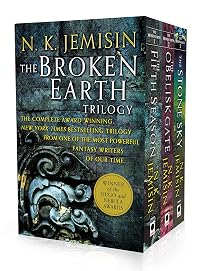
The Broken Earth Trilogy: The Fifth Season, The Obelisk Gate, The Stone Sky
by N. K. Jemisin 
The Broken Earth (Collections and Selections — 1-3)
On This Page
Description
[Volume 1: The fifth season] : Three terrible things happen in a single day. Essun, masquerading as an ordinary schoolteacher in a quiet small town, comes home to find that her husband has brutally murdered their son and kidnapped their daughter. Mighty Sanze, the empire whose innovations have been civilization's bedrock for a thousand years, collapses as its greatest city is destroyed by a madman's vengeance. And worst of all, across the heartland of the world's sole continent, a great red show more rift has been torn which spews ash enough to darken the sky for years. Or centuries. But this is the Stillness, a land long familiar with struggle, and where orogenes--those who wield the power of the earth as a weapon--are feared far more than the long cold night. Essun has remembered herself, and she will have her daughter back. She does not care if the world falls apart around her. Essun will break it herself, if she must, to save her daughter. [Volume 2: The obelisk gate] : The season of endings grows darker as civilization fades into the long cold night. Alabaster Tenring -- madman, world-crusher, savior -- has returned with a mission: to train his successor, Essun, and thus seal the fate of the Stillness forever. It continues with a lost daughter, found by the enemy. It continues with the obelisks, and an ancient mystery converging on answers at last. The Stillness is the wall which stands against the flow of tradition, the spark of hope long buried under the thickening ashfall. And it will not be broken. [Volume 3: The stone sky] : THIS IS THE WAY THE WORLD ENDS... FOR THE LAST TIME. The Moon will soon return. Whether this heralds the destruction of humankind or something worse will depend on two women. Essun has inherited the power of Alabaster Tenring. With it, she hopes to find her daughter Nassun and forge a world in which every orogene child can grow up safe. For Nassun, her mother's mastery of the Obelisk Gate comes too late. She has seen the evil of the world, and accepted what her mother will not admit: that sometimes what is corrupt cannot be cleansed, only destroyed. The remarkable conclusion to the post-apocalyptic and highly acclaimed trilogy that began with the multi-award-nominated The Fifth Season. show lessTags
Recommendations



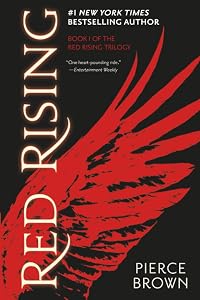
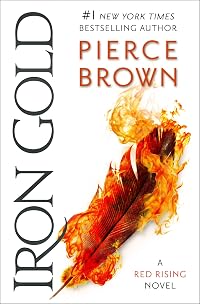
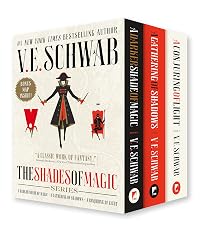
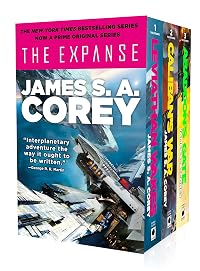
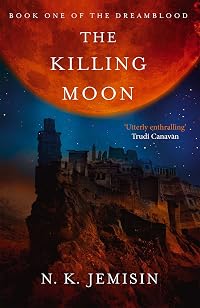

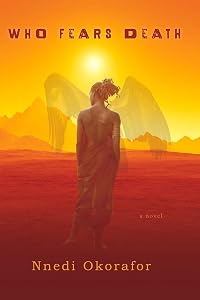
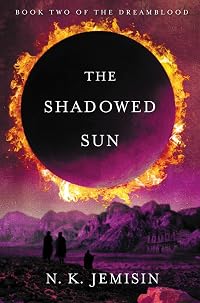
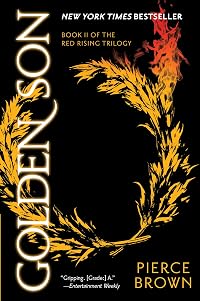
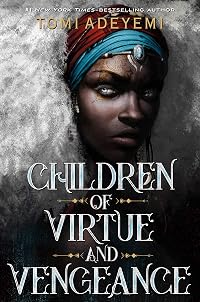
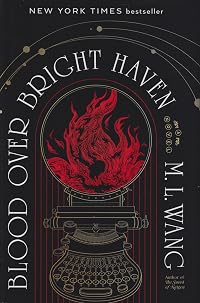
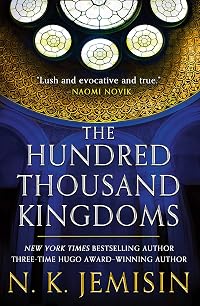
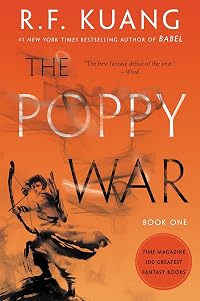
Member Recommendations
Member Reviews
The Fifth Season: a solid first entry in a trilogy, nominally science fiction rather than fantasy, but that depends on how you classify "Dying Earth" stories. Like other novels in this category from Clark Ashton Smith through Jack Vance and beyond, all traces of our history are long gone in this far future, slowly dying planet. A certain group of humans are born with orogeny, the power to cause or stop earthquakes, and other manipulations of energy. Because the earth is weakened -- or enraged? -- it is prone to frequent cataclysms, and so orogenes are necessary to preserve civilization. But such power is terrifying so orogenes are also feared and oppressed. The nasty name for them is rogga. The double-G and the way people react to the show more term make it clear that it is an analog for another double-G epithet. The novel follows a young orogene just learning her powers, a young adult orogene being trained to control them, and an older orogene who has tried to hide her powers. The novel starts with the end of the world -- most specifically, a male orogene ripping the earth asunder with such power that the the side effects will cause a winter -- a fifth season -- that will last thousands of year.
The Obelisk Gate: Unlike many trilogies, there is no middle-book sag with the Obelisk Gate. This book introduces a number of new characters, some of whom have been off-stage in one form or another. We finally find out what has happened to Nassun, the kidnapped daughter of Essun. We meet Hoa, the strange child whose actual nature is only gradually revealed. This is also the book that introduces the real reasons why Earth is falling apart, with global catastrophes every 100 years or so. We also see some characters return in very different form. We also learn that the 2nd person perspective used for tracking one character in the first novel was not a stylistic touch, but an important aspect of the plot. Despite all this, the book remains refreshingly free of info-dumps. Flashbacks and other forms are used to explain what's gong on. I have two disappointments. The second book is even more fantasy than science than the first, but it share one feature with modern space opera that has always annoyed me: casual destruction of large populations.
The Stone Sky: For me, the third book is the least interesting for several reasons. It's basically two fairly linear quest story lines, plus an extended flashback. The three primary characters are the ones we already know well from the second book. We know where everything is headed. When the final conflict comes, it has the usual problem such big set pieces have --- a lot of description of massive forces operating at some impossible to describe level, with no real tension, because there is no solid foundation for the reader to predict and be surprised. The book is saved somewhat by its well-integrated themes of racial injustice, parenting, and communal responsibility. It's an OK conclusion.
Since all three volumes won a Hugo, my recommendation makes no difference. But I do recommend it. If it didn't amaze me as groundbreaking, it is a very good trilogy, with a lot to say, and all of it well-said. show less
The Obelisk Gate: Unlike many trilogies, there is no middle-book sag with the Obelisk Gate. This book introduces a number of new characters, some of whom have been off-stage in one form or another. We finally find out what has happened to Nassun, the kidnapped daughter of Essun. We meet Hoa, the strange child whose actual nature is only gradually revealed. This is also the book that introduces the real reasons why Earth is falling apart, with global catastrophes every 100 years or so. We also see some characters return in very different form. We also learn that the 2nd person perspective used for tracking one character in the first novel was not a stylistic touch, but an important aspect of the plot. Despite all this, the book remains refreshingly free of info-dumps. Flashbacks and other forms are used to explain what's gong on. I have two disappointments. The second book is even more fantasy than science than the first, but it share one feature with modern space opera that has always annoyed me: casual destruction of large populations.
The Stone Sky: For me, the third book is the least interesting for several reasons. It's basically two fairly linear quest story lines, plus an extended flashback. The three primary characters are the ones we already know well from the second book. We know where everything is headed. When the final conflict comes, it has the usual problem such big set pieces have --- a lot of description of massive forces operating at some impossible to describe level, with no real tension, because there is no solid foundation for the reader to predict and be surprised. The book is saved somewhat by its well-integrated themes of racial injustice, parenting, and communal responsibility. It's an OK conclusion.
Since all three volumes won a Hugo, my recommendation makes no difference. But I do recommend it. If it didn't amaze me as groundbreaking, it is a very good trilogy, with a lot to say, and all of it well-said. show less
Not a fan. I would have stopped reading by age 24 except that a friend of mine had recommended the series and wanted to discuss the books with me.
The world building and characters were interesting, but I just couldn't get past the third-person and second-person present tense used in the books. It meant a lot of characters were telling things and not showing. I found the literary devices pretentious. It constantly pulled me out of the story by making me pay attention to how the book was written and not what the book was about.
I can see why it won a Hugo because of its themes of hate and slavery, and the exceptional world-building. But frankly, I would prefer to spend my time reading something else.
The story plods, clues are given out in show more dribs and drabs. I figured things out long before the characters did in many instances.
I never felt a connection to any of the characters. I found the writing distanced me from them rather than pulling me in.
This book was a great disappointment. show less
The world building and characters were interesting, but I just couldn't get past the third-person and second-person present tense used in the books. It meant a lot of characters were telling things and not showing. I found the literary devices pretentious. It constantly pulled me out of the story by making me pay attention to how the book was written and not what the book was about.
I can see why it won a Hugo because of its themes of hate and slavery, and the exceptional world-building. But frankly, I would prefer to spend my time reading something else.
The story plods, clues are given out in show more dribs and drabs. I figured things out long before the characters did in many instances.
I never felt a connection to any of the characters. I found the writing distanced me from them rather than pulling me in.
This book was a great disappointment. show less
After a long absence from reading fiction due to the same stuff being told over and over I picked up these amazing books. They have restored my faith in the human race. Bloody Brilliant! N.K.Jemisin is a master story teller with characters that will break your heart while giving you hope. I had to go and buy everything she has written. Please do the same.
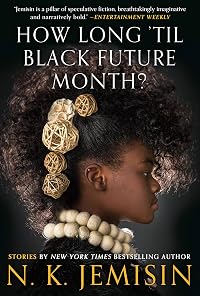
Over-hyped by its fan base. There were wa-a-a-ay too many characters, losing focus on the major ones; and the "magic" just got too confusing. Still, I've got Jemisin's story anthology How Long 'til Black Future Month? on TBR and I'll definitely be getting around to it.
Great world, I loved the characters
Ratings
Members
- Recently Added By
Lists

Favorite Science Fiction by Women Authors
737 works; 196 members

Must-Read Books by Black Authors
114 works; 92 members

Top Five Books of 2020
982 works; 350 members

Recommended Nature Writing
346 works; 180 members

Book Worlds We'd Like To Visit
322 works; 158 members

Books We Want To Read Again For The First Time
384 works; 160 members

Favorite Science Fiction
456 works; 218 members

Illumicrates 100 Best Sci-Fi, Fantasy & Horror Books of the 21st Century
27 works; 1 member
Author Information

68+ Works 45,411 Members
N. K. Jemisin is an American author and blogger, born in 1972, and based in Brooklyn, New York. She earned a B.S. in Psychology from Tulane University and her Masters of Education from the University of Maryland College Park. Her work includes numerous short stories, a novella, a triptych, The Inheritance trilogy, Dreamblood series, and The Broken show more Earth trilogy. The Fifth Season is a book in The Inheritance trilogy for which she won the 2016 Hugo Award for Best Novel. Her other awards include Romantic Times Reviewers' Choice, Fantasy (for The Shadowed Sun); Sense of Gender Award, 2011 (for The Hundred Thousand Kingdoms, Japanese version); Romantic Times Reviewers' Choice, Fantasy (for The Broken Kingdoms); and the Locus Award, 2010 (First Novel, for The Hundred Thousand Kingdoms). She won the 2017 Nebula Award and the 2018 Hugo Award, Best Novel category for The Stone Sky. (Bowker Author Biography) show less
N. K. Jemisin is a LibraryThing Author, an author who lists their personal library on LibraryThing.
Awards and Honors
Series

Work Relationships
Common Knowledge
- Original publication date
- 2015-2017
Classifications
Statistics
- Members
- 568
- Popularity
- 51,954
- Reviews
- 5
- Rating
- (4.36)
- Languages
- English
- Media
- Paper, Ebook
- ISBNs
- 7
- ASINs
- 2