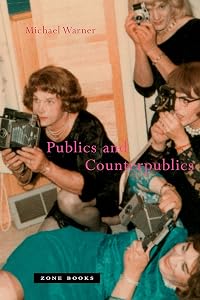
Publics and Counterpublics
by Michael Warner
On This Page
Description
"By combining historical analysis, theoretical reflection, and extended case studies, Publics and Counterpublics shows how the idea of a public works as a formal device in modern culture and traces its implications for contemporary life. Michael Warner offers a revisionist account at the junction of two intellectual traditions with which he has been associated: public-sphere theory and queer theory. To public-sphere theory, this book brings a new emphasis on cultural forms, and a new focus show more on the dynamics of counterpublics. To queer theory, it brings a new way of seeing how queer culture (among other examples) is shaped by the counter-public environment."--Jacket. show lessTags
Recommendations










































Member Reviews
In Publics and Counterpublics (2002), Michael Warner explains that the public/private distinction is a complex set of dichotomies (15 separate senses of opposition, he claims, with 3 senses of private with no corresponding sense of public) (29-30). Liberal thought, he explains, claimed the private as positive, no longer a sense of privation, as Arendt sees it, but as a sense common to all people who have rights as private beings (39).
From his essay "Publics and Counterpublics" (summary from my thesis):
In “Publics and Counterpublics,” Michael Warner makes distinctions between three uses of the word public, concepts that we often conflate when we evoke the term: 1) the public, “a kind of social totality” such as a nation; 2) “a show more concrete audience, a crowd witnessing itself in visible space, as with a theatrical public”; and 3) the concept that interests Warner the most in his essay, “the kind of public that comes into being only in relation to texts and their circulation” (49, 50). This third kind of public, different from the public as a totality and a specific audience bound to an event, is commonly evoked and understood, but its rules are never explained. Warner sets out to explain these “rather odd” rules of publics: a public 1) “is self-organized,” “exist[ing:] by virtue of being addressed”; 2) “is a relation among strangers”; 3) is addressed in both personal and impersonal terms; 4) “is constituted through mere attention”; 5) “is the social space created by the reflexive circulation of discourse”; 6) “act[s:] historically according to the temporality of their [texts’:] circulation”; and 7) “is poetic world-making” (50, 55, 57, 60, 62, 68, 82, emphasis original). Warner believes that counterpublics act in the same way, except, “counterpublic discourse also addresses those strangers as not just anybody. Addresses are socially marked by their participation in this kind of discourse; ordinary people are presumed to not want to be mistaken for the kind of person who would participate in this kind of talk or be present in this kind of scene” (86). Also, as I have noted in the previous interchapter, Warner insists that a counterpublic does not have to be subaltern, as Fraser describes them, but can be understood as “a scene for developing oppositional nterpretations of its members’ identities, interests, and needs” (86). Counterpublics also have an awareness at some level, whether conscious or not, of their subordinate status to dominant culture (86). show less
From his essay "Publics and Counterpublics" (summary from my thesis):
In “Publics and Counterpublics,” Michael Warner makes distinctions between three uses of the word public, concepts that we often conflate when we evoke the term: 1) the public, “a kind of social totality” such as a nation; 2) “a show more concrete audience, a crowd witnessing itself in visible space, as with a theatrical public”; and 3) the concept that interests Warner the most in his essay, “the kind of public that comes into being only in relation to texts and their circulation” (49, 50). This third kind of public, different from the public as a totality and a specific audience bound to an event, is commonly evoked and understood, but its rules are never explained. Warner sets out to explain these “rather odd” rules of publics: a public 1) “is self-organized,” “exist[ing:] by virtue of being addressed”; 2) “is a relation among strangers”; 3) is addressed in both personal and impersonal terms; 4) “is constituted through mere attention”; 5) “is the social space created by the reflexive circulation of discourse”; 6) “act[s:] historically according to the temporality of their [texts’:] circulation”; and 7) “is poetic world-making” (50, 55, 57, 60, 62, 68, 82, emphasis original). Warner believes that counterpublics act in the same way, except, “counterpublic discourse also addresses those strangers as not just anybody. Addresses are socially marked by their participation in this kind of discourse; ordinary people are presumed to not want to be mistaken for the kind of person who would participate in this kind of talk or be present in this kind of scene” (86). Also, as I have noted in the previous interchapter, Warner insists that a counterpublic does not have to be subaltern, as Fraser describes them, but can be understood as “a scene for developing oppositional nterpretations of its members’ identities, interests, and needs” (86). Counterpublics also have an awareness at some level, whether conscious or not, of their subordinate status to dominant culture (86). show less
Ratings
Members
- Recently Added By
Author Information

7+ Works 1,494 Members
Classifications
- Genres
- Sociology, Nonfiction, Anthropology, Sexuality and Gender Studies, Philosophy, General Nonfiction, LGBTQ+, Literature Studies and Criticism, Politics and Government
- DDC/MDS
- 301 — Society, government, & culture Social sciences, sociology & anthropology Sociology and anthropology
- LCC
- HM706 .W37 — Social sciences Sociology (General) Sociology Social structure
- BISAC
Statistics
- Members
- 240
- Popularity
- 135,389
- Reviews
- 1
- Rating
- (3.82)
- Languages
- English, Spanish
- Media
- Paper, Ebook
- ISBNs
- 4