On This Page
Description
In an isolated hut not far from the sleepy country town of Merino, stockman George Kendall is found dead and it looks very much like murder. Six weeks later, when the murderer is still at large, another stockman turns up in the township and, as a first move, provokes the local sergeant to lock him up. This particular stockman is Detective-Inspector Napoleon Bonaparte, and there's method in his seeming madness. While serving a semi-detention sentence and being made to paint the police show more station, he wears the best of all possible disguises for a policeman on the trail of a ruthless and single-minded killer. show lessTags
Recommendations
















Member Reviews
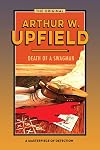
'Death Of A Swagman' is an Australian Golden Age Mystery first published in 1945. The publishers felt the need to preface the book with this text:
Editorial Note
Part of the appeal of Arthur Upfield's stories lies in their authentic portrayal of many aspects of Outback Australian life in the 1930s and through into the 1950s, The dialogue especially, is a faithful evocation of how people spoke. Hence these books reflect and depict the attitudes and ways of speech, particularly with regard to Aborigines and to women, which were then commonplace. In reproducing these books, the publisher does not endorse the attitudes or opinions they express.
Having read the book, I can see why they did this. The gap between this and a modern drama like show more 'Mystery Road' is immense.
For example, the start of the story depends on the fact that, because Napoleon Bonaparte is, in his words, a half-caste, no one meeting him for the first time would assume that he was a police officer. Arriving in town incognito, he manages to get the local police sergeant to arrest him simply by sleeping on a bench during the day and by telling the sergeant to go away when the man wakes him. Throughout the book, Bonaparte's 'mixed blood' is used as the key to his personality. His unusual abilities are explained as coming from the amalgamation of the rational, educated, dispassion gifted him by his white side and his ability to feel the call of the bush and to read the signs upon it like words on a page that comes from his aboriginal blood which has apparently made his an expert tracker although, as he says, "Not as good as a full black".
I'm glad that Bolinda Publishing decided to deal with this by adding an editorial note and leaving the reader to deal with the text rather than taking the bowdlerisation approach that HarperCollins has currently proposed for Agatha Christie's books I think it serves us well to see the attitudes and behaviours that were taken for granted only seventy-eight years ago. How else do we judge the changes made in a lifetime?
I enjoyed 'Death Of A Swagman' mostly for the slightly humorous and eccentric view it gave me of life in a small town in the bush in 1945. The town of Merino is a long way from Miss Marple's St. Mary Mead. The Police Sergeant based there rules over a region of 9,000 square miles and 120 people. The one-street town is surrounded by cattle stations and dominated by the massive white sand dunes of the Walls Of China in what is now the Mungo National Park.
I enjoyed the window into this different world. The scene with the funeral and the race ahead of the storm that followed it was beautifully done. The dialogue, with the exception of the words spoken by Bonaparte himself, was evocative and convincing.
I struggled with Bonaparte at first, He didn't seem real to me. He seems to me to be a literary construct, like Sherlock Holmes. Someone who is more a plot device than a person. He's interesting to watch but hard to believe in, something that Upfield compensates for by surrounding him with recognisable, relatable people. Well, actually, it's really recognisable, relatable men. The women are all a little too sanitised to be relatable.
The attitudes towards women and children and this book caught me by surprise. They were romanticised in a way that reminded me of Dickens and Twain from nearly a century earlier.
The plot held me for most of the book. I enjoyed watching Bonaparte investigate in a leisurely way. The action scenes worked well and the abduction of a key character towards the end added a satisfying amount of tension. Unfortunately, when we reached the big reveal, the motive behind the whole elaborate scheme required a suspension of disbelief that I wasn't capable of. It made no sense to me and I couldn't see why anyone else would give it credence. The way the killer reacted after being confronted also seemed very unlikely.
I'm glad to have sampled Arthur Upfield's work but I don't think I'll travel any further in the company of Detective Inspector Napoleon Bonaparte. show less
Editorial Note
Part of the appeal of Arthur Upfield's stories lies in their authentic portrayal of many aspects of Outback Australian life in the 1930s and through into the 1950s, The dialogue especially, is a faithful evocation of how people spoke. Hence these books reflect and depict the attitudes and ways of speech, particularly with regard to Aborigines and to women, which were then commonplace. In reproducing these books, the publisher does not endorse the attitudes or opinions they express.
Having read the book, I can see why they did this. The gap between this and a modern drama like show more 'Mystery Road' is immense.
For example, the start of the story depends on the fact that, because Napoleon Bonaparte is, in his words, a half-caste, no one meeting him for the first time would assume that he was a police officer. Arriving in town incognito, he manages to get the local police sergeant to arrest him simply by sleeping on a bench during the day and by telling the sergeant to go away when the man wakes him. Throughout the book, Bonaparte's 'mixed blood' is used as the key to his personality. His unusual abilities are explained as coming from the amalgamation of the rational, educated, dispassion gifted him by his white side and his ability to feel the call of the bush and to read the signs upon it like words on a page that comes from his aboriginal blood which has apparently made his an expert tracker although, as he says, "Not as good as a full black".
I'm glad that Bolinda Publishing decided to deal with this by adding an editorial note and leaving the reader to deal with the text rather than taking the bowdlerisation approach that HarperCollins has currently proposed for Agatha Christie's books I think it serves us well to see the attitudes and behaviours that were taken for granted only seventy-eight years ago. How else do we judge the changes made in a lifetime?
I enjoyed 'Death Of A Swagman' mostly for the slightly humorous and eccentric view it gave me of life in a small town in the bush in 1945. The town of Merino is a long way from Miss Marple's St. Mary Mead. The Police Sergeant based there rules over a region of 9,000 square miles and 120 people. The one-street town is surrounded by cattle stations and dominated by the massive white sand dunes of the Walls Of China in what is now the Mungo National Park.
I enjoyed the window into this different world. The scene with the funeral and the race ahead of the storm that followed it was beautifully done. The dialogue, with the exception of the words spoken by Bonaparte himself, was evocative and convincing.
I struggled with Bonaparte at first, He didn't seem real to me. He seems to me to be a literary construct, like Sherlock Holmes. Someone who is more a plot device than a person. He's interesting to watch but hard to believe in, something that Upfield compensates for by surrounding him with recognisable, relatable people. Well, actually, it's really recognisable, relatable men. The women are all a little too sanitised to be relatable.
The attitudes towards women and children and this book caught me by surprise. They were romanticised in a way that reminded me of Dickens and Twain from nearly a century earlier.
The plot held me for most of the book. I enjoyed watching Bonaparte investigate in a leisurely way. The action scenes worked well and the abduction of a key character towards the end added a satisfying amount of tension. Unfortunately, when we reached the big reveal, the motive behind the whole elaborate scheme required a suspension of disbelief that I wasn't capable of. It made no sense to me and I couldn't see why anyone else would give it credence. The way the killer reacted after being confronted also seemed very unlikely.
I'm glad to have sampled Arthur Upfield's work but I don't think I'll travel any further in the company of Detective Inspector Napoleon Bonaparte. show less
Inspector Napoleon "Bony" Bonaparte arrives in the tiny outpost of Merino as he usually enters these stories: Undercover as a half-caste itinerant "swagman" or itinerant worker. He contrives to get himself arrested as prelude to confiding his true identity to the local police sergeant, telling him he has arrived to investigate the recent murder of a local stockman.
Bony's usual method is to wander around talking to everyone, taking their measure and looking for the deadly "sting-ray" among the human fish he collects in his net. As he says, referencing an earlier book in the series, "It is not very exciting work. It is not comparable, for instance, to angling for swordfish." There aren't many fish for Bony to sweep up in his net, with a show more population of 120 people scattered over a 9,000-square mile region, but it still takes time to pinpoint the culprit.
The mystery itself is a cut above the average in this series, except for the ultimate motivation of the killer. Bony's whimsical relationship with the police sergeant's young daughter is charming. And as always, Upfield paints a picture of the Australian outback that makes me feel as if I've been there. Here it's a geological feature called the Walls of China, a great sand dune formed long ago by the action of the ever-present wind.
A solid entry in a solid series. show less
Bony's usual method is to wander around talking to everyone, taking their measure and looking for the deadly "sting-ray" among the human fish he collects in his net. As he says, referencing an earlier book in the series, "It is not very exciting work. It is not comparable, for instance, to angling for swordfish." There aren't many fish for Bony to sweep up in his net, with a show more population of 120 people scattered over a 9,000-square mile region, but it still takes time to pinpoint the culprit.
The mystery itself is a cut above the average in this series, except for the ultimate motivation of the killer. Bony's whimsical relationship with the police sergeant's young daughter is charming. And as always, Upfield paints a picture of the Australian outback that makes me feel as if I've been there. Here it's a geological feature called the Walls of China, a great sand dune formed long ago by the action of the ever-present wind.
A solid entry in a solid series. show less
DEATH OF A SWAGMAN is Upfield’s ninth novel to feature half Aboriginal, half European police inspector Napoleon ‘Bony’ Bonaparte. In this installment Bony has inveigled himself into the investigation of a death in rural New South Wales after having recognised a possible clue in a photo of the death scene. It is nearly two months since the stockman, George Kendall, was found dead but even so Bony slides into the case in a sideways move rather than hurrying to sort things out. He arrives in town with no fanfare and in something of a disguise so that he can get himself arrested and have an excuse to stay in town to question and observe the locals without them being wary of his official, and somewhat famous, status.
As always, Upfield show more depicts his chosen setting with rich imagery. On this occasion we travel to a small town in the south west part of New South Wales where the most notable natural feature is the nearby Walls of China, ancient, wind-formed sand dunes that stand out due to both their age and height in the otherwise flat landscape. The place where the body was discovered is described forcefully
…the hut faced toward the east across three miles of open country falling gently to the foot of the Walls of China. Here and there were giant red claypans, hard as cement and separated by narrow ridges of loose sand. Old man saltbush were scattered about the scene, and widely spaced water gutters, now dry, zigzagged slightly to the northeast to join a dry creek bordered by box trees.
Even if I hadn’t been there on what seemed like a fairly dull school trip I would be able to picture the place.
Less usually this book also has some quite deep character development and displays a lot less of the casual bigotry towards Bony than is standard for the series. Whether they know him to be a policeman or believe him to be a vaguely shady stockman (having been arrested after all) Bony is treated with warmth by most of the townsfolk. Of course that’s as it should be but this is 1945 and it isn’t always the case for Bony. Just as he is accepted by the townsfolk he quickly grows to like them too, especially the young daughter of the town’s police Sergeant. Rose Marie is a clever and engaging little girl and her conversations with Bony are a highlight of the novel.
The story is more standard for the series in that it relies heavily on Bony’s skills as a bush tracker as well as his deductive reasoning to move things along. It starts out fairly slowly but its ending is dramatic as the novel’s cutest character is in peril which worries Bony and the reader in equal measure. The resolution is well enough reasoned but is nothing short of peculiar, at least with respect to the motive it supplies for the killer, and I think falls into the “each whodunit has to have a more bizarre puzzle than the last” trap.
One of the things that identifies DEATH OF A SWAGMAN as belonging at least to a different era if not the actual year 1945 is the amount of smoking that takes place. Eh gads it’s continuous!. But one thing I noticed by its absence was any discussion of the war. If there were any returned soldiers or war widows or elements of that nature mention must have been rapid because they entirely passed me by which does strike me as unusual for a book published in 1945. Or perhaps it is only distance that has assigned that period only one significant event?
Overall though I found this a thoroughly entertaining read and I’d recommend it as a great introduction to the Bony series if you’ve never tried it before. If you happen to be a fan of audio books the narration by local actor Peter Hosking is a delight: really bringing to life Upfield’s authentic contemporary dialogue. show less
As always, Upfield show more depicts his chosen setting with rich imagery. On this occasion we travel to a small town in the south west part of New South Wales where the most notable natural feature is the nearby Walls of China, ancient, wind-formed sand dunes that stand out due to both their age and height in the otherwise flat landscape. The place where the body was discovered is described forcefully
…the hut faced toward the east across three miles of open country falling gently to the foot of the Walls of China. Here and there were giant red claypans, hard as cement and separated by narrow ridges of loose sand. Old man saltbush were scattered about the scene, and widely spaced water gutters, now dry, zigzagged slightly to the northeast to join a dry creek bordered by box trees.
Even if I hadn’t been there on what seemed like a fairly dull school trip I would be able to picture the place.
Less usually this book also has some quite deep character development and displays a lot less of the casual bigotry towards Bony than is standard for the series. Whether they know him to be a policeman or believe him to be a vaguely shady stockman (having been arrested after all) Bony is treated with warmth by most of the townsfolk. Of course that’s as it should be but this is 1945 and it isn’t always the case for Bony. Just as he is accepted by the townsfolk he quickly grows to like them too, especially the young daughter of the town’s police Sergeant. Rose Marie is a clever and engaging little girl and her conversations with Bony are a highlight of the novel.
The story is more standard for the series in that it relies heavily on Bony’s skills as a bush tracker as well as his deductive reasoning to move things along. It starts out fairly slowly but its ending is dramatic as the novel’s cutest character is in peril which worries Bony and the reader in equal measure. The resolution is well enough reasoned but is nothing short of peculiar, at least with respect to the motive it supplies for the killer, and I think falls into the “each whodunit has to have a more bizarre puzzle than the last” trap.
One of the things that identifies DEATH OF A SWAGMAN as belonging at least to a different era if not the actual year 1945 is the amount of smoking that takes place. Eh gads it’s continuous!. But one thing I noticed by its absence was any discussion of the war. If there were any returned soldiers or war widows or elements of that nature mention must have been rapid because they entirely passed me by which does strike me as unusual for a book published in 1945. Or perhaps it is only distance that has assigned that period only one significant event?
Overall though I found this a thoroughly entertaining read and I’d recommend it as a great introduction to the Bony series if you’ve never tried it before. If you happen to be a fan of audio books the narration by local actor Peter Hosking is a delight: really bringing to life Upfield’s authentic contemporary dialogue. show less
Before finding the novel, I found a non-fiction article in a newspaper written by Upfield, where he is describing "The Walls of China" -- drawn by the headline oxymoron, I loved his portrayal. The piece mentioned that it was the setting for one of his mysteries, and that it was serialized in a newspaper. This was my first Upfield book, and I came to the story not knowing Upfield's well developed back-story for his detective. I loved the characters, the procedures, the easy way he can gracefully paint a million dollar portrait of an essentially 'barren" desert. His descriptions are as eloquent as some of the more famous USA writers describing the Southwest deserts. As a mystery, it is a bit slow, but for a non-Australian, it gives you show more time to adjust to the different seasons, weather patterns, cultures -- both European and Aboriginal. I'll be reading more of his works from the Australian Library digital files. show less
The editorial note at the front of the book will be of interest:
"Part of the appeal of Arthur Upfield's stories lies in their authentic portrayal of many aspects of outback Australian life in the 1930s and into the 1950s. The dialogue, especially, is a faithful evocation of how people spoke. Hence, these books reflect and depict the attitudes and ways of speech, particularly with regard to Aborigines and to women, which were then commonplace. In reprinting these books the publisher does not endorse the attitudes or opinions they express."
There is considerable similarity between Bony and his contemporary Hercule Poirot. Both emphasise the importance of observation in their methods of detection. In this book Bony is able to move freely show more among the people of the town of Merino because his real identity is kept secret. He collects information, and checks alibis, without those he is checking suspecting.
The other similarity with Poirot lies in his confidence that he will solve the crime in the end. He does not take on cases that will not provide a challenge and treats all the evidence as puzzle to be correctly assembled.
In the 1930s Bony would have been a conundrum is Australian society: an Aboriginal half caste, with a better education than 99% of the population.
I think the writing comes across as a little dated until the reader becomes immersed in the puzzle Bony is solving. One interesting aspect of this novel are the coded messages itinerant swagmen are leaving in shearing sheds and at station gates. They look like noughts and crosses puzzles but contain information about how the cook and manager of the place will treat a swaggie. And of course, set at the beginning of the Depression, swaggies looking for work are common in the outback.
An interesting read for those who have not met this author before. show less
"Part of the appeal of Arthur Upfield's stories lies in their authentic portrayal of many aspects of outback Australian life in the 1930s and into the 1950s. The dialogue, especially, is a faithful evocation of how people spoke. Hence, these books reflect and depict the attitudes and ways of speech, particularly with regard to Aborigines and to women, which were then commonplace. In reprinting these books the publisher does not endorse the attitudes or opinions they express."
There is considerable similarity between Bony and his contemporary Hercule Poirot. Both emphasise the importance of observation in their methods of detection. In this book Bony is able to move freely show more among the people of the town of Merino because his real identity is kept secret. He collects information, and checks alibis, without those he is checking suspecting.
The other similarity with Poirot lies in his confidence that he will solve the crime in the end. He does not take on cases that will not provide a challenge and treats all the evidence as puzzle to be correctly assembled.
In the 1930s Bony would have been a conundrum is Australian society: an Aboriginal half caste, with a better education than 99% of the population.
I think the writing comes across as a little dated until the reader becomes immersed in the puzzle Bony is solving. One interesting aspect of this novel are the coded messages itinerant swagmen are leaving in shearing sheds and at station gates. They look like noughts and crosses puzzles but contain information about how the cook and manager of the place will treat a swaggie. And of course, set at the beginning of the Depression, swaggies looking for work are common in the outback.
An interesting read for those who have not met this author before. show less
Death of a Swagman is the 9th of Arthur Upfield’s Inspector Bonaparte Mysteries. A swagman is found dead in a pool of blood in a hut near the Riverina town of Merino. Bony only sees a photo of the hut but is convinced the man did not die there, and is intrigued enough to take the case. He arrives in town incognito, gets himself arrested and, as well as painting the Police Station fence a sickly yellow, he investigates as only Bony can. During the course of the investigation, he befriends the Police Sergeant’s young daughter, and, at one point, momentarily doubts his usually infallible approach to crime detection. Bony pontificates several times about the difference between city crime solving and bush police work. As often happens in show more small towns, people may have more than one profession: to wit the wheelright who is also the funeral director, coroner and magistrate. And a secret noughts-and-crosses code for swagmen: who’d have thought? A few twists before Bony solves the case. It may be from 1945, but it’s still a great read. show less
Bony solves murders of stockmen in outback. Murderer had become fixated on self hypnosis by windmill and killed to assure access to a windmill
Members
- Recently Added By
Author Information

56+ Works 6,464 Members
Author Arthur W. Upfield was born in Gosport, Hampshire, England on September 1, 1890. He moved to Australia and adopted it as his homeland. He is best known for his series of books featuring Detective Inspector Napoleon "Bony" Bonaparte of the Queensland State Police. He died on February 13, 1964. (Bowker Author Biography)
Series

Belongs to Publisher Series
Doubleday Crime Club (1945.41)
Work Relationships
Common Knowledge
- Canonical title
- Death of a Swagman
- Original title
- Death of a swagman
- Original publication date
- 1945
- People/Characters
- Napoleon 'Bony' Bonaparte (Detective Inspector); Sergeant Marshall; Rose Marie Marshall; Constable Gleeson
- Important places
- Lake Mungo, New South Wales, Australia; The Walls of China, New South Wales, Australia
- First words
- No gangs of yellow men carrying earth and rubble in baskets, no human chains of men and women, and even children carrying stones in their lacerated arms, built these Walls of China.
- Last words
- (Click to show. Warning: May contain spoilers.)"Mrs Llewellyn James."
Classifications
Statistics
- Members
- 249
- Popularity
- 130,274
- Reviews
- 10
- Rating
- (3.71)
- Languages
- English, French, German
- Media
- Paper, Audiobook, Ebook
- ISBNs
- 28
- ASINs
- 11