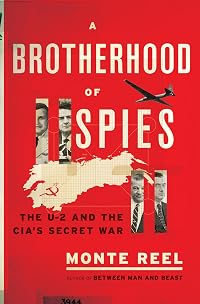
A Brotherhood of Spies: The U-2 and the CIA's Secret War
by Monte Reel
On This Page
Description
On May 1, 1960, an American U-2 spy plane was shot down over the Soviet Union just weeks before a peace summit between the two nations. The CIA concocted a cover story for President Eisenhower to deliver, assuring him that no one could have survived a fall from that altitude. And even if pilot Francis Gary Powers had survived, he had been supplied with a poison pin with which to commit suicide. But against all odds, Powers emerged from the wreckage and was seized by the KGB. He confessed to show more espionage charges, revealing to the world that Eisenhower had just lied to the American people--and to the Soviet Premier. Infuriated, Nikita Khrushchev slammed the door on a rare opening in Cold War relations. In A Brotherhood of Spies, award-winning journalist Monte Reel reveals how the U-2 spy program, principally devised by four men working in secret, upended the Cold War and carved a new mission for the CIA. This secret fraternity, made up of Edwin Land, best known as the inventor of instant photography and the head of Polaroid Corporation; Kelly Johnson, a hard-charging taskmaster from Lockheed; Richard Bissell, the secretive and ambitious spymaster; and ace Air Force flyer Powers, set out to replace yesterday's fallible human spies with tomorrow's undetectable eye in the sky. Their clandestine successes and all-too-public failures make this brilliantly reported account a true-life thriller with the highest stakes and tragic repercussions. show lessTags
Recommendations


Member Reviews
This is a fascinating and very readable account of the events surrounding the U-2 spy plane. Focusing mainly on four important characters, Monte Reel shows how the U.S. entered the world of spy-craft during an intense period of the Cold War.
In the mid 1950s, there was great concern over the perceived "missile-gap." It was believed that the USSR had developed far more nuclear missiles than the US and that America was at imminent risk. (It must be remembered that many at the time expected nuclear weapons would certainly be used.) The problem was that there was little evidence or knowledge of the actual state of things in the Soviet Union, and America didn't have a knowledgeable spy network. Instead of developing a human system of show more informants (which would have taken a lot of time), a technological solution was devised.
Edwin Land, the inventor of the Polaroid camera, was enlisted to develop a camera that could produce detailed photos from a great altitude, and Kelly Johnson of Lockheed came up with a very unconventional plane that would fly above 70,000 feet. Richard Bissell of the CIA was charged with overseeing the operation, which was kept out of the military to avoid the appearance of an overt act of war. It was believed that the U-2 would fly so high that it wouldn't be detected by Soviet radar.
Unfortunately, the U-2 was detected on its very first flight. And while Soviet fighter jets couldn't fly high enough to shoot them down, Nikita Khrushchev saw the invasion of Soviet airspace as an act of war. But the information gathered by the U-2 flights turned out to be a goldmine of information for the U.S. until May 1, 1960, when U-2 pilot Francis Gary Powers was shot down over the USSR. It was believed that neither the pilot nor the plane would survive from such a height, but Powers survived relatively unhurt and many incriminating parts of the plane were recovered.
As I said before, this is a very fascinating account. I came away with an appreciation for not only the men who built and flew the U-2 (even though some of them weren't always very noble), but a better understanding of some of the pressures the leaders of both countries faced. And I especially gained a greater appreciation for the plane itself. Several years ago I saw one at an airshow at Edwards AFB (next to an SR-71 Blackbird in fact) and was stunned at what a weird-looking plane it was (both of them, actually). This is a book I highly recommend for those who enjoy reading about the Cold War. (I rec'd an advance copy of the book through Amazon Vine.) show less
In the mid 1950s, there was great concern over the perceived "missile-gap." It was believed that the USSR had developed far more nuclear missiles than the US and that America was at imminent risk. (It must be remembered that many at the time expected nuclear weapons would certainly be used.) The problem was that there was little evidence or knowledge of the actual state of things in the Soviet Union, and America didn't have a knowledgeable spy network. Instead of developing a human system of show more informants (which would have taken a lot of time), a technological solution was devised.
Edwin Land, the inventor of the Polaroid camera, was enlisted to develop a camera that could produce detailed photos from a great altitude, and Kelly Johnson of Lockheed came up with a very unconventional plane that would fly above 70,000 feet. Richard Bissell of the CIA was charged with overseeing the operation, which was kept out of the military to avoid the appearance of an overt act of war. It was believed that the U-2 would fly so high that it wouldn't be detected by Soviet radar.
Unfortunately, the U-2 was detected on its very first flight. And while Soviet fighter jets couldn't fly high enough to shoot them down, Nikita Khrushchev saw the invasion of Soviet airspace as an act of war. But the information gathered by the U-2 flights turned out to be a goldmine of information for the U.S. until May 1, 1960, when U-2 pilot Francis Gary Powers was shot down over the USSR. It was believed that neither the pilot nor the plane would survive from such a height, but Powers survived relatively unhurt and many incriminating parts of the plane were recovered.
As I said before, this is a very fascinating account. I came away with an appreciation for not only the men who built and flew the U-2 (even though some of them weren't always very noble), but a better understanding of some of the pressures the leaders of both countries faced. And I especially gained a greater appreciation for the plane itself. Several years ago I saw one at an airshow at Edwards AFB (next to an SR-71 Blackbird in fact) and was stunned at what a weird-looking plane it was (both of them, actually). This is a book I highly recommend for those who enjoy reading about the Cold War. (I rec'd an advance copy of the book through Amazon Vine.) show less
Ratings
Members
- Recently Added By
Lists

Books Read in 2024
4,623 works; 126 members
Author Information

5+ Works 455 Members
Classifications
- Genres
- Nonfiction, History, Politics and Government, General Nonfiction
- DDC/MDS
- 327.1273047 — Society, government, & culture Political science International Relations: Spies Foreign policy and specific topics in international relations Espionage and subversion North America United States
- LCC
- JK468 .I6 .R45 — Political Science Political institutions and public administration (United States) Political institutions and public administration United States Government. Public administration
- BISAC
Statistics
- Members
- 82
- Popularity
- 387,022
- Reviews
- 1
- Rating
- (4.23)
- Languages
- English
- Media
- Paper, Audiobook, Ebook
- ISBNs
- 5
- ASINs
- 2