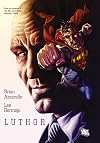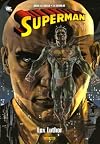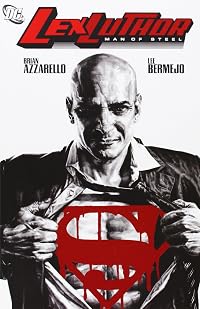
Lex Luthor: Man of Steel
by Brian Azzarello, Lee Bermejo (Illustrator)
Lex Luthor: Man of Steel (Collections and Selections — 1-5)
On This Page
Description
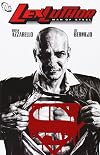
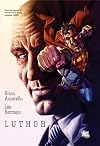
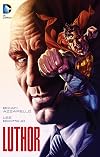
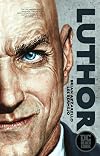
Superman has been called many things, from the defender of truth, justice and the American way to the Big Blue Boy Scout. In Lex Luthor: Man Of Steel, he is called something he has never been called before: a threat to all humanity. Brian Azzarello and artist Lee Bermejo-the acclaimed team who brought you the best-selling Joker-deliver a bold story in which readers get a glimpse into the mind of Superman's longtime foe. Man Of Steel reveals why Luthor chooses to be the proverbial thorn in show more the Man of Steel's side: to save humanity from an untrustworthy alien being. show lessTags
Recommendations







Member Reviews
It's a well-established fact that Lex Luthor is my favorite comic book villain of all time. Superman's my favorite hero, and Luthor is the perfect opposite for him:a self-made man, through and through. Both see themselves as wanting the best for everyone around them, but the difference is that for Luthor, what's best for everyone else is always also best for him. I also love his casual arrogance, his manipulation of those around him... which is deserved, because he actually is the smartest man in the room. My preferred Luthor is the accomplished, brilliant businessman-- that's the one I grew up on in the Superman cartoon-- but I also admit a fondness for the Gene Hackman/Kevin Spacey version, who I think still has the same fundamental show more core. The highest compliment I can give to a villain is to compare them to Lex Luthor; I like to try to do this in graduate seminars, and have thus far succeeded with the man in the yellow suit in Tuck Everlasting and Madame Beck in Villette. But the threat to Luthor is simple and strong: Superman.
The threat that Superman poses to Luthor is something that Lex Luthor: Man of Steel aims to explore. It's a Lex Luthor comic book, told almost entirely from his perspective. What are his adventures? What does he think? Why is he such an utter bastard?
As Brian Azzarello paints it-- and this I agree with, it's how I see Luthor as well-- Lex Luthor thinks that Superman is a threat to humanity. Not because Superman is openly antagonistic or anything like that, but because the idea of Superman threatens humanity. As an outsider, Superman cuts off humanity's potential. Why should humanity aspire to do greater, if Superman is out there, doing it for them? Lex rejects the concepts of fate and destiny: "All of us-- everyone-- deserves a chance at greatness. All that takes is the belief that it exists. But his existence threatens not just that belief... but our existence. I believe there's something inherently dangerous when something real becomes something mythic. I believe when that happens, we lose the part of ourselves that yearns to be great. Because when faced with a myth? We can't win." Superman threatens that achievement time and again... and the possibility of humanity to achieve is something Luthor spends all his time in Man of Steel trying to prove.
The event that's going on in the background of this book is Lexcorp's construction of the Science Spire, a gigantic research facility in the heart of Metropolis. The book doesn't have one strong overarching storyline, but a couple smaller ones, interspersed with moments of Lex Luthor being Lex Luthor. It's one of these moments that's my favorite: Luthor learns that his office janitor's son is interested in science, but that he cuts class frequently, so he's not making the grades he should be. Luthor gives the janitor an invitation for the opening of the Science Spire, one he can only pass on if the son gets an A. But after the janitor leaves, Luthor instructs his personal assistant, Mona, to ensure that the son gets one of twelve spots in the incoming class at Von Rauch Academy, a very exclusive private school. Mona objects that the school's picked its incoming class already; Luthor tells her to make it work. That's Lex Luthor. He's a man who believes every human being has great potential within... and will do totally unethical things to realize that potential.
My other favorite small moment is when Luthor brutally dismisses Mona and her advances:
MONA: Lex, can I talk freely?
LUTHOR: I sign your checks, Mona.
MONA: Do you want to know what I think about this?
LUTHOR: No. Here's what you think: "My boss is getting dangerously close to making a mistake that could ruin him. He's been touched by an ideal, when all I want is for him to touch me. Despite the way I dress, he won't notice me. He only has eyes for his ideal. How can I change that? How can I make myself... ideal?"
MONA: You're a bastard.
LUTHOR: No, Mona... I'm an idealist.
It's one of these small moments that's also my least favorite. The Science Spire is going overbudget, but Lexcorp can't renegotiate its contracts with its construction workers because they have a strong union, so Luthor has Mr. Orr intimidate the union boss and threaten to throw him over the side of the building. Though this is the sort of problem-solving the ever-crude Mr. Orr might partake in, it seems a little bit beneath Luthor, using a bludgeon when a scalpel will suffice. Threatening murder just to get a building finished on time and on budget seems to be overdoing it-- especially when he's thinking about incorporating the Science Spire as a nonprofit and doesn't care about the money he makes! So why all this then?
The best extended plotline is Luthor's trip to Gotham, to meet with one of his business partners... a certain Bruce Wayne. It's a well-done chapter, cutting between Luthor's conversation with Wayne and a Batman/Superman fight precipitated by the visit: Luthor gives Wayne a piece of kryptonite, and Superman's not too happy about that. Does Luthor know that Wayne is Batman? It's never directly said... but it seems strongly implied. He knows that Wayne has something going on, though, and is willing to take a chance to get what he wants. It's a fantastic conversation. To an utterly innocent outside observer, Luthor would appear to be a forward-thinking idealist, Wayne a lackadaisical playboy. Yet, underneath, neither is the man they pretend to be.
The dedication of the Science Spire corresponds with Luthor's revelation of his own, homegrown hero: Hope. Hope is a woman created in one of Lexcorp's labs to be the ultimate superhero. You see, she's human, and the pinnacle of human achievement. Humans created her with human technology. There's a brief time where she supplants Superman in the hearts and minds of Metropolis. And as for Luthor, how does he react? Hope is the ultimate expression of his every desire. How could he react but to fall in love with her? Dang, Lex Luthor, but you're creepy. But it's believable, because Luthor's really in love with one person beneath it all: himself. He is the best humankind has to offer, and he created Hope. The sheer arrogance of that name-- who other than Lex Luthor could believe that he'd personally created hope itself?
But Hope is part of a more elaborate plot, and this is where the book loses me again. She's just not an artificial superhero: she does artificial good. The initial disaster she helps fight is manufactured by Luthor via Mr. Orr (who gets the Toyman to do it for him, in a rare good use of the character). And the book climaxes with Hope apprehending the Toyman for his crime... and dropping him, her body operating at Luthor's will. Superman saves the Toyman, of course, and a battle between the two "heroes" ensues. And during that fight, Luthor causes her to detonate, collapsing the Science Spire himself. I love the idea of a man willing to destroy is own greatest achievements for the greater good. But the justification is weak: "What the world watched you do tonight... if it only changes one mind about what you are..." That's it? Turning one mind against Superman is worth that? I don't buy it; Luthor is too calculating for that. And the fight just doesn't work either; why would saving the Toyman escalate into something like that? It's a disappointing ending, even if it does yield another fantastic Lex Luthor line: "I know I can't beat you... alone. But then, I'm not alone. There are six and a half billion of me... and only one of you."
The art's usually great. Lee Bermejo's work is rough and harsh, perfect for the world of Lex Luthor. Even if he does look a little too craggy from time to time. His Luthor is perfectly expressive, able to go from warm and friendly to cold and calculating and still be the same person. He does a good job at all the other characters, too. There is one very weird sequence with a redhead being reflected in a glass wall that I found confusing, but I eventually puzzled my way through what was happening there. The occasionally switching style is nice, too: the issue that intercuts Lex talking to Bruce with Batman fighting Superman uses a different style for each strand-- the Batman/Superman one looks more painted-- which is very effective. The colors by Dave Stewart really help, too: a lot of dark grays and greens, muddy colors for Lex's world. Superman is brighter than everything else... but only relatively. It's still a dim world.
Superman is an ominous presence in Lex Luthor: Man of Steel, and that works immensely well. He hovers outside Luthor's office, fights Batman, reports on the Science Spire, and battles Hope for the Toyman. His glowing red eyes are a recurring motif. But he only has one line of dialogue: "You're wrong... I can see your soul." It's a line that chills Luthor to the bone, because he knows it's true. Lex Luthor might be the better human being... but Superman is the better person and always will be. And they both know it, even if Luthor will never admit. Luthor will go on fighting that good fight, trying to serve humanity the best he can: the most unethical way possible. And that is why I love him. show less
The threat that Superman poses to Luthor is something that Lex Luthor: Man of Steel aims to explore. It's a Lex Luthor comic book, told almost entirely from his perspective. What are his adventures? What does he think? Why is he such an utter bastard?
As Brian Azzarello paints it-- and this I agree with, it's how I see Luthor as well-- Lex Luthor thinks that Superman is a threat to humanity. Not because Superman is openly antagonistic or anything like that, but because the idea of Superman threatens humanity. As an outsider, Superman cuts off humanity's potential. Why should humanity aspire to do greater, if Superman is out there, doing it for them? Lex rejects the concepts of fate and destiny: "All of us-- everyone-- deserves a chance at greatness. All that takes is the belief that it exists. But his existence threatens not just that belief... but our existence. I believe there's something inherently dangerous when something real becomes something mythic. I believe when that happens, we lose the part of ourselves that yearns to be great. Because when faced with a myth? We can't win." Superman threatens that achievement time and again... and the possibility of humanity to achieve is something Luthor spends all his time in Man of Steel trying to prove.
The event that's going on in the background of this book is Lexcorp's construction of the Science Spire, a gigantic research facility in the heart of Metropolis. The book doesn't have one strong overarching storyline, but a couple smaller ones, interspersed with moments of Lex Luthor being Lex Luthor. It's one of these moments that's my favorite: Luthor learns that his office janitor's son is interested in science, but that he cuts class frequently, so he's not making the grades he should be. Luthor gives the janitor an invitation for the opening of the Science Spire, one he can only pass on if the son gets an A. But after the janitor leaves, Luthor instructs his personal assistant, Mona, to ensure that the son gets one of twelve spots in the incoming class at Von Rauch Academy, a very exclusive private school. Mona objects that the school's picked its incoming class already; Luthor tells her to make it work. That's Lex Luthor. He's a man who believes every human being has great potential within... and will do totally unethical things to realize that potential.
My other favorite small moment is when Luthor brutally dismisses Mona and her advances:
MONA: Lex, can I talk freely?
LUTHOR: I sign your checks, Mona.
MONA: Do you want to know what I think about this?
LUTHOR: No. Here's what you think: "My boss is getting dangerously close to making a mistake that could ruin him. He's been touched by an ideal, when all I want is for him to touch me. Despite the way I dress, he won't notice me. He only has eyes for his ideal. How can I change that? How can I make myself... ideal?"
MONA: You're a bastard.
LUTHOR: No, Mona... I'm an idealist.
It's one of these small moments that's also my least favorite. The Science Spire is going overbudget, but Lexcorp can't renegotiate its contracts with its construction workers because they have a strong union, so Luthor has Mr. Orr intimidate the union boss and threaten to throw him over the side of the building. Though this is the sort of problem-solving the ever-crude Mr. Orr might partake in, it seems a little bit beneath Luthor, using a bludgeon when a scalpel will suffice. Threatening murder just to get a building finished on time and on budget seems to be overdoing it-- especially when he's thinking about incorporating the Science Spire as a nonprofit and doesn't care about the money he makes! So why all this then?
The best extended plotline is Luthor's trip to Gotham, to meet with one of his business partners... a certain Bruce Wayne. It's a well-done chapter, cutting between Luthor's conversation with Wayne and a Batman/Superman fight precipitated by the visit: Luthor gives Wayne a piece of kryptonite, and Superman's not too happy about that. Does Luthor know that Wayne is Batman? It's never directly said... but it seems strongly implied. He knows that Wayne has something going on, though, and is willing to take a chance to get what he wants. It's a fantastic conversation. To an utterly innocent outside observer, Luthor would appear to be a forward-thinking idealist, Wayne a lackadaisical playboy. Yet, underneath, neither is the man they pretend to be.
The dedication of the Science Spire corresponds with Luthor's revelation of his own, homegrown hero: Hope. Hope is a woman created in one of Lexcorp's labs to be the ultimate superhero. You see, she's human, and the pinnacle of human achievement. Humans created her with human technology. There's a brief time where she supplants Superman in the hearts and minds of Metropolis. And as for Luthor, how does he react? Hope is the ultimate expression of his every desire. How could he react but to fall in love with her? Dang, Lex Luthor, but you're creepy. But it's believable, because Luthor's really in love with one person beneath it all: himself. He is the best humankind has to offer, and he created Hope. The sheer arrogance of that name-- who other than Lex Luthor could believe that he'd personally created hope itself?
But Hope is part of a more elaborate plot, and this is where the book loses me again. She's just not an artificial superhero: she does artificial good. The initial disaster she helps fight is manufactured by Luthor via Mr. Orr (who gets the Toyman to do it for him, in a rare good use of the character). And the book climaxes with Hope apprehending the Toyman for his crime... and dropping him, her body operating at Luthor's will. Superman saves the Toyman, of course, and a battle between the two "heroes" ensues. And during that fight, Luthor causes her to detonate, collapsing the Science Spire himself. I love the idea of a man willing to destroy is own greatest achievements for the greater good. But the justification is weak: "What the world watched you do tonight... if it only changes one mind about what you are..." That's it? Turning one mind against Superman is worth that? I don't buy it; Luthor is too calculating for that. And the fight just doesn't work either; why would saving the Toyman escalate into something like that? It's a disappointing ending, even if it does yield another fantastic Lex Luthor line: "I know I can't beat you... alone. But then, I'm not alone. There are six and a half billion of me... and only one of you."
The art's usually great. Lee Bermejo's work is rough and harsh, perfect for the world of Lex Luthor. Even if he does look a little too craggy from time to time. His Luthor is perfectly expressive, able to go from warm and friendly to cold and calculating and still be the same person. He does a good job at all the other characters, too. There is one very weird sequence with a redhead being reflected in a glass wall that I found confusing, but I eventually puzzled my way through what was happening there. The occasionally switching style is nice, too: the issue that intercuts Lex talking to Bruce with Batman fighting Superman uses a different style for each strand-- the Batman/Superman one looks more painted-- which is very effective. The colors by Dave Stewart really help, too: a lot of dark grays and greens, muddy colors for Lex's world. Superman is brighter than everything else... but only relatively. It's still a dim world.
Superman is an ominous presence in Lex Luthor: Man of Steel, and that works immensely well. He hovers outside Luthor's office, fights Batman, reports on the Science Spire, and battles Hope for the Toyman. His glowing red eyes are a recurring motif. But he only has one line of dialogue: "You're wrong... I can see your soul." It's a line that chills Luthor to the bone, because he knows it's true. Lex Luthor might be the better human being... but Superman is the better person and always will be. And they both know it, even if Luthor will never admit. Luthor will go on fighting that good fight, trying to serve humanity the best he can: the most unethical way possible. And that is why I love him. show less
To preface this post, I'm not the hugest fan of the Superman mythos and I don't really follow much of Superman in the many pop culture ways he shows up (comics, movies, TV, etc.) ButI received this book as a gift, so of course I had to give it a shot.
Lex Luthor: Man of Steel is an interesting Superman comic book in that Superman isn't really the main character. We see everything from Lex Luthor's perspective, with the idea that Superman is the real villain (an alien force who can't truly care about humanity) and Lex Luthor is the people's savior (the human who does understand humanity's needs). Of course, Lex Luthor is still a manipulative businessman who uses any means possible - legal and illegal - to reach his ends. And while show more Superman is certainly a brooding, ominous character in this comic, the reader is by no way convinced that he is evil.
Overall, I had a hard time getting into this story because I could not like the main character of Lex Luthor - or any other character for that matter. However, technically speaking, the writing was well done and the illustrations were really quite good with some interesting cinematic shots. There's also some appearances of Gotham City, Bruce Wayne, and Batman, which are fun if you're interesting in that sort of crossover. show less
Lex Luthor: Man of Steel is an interesting Superman comic book in that Superman isn't really the main character. We see everything from Lex Luthor's perspective, with the idea that Superman is the real villain (an alien force who can't truly care about humanity) and Lex Luthor is the people's savior (the human who does understand humanity's needs). Of course, Lex Luthor is still a manipulative businessman who uses any means possible - legal and illegal - to reach his ends. And while show more Superman is certainly a brooding, ominous character in this comic, the reader is by no way convinced that he is evil.
Overall, I had a hard time getting into this story because I could not like the main character of Lex Luthor - or any other character for that matter. However, technically speaking, the writing was well done and the illustrations were really quite good with some interesting cinematic shots. There's also some appearances of Gotham City, Bruce Wayne, and Batman, which are fun if you're interesting in that sort of crossover. show less
While it was good, it wasn't particularly entertaining.
I expected more from Lex Luthor (action, maybe?). However, I greatly enjoyed his ''pure views'' against Superman and I think them fitting. I guess one can't help siding with him (I know I can't!).
If you're a big comics fan (and villains' too!), I suggest you check it out the library like I did and read it just so you know what it's about. But buying it? I'm not too sure.
[a:Brian Azzarello|17029|Brian Azzarello|https://images.gr-assets.com/authors/1314572772p2/17029.jpg] usually impresses me (like with ''[b:The Joker|3134981|The Joker|Brian Azzarello|https://images.gr-assets.com/books/1334501983s/3134981.jpg|3166405]''!), but this one didn't hit the bull's eye.
It wasn't bad; it was show more fun but not that much. So, two stars for this one. show less
I expected more from Lex Luthor (action, maybe?). However, I greatly enjoyed his ''pure views'' against Superman and I think them fitting. I guess one can't help siding with him (I know I can't!).
If you're a big comics fan (and villains' too!), I suggest you check it out the library like I did and read it just so you know what it's about. But buying it? I'm not too sure.
[a:Brian Azzarello|17029|Brian Azzarello|https://images.gr-assets.com/authors/1314572772p2/17029.jpg] usually impresses me (like with ''[b:The Joker|3134981|The Joker|Brian Azzarello|https://images.gr-assets.com/books/1334501983s/3134981.jpg|3166405]''!), but this one didn't hit the bull's eye.
It wasn't bad; it was show more fun but not that much. So, two stars for this one. show less
I hear this was inspiration for Nicholas Hoult's Lex in the new James Gunn Superman movie. The monologuing is very Tom King, though this predates most of King's work. I liked it. It's nice to get more of Luthor's motivation since I'm less familiar with his villain character. This justified him enough for me to understand why he does what he does.
A mature, fascinating and illuminating story that focuses on Lex Luthor, showing his drive to become a hero of the people, and the lengths to which he will go to drag down Superman from that place in their hearts. Azzarello does such a good job of showing us the world through Luthor's perception that the artwork by Lee Bermejo seems appropriate when it portrays Superman in a scary, more alien manner than we are used to.
An interesting, if somewhat cold, character study of the classic Superman villian. This is a very dark take on the DC universe that gives Luthor a more real-world villainy.
While it was good, it wasn't particularly entertaining.
I expected more from Lex Luthor (action, maybe?). However, I greatly enjoyed his ''pure views'' against Superman and I think them fitting. I guess one can't help siding with him (I know I can't!).
If you're a big comics fan (and villains' too!), I suggest you check it out the library like I did and read it just so you know what it's about. But buying it? I'm not too sure.
Brian Azzarello usually impresses me (like with ''The Joker''!), but this one didn't hit the bull's eye.
It wasn't bad; it was fun but not that much. So, two stars for this one.
I expected more from Lex Luthor (action, maybe?). However, I greatly enjoyed his ''pure views'' against Superman and I think them fitting. I guess one can't help siding with him (I know I can't!).
If you're a big comics fan (and villains' too!), I suggest you check it out the library like I did and read it just so you know what it's about. But buying it? I'm not too sure.
Brian Azzarello usually impresses me (like with ''The Joker''!), but this one didn't hit the bull's eye.
It wasn't bad; it was fun but not that much. So, two stars for this one.
Members
- Recently Added By
Lists

Batman: Modern Non-Canon
86 works; 1 member
Author Information

668+ Works 16,611 Members

All Editions
Series

Belongs to Publisher Series
Work Relationships
Common Knowledge
- Canonical title
- Lex Luthor: Man of Steel
- Original title
- Lex Luthor: Man of Steel
- Alternate titles
- Luthor
- Original publication date
- 2010-10-26
- People/Characters
- Lex Luthor; Superman; Bruce Wayne; Batman; Alfred Pennyworth
- Important places
- Metropolis, USA
Classifications
- Genre
- Graphic Novels & Comics
- DDC/MDS
- 741.5 — Arts & recreation Drawing & decorative arts Drawing Comic books, graphic novels, fotonovelas, cartoons, caricatures, comic strips
- LCC
- PN6728 .L8 .A98 — Language and Literature Literature (General) Literature (General) Collections of general literature Comic books, strips, etc.
- BISAC
Statistics
- Members
- 273
- Popularity
- 118,841
- Reviews
- 10
- Rating
- (3.88)
- Languages
- 5 — English, French, Italian, Portuguese, Spanish
- Media
- Paper, Ebook
- ISBNs
- 22
- ASINs
- 3