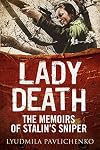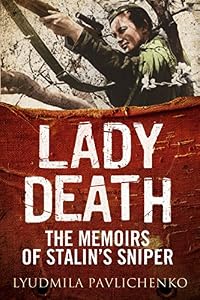
Lady Death: The Memoirs of Stalin's Sniper
by Lyudmila Pavlichenko
On This Page
Description
In June 1941, when Hitler launched Operation Barbarossa, Lyudmila Pavlichenko left her university studies and ignored the offer of a position as a nurse to become one of Soviet Russia's 2000 female snipers. Less than a year later she had 309 recorded kills, including twenty-nine enemy sniper kills. She was withdrawn from active duty after being injured. She was also regarded as a key heroic figure for the war effort. She spoke at rallies in Canada and the U.S., and the folk singer Woody show more Guthrie wrote a song, "Killed By A Gun," about her exploits. Her U.S. trip included a tour of the White House with FDR. In November 1942 she visited Coventry and accepted donations of £4,516 from Coventry workers to pay for three X-ray units for the Red Army. She also visited a Birmingham factory as part of her fundraising tour. She never returned to combat but trained other snipers. After the war, she finished her education at Kiev University and began a career as a historian. She died on October 10, 1974 at age fifty-eight, and was buried in Moscow's Novodevichy Cemetery. show lessTags
Recommendations

















Member Reviews
3.5 stars, good with some bad. The good : It’s a valuable look at the experiences of an eastern front sniper from the early period, and a mostly unvarnished look at the experiences of a female soldier in frontline combat, and dealing with the expectations of men around her. In that sense, there is a unique combination of what might be called feminism with a true love of and appreciation of shooting and weaponry that very much resonates with me as a female competitive shooter today. I feel as though I’d have loved to have spoken with her or spent an afternoon at the range with her. Some of her discussions of ballistics, shooting techniques,, specific weapons and glass, specific ammunition and so on almost feels like a chance to talk show more shop with her. And so much of what she said on these topics remains entirely relevant and accurate today - in fact the Mosin rifle she used is still seeing combat today in the Russo-Ukraine War.
I appreciated her professional competence and fury as a soldier with her full femininity understood in a mostly traditional sense. For her there was no tension, and here again it feels as though she was in part a kindred spirit.
There are also some interesting impressions from her visits to the USA and the UK, especially her impressions of Eleanor Roosevelt.
The bad - some gross factual errors, eg, her statement that as of 1942 (!) the USA had never had a bomb dropped on its territory, some omissions (no discussion of Russia’s complicity in the invasion of Poland, its uncalled-for invasion of Finland ) and some creepy hero worship of Stalin, one of history’s great mass murderers. There are also some troublingly racist descriptions of eg Romanian soldiers.
In all I think it’s a good read if you are interested in snipers and their weapons and techniques, in the female combat experience, and in experience of the Eastern Front, early war period, from the USSR side. show less
I appreciated her professional competence and fury as a soldier with her full femininity understood in a mostly traditional sense. For her there was no tension, and here again it feels as though she was in part a kindred spirit.
There are also some interesting impressions from her visits to the USA and the UK, especially her impressions of Eleanor Roosevelt.
The bad - some gross factual errors, eg, her statement that as of 1942 (!) the USA had never had a bomb dropped on its territory, some omissions (no discussion of Russia’s complicity in the invasion of Poland, its uncalled-for invasion of Finland ) and some creepy hero worship of Stalin, one of history’s great mass murderers. There are also some troublingly racist descriptions of eg Romanian soldiers.
In all I think it’s a good read if you are interested in snipers and their weapons and techniques, in the female combat experience, and in experience of the Eastern Front, early war period, from the USSR side. show less
A fascinating read through the memoirs of a truly bad ass woman. If you liked American Sniper, then I suggest this book. If you like Russian history, I recommend this book. If you like military history, then seriously, get this book. What a rarity to have a woman in this sort of position years ago. Lady Death is readable and informative.
"Lady Death" is the story of Lyudmila Pavlichenko, one of over 2000 female snipers, yet one of the more well-known names with 309 recorded kills, including 29 enemy sniper kills, to her name. After being "retired" from active duty, she visited the USA and UK, before returning to train other snipers.
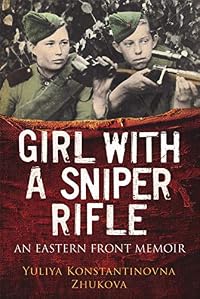
Both memoirs (read in conjunction withGirl with a Sniper Rifle: An Eastern Front Memoir) are highly readable offering a different yet similar view of their experiences - we often comment that fact is sometimes more enthralling than fiction. Pavlichenko, the historian, would take a more academic approach, supplementing her diary with historical research; whilst Zhukova relied on memory, letters (that escaped being destroyed as she tried to show more forget her past) and remembrances of her fellow cadets. Both women were dedicated in their commitment to both Russia and the Russian war effort - "... dying for the motherland was considered a worthwhile sacrifice ...". It is hoped that readers will discover, through both works, the comaraderie, strength of spirit, unflinching loyalty that these two women - and the many others like them - displayed in the face of the terror of war. How many readers are left wondering whether or not they could do the same.
full review of both books here @ Melisende's Library show less
Both memoirs (read in conjunction withGirl with a Sniper Rifle: An Eastern Front Memoir) are highly readable offering a different yet similar view of their experiences - we often comment that fact is sometimes more enthralling than fiction. Pavlichenko, the historian, would take a more academic approach, supplementing her diary with historical research; whilst Zhukova relied on memory, letters (that escaped being destroyed as she tried to show more forget her past) and remembrances of her fellow cadets. Both women were dedicated in their commitment to both Russia and the Russian war effort - "... dying for the motherland was considered a worthwhile sacrifice ...". It is hoped that readers will discover, through both works, the comaraderie, strength of spirit, unflinching loyalty that these two women - and the many others like them - displayed in the face of the terror of war. How many readers are left wondering whether or not they could do the same.
full review of both books here @ Melisende's Library show less
Interesting memoir. I had no idea that Russia had female snipers.
Ratings
Members
- Recently Added By
Author Information

1 Work 104 Members
Some Editions
Series
Belongs to Publisher Series
Work Relationships
Inspired
Common Knowledge
- Canonical title
- Lady Death: The Memoirs of Stalin's Sniper
- People/Characters
- Mila Pavlichenko
Classifications
- Genres
- Nonfiction, History, Biography & Memoir, General Nonfiction
- DDC/MDS
- 940.541247 — History & geography History of Europe History of Europe 1918- Military history of World War II Operations and units
- LCC
- D764 .P38 — History of Europe, Asia, Africa and Oceania History (General) World War II (1939-1945)
- BISAC
Statistics
- Members
- 102
- Popularity
- 309,780
- Reviews
- 4
- Rating
- (3.94)
- Languages
- English
- Media
- Paper, Audiobook, Ebook
- ISBNs
- 11
- ASINs
- 3