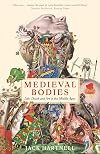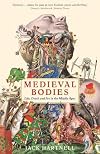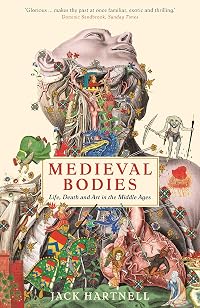
Medieval Bodies: Life and Death in the Middle Ages
by Jack Hartnell
On This Page
Description
"With wit, wisdom, and a sharp scalpel, Jack Hartnell dissects the medieval body and offers a remedy to our preconceptions. Medieval beliefs about the body were drastically different from ours today: Hair was thought to be a condensation of fumes emitted from the pores, ideas were supposedly committed to memory by being directly imprinted on the brain, and the womb of a goat was believed to function as a contraceptive. But while this medieval medicine now seems archaic, it also made a show more critical contribution to modern science. Medieval Bodies guides us on a head-to-heel journey through this era's revolutionary advancements and disturbing convictions. We learn about the surgeons who dissected a living man's stomach, then sewed him up again; about the geographers who delineated racial groups by skin color; and about the practice of fasting to gain spiritual renown. Encompassing medicine and mysticism, politics and art-and complete with vivid, full-color illustrations-Medieval Bodies shows us how it felt to live and die a thousand years ago"-- show lessTags
Recommendations















Member Reviews
Hartnell breaks it all down from head to toe, literally! Arabic and Western medicine are both featured, demonstrating an equal exchange. Each chapter is dedicated to a region that, altogether, would've composed the medieval image of the human body: the head, the senses, skin, bone, the heart, blood, the hands, the stomach, the genitals, and feet. This was a time before commonplace microscopes, so our lymph nodes, brain cells, a layout of our nervous system, didn't appear until much later. But as Hartnell attests, medieval medicine was not a "dark age" of constant bloodletting and wishful thinking. Medieval doctors knew that the head was "the locus of human rationality, sanity and personhood," of blood poisoning and inherited conditions, show more that oral hygiene was a necessity, and that an unvaried, heavy diet or a night of drunken binging could easily put an otherwise healthy individual into an early grave.
You'll be happy to know that this book is full of bright, full page illustrations to demonstrate how, in more ways than not, progress was being made. One of my favorites is a 9th c. Arabic diagram of the eye. My only qualm is that the chapter on the "Senses" felt neglected. "Miasma," or polluted air, that dominated the medieval understanding of the spread of disease, got 2 sentences. But Hartnell's style is delightful, and what they do include, I haven't read anywhere else. The German personnification of love, Frau Minne; animated headless saints called cephalophores, the Wundenmann, the leche finger, chyle, monastic sign language, a dirty Anglo-Saxon riddle, and why Maubuisson Abbey is full of royal entrails. I learned so much from this read, and it was a great double-feature with Caciola's "Afterlives!" show less
You'll be happy to know that this book is full of bright, full page illustrations to demonstrate how, in more ways than not, progress was being made. One of my favorites is a 9th c. Arabic diagram of the eye. My only qualm is that the chapter on the "Senses" felt neglected. "Miasma," or polluted air, that dominated the medieval understanding of the spread of disease, got 2 sentences. But Hartnell's style is delightful, and what they do include, I haven't read anywhere else. The German personnification of love, Frau Minne; animated headless saints called cephalophores, the Wundenmann, the leche finger, chyle, monastic sign language, a dirty Anglo-Saxon riddle, and why Maubuisson Abbey is full of royal entrails. I learned so much from this read, and it was a great double-feature with Caciola's "Afterlives!" show less
I was expecting a medical book. What I got was more of an art history, hung on the frame of the human body. This was a very broad look at the medieval period, so it was, by default, not a deep look. Like many such broad treatment, parts were fascinating; other parts less so.
I'm not a historian, so have heard very little about any kind of enlightenment in the Middle Ages. I found there was more diversity of viewpoints during this period, and more culture than I had realized. It was the time when the heart became known as the seat of emotion, especially love.
The illustrations are amazing; this is definitely a book that should be read in paper format. No e-book or audible version would do it justice.
I'm not a historian, so have heard very little about any kind of enlightenment in the Middle Ages. I found there was more diversity of viewpoints during this period, and more culture than I had realized. It was the time when the heart became known as the seat of emotion, especially love.
The illustrations are amazing; this is definitely a book that should be read in paper format. No e-book or audible version would do it justice.
'Medieval Bodies' is a cultural history for the general reader. You should not expect anything more deep or less anecdotal than you get. Nevertheless as a run-through of examples of how the medieval mind worked and the body acted, the book is informative, useful and entertaining.
Hartnell (under the Wellcome Collection imprint) uses the parts of the human body from the head to the feet to provide a flow of mini-essays on whatever aspect of medieval culture comes to mind at each stage.
From this perspective, it can be seen as a loose small-scale encyclopedia on a whole variety of subjects from attitudes to nudity, burial customs and the heart in courtly love through to blood miracles and bleeding icons, surgical instruments and the show more medieval attitude to farting.
Where it scores is not only in its up to date scholarship but in its superb and copious illustrations and its inclusion of Islamic and to a lesser extent Judaic medieval ideas and images. The publishers have made a real effort to have each relevant illustration match its text. A model of its kind in this respect.
There are, of course, many things that will be new to the average reader in the book although probably not its general picture of the medieval mind with its faith-based world view. What is striking as one reads it is just how much of that world survives today.
We see a medieval population no different in fundamentals from us but with a different ideological structure that had its logic and use-value in its time and which would only be changed with the arrival of scientific method and empirical investigation of claims about the world.
Materially our world is very different but a surprisingly large number of people today still believe things believed in then. Such ideas as the heart as expression of certain emotions have a 'stickiness' that provides strong continuity with that long multicultural age of approximately 1,000 years.
There is too much detail in the book to review and share here but one insight should noted - that we seem to have lost the bulk of a complex language of hand signals and possibly of touch of which there remains only traces in Catholic signing and (I would add) Italian expression.
The medieval world is both different in its priorities from ours and the same in its essential humanity. 'Medieval Bodies' adds value as a non-academic popular gateway to that world, clearly written and with something of interest on almost very page. show less
Hartnell (under the Wellcome Collection imprint) uses the parts of the human body from the head to the feet to provide a flow of mini-essays on whatever aspect of medieval culture comes to mind at each stage.
From this perspective, it can be seen as a loose small-scale encyclopedia on a whole variety of subjects from attitudes to nudity, burial customs and the heart in courtly love through to blood miracles and bleeding icons, surgical instruments and the show more medieval attitude to farting.
Where it scores is not only in its up to date scholarship but in its superb and copious illustrations and its inclusion of Islamic and to a lesser extent Judaic medieval ideas and images. The publishers have made a real effort to have each relevant illustration match its text. A model of its kind in this respect.
There are, of course, many things that will be new to the average reader in the book although probably not its general picture of the medieval mind with its faith-based world view. What is striking as one reads it is just how much of that world survives today.
We see a medieval population no different in fundamentals from us but with a different ideological structure that had its logic and use-value in its time and which would only be changed with the arrival of scientific method and empirical investigation of claims about the world.
Materially our world is very different but a surprisingly large number of people today still believe things believed in then. Such ideas as the heart as expression of certain emotions have a 'stickiness' that provides strong continuity with that long multicultural age of approximately 1,000 years.
There is too much detail in the book to review and share here but one insight should noted - that we seem to have lost the bulk of a complex language of hand signals and possibly of touch of which there remains only traces in Catholic signing and (I would add) Italian expression.
The medieval world is both different in its priorities from ours and the same in its essential humanity. 'Medieval Bodies' adds value as a non-academic popular gateway to that world, clearly written and with something of interest on almost very page. show less
I read this because it was recommended to me by the barista at my favorite bookshop (I get a free coffee with my books there) who said it was the best nonfiction they had read all of last year. Happy to report that the barista has excellent taste (in a literary and literal sense it seems).
I might have enjoyed it even more during my “historical bodies in artistic representation” phase, which began with The Sick Rose, but it was still excellent and I do love a book with pictures despite being a fully grown adult with multiple degrees
I might have enjoyed it even more during my “historical bodies in artistic representation” phase, which began with The Sick Rose, but it was still excellent and I do love a book with pictures despite being a fully grown adult with multiple degrees
A very readable, head-to-toe survey of how the human body was perceived and understood by people in medieval times, as evidenced in artwork and manuscripts of the time. The handsome and judiciously selected color illustrations enhance the text and make this an enjoyable read. However "wrong" many of the concepts of the body's workings were, art historian Hartnell successfully makes a case for the complexity and sophistication of medieval thoughts on the subject - the beautiful 12th century Thorney Computus illustrates a delightfully kaleidoscopic interweaving of elements, humors, zodiac, months, winds and ages. A thirteenth century diagram of the brain is of course grossly oversimplified and flat wrong, but they DID get the optic chiasm show more right: the optic nerves correctly cross over, sending impulses from each eye to the opposite sides of the brain.
Other reviewers have "complained" that the book trends to wander from its structure of focusing on specific body parts - the sense of hearing includes discussion of the significance of church bells, for example - and the lengthy discursion from feet into pilgrimage travel goes a little too far afield. But Hartnell's stated intent is to consider the medieval body in "its very broadest sense, a jumping-off point for exploring all kinds of aspects of medieval life." Fair enough. I found it all engaging, fascinating, amusing (see the nuns harvesting a penis tree on p. 252), and particularly enjoyed his inclusion of Islamic, Jewish, and north African ideas alongside the western European. A nice addition to the history of medicine collection, and an interesting companion to David Bainbridge's Stripped Bare on the art of veterinary anatomy.
julistielstra.com show less
Other reviewers have "complained" that the book trends to wander from its structure of focusing on specific body parts - the sense of hearing includes discussion of the significance of church bells, for example - and the lengthy discursion from feet into pilgrimage travel goes a little too far afield. But Hartnell's stated intent is to consider the medieval body in "its very broadest sense, a jumping-off point for exploring all kinds of aspects of medieval life." Fair enough. I found it all engaging, fascinating, amusing (see the nuns harvesting a penis tree on p. 252), and particularly enjoyed his inclusion of Islamic, Jewish, and north African ideas alongside the western European. A nice addition to the history of medicine collection, and an interesting companion to David Bainbridge's Stripped Bare on the art of veterinary anatomy.
julistielstra.com show less
I was excited to read this, because it got rave reviews and the cover is so enticing—I thought perhaps it could become the core text for a course I'm thinking of teaching on the medieval body and medicine in the near future. Unfortunately, while lavishly illustrated and containing some interesting anecdotes, Medieval Bodies is a let down. It's an example of the pitfalls that can befall someone who's writing not only about a very broad topic, encompassing all of Europe and the Mediterranean region over the period of a thousand years, but also outside of their discipline.
Jack Hartnell is an art historian, and it shows. While his teasing apart of the objects and images he discusses is often very well done, his analysis of texts is show more often, um, less so, and his historiography is often dated and/or shallow. So for instance, you cannot talk about how Urban II's 1095 call to Crusade shows anything about his own racial thinking, because the text of his sermon doesn't survive. (We've got, I think, something like four medieval versions, written down from people's memories of the speech well after the fact—they all diverge substantially. Any undergrad could see the problems with using this as a source for Urban's thinking.) His account of medieval women and their access to power was positively Duby-esque (Duby's not mentioned in the bibliography, but given that Hartnell doesn't seem to have read deeper on the topic than Schaus's Encyclopedia, that's unsurprising). Those are big picture failings, but there are also lots of factual mistakes. For instance, the Catalan Atlas isn't oriented towards the north—it's a portolan chart, so "orientation" doesn't apply. I'm pretty sure Mansa Musa is depicted on it holding either a world orb or a lump of gold ore, not "an enormous gold coin."
These examples could all be multiplied, but I don't like reviews which descend into a litany of all the errors in a book—especially when there's the kernel of such a good idea and approach here. Suffice to say this is not the introductory survey I hoped it could be. show less
Jack Hartnell is an art historian, and it shows. While his teasing apart of the objects and images he discusses is often very well done, his analysis of texts is show more often, um, less so, and his historiography is often dated and/or shallow. So for instance, you cannot talk about how Urban II's 1095 call to Crusade shows anything about his own racial thinking, because the text of his sermon doesn't survive. (We've got, I think, something like four medieval versions, written down from people's memories of the speech well after the fact—they all diverge substantially. Any undergrad could see the problems with using this as a source for Urban's thinking.) His account of medieval women and their access to power was positively Duby-esque (Duby's not mentioned in the bibliography, but given that Hartnell doesn't seem to have read deeper on the topic than Schaus's Encyclopedia, that's unsurprising). Those are big picture failings, but there are also lots of factual mistakes. For instance, the Catalan Atlas isn't oriented towards the north—it's a portolan chart, so "orientation" doesn't apply. I'm pretty sure Mansa Musa is depicted on it holding either a world orb or a lump of gold ore, not "an enormous gold coin."
These examples could all be multiplied, but I don't like reviews which descend into a litany of all the errors in a book—especially when there's the kernel of such a good idea and approach here. Suffice to say this is not the introductory survey I hoped it could be. show less
Medieval Bodies: Life, Death and Art in the Middle Ages by Jack Hartnell was a great follow up after reading Life in a Medieval Castle by Joseph Gies and Frances Gies in July.
Medieval Bodies is structured with chapters dedicated to different parts of the body (e.g. head, heart, hands, feet and so on) from the head to foot in order to provide the reader with an overall picture of the body in the middle ages and the approach to medicine at the time. Of course, this includes the four humours (blood, yellow bile, black bile and phlegm), and if a person was unwell, this was attributed to an imbalance of the humours. The appropriate treatment was then prescribed, which might include blood letting, leeches, poultices and more.
"Lauded above show more sweat or urine or spiritus, blood was the medieval body’s most vital substance." Chapter 7
Occasionally the author drifted off topic and while still maintaining my interest in the content provided, it weakened the overall structure of the book in my opinion.
Jack Hartnell is an Associate Professor of Art History specialising in the art of the Middle Ages and it shows in this book. There was a clear focus on the Art in the Life, Death and Art in the Middle Ages subtitle, and by listening to this on audiobook, I missed out on the illustrations which might have lifted this from a 3 star to a 4 star read. My natural curiosity led me to seek out the artworks mentioned online and my efforts were rewarded.
Medieval Bodies: Life, Death and Art in the Middle Ages by Jack Hartnell is recommended reading in print form for those with an interest in history, art, medicine and the middle ages. show less
Medieval Bodies is structured with chapters dedicated to different parts of the body (e.g. head, heart, hands, feet and so on) from the head to foot in order to provide the reader with an overall picture of the body in the middle ages and the approach to medicine at the time. Of course, this includes the four humours (blood, yellow bile, black bile and phlegm), and if a person was unwell, this was attributed to an imbalance of the humours. The appropriate treatment was then prescribed, which might include blood letting, leeches, poultices and more.
"Lauded above show more sweat or urine or spiritus, blood was the medieval body’s most vital substance." Chapter 7
Occasionally the author drifted off topic and while still maintaining my interest in the content provided, it weakened the overall structure of the book in my opinion.
Jack Hartnell is an Associate Professor of Art History specialising in the art of the Middle Ages and it shows in this book. There was a clear focus on the Art in the Life, Death and Art in the Middle Ages subtitle, and by listening to this on audiobook, I missed out on the illustrations which might have lifted this from a 3 star to a 4 star read. My natural curiosity led me to seek out the artworks mentioned online and my efforts were rewarded.
Medieval Bodies: Life, Death and Art in the Middle Ages by Jack Hartnell is recommended reading in print form for those with an interest in history, art, medicine and the middle ages. show less
Members
- Recently Added By
Lists

History
37 works; 1 member

Books in the Bibliography of Humans: A Monstrous History by Surekha Davies
346 works; 1 member
Author Information
6+ Works 421 Members
Some Editions
Common Knowledge
- Original publication date
- 2018-03-29
- Important events
- Medieval Era
- First words
- In 2003 a preserved human head was sold by a dealer in Paris to a Canadian private collection for an undisclosed amount.
- Last words
- (Click to show. Warning: May contain spoilers.)Now they are awake and chattering like never before.
- Original language
- English, UK
Classifications
Statistics
- Members
- 404
- Popularity
- 76,849
- Reviews
- 11
- Rating
- (4.12)
- Languages
- English
- Media
- Paper, Audiobook, Ebook
- ISBNs
- 7
- ASINs
- 4