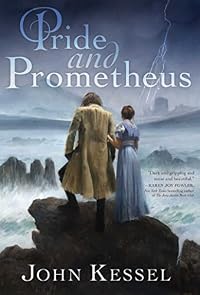
Pride and Prometheus
by John Kessel
On This Page
Description
Threatened with destruction unless he fashions a wife for his Creature, Victor Frankenstein travels to England where he meets Mary and Kitty Bennet, the remaining unmarried sisters of the Bennet family from Pride and Prejudice Meanwhile, the awkward Mary hopes that Victor will save her from approaching spinsterhood while wondering what dark secret he is keeping from her. Pride and Prometheus fuses the gothic horror of Mary Shelley with the Regency romance of Jane Austen in an exciting novel show more that combines two age-old stories in a fresh and startling way. show lessTags
Recommendations










Member Reviews
When this ARC showed up, I had two immediate thoughts: “How has nobody done this before? That’s brilliant!” and “This can’t possibly work as well in practice as I want it to.” And y’know, guys? Kessel pulls this off with aplomb though the story weakens towards the ending due to his unwillingness to change the plot of Frankenstein.
The thing that impressed me the most about this is how true the points of view feel to the source material. Mary Bennett’s parts sound like Austen, and Frankenstein’s and the Creature’s like the relevant parts of Frankenstein, though I think a bit of modern language and terminology snuck in. (And yes, there is a bit of a love triangle. No, it didn’t go how I was hoping.)
Kessel also stays show more very true to the characters, though he’s had to do a fair bit of character development on Mary. She’s older, wiser, interested in science which is how she hits it off with Frankenstein, but still recognizably the awkward girl of Pride and Prejudice. I liked seeing the Frankenstein characters from her point of view as well, and for that matter, the ones from P&P. Frankenstein and the Creature are equally true to their source and sympathetic. To a point. I mean, Frankenstein is still kind of a prick.
As for the story itself… it went places I wasn’t entirely expecting, from either the Regency romance direction or the “create a Bride to escape the Creature” one. It kept things interesting, as did the alternating POVs which played off each other well, and helped to make the book more than the pastiche mashups can end up as. It’s certainly a modern-feeling novel.
My only real complaint, beyond Kessel’s desire for this to be an interlude in the Frankenstein story, is that there were moments when I felt either the characters’ timelines didn’t line up with each other or that the timelines didn’t sync with known history well enough. A small thing, though. I definitely liked this enough to be recommending it on release day and if the summary raised your eyebrows like it did mine, you’re probably the target audience.
Warnings: One use of the g-slur. Class consciousness.
7.5/10 show less
The thing that impressed me the most about this is how true the points of view feel to the source material. Mary Bennett’s parts sound like Austen, and Frankenstein’s and the Creature’s like the relevant parts of Frankenstein, though I think a bit of modern language and terminology snuck in. (And yes, there is a bit of a love triangle. No, it didn’t go how I was hoping.)
Kessel also stays show more very true to the characters, though he’s had to do a fair bit of character development on Mary. She’s older, wiser, interested in science which is how she hits it off with Frankenstein, but still recognizably the awkward girl of Pride and Prejudice. I liked seeing the Frankenstein characters from her point of view as well, and for that matter, the ones from P&P. Frankenstein and the Creature are equally true to their source and sympathetic. To a point. I mean, Frankenstein is still kind of a prick.
As for the story itself… it went places I wasn’t entirely expecting, from either the Regency romance direction or the “create a Bride to escape the Creature” one. It kept things interesting, as did the alternating POVs which played off each other well, and helped to make the book more than the pastiche mashups can end up as. It’s certainly a modern-feeling novel.
My only real complaint, beyond Kessel’s desire for this to be an interlude in the Frankenstein story, is that there were moments when I felt either the characters’ timelines didn’t line up with each other or that the timelines didn’t sync with known history well enough. A small thing, though. I definitely liked this enough to be recommending it on release day and if the summary raised your eyebrows like it did mine, you’re probably the target audience.
Warnings: One use of the g-slur. Class consciousness.
7.5/10 show less
John Kessel’s Pride and Prometheus is fan fiction in the best sense of the term. In days of long ago yore, students learning to compose in Latin might be assigned to write an Ovidian ode or an oration in the manner of Cicero. Kessel, who teaches creative writing at N.C. State, has upped the stakes by having characters from Jane Austen interact with characters from Mary Shelley. Note: This is not a pastiche like Pride and Prejudice with Zombies. Kessel treats both stories seriously and gives the world views of both writers the respect they deserve. I was especially impressed with how well he preserves the style of both. Mary Bennet, now a spinster at 31, struggles to preserve her rational morality when confronted with the chaotic show more passion of Victor and his creature. Pride and Prejudice and Frankenstein were published only four years apart, but Kessel makes it clear that they come from diverging worlds with quickly changing language. show less
Pride and Prometheus by John Kessel is a darkly magical re-imagining that fuses two great classics- Mary Shelley's Frankenstein and Jane Austen's Pride and Prejudice- into a seamless narrative. A chance encounter between Mary Bennett and Victor Frankenstein sets in motion a series of relationships that will leave them both forever changed. Victor is travelling with his friend Henry, brooding over his promise to his Creature to create a bride for him. As the pair have travelled, Victor has slowly been collecting the equipment and tools needed. He plans to part from Henry for a time, retiring to the remote Orkneys to complete his project. All that remains is to secure the body of a young woman.
Victor's quest brings him in contact with show more Mary Bennett, that ends with an invitation to visit Pemberley, where Mary and her sister Kitty are currently staying. Both women are somewhat distressed over having reached their third decade and still being unmarried. Mary has some small hopes that Victor may yet save her from the life of an old maid. He has expressed some signs of interest. Victor's stay in Pemberley does indeed net him the body he needs, and he continues on to Emray Island, shadowed all the while by his Creature. And by Mary, who has gone after him in the wake of devastating events, hoping to find answers as to the cause. She ends up travelling in the Creature's company, learning more about Victor, and what the Creature seeks. Slowly, Mary begins to see the Creature, whom she calls Adam, as less a monster and more a human. Unfortunately, Victor does not accept that possibility. Can he still keep his promise in light of these feelings?
Pride and Prometheus keeps faith with the styles of the original works, while still allowing the author's own voice to shine through. This story is told through Mary, Victor, and the Creature's eyes. Victor and the Creature speak as first person, while Mary's part is third person. It was neat to see the overlapping events from these myriad perspectives, each so very different from the other. As always, my heart ached for the Creature, and how he is treated. To be abandoned even as you are born, first of your kind, has to be deeply scarring. His conflicted nature shows clear and strong. He wants to despise humans, yet grows to accept Mary at the least. It was nice to see how Mary grew to regard him as acquaintance, if not friend. She helps him in as many ways as he helped her. I love that even the nested aspect of Frankenstein was kept, encapsulating the final events of that story when Mary chances to meet a person from the ship that found Victor in the Arctic, and from where the Creature stole his body.
This story is a fantastically creepy homage to Shelley's Gothic masterpiece and Austen's Regency classic. It is a bold and well-played tale that will keep you reading long into the night. Recommended for those who love Frankenstein and/or Pride and Prejudice, and for any who love a good crossover sci-fi work.
***Many thanks to Netgalley and Saga Press for providing an egalley in exchange for a fair and honest review. Review for the Manhattan Book Review. show less
Victor's quest brings him in contact with show more Mary Bennett, that ends with an invitation to visit Pemberley, where Mary and her sister Kitty are currently staying. Both women are somewhat distressed over having reached their third decade and still being unmarried. Mary has some small hopes that Victor may yet save her from the life of an old maid. He has expressed some signs of interest. Victor's stay in Pemberley does indeed net him the body he needs, and he continues on to Emray Island, shadowed all the while by his Creature. And by Mary, who has gone after him in the wake of devastating events, hoping to find answers as to the cause. She ends up travelling in the Creature's company, learning more about Victor, and what the Creature seeks. Slowly, Mary begins to see the Creature, whom she calls Adam, as less a monster and more a human. Unfortunately, Victor does not accept that possibility. Can he still keep his promise in light of these feelings?
Pride and Prometheus keeps faith with the styles of the original works, while still allowing the author's own voice to shine through. This story is told through Mary, Victor, and the Creature's eyes. Victor and the Creature speak as first person, while Mary's part is third person. It was neat to see the overlapping events from these myriad perspectives, each so very different from the other. As always, my heart ached for the Creature, and how he is treated. To be abandoned even as you are born, first of your kind, has to be deeply scarring. His conflicted nature shows clear and strong. He wants to despise humans, yet grows to accept Mary at the least. It was nice to see how Mary grew to regard him as acquaintance, if not friend. She helps him in as many ways as he helped her. I love that even the nested aspect of Frankenstein was kept, encapsulating the final events of that story when Mary chances to meet a person from the ship that found Victor in the Arctic, and from where the Creature stole his body.
This story is a fantastically creepy homage to Shelley's Gothic masterpiece and Austen's Regency classic. It is a bold and well-played tale that will keep you reading long into the night. Recommended for those who love Frankenstein and/or Pride and Prejudice, and for any who love a good crossover sci-fi work.
***Many thanks to Netgalley and Saga Press for providing an egalley in exchange for a fair and honest review. Review for the Manhattan Book Review. show less
In this P&P sequel thirteen years has passed and Mary and Catherine Bennet are still living at Longbourn. But Kitty has not given up hope of marriage and to that end they attend a ball in town where Mary meets Victor Frankenstein. As their story enfolds we have the tale from the point of view of Mary Bennet, Victor Frankenstein, and the Creature.
A very enjoyable and satisfying well-written story even if the ending was not what I hoped for.
A very enjoyable and satisfying well-written story even if the ending was not what I hoped for.
Who can resist a tale that places Austen’s Mary Bennett with Shelley's Victor Frankstein in the same novel? I couldn’t.
Mary Bennett is now 31. She and Kitty are still unmarried living with their parents. Mary has moved away from her sermonizing days and, being the bookish lass that she is, has ventured into science. When we first meet her here in this book she is in Lyme Regis hunting for fossils in the company of an older gentleman, also a fossil enthusiast, and possibly her last chance at marriage (should he show interest in that way; he hasn’t yet and Mary is dubious he will). At a ball she and Kitty attend, Mary meets and dances with Victor Frankenstein, who is traveling with a close friend through England on his way north. show more They speak of science and, well, Mary is smitten. But Victor is being pursued on his trip by his monstrous creation who is still demanding that Victor produce a bride for him….
This novel is an expansion of a 2008 novelette that won both the Nebula and Shirley Jackson Award in its category…and for good reason. John Kessel does a fabulous and respectful job of merging these two stories. His details are wonderful and his mature Mary Bennett is someone we can finally admire—and she is really the main character here. Mary’s interest in Victor and a family tragedy soon bring her in contact with the monster and the story accelerates and moves north. I don’t think the story (at least in this full novel form) is quite as suspenseful as some of its promotional blurbs suggest, but no matter, it is a well-written, great romp of a book perfect for anytime reading (like the plane ride I was on) and you may never look at Mary Bennett quite the same way again. show less
Mary Bennett is now 31. She and Kitty are still unmarried living with their parents. Mary has moved away from her sermonizing days and, being the bookish lass that she is, has ventured into science. When we first meet her here in this book she is in Lyme Regis hunting for fossils in the company of an older gentleman, also a fossil enthusiast, and possibly her last chance at marriage (should he show interest in that way; he hasn’t yet and Mary is dubious he will). At a ball she and Kitty attend, Mary meets and dances with Victor Frankenstein, who is traveling with a close friend through England on his way north. show more They speak of science and, well, Mary is smitten. But Victor is being pursued on his trip by his monstrous creation who is still demanding that Victor produce a bride for him….
This novel is an expansion of a 2008 novelette that won both the Nebula and Shirley Jackson Award in its category…and for good reason. John Kessel does a fabulous and respectful job of merging these two stories. His details are wonderful and his mature Mary Bennett is someone we can finally admire—and she is really the main character here. Mary’s interest in Victor and a family tragedy soon bring her in contact with the monster and the story accelerates and moves north. I don’t think the story (at least in this full novel form) is quite as suspenseful as some of its promotional blurbs suggest, but no matter, it is a well-written, great romp of a book perfect for anytime reading (like the plane ride I was on) and you may never look at Mary Bennett quite the same way again. show less
This review and others posted over at my blog.
I received this book for free from the publisher in exchange for an honest review.
Arriving in time for the 200th anniversary of Shelley’s Frankenstein, this mash-up of classics follows Mary Bennet (of Pride and Prejudice fame) as she meets the mysterious Victor Frankenstein at a party. After running into him a few times, she learns his dark secret and meets the monster he’s created. Giving man and monster the benefit of the doubt, Mary hopes the haunted doctor could become more than a casual friend. But the creation of the monster’s bride could test even the long-suffering Mary’s kindness.
I’m game for almost any Austen adaptation or spin-off and I was intrigued by the combination show more of classics. I went into this book with middling expectations and was rewarded accordingly.
This book started off with lots of promise. Mary and Kitty, often forgotten not only in the original, but in adaptations as well, are finally getting the limelight. I am constantly on the lookout for Mary-centric books, or books that at least make Mary out to be more than a general embarrassment to the family, simply because she’s intelligent, pious and socially awkward (justice for Mary!) I’ve never understood why she can’t be smart, conservative and also a compelling character, rather than an annoying one. Kitty is typically Lydia’s idiot sidekick, following her orders and parroting her actions in an attempt to appeal to the opposite sex.
Mary is a character I want to like. I don’t hate her in the original, but she’s not meant to be endearing (at least, I don’t think she is…) and it’s easy to see why she adds to Lizzy and Jane’s continual embarrassment – though she does so much less often than other family members (cough-Mrs.Bennet-cough). Here, Kessel gives Mary an awareness of her youthful faults that I’ve never encountered before. She realizes she was silly and understands the embarrassment she caused her family with her actions. Approaching spinsterhood, she looks back with regret, but it’s clear she’s matured. However, her family still writes her off and she’s mostly left to care for her parents, who don’t find her all that interesting. This made her very compelling! Kitty is also getting older and bitter at her lack of marriage prospects, especially when she thinks about the offer she passed up. Again, compelling!
However, Mary’s character changes abruptly after meeting Victor. It’s clear she’s interested in him and that’s fine. What’s bothersome is how, as the story progresses, Mary becomes so clearly smitten with Victor that she loses some redeeming qualities. Suddenly she’s making stupid decisions, yet her calm, rational demeanor remains. Had she shown some signs of obsessive thoughts or feelings, maybe her decisions would make sense. But instead I kept scratching my head and wondering aloud at her choices and even her lack of anger at scenes that should have sent someone so intelligent into fits of sadness and anger.
It’s hard to explain without diving head-first into spoiler territory, so I’ll just say that her character development took a nose dive.
There’s also a TON of traveling in this book – I half expected Mary to come across some hobbits on their way to Mount Doom. It was boring and unnecessary. The hardships of her travels really had no lasting effects on her character or the story and could have been summed up in a few pages, rather than several chapters. For instance, after entering an unfamiliar town, Mary is dirty and destitute looking, so she’s accused of lying, locked in a basement overnight, prayed over in the morning and set free once more. The encounter didn’t alter her journey or her character by much and mostly served to get me wondering why someone would bother to lock her up at all if they could have just prayed over her and sent her on her way immediately. Or why not keep her locked up? Maybe report her to the local constabulary? This was all a pointless distraction from the main story.
Or maybe I felt all the travel was pointless because I was pissed at the decline in Mary’s character development and her sudden lack of common sense.
The point of view changes for each chapter puzzled me somewhat as well. Mary’s chapters were told in the third person, but Frankenstein and the monster had first-person perspectives. As a result, Mary’s chapters did stand out, though they had a little less depth when it came to her thoughts. On the flip side, both men felt so similar that I sometimes couldn’t figure out who was speaking until they referred
The ending was lackluster and devoid of emotion. At that point, I wasn’t surprised, but I’d still hoped for a strong finish.
This wasn’t the Mary book I was looking for (justice for Mary, dammit!) It’s not a terrible adaptation and maybe fans of Frankenstein will get more out of it than I did (shhh, I’ve not read that yet). You may also enjoy this if you’re not looking for justice for Mary – maybe as someone who’s never read Pride and Prejudice, or isn’t a diehard fan, this would be more appealing. show less
I received this book for free from the publisher in exchange for an honest review.
Arriving in time for the 200th anniversary of Shelley’s Frankenstein, this mash-up of classics follows Mary Bennet (of Pride and Prejudice fame) as she meets the mysterious Victor Frankenstein at a party. After running into him a few times, she learns his dark secret and meets the monster he’s created. Giving man and monster the benefit of the doubt, Mary hopes the haunted doctor could become more than a casual friend. But the creation of the monster’s bride could test even the long-suffering Mary’s kindness.
I’m game for almost any Austen adaptation or spin-off and I was intrigued by the combination show more of classics. I went into this book with middling expectations and was rewarded accordingly.
This book started off with lots of promise. Mary and Kitty, often forgotten not only in the original, but in adaptations as well, are finally getting the limelight. I am constantly on the lookout for Mary-centric books, or books that at least make Mary out to be more than a general embarrassment to the family, simply because she’s intelligent, pious and socially awkward (justice for Mary!) I’ve never understood why she can’t be smart, conservative and also a compelling character, rather than an annoying one. Kitty is typically Lydia’s idiot sidekick, following her orders and parroting her actions in an attempt to appeal to the opposite sex.
Mary is a character I want to like. I don’t hate her in the original, but she’s not meant to be endearing (at least, I don’t think she is…) and it’s easy to see why she adds to Lizzy and Jane’s continual embarrassment – though she does so much less often than other family members (cough-Mrs.Bennet-cough). Here, Kessel gives Mary an awareness of her youthful faults that I’ve never encountered before. She realizes she was silly and understands the embarrassment she caused her family with her actions. Approaching spinsterhood, she looks back with regret, but it’s clear she’s matured. However, her family still writes her off and she’s mostly left to care for her parents, who don’t find her all that interesting. This made her very compelling! Kitty is also getting older and bitter at her lack of marriage prospects, especially when she thinks about the offer she passed up. Again, compelling!
However, Mary’s character changes abruptly after meeting Victor. It’s clear she’s interested in him and that’s fine. What’s bothersome is how, as the story progresses, Mary becomes so clearly smitten with Victor that she loses some redeeming qualities. Suddenly she’s making stupid decisions, yet her calm, rational demeanor remains. Had she shown some signs of obsessive thoughts or feelings, maybe her decisions would make sense. But instead I kept scratching my head and wondering aloud at her choices and even her lack of anger at scenes that should have sent someone so intelligent into fits of sadness and anger.
It’s hard to explain without diving head-first into spoiler territory, so I’ll just say that her character development took a nose dive.
There’s also a TON of traveling in this book – I half expected Mary to come across some hobbits on their way to Mount Doom. It was boring and unnecessary. The hardships of her travels really had no lasting effects on her character or the story and could have been summed up in a few pages, rather than several chapters. For instance, after entering an unfamiliar town, Mary is dirty and destitute looking, so she’s accused of lying, locked in a basement overnight, prayed over in the morning and set free once more. The encounter didn’t alter her journey or her character by much and mostly served to get me wondering why someone would bother to lock her up at all if they could have just prayed over her and sent her on her way immediately. Or why not keep her locked up? Maybe report her to the local constabulary? This was all a pointless distraction from the main story.
Or maybe I felt all the travel was pointless because I was pissed at the decline in Mary’s character development and her sudden lack of common sense.
The point of view changes for each chapter puzzled me somewhat as well. Mary’s chapters were told in the third person, but Frankenstein and the monster had first-person perspectives. As a result, Mary’s chapters did stand out, though they had a little less depth when it came to her thoughts. On the flip side, both men felt so similar that I sometimes couldn’t figure out who was speaking until they referred
The ending was lackluster and devoid of emotion. At that point, I wasn’t surprised, but I’d still hoped for a strong finish.
This wasn’t the Mary book I was looking for (justice for Mary, dammit!) It’s not a terrible adaptation and maybe fans of Frankenstein will get more out of it than I did (shhh, I’ve not read that yet). You may also enjoy this if you’re not looking for justice for Mary – maybe as someone who’s never read Pride and Prejudice, or isn’t a diehard fan, this would be more appealing. show less
I have to give a lot of credit, in a way, to an author who decides to write a sequel to a classic novel (much less two). It's a gutsy thing to do, and risky, which I think is why I keep trying them – although, honestly, I'm hard-pressed to think of one that has actually been really good. You have to imagine Mr. Kessel telling people he was putting out a sequel to not only Frankenstein but – brace yourself – Pride and Prejudice …. It's crazy. It's crazy enough that it might work: mad gambles have pretty often turned out to be very enjoyable, in my experience.
I think the best thing about this book was the mention, while Mary Bennet is in Lyme, of A young woman who had stopped there the day before with a party of visitors from show more Uppercross had fallen from the Cobb. Witnesses of the accident said she had lain as if dead. She was being attended to in the home of Captain Harville, only recently settled in Lyme." It was quick and not much attention was drawn to it, and I loved it.
I have to say I didn't out and out love much else. I liked the way Mary and her growth to just-about-spinsterhood was charted (poor Mary); I liked how Kitty had grown bitter and reckless faced with the same fate. I appreciated the author's undeniable knowledge of both the books he was following up; he knows his Bennets (and Musgroves), and he knows his Frankenstein, and I never bickered with the way any of Shelley or Austen's characters were handled. Victor Frankenstein is self-involved – as Kerry Greenwood once said, "self-centred as a gyroscope", and absolutely clueless about what anyone else in the world, from his fiancée to Mary to his monster, might think or feel about anything. He also has a certain superficial charm that makes it easy to forget what a weasel he is.
And I liked that the frightening thing about the Monster wasn't that he was green with bolts in his neck and looked like Boris Karloff or Herman Munster. "I have studied my reflection in still water. There is no obvious flaw in my countenance." His problem is that death lingers about him. He unsettles people because he's not … quite … normal. He is too still, maybe, too alien. Something this book points out is that he was created only three years ago – he's a three year old in a giant adult body, and has been through more trauma in that short life than a lot of adults. He's not normal. He can't be.
So I had no argument with the approach, the premise of melding what happened to Mary Bennet after the events of P&P and Victor Frankenstein and his Monster after their book. The writing carried the day and made it very readable, if not perfect.
My unhappiness with the book was simply the place where Kitty and Mary are when the book opens, and – not to be spoilery – where the book takes them and Frankenstein, maker and monster. "At least Lizzy and Jane had taken an interest in Kitty; they had brought her into their homes for months at a time, and put her in the way of any number of eligible men, while they were content to let Mary live at Longbourn, the sole object upon which their mother might inflict her nerves. As far as Jane and Lizzy were concerned, Mary might retire into spinsterhood without a sigh." That's disappointing. Mary, here, has changed and grown from the stupid-smart girl of the book, and it's depressing that it all came too late for her, and that her family doesn't even notice. She has broadened her outlook – and at least this actually gave her something to talk about with her father. However, " He warned her of the sad fate of the female bookworm: 'Beware, Mary,' he said impishly. 'Too much learning makes a woman monstrous.'" Undoubtedly. She has finally begun to understand things like the fact that "The heart has its reasons of which reason knows nothing."
Also depressing is the fate of another secondary Austen character, someone I always rather liked, and who deserved better. And then there's Mr. Collins, who is thriving in his absolute obtuseness.
But most depressing at all is the book's headlong rush in exactly the direction I thought, with dread, that it might. Remember how Kitty coughed all through Pride and Prejudice? So does the author. And thus the story takes a turn to "an impossibility so out of keeping with the world of Bingley and Darcy" that the world Austen created quails away.
The believability of the whole thing stumbles around the same time. Again, trying not to be spoilery, suffice to say that Mary undertakes a two hundred mile journey under conditions which would be quite frankly physically impossible for – well, for any woman of the period, and darned unlikely for most women anytime. Sanitation, sustenance, safety, access to adequate clothing and footwear … it's all lacking, and I found it ridiculously improbable.
I suppose I should be grateful that the book did not do one thing I feared it might (which is a full-on romance between Mary and Victor, which because of so many things would have been such a horrible mistake ), but what happened instead was just … disheartening. There is no clichéd happy ending, for which I was relieved … but there's no real happy ending at all, and that's surprisingly hard.
The usual disclaimer: I received this book via Netgalley for review. show less
I think the best thing about this book was the mention, while Mary Bennet is in Lyme, of A young woman who had stopped there the day before with a party of visitors from show more Uppercross had fallen from the Cobb. Witnesses of the accident said she had lain as if dead. She was being attended to in the home of Captain Harville, only recently settled in Lyme." It was quick and not much attention was drawn to it, and I loved it.
I have to say I didn't out and out love much else. I liked the way Mary and her growth to just-about-spinsterhood was charted (poor Mary); I liked how Kitty had grown bitter and reckless faced with the same fate. I appreciated the author's undeniable knowledge of both the books he was following up; he knows his Bennets (and Musgroves), and he knows his Frankenstein, and I never bickered with the way any of Shelley or Austen's characters were handled. Victor Frankenstein is self-involved – as Kerry Greenwood once said, "self-centred as a gyroscope", and absolutely clueless about what anyone else in the world, from his fiancée to Mary to his monster, might think or feel about anything. He also has a certain superficial charm that makes it easy to forget what a weasel he is.
And I liked that the frightening thing about the Monster wasn't that he was green with bolts in his neck and looked like Boris Karloff or Herman Munster. "I have studied my reflection in still water. There is no obvious flaw in my countenance." His problem is that death lingers about him. He unsettles people because he's not … quite … normal. He is too still, maybe, too alien. Something this book points out is that he was created only three years ago – he's a three year old in a giant adult body, and has been through more trauma in that short life than a lot of adults. He's not normal. He can't be.
So I had no argument with the approach, the premise of melding what happened to Mary Bennet after the events of P&P and Victor Frankenstein and his Monster after their book. The writing carried the day and made it very readable, if not perfect.
My unhappiness with the book was simply the place where Kitty and Mary are when the book opens, and – not to be spoilery – where the book takes them and Frankenstein, maker and monster. "At least Lizzy and Jane had taken an interest in Kitty; they had brought her into their homes for months at a time, and put her in the way of any number of eligible men, while they were content to let Mary live at Longbourn, the sole object upon which their mother might inflict her nerves. As far as Jane and Lizzy were concerned, Mary might retire into spinsterhood without a sigh." That's disappointing. Mary, here, has changed and grown from the stupid-smart girl of the book, and it's depressing that it all came too late for her, and that her family doesn't even notice. She has broadened her outlook – and at least this actually gave her something to talk about with her father. However, " He warned her of the sad fate of the female bookworm: 'Beware, Mary,' he said impishly. 'Too much learning makes a woman monstrous.'" Undoubtedly. She has finally begun to understand things like the fact that "The heart has its reasons of which reason knows nothing."
Also depressing is the fate of another secondary Austen character, someone I always rather liked, and who deserved better. And then there's Mr. Collins, who is thriving in his absolute obtuseness.
But most depressing at all is the book's headlong rush in exactly the direction I thought, with dread, that it might. Remember how Kitty coughed all through Pride and Prejudice? So does the author. And thus the story takes a turn to "an impossibility so out of keeping with the world of Bingley and Darcy" that the world Austen created quails away.
The believability of the whole thing stumbles around the same time. Again, trying not to be spoilery, suffice to say that Mary undertakes a two hundred mile journey under conditions which would be quite frankly physically impossible for – well, for any woman of the period, and darned unlikely for most women anytime. Sanitation, sustenance, safety, access to adequate clothing and footwear … it's all lacking, and I found it ridiculously improbable.
I suppose I should be grateful that the book did not do one thing I feared it might (
The usual disclaimer: I received this book via Netgalley for review. show less
Members
- Recently Added By
Author Information

78+ Works 2,339 Members
Awards and Honors
Awards
Work Relationships
Is an expanded version of
Was inspired by
Common Knowledge
- Original publication date
- 2018
- Dedication
- For Karen Joy Fowler, who told me to write it.
- Disambiguation notice
- This is the NOVEL, first published in 2018 by Saga Press.
The original, award-winning novelette came out in 2008 in The magazine of fantasy and science fiction. The novel expands the novelette. ISBNs for the no... (show all)vel are:
9781481481472
9781481481496
9781481481489
1481481487
1481481479
1481481495
Classifications
- Genres
- Fiction and Literature, General Fiction, Science Fiction, Fantasy, Romance
- DDC/MDS
- 813.54 — Literature & rhetoric American literature in English American fiction in English 1900-1999 1945-1999
- LCC
- PS3561 .E6675 .P75 — Language and Literature American literature American literature Individual authors 1961-
- BISAC
Statistics
- Members
- 84
- Popularity
- 377,930
- Reviews
- 8
- Rating
- (3.69)
- Languages
- English
- Media
- Paper, Audiobook, Ebook
- ISBNs
- 5
- ASINs
- 1