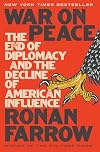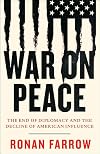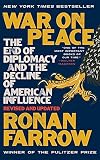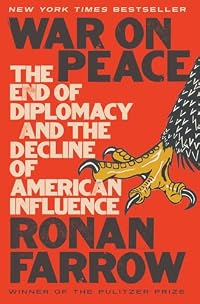
War on Peace: The End of Diplomacy and the Decline of American Influence
by Ronan Farrow
On This Page
Description
United States foreign policy is undergoing a dramatic transformation. Institutions of diplomacy and development are reeling from deep budget cuts. The diplomats who make America's deals and protect its citizens around the world are walking out in droves. Offices across the State Department sit empty, while abroad the military-industrial complex has assumed the work once undertaken by peacemakers. In a journey from the corridors of power in Washington, DC, to some of the most remote and show more dangerous places on earth--Afghanistan, Somalia, and North Korea among them--investigative journalist Ronan Farrow illuminates one of the most consequential and poorly understood changes in American history. His firsthand experience as a State Department official affords a personal look at some of the last standard bearers of traditional statecraft, including Richard Holbrooke, who made peace in Bosnia and died while trying to do so in Afghanistan. Drawing on newly unearthed documents, and richly informed by rare interviews with warlords, whistle-blowers, and policymakers--including every living secretary of state from Henry Kissinger to Hillary Clinton to Rex Tillerson--Farrow makes the case for an endangered profession. show lessTags
Recommendations







Member Reviews
Published in the distant days of 2018, War on Peace is an insider account of the collapse of American diplomacy by diplomat turned journalist Ronan Farrow. Before he brought down Harvey Weinstein, Farrow worked for Clinton alley and bureaucratic bulldozer Richard Holbrooke on the thorny issue of peace in Afghanistan during the first Obama administration. Farrow's job was coordination with NGOs, but what he really got was a front-row seat to the exercise of power. Through a series of vignettes, focusing mostly on Afghanistan, Pakistan, and the American diplomats who worked there, Farrow weaves a story about the ruin of soft power that reached a crescendo with the mass firings of senior State Department officials under Donald Trump, but show more reaches back decades earlier, possibly to the immediate aftermath of the highpoint of turning the WW2 Allies into the United Nations and founding NATO, and definitely to the Bush administration.
The basic problem that Farrow identifies is that State has allowed its bailiwick of diplomatic engagement to wither in favor of direct ties between the US military and foreign partners, the shadow wars of the CIA, the data-driven wiretapping of the NSA, and the presidential access of the National Security Advisor. Which means that when it comes time to talk, to trying and build consensus and 'win the peace', there's no one with the expertise and authority to do it.
Pakistan is Farrow's emblematic case. Pakistan has been an American client since the Soviet War in Afghanistan, where the CIA's covert aid was directed entirely through the Pakistani Inter-Services Intelligence. The ISI cultivated its own clients, who evolved into the Taliban. And when Pakistan became a crucial ally in the wake of 9/11, the relationship became fractally dysfunctional. As murky as American objectives were in Afghanistan, they were beholden to Pakistan's geographic grip on the ground lines of communication, and sovereignty over border regions that the mujahideen fighters used. Billions of dollars in aid flowed to Pakistan, and when American diplomats asked for progress on other issues, like democracy, human rights, and nuclear non-proliferation, the answer was a shrug: "Do you really care about those things, or do you care about your war?"
Repeatedly, American patronage of strongmen reversed the expected power dynamic. American policy could only advance through the actions of local leaders, who were often unpopular and sustained solely by American aid. Yet abandoning these strongmen, whatever their flaws, would mean chaos. And so America became identified with and reliant on warlords profoundly antithetical to stated American values in Pakistan, Afghanistan, Sudan, Egypt, Colombia, etc etc.
There are fair bureaucratic reasons for this. When the President gives an order to the military or the CIA, odds are something will happen. The same order given to State will result in a discussion. When the domestic 24 hour news cycle is what drives Washington, the slow and halting work of negotiation is both unsatisfying and presents the possibility for awkward news cycles. All recent administrations have participated in the process. Trump's Twitter driven foreign policy was novel more in its speed and random nature than it's uncoupling from the experts at State.
Broadly, I agree with Farrow's assessment that America should be more open in who it talks to, and exercise much more discretion in who it pays. There are hard questions to be asked about what level of past atrocities block an individual or organization from receiving American support, as well as what can be overlooked among America's friends in terms of corruption and violence, and this book doesn't really have the answers.
What I can say is that at a remove, American diplomacy is likely cooked. Since 9/11, we've lost or burnt out an entire generation of public servants. I don't think there's anyone like Holbrooke left at State, the kind of robust Kennedy-esque liberal who really did believe in "Asking what they could do for their country". Anyone with ideals and skills has either quit or gone into hiding, leaving the ticket-punchers and careerists.
What are the consequences? Well, I can only close with a quote from a Statecraft interview with DARPA officer Eric Van Gieson on Ebola response.
Cutting diplomacy is penny-wise, pound foolish. This is what it sounds like when an empire falls. show less
The basic problem that Farrow identifies is that State has allowed its bailiwick of diplomatic engagement to wither in favor of direct ties between the US military and foreign partners, the shadow wars of the CIA, the data-driven wiretapping of the NSA, and the presidential access of the National Security Advisor. Which means that when it comes time to talk, to trying and build consensus and 'win the peace', there's no one with the expertise and authority to do it.
Pakistan is Farrow's emblematic case. Pakistan has been an American client since the Soviet War in Afghanistan, where the CIA's covert aid was directed entirely through the Pakistani Inter-Services Intelligence. The ISI cultivated its own clients, who evolved into the Taliban. And when Pakistan became a crucial ally in the wake of 9/11, the relationship became fractally dysfunctional. As murky as American objectives were in Afghanistan, they were beholden to Pakistan's geographic grip on the ground lines of communication, and sovereignty over border regions that the mujahideen fighters used. Billions of dollars in aid flowed to Pakistan, and when American diplomats asked for progress on other issues, like democracy, human rights, and nuclear non-proliferation, the answer was a shrug: "Do you really care about those things, or do you care about your war?"
Repeatedly, American patronage of strongmen reversed the expected power dynamic. American policy could only advance through the actions of local leaders, who were often unpopular and sustained solely by American aid. Yet abandoning these strongmen, whatever their flaws, would mean chaos. And so America became identified with and reliant on warlords profoundly antithetical to stated American values in Pakistan, Afghanistan, Sudan, Egypt, Colombia, etc etc.
There are fair bureaucratic reasons for this. When the President gives an order to the military or the CIA, odds are something will happen. The same order given to State will result in a discussion. When the domestic 24 hour news cycle is what drives Washington, the slow and halting work of negotiation is both unsatisfying and presents the possibility for awkward news cycles. All recent administrations have participated in the process. Trump's Twitter driven foreign policy was novel more in its speed and random nature than it's uncoupling from the experts at State.
Broadly, I agree with Farrow's assessment that America should be more open in who it talks to, and exercise much more discretion in who it pays. There are hard questions to be asked about what level of past atrocities block an individual or organization from receiving American support, as well as what can be overlooked among America's friends in terms of corruption and violence, and this book doesn't really have the answers.
What I can say is that at a remove, American diplomacy is likely cooked. Since 9/11, we've lost or burnt out an entire generation of public servants. I don't think there's anyone like Holbrooke left at State, the kind of robust Kennedy-esque liberal who really did believe in "Asking what they could do for their country". Anyone with ideals and skills has either quit or gone into hiding, leaving the ticket-punchers and careerists.
What are the consequences? Well, I can only close with a quote from a Statecraft interview with DARPA officer Eric Van Gieson on Ebola response.
Q: When you were on the ground, how did our engagement in Africa stack up with Chinese and Russian engagement? Did you cross paths?
Yeah. There's an example of where we were waiting to go in to meet with an African delegation. I won't name the country, but our team was prepared to speak in French — we had translators. And we got half an hour with the delegation from their Ministry of Health. We walked out, and the Chinese delegation came in, but they went to the effort of not only knowing French, but also knowing a local language that none of us had ever heard, and they spoke in that language to their hosts. We were ushered out. The Chinese stayed for three hours.
Cutting diplomacy is penny-wise, pound foolish. This is what it sounds like when an empire falls. show less
Works best when it is a valentine to Richard Holbrooke, as Farrow clearly had a lot of respect for the man and worked closely enough with him to have an understanding of him that is not hagiographic, exactly. Weirdly, this Holbrooke-centric nature means that the narrative skips, more or less from Vietnam straight to Clinton.
It goes without saying that the Trump State Department is known to be a diplomatic cataclysm, and so further reiteration of this is not needed. There is some light discussion of the hand that Tillerson was dealt in this, though he is somebody who does not need sympathy. But the book is a bit like a discussion of Antediluvian farming techniques. It isn't like farming tips aren't helpful, and won't be helpful again. show more But having the destruction of everything be the opening and concluding chapters makes the rest of the narrative feel a bit small beer.
The most interesting aspect for people not steeped in diplomatic history, likely, is how cyclical these disasters are: new administration thinks diplomacy is a waste of time, and by second term spends four years undoing the first term's mistakes. Obama comes in for this criticism as well, which is interesting for a foreign policy team who's mantra (not expressed here) was allegedly: "Don't fuck things up." But Carter and Reagan aren't covered at all, which leaves a massive lacuna in any such history, in my opinion.
If one has read recent histories like [b:The Devil's Chessboard: Allen Dulles, the CIA, and the Rise of America's Secret Government|24723229|The Devil's Chessboard Allen Dulles, the CIA, and the Rise of America's Secret Government|David Talbot|https://images.gr-assets.com/books/1439315922s/24723229.jpg|44215740], one will ruefully nod in recognition of how many American disasters are predicated on consequences that are either unintended or to which the participants were indifferent for political reasons, though Farrow rarely gets into specifics about the political reasons, and instead simply acknowledges their existence.
The weirdest aspect is Farrow's tendency to foreground himself in the narrative, discussing the memos he sent or discussions he had in which he was always on the right side of history, lo, this one whole decade later. He's already become la belle enfant of investigative journalism. He really has no need to pad his resume in book form. show less
It goes without saying that the Trump State Department is known to be a diplomatic cataclysm, and so further reiteration of this is not needed. There is some light discussion of the hand that Tillerson was dealt in this, though he is somebody who does not need sympathy. But the book is a bit like a discussion of Antediluvian farming techniques. It isn't like farming tips aren't helpful, and won't be helpful again. show more But having the destruction of everything be the opening and concluding chapters makes the rest of the narrative feel a bit small beer.
The most interesting aspect for people not steeped in diplomatic history, likely, is how cyclical these disasters are: new administration thinks diplomacy is a waste of time, and by second term spends four years undoing the first term's mistakes. Obama comes in for this criticism as well, which is interesting for a foreign policy team who's mantra (not expressed here) was allegedly: "Don't fuck things up." But Carter and Reagan aren't covered at all, which leaves a massive lacuna in any such history, in my opinion.
If one has read recent histories like [b:The Devil's Chessboard: Allen Dulles, the CIA, and the Rise of America's Secret Government|24723229|The Devil's Chessboard Allen Dulles, the CIA, and the Rise of America's Secret Government|David Talbot|https://images.gr-assets.com/books/1439315922s/24723229.jpg|44215740], one will ruefully nod in recognition of how many American disasters are predicated on consequences that are either unintended or to which the participants were indifferent for political reasons, though Farrow rarely gets into specifics about the political reasons, and instead simply acknowledges their existence.
The weirdest aspect is Farrow's tendency to foreground himself in the narrative, discussing the memos he sent or discussions he had in which he was always on the right side of history, lo, this one whole decade later. He's already become la belle enfant of investigative journalism. He really has no need to pad his resume in book form. show less
War on Peace: The End of Diplomacy and the Decline of American Influence by Ronan Farrow is a fascinating look at the role of diplomacy in America's dealings around the world. Farrow spares no one as he examines the successes and failures of diplomacy. He demonstrates how the erosion of diplomacy has coincided with the increase of militarization of negotiation. Farrow details the complicated internal negotiations and jurisdictional struggles that go on within the myriad branches of the United States government and explains how those struggles shape our reactions around the world in ways that often seem more detrimental to peace and more conducive to war than we'd like to believe. Farrow interviewed many people who have participated in show more diplomacy and presents their experiences and opinions amidst the facts and evidence to demonstrate the complexity of the role of diplomacy in the world we all share. In the process, he also demonstrates how that erosion of diplomacy affects the influence of America throughout the world. War on Peace pushes the reader to think about not only the role of diplomacy and the influence of militarization on diplomacy but of the role of the United States of America in the world. show less
About half of this book recounts the author's time working with and for Richard Holbrooke and as such makes more of a statement about the late diplomat's personality and career than a coherent argument about the role of civilians, diplomats, in shaping and carrying out foreign policy. The remainder of the book makes a very effective argument for taking most of the power and a good bit of the money from the military and intelligence communities and putting them back into the hands of career, professional diplomats. Farrow bookends his work with the story of Thomas Countryman, someone I know n respect as a highly intelligent, highly dedicated public servant who was summarily dismissed in the midst of negotiations for no discernible show more reason. Unfortunately, there are now hundreds of stories like Tom's, dedicated civil servants, expert diplomats, dismissed without cause early in the Trump Administration. Farrow hints at many problems but takes aim at one that was growing even when I was still working as a U.S. diplomat, the swing toward military solutions for complex, often multi-lateral, issues in foreign relations. This isn't the book I had hoped Farrow wrote, but it is a damn good book! show less
Wow, if I wasn't depressed enough about the status and standing of the United States in the world, Farrow threw buckets of cold water on any of my expectations for American exceptionalism. Farrow did a tour around the world and showed how ineffective our diplomatic efforts have been in Afghanistan, North Korea, Columbia and Somalia. Farrow's interview with an obviously overmatched Rex Tillerson is worth the price of the book alone.
His description of Richard Holbrook's efforts to use statecraft and diplomacy to seek peace and resolution in Afghanistan is compelling reading. (Pretty obvious we can't trust anyone in that part of the world, especially Pakistan. This country looked the other way as dictators tortured and killed innocent show more civilians , including children.
Excellent journalism. A great book... show less
His description of Richard Holbrook's efforts to use statecraft and diplomacy to seek peace and resolution in Afghanistan is compelling reading. (Pretty obvious we can't trust anyone in that part of the world, especially Pakistan. This country looked the other way as dictators tortured and killed innocent show more civilians , including children.
Excellent journalism. A great book... show less
Investigative reporter Farrow draws on his years working in the state department and his various contacts to produce a credible argument for the importance of diplomacy in today's chaotic world. He examines events in recent history, particularly since 9/11/2001, that reflect on the growth of military influence in our government as opposed to the use of diplomatic efforts to solve worldwide issues. He argues that diplomacy should be supported by military force, not the other way around, which is what exists today. He discusses the further decline of diplomacy under Trump who appears to prefer loading his administration with ex-military people than seasoned diplomats and how Tillerson did more to destroy the state department than any show more other secretary of state. This is a thoughtful and insightful look at an important issue that is too often overlooked today. show less
Farrow's thesis here is that U.S. foreign policy is leaning heavily toward military decision makers and, as a consequence, away from diplomats. While he offers quite a few examples of how U.S. foreign policy has failed to address the biggest, thorniest issues of the past decade (Afghanistan, the Arab Spring, North Korea), I'm not sure he makes the case that those failures are because of a tilt toward military decision making rather than, for example, overinvolvement of domestic political actors or a desire for 'easy' wins over longterm planning. After all, diplomats could potentially be just as susceptible to those flaws as military leaders. That said, there's a lot of food for thought in this book, and I suspect I'll be thinking about show more it for quite awhile. show less
Members
- Recently Added By
Author Information

5+ Works 2,653 Members
Ronan Farrow is an American investigative journalist, lawyer, former government advisor, television anchor, writer, and makes documentaries for HBO. He was born in New York City in 1987. His writing has appeared in The Wall Street Journal, The New York Times, and The Washington Post. His reporting helped The New Yorker win the 2018 Pulitzer Prize show more for public service, along with The New York Times. His other awards include the George Polk Award, and the National Magazine Award, among other commendations. He is the author of War on Peace: The End of Diplomacy and the Decline of American Influence. (Bowker Author Biography) show less
Common Knowledge
- Canonical title*
- Guerra alla pace. Il declino della politica americana nel mondo
- Original title
- War on Peace: The End of Diplomacy and the Decline of American Influence
- Original publication date
- 2018
- Dedication
- For Mom
- First words
- Prologue
The diplomat had no clue that his career was over.
The diplomat was not always an endangered species. - Last words
- (Click to show. Warning: May contain spoilers.)If China can mature as a diplomatic power as rapidly as it has as a force for economic development, America will have ceded one of the most important ways in which great powers shape the world.
(Click to show. Warning: May contain spoilers.)Epilogue
For the following year, the job Tom Countryman once held would sit empty, like so many others. - Blurbers
- Isaacson, Walter; Raddatz, Martha; Bremmer, Ian; Polgreen, Lydia
- Original language
- English
- Canonical DDC/MDS
- 327.73
- Canonical LCC
- JZ1480.F37
*Some information comes from Common Knowledge in other languages. Click "Edit" for more information.
Classifications
- Genres
- Politics and Government, General Nonfiction, Nonfiction, History
- DDC/MDS
- 327.73 — Society, Government, and Culture Political science International Relations: Spies North America United States
- LCC
- JZ1480 .F37 — Political Science International relations International relations Scope of international relations. Political theory. Scope of international relations with regard to
- BISAC
Statistics
- Members
- 726
- Popularity
- 38,798
- Reviews
- 15
- Rating
- (4.14)
- Languages
- 5 — Dutch, English, German, Italian, Portuguese
- Media
- Paper, Audiobook, Ebook
- ISBNs
- 18
- ASINs
- 7