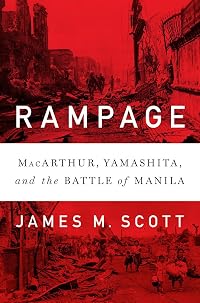
Rampage: MacArthur, Yamashita, and the Battle of Manila
by James M. Scott
On This Page
Description
Before World War II, Manila was a slice of America in Asia, populated with elegant neoclassical buildings, spacious parks, and home to thousands of U.S. servicemen and business executives who enjoyed the relaxed pace of the tropics. The outbreak of the war, however, brought an end to the good life. General Douglas MacArthur, hoping to protect the Pearl of the Orient, declared the Philippine capital an open city and evacuated his forces. The Japanese seized Manila on January 2, 1942, rounding show more up and interning thousands of Americans. MacArthur, who escaped soon after to Australia, famously vowed to return. For nearly three years, he clawed his way north, obsessed with redeeming his promise and turning his earlier defeat into victory. By early 1945, he prepared to liberate Manila, a city whose residents by then faced widespread starvation. Convinced the Japanese would abandon the city as he did, MacArthur planned a victory parade down Dewey Boulevard. But the enemy had other plans. Determined to fight to the death, Japanese marines barricaded intersections, converted buildings into fortresses, and booby-trapped stores, graveyards, and even dead bodies.The twenty-nine-day battle to liberate Manila resulted in the catastrophic destruction of the city and a rampage by Japanese forces that brutalized the civilian population. Landmarks were demolished, houses were torched, suspected resistance fighters were tortured and killed, countless women were raped, and their husbands and children were murdered. American troops had no choice but to battle the enemy, floor by floor and even room by room, through schools, hospitals, and even sports stadiums. In the end, an estimated 100,000 civilians lost their lives in a massacre as heinous as the Rape of Nanking. Based on extensive research in the United States and the Philippines, including war-crimes testimony, after-action reports, and survivor interviews, Rampage recounts one of the most heartbreaking chapters of Pacific war history. show lessTags
Recommendations






Member Reviews
This is a tough book to read, because the extensive, almost unbelievable cruelty of this campaign toward civilians is described in horrifying, sickening detail. Yet as time passes, the importance of books like these in helping us bear witness and remember becomes ever greater.
I wasn’t familiar with this campaign nor especially the legal aftermath. I felt pride as an American in learning of the vigor with which the Japanese Army commanding general was defended by Americans in his war crimes trial - not because I disagree with the verdict, but because it’s a measure of the greatness of our legal traditions at their best.
As a side note, General MacArthur, as one knows to expect if one studies history, comes off as gifted but arrogant show more in the extreme. Declaring Manila retaken before the fighting had even flared up fully was really something, even for him. show less
I wasn’t familiar with this campaign nor especially the legal aftermath. I felt pride as an American in learning of the vigor with which the Japanese Army commanding general was defended by Americans in his war crimes trial - not because I disagree with the verdict, but because it’s a measure of the greatness of our legal traditions at their best.
As a side note, General MacArthur, as one knows to expect if one studies history, comes off as gifted but arrogant show more in the extreme. Declaring Manila retaken before the fighting had even flared up fully was really something, even for him. show less
In Rampage, James Scott reminds us that the Holocaust was not the only atrocity of World War II. During the liberation of Manilla, the Japanese military displayed extreme barbarity towards the population: beheading or bayoneting men and boys who may become guerillas, gang-rape of teenage girls, mass burning of trapped people... It's almost too bad there wasn't a third atomic bomb.
Thanking of MacArthur and the Philippines, I previously thought of: Corregidor, flight before fall w/"I shall return", followed by the Bataan Death March. Well, all that is merely a few paragraphs of the several hundred pages of WW II scholarship here.
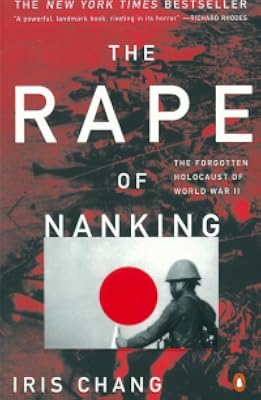
Instead, Yamashita and Sanji Iwabuchi (Rear Admiral in the Imperial Japanese Navy) lead Japanese marines etc. in a ruthless and hopeless defence of Manilla while exacting a rape and rampage holocaust on internees and civilians during the Battle of Manila recalling The Rape of Nanking. So, this is much more about the grim realities of those left behind waiting for the "return", many of which died in the crossfire and cruelties. The closing act is the hasty trial of Yamashita with its show more questionable process and conclusion.
[I obtained an ARC to review] show less
Instead, Yamashita and Sanji Iwabuchi (Rear Admiral in the Imperial Japanese Navy) lead Japanese marines etc. in a ruthless and hopeless defence of Manilla while exacting a rape and rampage holocaust on internees and civilians during the Battle of Manila recalling The Rape of Nanking. So, this is much more about the grim realities of those left behind waiting for the "return", many of which died in the crossfire and cruelties. The closing act is the hasty trial of Yamashita with its show more questionable process and conclusion.
[I obtained an ARC to review] show less
Ratings
Members
- Recently Added By
Lists

Dan Carlin's Supernova in the East Book List
61 works; 1 member
Author Information
6 Works 903 Members
Awards and Honors
Distinctions
Classifications
Statistics
- Members
- 181
- Popularity
- 178,645
- Reviews
- 3
- Rating
- (3.71)
- Languages
- English
- Media
- Paper, Audiobook, Ebook
- ISBNs
- 4
- ASINs
- 2