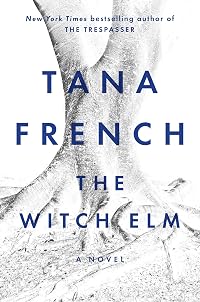
The Wych Elm
by Tana French
On This Page
Description
Toby is a happy-go-lucky charmer who is celebrating with friends when the night takes a turn that will change his life: he surprises two burglars who beat him and leave him for dead. Struggling to recover from his injuries, he takes refuge at his family's ancestral home to care for his dying uncle Hugo. Then a skull is found in the trunk of an elm tree in the garden. As detectives close in, Toby is forced to face the possibility that his past may not be what he has always believed.Tags
Recommendations









Member Recommendations

by anonymous user
dmenon90 A long-buried murder victim is found in familiar site, a close-knit group of friends under suspicion, well-drawn detective character, inner workings of narrator's mind, English/Irish setting, great pacing and dialog.
Member Reviews
After being violently attacked during a burglary in his apartment, the normally unflappable Toby is no longer able to spend nights alone. At his cousin Susanna’s request, he agrees to stay at his family’s ancestral home to look after his uncle Hugo, recently diagnosed with terminal brain cancer. And perhaps the time off from work and the peaceful setting will speed Toby’s recovery. But one afternoon during a family gathering a skull is discovered in the trunk of a wych elm tree in the garden, and the subsequent investigation throws the family into chaos.
The victim turns out to be someone known to Toby and his cousins, but it’s hard to imagine how the skull ended up in the tree. Was it in any way related to the burglary and show more attack? The police investigation has so many twists that almost any character in the novel could have committed the crimes. Tana French kept the suspense on high from start to finish, bringing forward more than one plausible suspect with only the number of pages remaining as a clue to whether they were really “the one.”
I found Toby rather obnoxious and self-centered, but that made for the most interesting aspect of this novel. While the attack damaged Toby’s memory and made him an unreliable narrator, in a painfully emotional scene with cousins Susanna & Leon, they revealed how Toby’s white male privilege caused him to minimize, discard, or “forget” key events in their lives. This behavior turned out to be a significant contributing factor in the victim’s untimely death. While it took Tana French a long time (508 pages!) to wrap up all the loose ends in this book, there is much to admire and think about. show less
The victim turns out to be someone known to Toby and his cousins, but it’s hard to imagine how the skull ended up in the tree. Was it in any way related to the burglary and show more attack? The police investigation has so many twists that almost any character in the novel could have committed the crimes. Tana French kept the suspense on high from start to finish, bringing forward more than one plausible suspect with only the number of pages remaining as a clue to whether they were really “the one.”
I found Toby rather obnoxious and self-centered, but that made for the most interesting aspect of this novel. While the attack damaged Toby’s memory and made him an unreliable narrator, in a painfully emotional scene with cousins Susanna & Leon, they revealed how Toby’s white male privilege caused him to minimize, discard, or “forget” key events in their lives. This behavior turned out to be a significant contributing factor in the victim’s untimely death. While it took Tana French a long time (508 pages!) to wrap up all the loose ends in this book, there is much to admire and think about. show less
The Witch Elm by Tana French reads less like a thriller and more like a mystery. Even then, it is less a whodunit and more of a search for the correct psychopath. All of this with elements of a family drama, a coming-of-age reckoning, and a reflection on the idea of memory. Toby’s story doesn’t appear to be complex, and yet there are more layers to it than a good lasagna. And yet, you will spend an inordinate amount of time trying to figure out just how big a tree needs to be to hide a man.
Ms. French puts poor Toby through the shit in The Witch Elm. Not only does he face a brutal assault at the hands of burglars in his home, but he must also deal with his favorite uncle slowly dying from brain cancer. Because that is not enough for show more one person to experience in a matter of weeks, she then adds a murder mystery at the family home on top of all that. Yet, for the most part, Toby handles all of it better than I would on my best day. Just thinking about dealing with all that is enough to send me into an anxiety-filled paralysis.
As most of her novels are more character than plot-driven, this is exactly the point. She takes Toby and pushes him to see what his breaking point is. How she does this is brilliant, fascinating, and cruel, as she questions the very nature of memory. She starts with the obvious with Toby’s memory loss due to the brain injuries he suffers. Her shift towards the frailty of memory as a whole is subtle and yet terrifying, as she points out again and again that two people will remember two very different events. While Toby questions the very nature of his relationships with his cousins, you too can’t help but question the validity of all of your memories. Eventually, the term unreliable witness has a completely different meaning as you watch Toby repeatedly reconcile his memories with the stories others tell him.
Because Ms. French is a writing master, she doesn’t stop with memory though. She throws in the complications of family dynamics. Here too, Toby realizes that the relationships he thought were so important may not have the same importance to other family members. This hurts in any relationship, but there is something particularly bittersweet when this happens among family. For Toby, it throws yet another level of tension into an already intense situation.
The Witch Elm is the type of story where the whodunit is less important than the reasons why and what happens next. That doesn’t mean that the whodunit reveal isn’t chilling. In fact, it is so matter-of-fact as to be very disturbing upon reflection. Still, after everything Toby experiences, everything we learn about the reasoning behind the murder is essentially anticlimactic. While not totally predictable, one can infer a lot before the big reveal, and the whole scene is less than satisfactory, which again is Ms. French’s plan.
If anything, The Witch Elm is a tough read that reiterates that life rarely provides satisfactory answers to its problems. I expected the intensity and the level of disturbing given the other French novels I read. I was not prepared for the emotional aspect of the story. Toby bears so much, and you can’t help but empathize with him as he waffles between anger, grief, confusion, anxiety, and everything in between. All while obsessing over the size of that damn tree. show less
Ms. French puts poor Toby through the shit in The Witch Elm. Not only does he face a brutal assault at the hands of burglars in his home, but he must also deal with his favorite uncle slowly dying from brain cancer. Because that is not enough for show more one person to experience in a matter of weeks, she then adds a murder mystery at the family home on top of all that. Yet, for the most part, Toby handles all of it better than I would on my best day. Just thinking about dealing with all that is enough to send me into an anxiety-filled paralysis.
As most of her novels are more character than plot-driven, this is exactly the point. She takes Toby and pushes him to see what his breaking point is. How she does this is brilliant, fascinating, and cruel, as she questions the very nature of memory. She starts with the obvious with Toby’s memory loss due to the brain injuries he suffers. Her shift towards the frailty of memory as a whole is subtle and yet terrifying, as she points out again and again that two people will remember two very different events. While Toby questions the very nature of his relationships with his cousins, you too can’t help but question the validity of all of your memories. Eventually, the term unreliable witness has a completely different meaning as you watch Toby repeatedly reconcile his memories with the stories others tell him.
Because Ms. French is a writing master, she doesn’t stop with memory though. She throws in the complications of family dynamics. Here too, Toby realizes that the relationships he thought were so important may not have the same importance to other family members. This hurts in any relationship, but there is something particularly bittersweet when this happens among family. For Toby, it throws yet another level of tension into an already intense situation.
The Witch Elm is the type of story where the whodunit is less important than the reasons why and what happens next. That doesn’t mean that the whodunit reveal isn’t chilling. In fact, it is so matter-of-fact as to be very disturbing upon reflection. Still, after everything Toby experiences, everything we learn about the reasoning behind the murder is essentially anticlimactic. While not totally predictable, one can infer a lot before the big reveal, and the whole scene is less than satisfactory, which again is Ms. French’s plan.
If anything, The Witch Elm is a tough read that reiterates that life rarely provides satisfactory answers to its problems. I expected the intensity and the level of disturbing given the other French novels I read. I was not prepared for the emotional aspect of the story. Toby bears so much, and you can’t help but empathize with him as he waffles between anger, grief, confusion, anxiety, and everything in between. All while obsessing over the size of that damn tree. show less
Tana French has always kept her readers guessing, and with her first non-detective protagonist, she gives us even more guesswork: Toby is an unreliable narrator, partly due to brain trauma he received during a break-in and assault in his home, but there may be more to it.
The story starts with lucky, golden-boy Toby celebrating the end of a week with his mates Sean and Declan; he'd been in trouble at work, but weaseled out of it, and is relieved. But his night takes a dark turn, landing him in the hospital, and a long road to recovery. It turns out that his beloved Uncle Hugo is dying of cancer and needs help, so Toby and his girlfriend Melissa move into the Ivy House with Hugo. Toby had spent summers at the Ivy House as a kid and show more teenager with his cousins Susanna and Leon, but they don't share his golden memories; there was a lot going on that Toby wasn't aware of, despite Susanna and Leon's efforts to make him understand.
The plot really kicks off when one of the kids in the family discovers a skull in the 200-yer-old wych elm in the garden (this happens on page 162; it's a slow burn till then). The police swarm in, analyze the skull, cut down the tree (to the arborist's fury), and dig up the entire garden. Now it's a murder case, and the house's inhabitants are the prime suspects, and once the body is identified - it's Dominic Ganly, a old classmate of theirs - details of Toby, Susanna, and Leon's final summer in the Ivy House begin coming to light.
*Spoiler alert*
Toby wracks his brain for memories of that summer, and tries to get as much information as he can from Susanna and Leon, while at the same time suspecting that either or both of them are subtly pointing the cops in his direction. Susanna and Leon eventually reveal the extent that Dominic tormented not just Leon, both both of them: frightening, sadistic harassment, with the threat of violence and rape. They had tried to impress the seriousness of this on Toby at the time, but he hadn't understood; and when Susanna tells him about a doctor who molested her when she was pregnant with her first child, he doesn't really believe that either. In fact, that seems to be Toby's worst crime (thus far): he doesn't truly believe the authenticity of anyone's experience if it's different from his own.
Susanna and Leon reveal that they killed Dominic, and that Toby had no knowledge or involvement in it. (Hugo, however, saw them out the window; he saw enough to confess, to save them and Toby.) But when a detective visits Toby alone in the house at night, with Hugo's confession and enough corroborating evidence but without a motive - Toby snaps, they fight, and Toby kills him. After a trial, Toby winds up in a mental institution for a couple of years, and then is released: free, but on a completely different life track than he had been on before. And the break-in? It was connected to the problem at work, 500 pages ago, nothing to do with Dominic's murder.
Quotes
"I'm not the same person anymore." (Toby to Hugo, talking about his life after the assault, 219)
"Oh, you. I swear by the next week you'd forgotten it ever happened. Typical: anything you feel bad about just falls straight out of your head." (Susanna to Toby, 237)
"You know, Leon doesn't always like you that much." (Susanna to Toby, 240)
And if I was a real person within this, then I could do something about it. (Toby, realizing that the break-in was personal, not random, 252)
"I suppose the truth is that I've never been a man of action...A man of inertia, more like....The thing is, I suppose, one gets into the habit of being oneself. It takes some great upheaval to crack that shell and force us to discover what else might be underneath." (Hugo to Toby and Melissa, 297)
"We know each other too well; we don't really look at each other properly." (Susanna to Melissa, 320)
I couldn't tell whether Leon was rewriting history to make himself feel better about whatever he was trying to pull on me, or whether I had genuinely missed some subtle but crucial shift along the way. (Toby, 321)
This conversation was turning out to be enlightening in ways I hasn't expected. Apparently my image of Susanna...was out of date. (328)
I felt like there was an excellent chance she was exaggerating...and a non-zero chance that she was making the whole thing up... (Toby re: Susanna's story about the doctor, 328)
"Oh. My. God. You are unbelievable, do you know that? You're in your own world, it's like talking to an alien--" (Leon to Toby, 336)
"What could they know that'll make anything better?" (Melissa to Toby, 341)
"Maybe next time I tell you something, you'll stop fussing and take my word for it." (Hugo to Toby, 359)
I wasn't sure how to confess to something I didn't remember....I didn't for a second consider the possibility that Hugo was telling the truth. (365)
I had hung on to the idea that at least I was a decent guy, one of the good guys...I had never seen myself as some white knight...but I did still want to believe that at some level, at least, I had been a decent guy. (398-399)
At this point nothing my memory came up with felt reliable.... (442)
The world I had been blithely bouncing through had been so utterly unrelated to this one running along its dark subterranean track, I couldn't make the two of them click together in my mind. (442)
But my mind still had ravaged places in it, gaping holes full of drifting things...(506) show less
The story starts with lucky, golden-boy Toby celebrating the end of a week with his mates Sean and Declan; he'd been in trouble at work, but weaseled out of it, and is relieved. But his night takes a dark turn, landing him in the hospital, and a long road to recovery. It turns out that his beloved Uncle Hugo is dying of cancer and needs help, so Toby and his girlfriend Melissa move into the Ivy House with Hugo. Toby had spent summers at the Ivy House as a kid and show more teenager with his cousins Susanna and Leon, but they don't share his golden memories; there was a lot going on that Toby wasn't aware of, despite Susanna and Leon's efforts to make him understand.
The plot really kicks off when one of the kids in the family discovers a skull in the 200-yer-old wych elm in the garden (this happens on page 162; it's a slow burn till then). The police swarm in, analyze the skull, cut down the tree (to the arborist's fury), and dig up the entire garden. Now it's a murder case, and the house's inhabitants are the prime suspects, and once the body is identified - it's Dominic Ganly, a old classmate of theirs - details of Toby, Susanna, and Leon's final summer in the Ivy House begin coming to light.
*Spoiler alert*
Toby wracks his brain for memories of that summer, and tries to get as much information as he can from Susanna and Leon, while at the same time suspecting that either or both of them are subtly pointing the cops in his direction. Susanna and Leon eventually reveal the extent that Dominic tormented not just Leon, both both of them: frightening, sadistic harassment, with the threat of violence and rape. They had tried to impress the seriousness of this on Toby at the time, but he hadn't understood; and when Susanna tells him about a doctor who molested her when she was pregnant with her first child, he doesn't really believe that either. In fact, that seems to be Toby's worst crime (thus far): he doesn't truly believe the authenticity of anyone's experience if it's different from his own.
Susanna and Leon reveal that they killed Dominic, and that Toby had no knowledge or involvement in it. (Hugo, however, saw them out the window; he saw enough to confess, to save them and Toby.) But when a detective visits Toby alone in the house at night, with Hugo's confession and enough corroborating evidence but without a motive - Toby snaps, they fight, and Toby kills him. After a trial, Toby winds up in a mental institution for a couple of years, and then is released: free, but on a completely different life track than he had been on before. And the break-in? It was connected to the problem at work, 500 pages ago, nothing to do with Dominic's murder.
Quotes
"I'm not the same person anymore." (Toby to Hugo, talking about his life after the assault, 219)
"Oh, you. I swear by the next week you'd forgotten it ever happened. Typical: anything you feel bad about just falls straight out of your head." (Susanna to Toby, 237)
"You know, Leon doesn't always like you that much." (Susanna to Toby, 240)
And if I was a real person within this, then I could do something about it. (Toby, realizing that the break-in was personal, not random, 252)
"I suppose the truth is that I've never been a man of action...A man of inertia, more like....The thing is, I suppose, one gets into the habit of being oneself. It takes some great upheaval to crack that shell and force us to discover what else might be underneath." (Hugo to Toby and Melissa, 297)
"We know each other too well; we don't really look at each other properly." (Susanna to Melissa, 320)
I couldn't tell whether Leon was rewriting history to make himself feel better about whatever he was trying to pull on me, or whether I had genuinely missed some subtle but crucial shift along the way. (Toby, 321)
This conversation was turning out to be enlightening in ways I hasn't expected. Apparently my image of Susanna...was out of date. (328)
I felt like there was an excellent chance she was exaggerating...and a non-zero chance that she was making the whole thing up... (Toby re: Susanna's story about the doctor, 328)
"Oh. My. God. You are unbelievable, do you know that? You're in your own world, it's like talking to an alien--" (Leon to Toby, 336)
"What could they know that'll make anything better?" (Melissa to Toby, 341)
"Maybe next time I tell you something, you'll stop fussing and take my word for it." (Hugo to Toby, 359)
I wasn't sure how to confess to something I didn't remember....I didn't for a second consider the possibility that Hugo was telling the truth. (365)
I had hung on to the idea that at least I was a decent guy, one of the good guys...I had never seen myself as some white knight...but I did still want to believe that at some level, at least, I had been a decent guy. (398-399)
At this point nothing my memory came up with felt reliable.... (442)
The world I had been blithely bouncing through had been so utterly unrelated to this one running along its dark subterranean track, I couldn't make the two of them click together in my mind. (442)
But my mind still had ravaged places in it, gaping holes full of drifting things...(506) show less
I'm a fan. I've read and (mostly) loved all Tana French's books. I really liked this one; however, it diverges from her regular offerings in that the book isn't part of the Dublin Murder Squad series and, although there is a mystery, it isn't the main plot driver. The story is really a character study of the protagonist, Toby Hennessy, who skates above the troubled waters of the world in his rich-privileged-white-man bubble. Until he becomes the victim of a crime, and discovers how his own thoughtless actions have aided and abetted another.
This story isn't going to be for everyone. The Witch Elm IS NOT A THRILLER. It is a literary novel with a crime in it. It's a slow, rich burn with French's usual evocative, beautiful prose. Although show more we do discover the solution to the mystery in the witch elm, the real question is whether Toby will be able to change the kind of person he is. Although he does gain some awareness, he makes a grave mistake in how he chooses to transform himself, and we're left hanging as to whether he has truly succeeded. show less
This story isn't going to be for everyone. The Witch Elm IS NOT A THRILLER. It is a literary novel with a crime in it. It's a slow, rich burn with French's usual evocative, beautiful prose. Although show more we do discover the solution to the mystery in the witch elm, the real question is whether Toby will be able to change the kind of person he is. Although he does gain some awareness, he makes a grave mistake in how he chooses to transform himself, and we're left hanging as to whether he has truly succeeded. show less
Tana French has been lauded for her writing and her "ingenious plotting" by people who know a lot more about those subjects than I do (like Stephen King) but I concur with that assessment. I've only read one other book by her but I intend to read more.
Toby has lived a charmed life--he's good looking, intelligent, charming and, above all, lucky. At the age of twenty-eight he has a great job as the public relations person for a Dublin art gallery, he has a girlfriend who he adores and who adores him, he's got good mates and a close family. He has no siblings but his two cousins, Leon and Susanna, are his age and because they spent each summer with their uncle Hugo in his huge old house while their parents vacationed together they are show more closer perhaps than siblings would have been. Then his life is torn asunder one night when Toby's flat is broken into and he is badly beaten by the robbers. He has continuing neurological problems which may or may not resolve over time. He is not fit for work and he is terrified of being alone in his apartment. So, when his cousin Susanna tells him that Uncle Hugo is dying of brain cancer and he could use someone to move in with him, Toby decides to give it a go. He convinces his girlfriend Melissa to move in with him and it all seems to be working well for everyone. One Sunday when the whole clan has gathered at Hugo's house for lunch Susanna's two youngsters make a terrifying discovery. They find a skull in a hollow in a big wych elm at the end of Hugo's garden. Soon the police are crawling all over the garden where they discover a complete skeleton which turns out to be a classmate of Toby and Leon's who went missing the summer after they graduated from school. Everyone assumed he had committed suicide because he got such bad marks he couldn't get into any post-secondary schools. Of course the police soon determine he was killed and put into the tree to hide him. Did Toby kill him? Some evidence seems to point to him. When you finally learn who the guilty party was you can see how deftly French set this up. And then there is a final little twist that will leave your head spinning.
Remarkably good. show less
Toby has lived a charmed life--he's good looking, intelligent, charming and, above all, lucky. At the age of twenty-eight he has a great job as the public relations person for a Dublin art gallery, he has a girlfriend who he adores and who adores him, he's got good mates and a close family. He has no siblings but his two cousins, Leon and Susanna, are his age and because they spent each summer with their uncle Hugo in his huge old house while their parents vacationed together they are show more closer perhaps than siblings would have been. Then his life is torn asunder one night when Toby's flat is broken into and he is badly beaten by the robbers. He has continuing neurological problems which may or may not resolve over time. He is not fit for work and he is terrified of being alone in his apartment. So, when his cousin Susanna tells him that Uncle Hugo is dying of brain cancer and he could use someone to move in with him, Toby decides to give it a go. He convinces his girlfriend Melissa to move in with him and it all seems to be working well for everyone. One Sunday when the whole clan has gathered at Hugo's house for lunch Susanna's two youngsters make a terrifying discovery. They find a skull in a hollow in a big wych elm at the end of Hugo's garden. Soon the police are crawling all over the garden where they discover a complete skeleton which turns out to be a classmate of Toby and Leon's who went missing the summer after they graduated from school. Everyone assumed he had committed suicide because he got such bad marks he couldn't get into any post-secondary schools. Of course the police soon determine he was killed and put into the tree to hide him. Did Toby kill him? Some evidence seems to point to him. When you finally learn who the guilty party was you can see how deftly French set this up. And then there is a final little twist that will leave your head spinning.
Remarkably good. show less
This long and moody novel has much in common with the Dublin Murder Squad novels taken as a whole. It presents a complex, continual reframing of events over time, in gorgeous, intricately plotted prose. In a lot of ways, it’s a revisioning of the components of In the Woods, with a tight perspective from one point of view that looks back and resamples key incidents from the past. I knew I should maintain suspicion, but of who, and for how long? It’s delightfully unsettling.
This is a page turner of a psychological character study wearing the disguise of a dark Dublin-centered mystery. Toby is a PR guy for an art gallery -- privileged, white, well-off, and a charmer. He is good at fitting in, getting his way, and talking himself out of tight spots, and he knows it. He has a lovely girlfriend, some close mates, and owns his own flat. One night after blowing off some steam with his friends at the pub after a serious misstep at work, he is attacked by two burglars who beat him severely -- almost killing him and leaving him with a lasting head injury. Once an athletic smooth talker, Toby now struggles to find the right word, has big chunks missing from his memory, and has weakness on one side of his body. While show more he tries desperately to hide it from those around him, his confidence and assumption that things are safe and he is in charge has been ripped away, and he is devastated. At the same time, his beloved Uncle Hugo has been diagnosed with terminal brain cancer and needs someone to stay with him at the Ivy House, the rambling old family home where Toby would spend entire summers with his cousins -- including what he remembers as idyllic teenage years of drugs and parties under the not-so-watchful eye of Hugo. Toby and his girlfriend Melissa move in and things are going relatively smoothly when Susanna's son unearths a skull in a hole of an ancient Wych Elm in the back garden. The police are called in and Toby is thrust into a transformational mystery.
This is the first Tana French book I've read, and I really want to read more although, judging from other reviews, many die hard fans of her Dublin Murder Squad series were disappointed by this book. I came at it expecting it to be a fun suspense novel and was rewarded with something much more meaty and muddy than I expected with an evocative literary writing style and a deep, non-cliched level of characterization, even for relatively minor characters. Toby is a sympathetic, but not a likable protagonist, and the revelations of the book thrust pretty much everyone into a morally ambiguous territory. The ending leaves a lot to chew on, including the potentially huge impact of small cruelties, the dissatisfaction of knowing "the truth," the blinders of privilege, and the impact of the lies we all tell ourselves about ourselves and our pasts.
Stir in a classic unreliable narrator (my fave), some cancer stuff, charming Dublin slang, and a dash of archives and genealogy, and you have a recipe for an excellent read. Highly recommended, even if it may not be what you are expecting. show less
This is the first Tana French book I've read, and I really want to read more although, judging from other reviews, many die hard fans of her Dublin Murder Squad series were disappointed by this book. I came at it expecting it to be a fun suspense novel and was rewarded with something much more meaty and muddy than I expected with an evocative literary writing style and a deep, non-cliched level of characterization, even for relatively minor characters. Toby is a sympathetic, but not a likable protagonist, and the revelations of the book thrust pretty much everyone into a morally ambiguous territory. The ending leaves a lot to chew on, including the potentially huge impact of small cruelties, the dissatisfaction of knowing "the truth," the blinders of privilege, and the impact of the lies we all tell ourselves about ourselves and our pasts.
Stir in a classic unreliable narrator (my fave), some cancer stuff, charming Dublin slang, and a dash of archives and genealogy, and you have a recipe for an excellent read. Highly recommended, even if it may not be what you are expecting. show less
Members
- Recently Added By
Lists

Female Author
1,234 works; 67 members

Amazon best fictional genre picks monthly for 2018
418 works; 9 members

Books Read in 2019
4,052 works; 108 members

Dim Sum Lunch Reading
43 works; 2 members

Books Read in 2020
4,379 works; 124 members

BBC Radio 4 Bookclub
340 works; 13 members

Top Five Books of 2023
767 works; 317 members

Overdue Podcast
806 works; 9 members

Fiction (Non-Fantasy) by Irish Authors Set in Ireland
87 works; 3 members

Feminism
167 works; 4 members

Books Read in 2025
4,091 works; 97 members
Author Information

27+ Works 41,529 Members
Tana French grew up in Ireland, Italy, the US and Malawi. She trained as a professional actress at Trinity College, Dublin, and has worked in theatre, film and voiceover. Her first novel, In the Woods, won the 2007 Edgar Award for Best First Novel. Her other books include The Likeness, Faithful Place, Broken Harbor, and The Secret Place. The show more Trespasser and The Witch Elm made the New York Times bestseller list. (Bowker Author Biography) show less
Some Editions
Awards and Honors
Awards
Distinctions
Notable Lists
Series
Belongs to Publisher Series
Fischer Taschenbuch (70163)
Common Knowledge
- Canonical title
- The Wych Elm
- Alternate titles
- The Witch Elm (US) (US)
- Original publication date
- 2018
- People/Characters
- Toby Hennessy; Hugo Hennessy; Leon Hennessy; Susanna Hennessy; Dominic Ganly; Mike Rafferty (show all 7); Declan McGinty
- Important places
- Dublin, Ireland
- Epigraph
- Lord, we know what we are,
but know not what we may be.
-- William Shakespeare, Hamlet - Dedication
- For Kristina
- First words
- I've always considered myself to be, basically, a lucky person.
- Last words
- (Click to show. Warning: May contain spoilers.)And if somehow that has been excised from me, and if in fact I am stil here without it, then what am I?
- Blurbers
- King, Stephen
- Canonical DDC/MDS
- 823.92
- Canonical LCC
- PR6106.R457
Classifications
Statistics
- Members
- 3,348
- Popularity
- 5,052
- Reviews
- 193
- Rating
- (3.57)
- Languages
- 7 — Dutch, English, French, German, Polish, Spanish, Swedish
- Media
- Paper, Audiobook, Ebook
- ISBNs
- 41
- ASINs
- 7