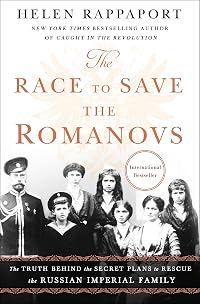
The Race to Save the Romanovs: The Truth Behind the Secret Plans to Rescue the Russian Imperial Family
by Helen Rappaport
On This Page
Description
"Investigating the murder of the Russian Imperial Family, Helen Rappaport embarks on a quest to uncover the many international plots to save them, why they failed, and who was responsible. The murder of the Romanov family in July 1918 horrified the world and its aftershocks still reverberate today. In Putin's autocratic Russia, the Revolution itself is considered a crime and its one hundredth anniversary was largely ignored. In stark contrast, the centenary of the massacre of the Imperial show more Family will be a huge ceremony to be attended by the Patriarch of the Russian Orthodox Church. While the murder itself has received major attention, what has never been investigated in detail are the various plots behind the scenes to save the family--on the part of their royal relatives, other governments, and Russian monarchists loyal to the Tsar. Rappaport refutes the accusation that the fault lies entirely with King George V, as has been the traditional claim for the last century. The responsibility for failing the Romanovs must be equally shared. The question of asylum for the Tsar and his family was an extremely complicated issue that presented enormous political, logistical and geographical challenges at a time when Europe was still at war. Like a modern-day detective, Helen Rappaport draws on new and never-before-seen sources from archives in the United States, Russia, Spain and the United Kingdom, creating a powerful account of near misses and close calls with a heartbreaking conclusion. With its up-to-the-minute research, The Race to Save the Romanovs is sure to replace outdated classics as the final word on the fate of the Romanovs"-- show lessTags
Recommendations







Member Recommendations
Member Reviews
This is truly a fantastic book, and one that just "happened" to be sitting on display at the library when I went to pick up another book. And what kept me reading, and paying a library fine, and renewing this book was the enormous gift Ms. Rappaport has for explaining the relations between the descendants of Queen Victoria. It's not easy to do, but the consistency of using the same terms and explaining the same rulers in the same way, throughout the book ensures that the reader has a better understanding of who was related to whom, who married whom from what house, and why that all plays a role in the tragedy of Tsar Nicholas and his family.
And in the end, it was a tragedy. The murder of this family was not a clean, swift execution. And show more Rappaport also describes the feelings that Nicholas and Alexandra had towards their country; their loyalty to Russia meant that even if a quick rescue could have happened, they may not have wanted to leave. Which is an interesting and tragic thought.
Rappaport has access to diaries, letters, memoirs, cables, and recollections of the people who decided not to save them and why, or who tried to save them by urging other heads of state to do something, anything, despite the frozen bays and lakes and vast distances. Monarchist, spy, loyal Russians, family members, all failed and there is little evidence that few even tried. show less
And in the end, it was a tragedy. The murder of this family was not a clean, swift execution. And show more Rappaport also describes the feelings that Nicholas and Alexandra had towards their country; their loyalty to Russia meant that even if a quick rescue could have happened, they may not have wanted to leave. Which is an interesting and tragic thought.
Rappaport has access to diaries, letters, memoirs, cables, and recollections of the people who decided not to save them and why, or who tried to save them by urging other heads of state to do something, anything, despite the frozen bays and lakes and vast distances. Monarchist, spy, loyal Russians, family members, all failed and there is little evidence that few even tried. show less
The author here has defied the odds and has actually written something fresh and interesting on the last days of the Imperial Russian family. This, in no small measure due to the fact that she has done some diligent research and has turned up new material, including (literally) some material that had been misfiled. She explores the question of who, if anyone, could have saved the Romanovs. If race it was, it was a race where a number of the competitors were wearing leaden shoes, versus a ruthless and determined group that had decreed the fate of the family months before. Only King Alfonso XIII of Spain comes out from this account as something of a hero; even the Empress Alexandra, owing to her stubbornness and lack of common sense, gets show more some richly deserved criticism. Well worth reading; I read this book on almost precisely the 100th anniversary of the murders. show less
This week marks the 100th anniversary of the murder of the Russian imperial family by the Bolsheviks. Among those killed were not only the hated Tsar Nicholas and his wife Alexandra, but also their five children and the servants. It is now generally accepted that the murder was a barbaric act, and these days it is marked by pilgrimages of many thousands of Russians to the site of the crime.
Helen Rappaport’s book, completed just in time to mark the anniversary, is the latest attempt by a historian to discover the truth about the fate of the Romanovs. We now know with certainty that they all died; the discovery of their graves and DNA evidence is quite convincing on these points. All those men and women who claimed to be Anastasia or show more Alexei were frauds. What we do not know is if they could have been saved, and if so, by whom.
Rappaport has done an extraordinary job of research in archives, including some of the most unlikely places, to try to discover the truth behind stories of attempts by the British royal family, or the German Kaiser, or local Russian monarchists, to whisk the imperial family away from their captors. She concludes that there really never was much of a chance, once the Tsar had abdicated, of this happening, not least because he and his wife had no desire to go into exile.
She also makes it abundantly clear that the British royal family made no effort to intervene in part for fear that hosting the hated former Tsar on British soil could trigger a republican revolution that would have brought down the House of Windsor.
The book is punctuated with italicised paragraphs going into great deal about things like the mis-filing of documents in the National Archives in Kew — which interested me tremendously though I doubt a general audience would enjoy these as much.
The only failings in the book which I could see — and this is something every historian deals with — is when she leaves the familiar ground of the imperial family and comments on something else. For example, she describes historian N. Sukhanov as a Bolshevik when he was not; in fact, he was tried as a Menshevik and eventually executed on Stalin’s orders. Or her reference to “the new official newspaper, the Bolshevik-run Pravda” in early 1917 — a time when Pravda was the party organ of Lenin’s Bolsheviks. It would not have any “official” status until the Bolshevik coup in November of that year. She may even have gotten it wrong in referring to “railway lines largely controlled by hostile Bolshevik revolutionaries” in April 1917 — a time when the Bolsheviks were a fairly small party, one among many, and without Lenin yet on the scene, not much more militant than any of the others.
That having been said, the book is not about the Bolsheviks — it’s about the fate of the Romanovs, and it’s excellently researched and well-written and may, perhaps, turn out to be the final word on the subject. show less
Helen Rappaport’s book, completed just in time to mark the anniversary, is the latest attempt by a historian to discover the truth about the fate of the Romanovs. We now know with certainty that they all died; the discovery of their graves and DNA evidence is quite convincing on these points. All those men and women who claimed to be Anastasia or show more Alexei were frauds. What we do not know is if they could have been saved, and if so, by whom.
Rappaport has done an extraordinary job of research in archives, including some of the most unlikely places, to try to discover the truth behind stories of attempts by the British royal family, or the German Kaiser, or local Russian monarchists, to whisk the imperial family away from their captors. She concludes that there really never was much of a chance, once the Tsar had abdicated, of this happening, not least because he and his wife had no desire to go into exile.
She also makes it abundantly clear that the British royal family made no effort to intervene in part for fear that hosting the hated former Tsar on British soil could trigger a republican revolution that would have brought down the House of Windsor.
The book is punctuated with italicised paragraphs going into great deal about things like the mis-filing of documents in the National Archives in Kew — which interested me tremendously though I doubt a general audience would enjoy these as much.
The only failings in the book which I could see — and this is something every historian deals with — is when she leaves the familiar ground of the imperial family and comments on something else. For example, she describes historian N. Sukhanov as a Bolshevik when he was not; in fact, he was tried as a Menshevik and eventually executed on Stalin’s orders. Or her reference to “the new official newspaper, the Bolshevik-run Pravda” in early 1917 — a time when Pravda was the party organ of Lenin’s Bolsheviks. It would not have any “official” status until the Bolshevik coup in November of that year. She may even have gotten it wrong in referring to “railway lines largely controlled by hostile Bolshevik revolutionaries” in April 1917 — a time when the Bolsheviks were a fairly small party, one among many, and without Lenin yet on the scene, not much more militant than any of the others.
That having been said, the book is not about the Bolsheviks — it’s about the fate of the Romanovs, and it’s excellently researched and well-written and may, perhaps, turn out to be the final word on the subject. show less
July 17 2018 Marks the 100th year Anniversary of the murder of the Russian Imperial family -
I wanted to read another book on the Russian Imperial Family and when I listenend to Helen Helen Rappaport's interview on Dan Snows History Hit Podcast , I just had to get my hands on a copy of[b:The Race to Save the Romanovs: The Truth Behind the Secret Plans to Rescue the Russian Imperial Family|33116011|The Race to Save the Romanovs The Truth Behind the Secret Plans to Rescue the Russian Imperial Family|Helen Rappaport|https://images.gr-assets.com/books/1527712878s/33116011.jpg|53780528]
Helen Rappaport an acclaimed historian and researcher has written in my opinion an extremely well researched and informative account of the last few show more months of the Russian Imperial Family.
This book is different than anything else I have read concerning the Romanovs as this account embarks on a quest to uncover the various plots and plans to save the family, why they failed, and who was responsible. At last a book that tries to answer the questions I had running around in my head while reading other books on the Romanovs. Many of the Royal courts of Europe were closely related to the family and what plans if any were out to rescue them is well documented here and they reasons why these plans didn't materialise or if indeed they were ever in place. The author puts to bed many myths and inaccuracies surrounding this horrible time in Russian history.
A word of warning this book has a lot of information, dates names and I was grateful to find that the book had two family trees and a glossary of names which I found necessary when trying to keep up with who was who. This isn't a book about the Romanovs and their lives although the author does go into quite a bit of detail about their last few months of their lives, but the book concentrates more on why European relatives and Allied governments failed to save Czar Nicholas and his family and a lot of this information was new to me.
I listened to this one on audible and while the narrator Danien Lynch is excellent I had to purchase the hard copy as I found the details, maps and glossary of names (and there are a lot) and illustrations necessary in order to get the full benefit of the book.
This is a book I can honestly say I WILL read again and while this was my first book by Helen Rappaport I look forward now to checking out her other books. show less
I wanted to read another book on the Russian Imperial Family and when I listenend to Helen Helen Rappaport's interview on Dan Snows History Hit Podcast , I just had to get my hands on a copy of[b:The Race to Save the Romanovs: The Truth Behind the Secret Plans to Rescue the Russian Imperial Family|33116011|The Race to Save the Romanovs The Truth Behind the Secret Plans to Rescue the Russian Imperial Family|Helen Rappaport|https://images.gr-assets.com/books/1527712878s/33116011.jpg|53780528]
Helen Rappaport an acclaimed historian and researcher has written in my opinion an extremely well researched and informative account of the last few show more months of the Russian Imperial Family.
This book is different than anything else I have read concerning the Romanovs as this account embarks on a quest to uncover the various plots and plans to save the family, why they failed, and who was responsible. At last a book that tries to answer the questions I had running around in my head while reading other books on the Romanovs. Many of the Royal courts of Europe were closely related to the family and what plans if any were out to rescue them is well documented here and they reasons why these plans didn't materialise or if indeed they were ever in place. The author puts to bed many myths and inaccuracies surrounding this horrible time in Russian history.
A word of warning this book has a lot of information, dates names and I was grateful to find that the book had two family trees and a glossary of names which I found necessary when trying to keep up with who was who. This isn't a book about the Romanovs and their lives although the author does go into quite a bit of detail about their last few months of their lives, but the book concentrates more on why European relatives and Allied governments failed to save Czar Nicholas and his family and a lot of this information was new to me.
I listened to this one on audible and while the narrator Danien Lynch is excellent I had to purchase the hard copy as I found the details, maps and glossary of names (and there are a lot) and illustrations necessary in order to get the full benefit of the book.
This is a book I can honestly say I WILL read again and while this was my first book by Helen Rappaport I look forward now to checking out her other books. show less
Ratings
Members
- Recently Added By
Lists

THE WAR ROOM
813 works; 24 members
Author Information

18+ Works 4,073 Members
Helen F. Rappaport was born in 1947 in Bromley. She is a British historian, author, and actress. She studied Russian at Leeds University where she was involved in the university theatre group and launched her acting career. After acting with the Leeds University theatre group she appeared in several television series including Crown Court, Love show more Hurts and The Bill. In the early nineties she became a copy editor for academic publishers Blackwell and OUP. She also contributed to historical and biographical reference works published by Cassell and Readers Digest. She became a full-time writer in 1998, writing three books including An Encyclopaedia of Women Social Reformers in 2001, with a foreword by Marian Wright Edelman. It won an award in 2002 from the American Library Association as an Outstanding Reference Source. Her 2008 book Ekaterinburg: The Last Days of the Romanovs received many positive reviews in both the UK and US where it became a bestseller. Her titles include: Joseph Stalin: A Biographical Companion, Conspirator: Lenin in Exile, Magnificent Obsession; Victoria, Albert and the Death that Changed the Monarchy, and Capturing the Light: The Birth of Photography. In 2014 her title, The Romanov Sisters: The Lost Lives of the Daughters of Nicholas and Alexandra made The New York Times Best Seller List. (Bowker Author Biography) show less
Some Editions
Awards and Honors
Awards
Notable Lists
Common Knowledge
- Original title
- The Race to Save the Romanovs: The Truth Behind the Secret Plans to Rescue the Russian Imperial Family
- Original publication date
- 2018-06-28
- People/Characters
- Nicholas II, Emperor of Russia; Alexandra Feodorovna, Empress of Russia; Olga Nikolayevna Grand Duchess of Russia; Tatiana Nikolayevna Grand Duchess of Russia; Marie Nikolayevna Grand Duchess of Russia; Anastasia Nikolayevna Grand Duchess of Russia (show all 7); Alexei Nikolayevich Tsesarevich of Russia
- Important places
- Ekaterinburg, Russia
- Important events
- Russian Revolution
- Dedication
- In memory of my parents, Kenneth and Mary Ware
- First words
- After publishing two books on Russia's last Imperial Family, in 2008 and 2014, a book on Lenin in 2009, and one of the Russian Revolution in 2016, I really thought I had come to the end of my written love affairs with the Rom... (show all)anovs and Russia. -By Way of a Beginning (Preface)
In April 1894, the last of a succession of royal dynastic marriages engineered by Queen Victoria as "Grandmamma of Europe" took place Coburg, the capital of the German duchy of Saxe-Coburg. -Happy Families, Chapter 1 - Canonical DDC/MDS
- 947.083
- Canonical LCC
- DK258.6
Classifications
- Genres
- History, Nonfiction, General Nonfiction, Biography & Memoir
- DDC/MDS
- 947.083 — History & geography History of Europe Eastern European Counties and Russia Russian & Slavic History by Period 1855- Nicholas II, 1894-1917
- LCC
- DK258.6 — History of Europe, Asia, Africa and Oceania Russia. Soviet Union. Former Soviet Republics – Poland History of Russia. Soviet Union. Former Soviet Republics History
- BISAC
Statistics
- Members
- 353
- Popularity
- 89,016
- Reviews
- 4
- Rating
- (3.82)
- Languages
- English, Estonian, Portuguese (Portugal)
- Media
- Paper, Audiobook, Ebook
- ISBNs
- 15
- ASINs
- 3