
Poems & Sketches of E. B. White
by E. B. White
On This Page
Description
Offers a collection of approximately fifty poems and thirty-five sketches, stories, parodies, and commentary, selected by the author from a lifetime of writing.Tags
Recommendations



















Member Reviews
Perhaps best known for his children's classic, CHARLOTTE'S WEB, White was also a long time contributor to The New Yorker. This varied 1981 collection of short pieces from his long career was probably one of his last books. White died in 1985. It's a bit uneven of course, but there is plenty to enjoy here, and I've found much to reflect on and chuckle over as I sampled from it over the past several weeks. (Its short pieces make it a perfect book for the bathroom or maybe to tuck in the door pocket of your car.)
White tries to disavow himself as a poet, preferring 'non-poet' -
"The life of a non-poet is an agreeable one: he feels no obligation to mingle with other writers of verse to exchange sensitivities, no compulsion to visit the Y to show more read from his own works, no need to travel the wine-and-cheese circuit, where the word 'poet' carries the aroma of magic and ladies creep up from behind carrying ballpoint pens and sprigs of asphodel."
I must confess this cracked me up. But despite his protestations about his skill at poetry, here are a couple samples of his poems that brought me up short.
"This is what youth must figure out:
Girls, love and living.
The having, the not having,
The spending and giving,
And the melancholy time of not knowing.
This is what age must learn about:
The ABC of dying.
The going, yet not going,
The loving and leaving,
And the unbearable knowing and knowing."
("Youth and Age")
Or this one, from "Incident on a Campus," wherein he revisits his college town and watches the students walking by (something I like to do too) -
"Eagerly,
Strong and resolute and sad,
Firm and gay and brave and fair,
And it was more than I could bear
That none of them was I,
That not a one was I."
That probably could have also been called 'Youth and Age.' It sure gut-punched this old man.
But enough. This is a book packed chock full of vintage E.B. White, one of the last great practitioners of writing in this odd English language. Very highly recommended.
- Tim Bazzett, author of the memoir, BOOKLOVER show less
White tries to disavow himself as a poet, preferring 'non-poet' -
"The life of a non-poet is an agreeable one: he feels no obligation to mingle with other writers of verse to exchange sensitivities, no compulsion to visit the Y to show more read from his own works, no need to travel the wine-and-cheese circuit, where the word 'poet' carries the aroma of magic and ladies creep up from behind carrying ballpoint pens and sprigs of asphodel."
I must confess this cracked me up. But despite his protestations about his skill at poetry, here are a couple samples of his poems that brought me up short.
"This is what youth must figure out:
Girls, love and living.
The having, the not having,
The spending and giving,
And the melancholy time of not knowing.
This is what age must learn about:
The ABC of dying.
The going, yet not going,
The loving and leaving,
And the unbearable knowing and knowing."
("Youth and Age")
Or this one, from "Incident on a Campus," wherein he revisits his college town and watches the students walking by (something I like to do too) -
"Eagerly,
Strong and resolute and sad,
Firm and gay and brave and fair,
And it was more than I could bear
That none of them was I,
That not a one was I."
That probably could have also been called 'Youth and Age.' It sure gut-punched this old man.
But enough. This is a book packed chock full of vintage E.B. White, one of the last great practitioners of writing in this odd English language. Very highly recommended.
- Tim Bazzett, author of the memoir, BOOKLOVER show less
Ratings
Members
- Recently Added By
Author Information

81+ Works 112,083 Members
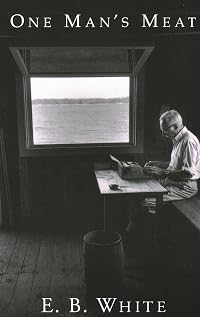
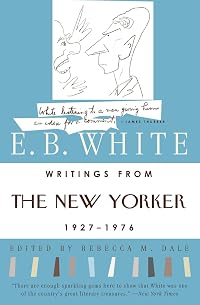
Born in Mount Vernon, New York, E. B. White was educated at Cornell University and served as a private in World War I. After several years as a journalist, he joined the staff of the New Yorker, then in its infancy. For 11 years he wrote most of the "Talk of the Town" columns, and it was White and James Thurber who can be credited with setting the show more style and attitude of the magazine. In 1938 he retired to a saltwater farm in Maine, where he wrote essays regularly for Harper's Magazine under the title "One Man's Meat." Like Thoreau, White preferred the woods; he also resembled Thoreau in his impatience and indignation. White received several prizes: in 1960, the gold medal of the American Academy of Arts and Letters; in 1963, the Presidential Medal of Freedom, the nation's highest civilian award (he was honored along with Thornton Wilder and Edmund Wilson); and in 1978, a special Pulitzer Prize. His verse is original and witty but with serious undertones. His friend James Thurber described him as "a poet who loves to live half-hidden from the eye." Three of his books have become children's classics: Stuart Little (1945), about a mouse born into a human family, Charlotte's Web (1952), about a spider who befriends a lonely pig, and The Trumpet of the Swan (1970). Among his best-known and most widely used books is The Elements of Style (1959), a guide to grammar and rhetoric based on a text written by one of his professors at Cornell, William Strunk, which White revised and expanded. White was married to Katherine Angell, the first fiction editor of the New Yorker. (Bowker Author Biography) Elwyn Brooks White was born on July 11, 1899, in Mt. Vernon, New York. After graduating from Cornell University, he worked briefly for an advertising agency and as a newspaper reporter before joining the staff of The New Yorker magazine in 1927. As a columnist for The New Yorker and a contributor to Harper's Magazine, White established a reputation as a prose stylist of exceptional elegance, clarity and wit. His interests, as reflected in his writing, were numerous and varied; his essays touched on such wide-ranging subjects as politics, farm animals, and life in New York City. White married Katharine S. Angell in 1929. They had one son, and in 1957 the family left New York for a farm in North Brookline, Maine. Writings from The New Yorker, 1927-1976 is a compilation of columns and essays produced during White's long relationship with the magazine. One Man's Meat, published in 1942, is a collection of his writings for Harper's. White adapted a short guide to English grammar and usage, The Elements of Style, from a college text written by one of his professors at Cornell, William Strunk Jr. It has sold millions of copies since it was first published in 1959 and has become a cherished resource for guidance in writing. White also co-authored Is Sex Necessary? with the humorist James Thurber, a fellow staff member at The New Yorker. E.B. White died on October 1, 1985 after succumbing to Alzheimer's. His diverse legacy also includes three children's books: Stuart Little, Charlotte's Web, and The Trumpet of the Swan. In 1970 the American Library Association presented White the Laura Ingalls Wilder Award in recognition of his "substantial and lasting contribution to literature for children." He was also awarded the Presidential Medal of Freedom in 1963 and received a special Pulitzer Prize citation for his body of work in 1970. (Bowker Author Biography) show less
Classifications
Statistics
- Members
- 317
- Popularity
- 101,044
- Reviews
- 1
- Rating
- (4.16)
- Languages
- English
- Media
- Paper
- ISBNs
- 3
- ASINs
- 2


