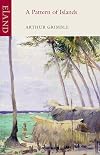
A Pattern of Islands
by Arthur Grimble
On This Page
Description
Arthur Grimble was sent to the Gilbert and Ellice islands as a colonial administrator in the twilight of the Edwardian era. He lived there for the next twenty-five years and developed a rare passion for the language, life and landscape of the place. Fortunately his island neighbours, a fascinating cast of fishermen, sorcerers, poets and fighters, began to trust this charming, happy and energetic young man, and shared with him their treasury of stories from the days when warfare was endemic show more and magic an essential part of everyday life. A Pattern of Islands is a rich and complex cultural history of the dances and legends, rituals, spells and way of life of the islands. It is also a riproaring adventure story. Grimble learns to spear hungry sharks, to negotiate fearsome reefs and, on one terrifying day, is used as human bait to catch a giant squid. show lessTags
Recommendations

































Member Recommendations

Member Reviews
Arthur Grimble was fresh out of Oxford and was interviewed by the colonial office for a post overseas. He got the job and was despatched to the other side of the world to work on the Gilbert Islands in the pacific. This was the time of colonialism and he was starting there as a cadet officer. Coming from the UK this was a form of paradise and it was going to be a place that he was to fall in love with over the next three decades.
You probably think, Grimble, that you’re here to teach these people our code of manners, not to learn theirs. You’re making a big mistake.
He was given the piece of advice above and he took it completely to heart. He was fascinated by the islanders, their history and just how they managed to eke a living in show more the middle of the vast ocean. Not only did they survive by developing unique ways of catching food from the ocean but they also developed a sophisticated pagan culture that was full of legends, folklore, rituals and spells. It was a way of life that was vanishing as the Catholic and Protestant religion was being draped over the culture. But if you knew where to look you could still see their earlier pagan culture shining through and as the people began to trust him they began to share their stories.
I really liked this, he is an eloquent author and a sensitive observer of the culture of these islands. He is prepared to get involved in the activities too, learning to catch octopus seeing men face tiger sharks with only a spear and witnessing the initiation rituals of the clans. I think if he hadn’t have taken that small piece of advice then this would have been a much poorer book. A great read of a part of the world that I have never heard of. show less
You probably think, Grimble, that you’re here to teach these people our code of manners, not to learn theirs. You’re making a big mistake.
He was given the piece of advice above and he took it completely to heart. He was fascinated by the islanders, their history and just how they managed to eke a living in show more the middle of the vast ocean. Not only did they survive by developing unique ways of catching food from the ocean but they also developed a sophisticated pagan culture that was full of legends, folklore, rituals and spells. It was a way of life that was vanishing as the Catholic and Protestant religion was being draped over the culture. But if you knew where to look you could still see their earlier pagan culture shining through and as the people began to trust him they began to share their stories.
I really liked this, he is an eloquent author and a sensitive observer of the culture of these islands. He is prepared to get involved in the activities too, learning to catch octopus seeing men face tiger sharks with only a spear and witnessing the initiation rituals of the clans. I think if he hadn’t have taken that small piece of advice then this would have been a much poorer book. A great read of a part of the world that I have never heard of. show less
The wonderfully written story of Grimble's time as a district officer in the Gilbert Islands (Kiribati) in the south Pacific. I first read this as a nine-year-old boy and was enchanted. It is an extraordinary book, by an extraordinarily sensitive and humane man.
This is a wonderfully well-told tale. It deserves to be read.
This is a wonderfully well-told tale. It deserves to be read.
Read 2011. Delightful account of life in the colonial administration, in the Pacific, in the early part of the 20C.
Tela editorial sin sobrecubierta. Guardas decoradas. 12 láminas.
1º Edición, 2ª reimpresión.
Buen estado
1º Edición, 2ª reimpresión.
Buen estado
Apr 28, 2023Spanish
Ratings
Members
- Recently Added By
Lists

School Made Us Read It
380 works; 196 members
Author Information
6+ Works 352 Members
Series
Belongs to Publisher Series
Work Relationships
Is abridged in
Common Knowledge
- Canonical title
- A Pattern of Islands
- Original title
- A Pattern of Islands
- Alternate titles
- We Chose the Islands (USA) (USA)
- Original publication date
- 1952
- Important places
- Gilbert Islands; Kiribati
Classifications
- Genres
- Travel, Nonfiction, Biography & Memoir, General Nonfiction
- DDC/MDS
- 919.681 — History & geography Geography & travel Geography of and travel in Australasia, Pacific Ocean islands, Atlantic Ocean islands, Arctic islands, Antarctica and on extraterrestrial worlds Polynesia Marshall Islands and Kiribati
- LCC
- DU615 .G83 — History of Europe, Asia, Africa and Oceania Oceania (South Seas) History of Oceania (South Seas) Smaller island groups
- BISAC
Statistics
- Members
- 274
- Popularity
- 118,298
- Reviews
- 4
- Rating
- (4.01)
- Languages
- 5 — English, Finnish, French, German, Spanish
- Media
- Paper, Ebook
- ISBNs
- 12
- ASINs
- 14