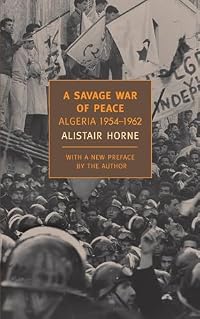
A Savage War of Peace: Algeria 1954-1962
by Alistair Horne
On This Page
Description
The Algerian War lasted from 1954 to 1962. It brought down six French governments, led to the collapse of the Fourth Republic, returned de Gaulle to power, and came close to provoking a civil war on French soil. More than a million Muslim Algerians died in the conflict and as many European settlers were driven into exile. Above all, the war was marked by an unholy marriage of revolutionary terror and repressive torture. Nearly a half century has passed since this savagely fought war ended in show more Algeria's independence, and yet--as Alistair Horne argues in his new preface to his now-classic work of history--its repercussions continue to be felt not only in Algeria and France, but throughout the world. Indeed from today's vantage point the Algerian War looks like a full-dress rehearsal for the sort of amorphous struggle that convulsed the Balkans in the 1990s and that now ravages the Middle East, from Beirut to Baghdad--struggles in which questions of religion, nationalism, imperialism, and terrorism take on a new and increasingly lethal intensity. A Savage War of Peace is the definitive history of the Algerian War, a book that brings that terrible and complicated struggle to life with intelligence, assurance, and unflagging momentum. It is essential reading for our own violent times as well as a lasting monument to the historian's art. show lessTags
Recommendations















Member Reviews
I'm about, oh, 15 years late to this, but boy was it worth the wait. A brilliant overview of the conflict that nearly tore France asunder, and a prime example of, perhaps, how not to do counterinsurgency. Horne's major lesson from the sad history of French Algeria is that its loss was a series of missed opportunities - so many chances to compromise to give just a little - but the intransigence of the French right and the pied noirs doomed those efforts forever.
When the New York Review of Books republished this in 2006, a lot was made of its relevance to modern US-led adventures in Iraq and Afghanistan. This is kind of true, but also a bit irritating (because a well-told history like this shouldn't require modern parallels to be worth reading), and for that matter also overstated – the differences were really more striking to me than the similarities. America was fighting in a foreign country. France was not, and that was really the whole point. I don't think I had appreciated before quite how French Algeria was considered to be. It wasn't like neighbouring Morocco or Tunisia. Those were French protectorates, administered by the foreign office; but Algeria came under the interior ministry, show more and on paper it was as French as Normandy or Provence. The French had been there since 1830, and generations of European families – the so-called pieds noirs – had grown up there who had never set foot in mainland France. Here's the (left-wing) French PM in 1953:
Mesdames, Messieurs, several deputies have made comparisons between French policy in Algeria and Tunisia. I declare that no parallel is more erroneous, that no comparison is falser or more dangerous. Ici, c'est la France!
This is one reason why the Algerian War was characterised by such total intransigence on each side. In Paris it was politically unthinkable to imagine giving up an integral part of France itself; while the pieds noirs themselves were fighting for the survival of their whole world. The French military were desperate not to lose again after humiliation in 1940 and later in Indochina. On the Muslim side, it was a simple matter of liberty and representation, which had been denied them to an extraordinary extent. Unlike, say, the British in India, who had trained a whole middle class of native administrators and civil servants that could gradually take over as the British pulled back, the French had allowed only the most token participation from Muslims in Algerian affairs.
One of the most depressing things about this story is how many good viable alternatives to war were clearly available in the 1950s. At first there was a huge middle ground of Europeans and Muslims who would have been very happy with interim solutions – a protectorate, for example, or quotas to ensure Muslim representation in state councils. Again and again such ideas were shot down by hawks in Paris and by the burgeoning independence movement in Algeria. And once they had finished shooting down ideas, they started shooting down people. Gradually – in a process that becomes a theme of this book – moderates were turned, one by one, into extremists.
It was a very violent conflict. The nationalist FLN was basically just a sprinkling of inexperienced politicians over a vast mass of angry guerrillas, whose two main targets were European civilians and moderate Muslims. Bombs in cafés, cinemas, dancehalls in the cities; in the countryside, throat-slitting, or the "Kabyle smile". Towards French soldiers, once these started to arrive in greater numbers, the guerrillas could be more cruelly creative, and the troops were always aware that they were risking not death, but something worse. Here's a French para describing how his colleague was caught in a firefight while the rest of them were pinned down by an FLN group.
My poor friend V. lay howling on his bed of stones till morning. He suffered unimaginably, both physically and mentally, a prey to mortal terror. He only really stopped at dawn, when we could perhaps have saved him. For several hours a rebel had been slithering towards him. He could have seen him all that while. There he was. The rebel touched his body. He took away his weapons. Then he gouged out his eyes. Then he slashed his Achilles' tendons, afraid, perhaps, that he might still come back and die with us. But he didn't finish him off, merely wanting him to have to lie still and suffer.
If that sounds bad, consider how sickening it is to have to say that the French were no better. In response to FLN outrages, gangs of soldiers and pieds noirs would go on indiscriminate rampages through Muslim parts of Algiers, looting shops and killing any Muslims they could lay their hands on. Towards the end, when it was clear which way the wind was blowing, some of them came together to organise a counter-terrorist group called the OAS which carried out a revolting series of bomb attacks both in Algeria and in mainland France. The French army, meanwhile, often resorted to the worst of methods to try and extract information from their prisoners: Algeria was where the whole business of institutionalised military torture first came under the spotlight in a serious way.
At least one general freely admitted that torture was used, and seemed perfectly happy with it. The preferred method was the infamous gégène – a field dynamo with electrodes attached to the victim's body, usually to the genitals. Occasionally things were even worse: girls deflowered with glass bottles, high pressure hoses inserted in the rectum, and so on.
Almost as painful as the torture inflicted on oneself was the awareness of the suffering of others nearby: "I don't believe that there was a single prisoner who did not, like myself, cry from hatred and humiliation on hearing the screams of the tortured for the first time," says Alleg, and he records the horror of the elderly Muslim hoping to appease his tormentors: "Between the terrible cries which the torture forced out of him, he said, exhausted: ‘Vive la France! Vive la France!’ "
I've lived with this book for a couple of weeks, and typing this passage out is making me lose my breath with distress all over again. There are a few heros: Paul Teitgen, head of the Algiers police, was faced with a real-life example of the famous "ticking bomb" scenario, when a terrorist was caught planting a device in a gasworks, but it was believed there was already a second bomb somewhere which had not yet gone off. Would Teitgen give permission to torture the suspect to find out where it was, potentially saving dozens of lives? Teitgen had himself been tortured by the Gestapo. He refused. "I trembled the whole afternoon. Finally the bomb did not go off. Thank God I was right. Because if you once get into the torture business, you're lost."
And the French were lost. French society was increasingly outraged by what it heard, and by the time the war ended – it went on longer than either of the world wars – it had directly brought down no fewer than six French governments.
Alistair Horne tells the story well, but thoroughly – this is a very dense book and I don't know that it could really be considered general interest. There are a few updates in it, but most of the writing is from 1977, and I'm curious to know what historical sources have become available since then, especially on the Algerian side. Historians have been nervous of touching the subject because A Savage War of Peace is so widely considered, still, to be the definitive treatment. And it's easy to see why. Modern parallels or not, this is extremely enlightening. show less
Mesdames, Messieurs, several deputies have made comparisons between French policy in Algeria and Tunisia. I declare that no parallel is more erroneous, that no comparison is falser or more dangerous. Ici, c'est la France!
This is one reason why the Algerian War was characterised by such total intransigence on each side. In Paris it was politically unthinkable to imagine giving up an integral part of France itself; while the pieds noirs themselves were fighting for the survival of their whole world. The French military were desperate not to lose again after humiliation in 1940 and later in Indochina. On the Muslim side, it was a simple matter of liberty and representation, which had been denied them to an extraordinary extent. Unlike, say, the British in India, who had trained a whole middle class of native administrators and civil servants that could gradually take over as the British pulled back, the French had allowed only the most token participation from Muslims in Algerian affairs.
One of the most depressing things about this story is how many good viable alternatives to war were clearly available in the 1950s. At first there was a huge middle ground of Europeans and Muslims who would have been very happy with interim solutions – a protectorate, for example, or quotas to ensure Muslim representation in state councils. Again and again such ideas were shot down by hawks in Paris and by the burgeoning independence movement in Algeria. And once they had finished shooting down ideas, they started shooting down people. Gradually – in a process that becomes a theme of this book – moderates were turned, one by one, into extremists.
It was a very violent conflict. The nationalist FLN was basically just a sprinkling of inexperienced politicians over a vast mass of angry guerrillas, whose two main targets were European civilians and moderate Muslims. Bombs in cafés, cinemas, dancehalls in the cities; in the countryside, throat-slitting, or the "Kabyle smile". Towards French soldiers, once these started to arrive in greater numbers, the guerrillas could be more cruelly creative, and the troops were always aware that they were risking not death, but something worse. Here's a French para describing how his colleague was caught in a firefight while the rest of them were pinned down by an FLN group.
My poor friend V. lay howling on his bed of stones till morning. He suffered unimaginably, both physically and mentally, a prey to mortal terror. He only really stopped at dawn, when we could perhaps have saved him. For several hours a rebel had been slithering towards him. He could have seen him all that while. There he was. The rebel touched his body. He took away his weapons. Then he gouged out his eyes. Then he slashed his Achilles' tendons, afraid, perhaps, that he might still come back and die with us. But he didn't finish him off, merely wanting him to have to lie still and suffer.
If that sounds bad, consider how sickening it is to have to say that the French were no better. In response to FLN outrages, gangs of soldiers and pieds noirs would go on indiscriminate rampages through Muslim parts of Algiers, looting shops and killing any Muslims they could lay their hands on. Towards the end, when it was clear which way the wind was blowing, some of them came together to organise a counter-terrorist group called the OAS which carried out a revolting series of bomb attacks both in Algeria and in mainland France. The French army, meanwhile, often resorted to the worst of methods to try and extract information from their prisoners: Algeria was where the whole business of institutionalised military torture first came under the spotlight in a serious way.
At least one general freely admitted that torture was used, and seemed perfectly happy with it. The preferred method was the infamous gégène – a field dynamo with electrodes attached to the victim's body, usually to the genitals. Occasionally things were even worse: girls deflowered with glass bottles, high pressure hoses inserted in the rectum, and so on.
Almost as painful as the torture inflicted on oneself was the awareness of the suffering of others nearby: "I don't believe that there was a single prisoner who did not, like myself, cry from hatred and humiliation on hearing the screams of the tortured for the first time," says Alleg, and he records the horror of the elderly Muslim hoping to appease his tormentors: "Between the terrible cries which the torture forced out of him, he said, exhausted: ‘Vive la France! Vive la France!’ "
I've lived with this book for a couple of weeks, and typing this passage out is making me lose my breath with distress all over again. There are a few heros: Paul Teitgen, head of the Algiers police, was faced with a real-life example of the famous "ticking bomb" scenario, when a terrorist was caught planting a device in a gasworks, but it was believed there was already a second bomb somewhere which had not yet gone off. Would Teitgen give permission to torture the suspect to find out where it was, potentially saving dozens of lives? Teitgen had himself been tortured by the Gestapo. He refused. "I trembled the whole afternoon. Finally the bomb did not go off. Thank God I was right. Because if you once get into the torture business, you're lost."
And the French were lost. French society was increasingly outraged by what it heard, and by the time the war ended – it went on longer than either of the world wars – it had directly brought down no fewer than six French governments.
Alistair Horne tells the story well, but thoroughly – this is a very dense book and I don't know that it could really be considered general interest. There are a few updates in it, but most of the writing is from 1977, and I'm curious to know what historical sources have become available since then, especially on the Algerian side. Historians have been nervous of touching the subject because A Savage War of Peace is so widely considered, still, to be the definitive treatment. And it's easy to see why. Modern parallels or not, this is extremely enlightening. show less
A substantial, well written, thorough, clear-eyed account of this savage conflict’s causes, process, and consequences. I really didn’t know much about it going in, and much of it is shocking as well as saddening in the usual way accounts of warfare are. This, along with the two Fall books I read in the last few weeks, will give me a better background when I read Larteguy’s The Centurions and The Praetorians. Highly recommended.
An incredible book about a subject I knew nothing about. I really enjoy Alistair Horne's writing style, the only dry parts unlike his Price of Glory were the political side of things, but given the subject matter it was absolutely necessary to include.
A truly intimate examination of war, politics, atrocities, and terrorism, that still rings true to this day.
A truly intimate examination of war, politics, atrocities, and terrorism, that still rings true to this day.
Algeria's war of independence brought large amounts of suffering and little gain to both sides. For France, l'Algérie française was a unseparable part of France, especially given the large number of European settlers (pieds noirs) and the French investment in the oil and gas industry. L'Algérie française, however, had little consideration for the neglected and unrepresented Muslims who comprised the overwhelming majority of the population. To ensure pieds noirs support in the shaky 4th Republic politics, France refrained from educating and integrating the Muslims. Waiting too long for limited devolution, France was holding the wolf by the ears. In a savage guerrilla war, both the French as well as the FLN had little respect for show more human rights (see the excellent 1965 film "The Battle of Algiers"). The "Kabyle smile" of a cut throat was matched by French army torturers. After the French public and De Gaulle had lost any hope in winning the war, the army command staged a hopeless and braindead amateur coup which all but guaranteed Algerian independence.
Alistair Horne is an excellent writer with deep knowledge about the inner workings of France. His treatment is at times a little exhausting as the number of competing factions in France, the French army, the Algerian administration, the FLN leaderships as well as the terror cells expands. A worthy book for a reissue.
The NYRoB 2006 reprint, however, suffers from having been scanned in instead of being set. Punctation marks and dots are missing and some letters remain barely legible. show less
Alistair Horne is an excellent writer with deep knowledge about the inner workings of France. His treatment is at times a little exhausting as the number of competing factions in France, the French army, the Algerian administration, the FLN leaderships as well as the terror cells expands. A worthy book for a reissue.
The NYRoB 2006 reprint, however, suffers from having been scanned in instead of being set. Punctation marks and dots are missing and some letters remain barely legible. show less
A splendid book about the end of the colonial rule in Algeria. In this masterpiece by Alexander Horne, he tells us how the Algerian national movement sparked by the Second World War. In the beginning this movement was modest with unpretentious goals. Anyway, the French responded to it with repression. As in many other likewise examples this hardly gave the desired result. From now on, two parallel mechanics of the conflict was constantly evolving to the bitter end: 1. The Algerians in FLN became more and more radical, soon ending up with demands of complete freedom. 2. The French colonial masters managed to miss all trains, by always offering concessions too late when it ended up being too small. The war in itself was brutal, with the show more French fighting with dirty tactics and torture, while the FLN was certainly not better, with indiscriminate violence against French civilians, against Algerians that they considered traitors, and at last racist violence against the Jewish minority in Algerian whose allegiance was uncertain. In the end the French military might prevailed with the battle of Alger. But then political events made this military victory completely worthless.
Rather soon the political leadership in Paris realized that some kind of settlement had to be reached to end the conflict. Therefore fumbling negotiations started. But the French military leadership in Algeria saw this as nothing more than stab in the back. Not only that, they had the support of the French living in Algeria, the so called Pied Noirs, who certainly weren’t ready to give up their life as colonial masters, and a French fascist movement started to grow. This was extremely serious for Paris, since the French military in Algeria consisted of all the crack troops France could offer. It actually evolved to a real coup d’etat, where the Fourth Republic fell, and the Parisians awaited an unstoppable invasion from Algeria. Then from the cold, General De Gaulle was called upon to save the day. By skillfully not showing his real allegiance for the ringleaders of the coup he started conspiring and since no one either could call the old war hero a traitor, or in the long run position themselves against him, he in the end prevailed. But the general very soon found what was needed to be done, and the French army left Algeria in 1962, with one million Pied Noirs following them, while Algerians that had sided with the French got butchered by the FLN.
This is the best book I have read by Alexander Horne, with actually says a lot. He is an excellent writer and a superb historian, which in this case managed to be completely neutral describing the conflict. Also the book delivers a certain message, at least to me. It shows the folly of Colonialism (and NO I’m NOT thinking of today’s Iraq which is NOT colonialism). The problem was seldom that colonial powers deposed bloody despots in some God-for-saken place on Earth (even if there are examples of that too). Neither was the colonial rule per se, worse than what the local despot would have been (even if there also are examples of that, as in Belgian Congo, or today’s Tibet). No, the problem lay in how and when to dismantle the colonial rule moving into modern times. Amazingly, most colonial powers as France in Algeria never thought about this before it was too late. This is of certain moral interest in democratic societies being colonial power (but not in dictatorships because they are per definition immoral with or without colonies). Because if a country is based on total suffrage and rule of law, how should the colonial subjects be regarded? The state might for a while look at them as inferior citizens, and thereby attaining the, in the long run, morally absurd position, as being an apartheid state. That ruled out there exist two options: First, give the colonial subjects full rights in the empire. But that would have meant that most European colonial democracies in the last century would have been dominated by suffrage by millions of people from the Third world. This would of course not have been acceptable to Europeans. Then only one option is left, namely, give the colonies freedom. Today this is without any serious dispute the correct answer. But go back fifty years in France and people probably had another view. Pretty amazing actually how ideas can change so profoundly in a rather short time span. Five out of Five! show less
Rather soon the political leadership in Paris realized that some kind of settlement had to be reached to end the conflict. Therefore fumbling negotiations started. But the French military leadership in Algeria saw this as nothing more than stab in the back. Not only that, they had the support of the French living in Algeria, the so called Pied Noirs, who certainly weren’t ready to give up their life as colonial masters, and a French fascist movement started to grow. This was extremely serious for Paris, since the French military in Algeria consisted of all the crack troops France could offer. It actually evolved to a real coup d’etat, where the Fourth Republic fell, and the Parisians awaited an unstoppable invasion from Algeria. Then from the cold, General De Gaulle was called upon to save the day. By skillfully not showing his real allegiance for the ringleaders of the coup he started conspiring and since no one either could call the old war hero a traitor, or in the long run position themselves against him, he in the end prevailed. But the general very soon found what was needed to be done, and the French army left Algeria in 1962, with one million Pied Noirs following them, while Algerians that had sided with the French got butchered by the FLN.
This is the best book I have read by Alexander Horne, with actually says a lot. He is an excellent writer and a superb historian, which in this case managed to be completely neutral describing the conflict. Also the book delivers a certain message, at least to me. It shows the folly of Colonialism (and NO I’m NOT thinking of today’s Iraq which is NOT colonialism). The problem was seldom that colonial powers deposed bloody despots in some God-for-saken place on Earth (even if there are examples of that too). Neither was the colonial rule per se, worse than what the local despot would have been (even if there also are examples of that, as in Belgian Congo, or today’s Tibet). No, the problem lay in how and when to dismantle the colonial rule moving into modern times. Amazingly, most colonial powers as France in Algeria never thought about this before it was too late. This is of certain moral interest in democratic societies being colonial power (but not in dictatorships because they are per definition immoral with or without colonies). Because if a country is based on total suffrage and rule of law, how should the colonial subjects be regarded? The state might for a while look at them as inferior citizens, and thereby attaining the, in the long run, morally absurd position, as being an apartheid state. That ruled out there exist two options: First, give the colonial subjects full rights in the empire. But that would have meant that most European colonial democracies in the last century would have been dominated by suffrage by millions of people from the Third world. This would of course not have been acceptable to Europeans. Then only one option is left, namely, give the colonies freedom. Today this is without any serious dispute the correct answer. But go back fifty years in France and people probably had another view. Pretty amazing actually how ideas can change so profoundly in a rather short time span. Five out of Five! show less
1487 A Savage War of Peace: Algeria 1954-1962, by Alistair Horne (read 9 June 1978) (Book of the Year) This most fascinating book tells the awful and depressing story of Algeria from 1954 (the war began Nov. 1, 1954) to 1962. I was aware of the war as it was going on, but it did not seem very non-boring to me. But this book puts it all together and it is the sheerest dramatic tragedy. The book was especially poignant for me since in 1953 I spent several joyous days in Oran and Algiers--scenes of some of the most awful aspects of the war. The French colonists and their lunatic fringe literally forced Algeria to be solely Muslim eventually. Really sad, but certainly the result could have been foreseen. It is a dramatic story, dramatically show more told. show less
Members
- Recently Added By
Lists

Best Military History Books
123 works; 21 members

Blue Pyramid 1,276 Best Books of All Time
1,248 works; 32 members

Changamire's Bookshelf
19 works; 1 member

r/AskHistorians' Recommended Books
1,068 works; 17 members

Books recommended in the history category on FiveBooks.com
329 works; 4 members
Author Information

31+ Works 5,856 Members
Alistair Allan Horne was born in London, England on November 9, 1925. He enlisted in the Royal Air Force, but failed to qualify for pilot training because of poor eyesight. He later joined the Coldstream Guards, attaining the rank of captain. When the war ended, he was transferred to the Intelligence Corps and stationed in Cairo where he monitored show more Soviet activity in the Balkans. He received a master's degree in English in 1949 from Jesus College, Cambridge. Before becoming an author, he was a foreign correspondent for The Daily Telegraph and a spy for MI6, Britain's foreign intelligence service. His books included The Fall of Paris: The Siege and the Commune, 1870-71; To Lose a Battle: France 1940; Small Earthquake in Chile: A Visit to Allende's South America; The French Army and Politics, 1870-1970; Seven Ages of Paris; The Age of Napoleon; La Belle France: A Short History; and Kissinger: 1973, The Crucial Year. The Price of Glory: Verdun 1916 won the Hawthornden Prize and A Savage War of Peace: Algeria 1954-1962 won the Wolfson Prize. He wrote several memoirs including A Bundle from Britain and But What Do You Actually Do?: A Literary Vagabondage. He was knighted in 2003. He died on May 25, 2017 at the age of 91. (Bowker Author Biography) show less
Some Editions
Awards and Honors
Awards
Distinctions
Series
Belongs to Publisher Series
Common Knowledge
- Canonical title
- A Savage War of Peace: Algeria 1954-1962
- Original title
- A Savage war of peace. Algeria 1954-1962
- Original publication date
- 1977 (1e édition originale anglaise) (1e édition originale anglaise); 1980-04-23 (1e traduction et édition française, Albin Michel) (1e traduction et édition française, Albin Michel); 1987 (3e édition française revue et corrigée, Albin Michel) (3e édition française revue et corrigée, Albin Michel)
- Important places
- Algeria; France
- Important events
- Algerian War
- Epigraph
- Take up the White Man's Burdens - The savage wars of peace - Fill full the mouth of famine And bid the sickness cease - Rudyard Kipling
- Dedication
- To A.D.M. and C.D.H. the only begetters
- First words
- Setif, 1945 The market town of Setif sits haphazardly on a high and treeless plain some eighty miles west of Constantine.
- Last words
- (Click to show. Warning: May contain spoilers.)But perhaps even by now Plage Jeanne d'Arc has disappeared forever beneath the pounding surf - more immemorably than either Roman Timgad or Tipasa.
- Original language*
- Anglais (Royaume-Uni) (Royaume-Uni)
*Some information comes from Common Knowledge in other languages. Click "Edit" for more information.
Classifications
Statistics
- Members
- 1,202
- Popularity
- 20,578
- Reviews
- 18
- Rating
- (4.23)
- Languages
- English, French, Italian
- Media
- Paper, Audiobook, Ebook
- ISBNs
- 25
- ASINs
- 13