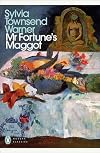
Mr Fortune's Maggot
by Sylvia Townsend Warner
On This Page
Description
The Reverend Timothy Fortune, ex-clerk of the Hornsey Branch of Lloyds Bank, has spent ten years as a South Seas Island missionary when a 'maggot' impels him to embark on what he describes as a 'sort of pious escapade' - an assignment to the even more remote island of Fanua, where a white man is a rarity. Mr Fortune is a good man, humble, earnest - he wishes to bring the joys of Christianity to the innocent heathen. But in his three years on Fanua he makes only one convert - the boy Lueli, show more who loves him. This love, and the sensuous freedom of the islanders produces in Mr Fortune a change of heart which is shattering... Beautifully imagined, the paradise island and its people are as vivid as a Gauguin painting. Told with the driest of wise humour, touching and droll by turns, its theme - that we can never love anything without messing it about - is only one of the delights of this enchanting book. show lessTags
Recommendations




















Member Reviews
I picked this novella off the library shelf solely on the strength of its author. Sylvia Townsend Warner is a fascinatingly versatile writer. I’ve read six of her novels and they are all very different in setting, genre, and plot. They share a similar cool, clever narrative style and striking originality. [b:Mr Fortune's Maggot|53246183|Mr Fortune's Maggot|Sylvia Townsend Warner|https://i.gr-assets.com/images/S/compressed.photo.goodreads.com/books/1591052017l/53246183._SY75_.jpg|44838918] includes a preface by the author explaining that the novella came to her in a dream and was written very quickly. It does have a somewhat dreamlike feeling, being set in a tropical island named Fanua that has very little contact with the rest of the show more world. The titular Mr. Fortune, previously a bank clerk, moves to the island as a missionary intending to convert the indigenous people to Christianity. This does not go according to plan. In another writer’s hands, I think such a topic could have aged very badly in the last hundred years. Townsend Warner’s psychological insight into her protagonist has kept it interesting and thoughtful. The essential absurdity of Mr. Fortune’s mission is evident from the start.
The novella begins gently by treating the reader to descriptions of glorious tropical forest and idyllic beaches as Mr. Fortune settles in. It becomes much sharper halfway through.An eruption of the volcanic island precipitates a loss of faith for Mr Fortune and for his friend Lueli. Mr Fortune has not only failed to find converts, he himself has been converted to the island way of life. His relative equanimity in the face of this is interesting, as it shows how his priorities have changed after years outside 'civilisation'. In quite subtle fashion, the narrative contrasts allegedly civilised and uncivilised ways of life, asking which of them actually makes better sense. It also considers in microcosm friendship, colonialism, and faith in a higher power.
At the end of the book Mr Fortune leaves Fanua, despite being happy living there, for the sake of his dear friend Lueli. He realises that his irresistible culturally-ingrained tendency to meddle and impose his views will ruin Lueli’s life, as it very nearly already has, so he must withdraw. Published in 1927, this miniature critique of the British Empire and Christian evangelism seems oddly contemporary in tone. It isn’t hard-hitting as such: Mr Fortune is no avatar of imperial rapaciousness and his efforts at conversion are limited and incompetent. Yet the message is powerful nonetheless. Seemingly well-meant attempts to impose an allegedly more modern and developed culture are inherently harmful. Sylvia Townsend Warner, who was left-wing and anti-fascist throughout her life, sets out this still-radical idea elegantly in a succinct little gem of a book. show less
The novella begins gently by treating the reader to descriptions of glorious tropical forest and idyllic beaches as Mr. Fortune settles in. It becomes much sharper halfway through.
Timothy Fortune leaves his job as a bank clerk to become a missionary on a Polynesian island. From the beginning, the reader knows Fortune will have limited success converting the locals to Christianity. But how will he deal with this “failure,” and what impact will the community have on him?
Fortune is no religious zealot; in fact he is quite naive. His one “convert” is a boy named Leuli, and over three years the two become close friends. Fortune learns as much from Leuli as the boy does from him, and experiences an epiphany of sorts that changes the course of his life. Written in the early 20th century, the narrative is a bit simplistic and glosses over some obvious issues, most notably the language barrier between Fortune and show more the island population. But the tone is light and witty in spots and it’s a sweet and enjoyable story. show less
Fortune is no religious zealot; in fact he is quite naive. His one “convert” is a boy named Leuli, and over three years the two become close friends. Fortune learns as much from Leuli as the boy does from him, and experiences an epiphany of sorts that changes the course of his life. Written in the early 20th century, the narrative is a bit simplistic and glosses over some obvious issues, most notably the language barrier between Fortune and show more the island population. But the tone is light and witty in spots and it’s a sweet and enjoyable story. show less
Mr Fortune’s Maggot was Sylvia Townsend Warner’s second published novel, and is according to the blurb on the back on my lovely old VMC green – her best loved novel.
A maggot as defined by Warner in the front of this book is a fancy or whimsy – Mr Fortune, or Rev Timothy Fortune to give him his correct title, an idealistic former bank clerk, is a missionary. Following a decade in the south-seas Mr Fortune’s particular fancy is to go to Fanua, a remote, volcanic island and convert the people there to Christianity. Mr Fortune has been warned that he faces an impossible task, the people of Fanua are certainly not savages or cannibals, they are in fact more like unruly children. Mr Fortune is a good and humble Christian, wishing show more only to share the joy of his faith with those poor souls he considers to be the heathen. When he first arrives on Fanua the people accept him immediately, he is made welcome, allowed to make an abandoned hut his home. Mr Fortune embraces his new home, delights in seeing it gently lit up after dark, lovingly arranging his small store of possessions inside it; they include a harmonium, a sewing machine and a silver teapot.
“Except for the lamp, the sewing machine, and the harmonium, Mr. Fortune’s house had not an European appearance, for while on the island he wished to live as its natives did. His bowls and platters and drinking vessels were made of polished wood, his bed (Ori’s gift) was a small wooden platform with many white mats. When everything was completed he gave each of the islanders a ginger-bread nut and made a little formal speech, first thanking them for their gifts and their assistance, and going on to explain his reasons for coming to Fanua. He had heard, he said with pleasure how happy a people they were, and he had come to dwell with them and teach them how they might be as happy in another life as they were in this.”
After three years on Fanua Mr Fortune has made only one covert – or so he believes for a time. His precious convert is a young boy Lueli, who loves Mr Fortune purely, with an honest childlike devotion. Mr Fortune quickly comes to love Lueli, opens his home to him, and tries to teach him so much of his faith, and later, rather comically, mathematics, for which of course Mr Fortune has a particular aptitude.
The people of Fanua don’t follow a recognised religion; each person has their own personal god, a carved figure of which they keep for life, paying homage to it, decorating it with flowers. This is not a practise of which Mr Fortune approves, but so far he has failed to free the Fanua people of their idols. Mr Fortune has however, learned to appreciate the life that he has found on Fanua – he begins to feel that he shall live the rest of his life on this tiny Polynesian island. He worries rather about the nubile, young women who try to attract his attention – ‘the bevies’ as he terms them, their irrepressible joy and lack of clothing slightly shock the gentle hearted Mr Fortune. When the long dormant volcano erupts, Mr Fortune’s home is destroyed – and poor Lueli who had been hiding his god from Mr Fortune is devastated when his idol is destroyed. That volcanic eruption is possibly an obvious, but nonetheless powerful metaphor for the upheaval, Mr Fortune has brought to the life of his adored young Lueli. On this very same night, a night of momentous change, Mr Fortune loses his own god – and with that loss of faith his vision begins to clear.
“And because I loved him so for what he was I could not spend a day without trying to alter him. How dreadful it is that because of our wills we can never love anything without messing it about! We couldn’t even love a tree, not a stone even; for sooner or later we should be pruning the tree or chipping a bit off the stone.”
Sylvia Townsend Warner writes superbly, her descriptions of an idyllic island really quite lovely, but for me it is her knowledge of how as human beings, we so often end up destroying what we think we love, when we seek to change it, that is so moving. This is a difficult lesson for Mr Fortune, but it is one he learns, and his final act is one of great love and understanding, and one that leaves the reader with a lump in their throat. This is a beautiful little novel about faith, and friendship, it is written with great affection, wit and imagination. show less
A maggot as defined by Warner in the front of this book is a fancy or whimsy – Mr Fortune, or Rev Timothy Fortune to give him his correct title, an idealistic former bank clerk, is a missionary. Following a decade in the south-seas Mr Fortune’s particular fancy is to go to Fanua, a remote, volcanic island and convert the people there to Christianity. Mr Fortune has been warned that he faces an impossible task, the people of Fanua are certainly not savages or cannibals, they are in fact more like unruly children. Mr Fortune is a good and humble Christian, wishing show more only to share the joy of his faith with those poor souls he considers to be the heathen. When he first arrives on Fanua the people accept him immediately, he is made welcome, allowed to make an abandoned hut his home. Mr Fortune embraces his new home, delights in seeing it gently lit up after dark, lovingly arranging his small store of possessions inside it; they include a harmonium, a sewing machine and a silver teapot.
“Except for the lamp, the sewing machine, and the harmonium, Mr. Fortune’s house had not an European appearance, for while on the island he wished to live as its natives did. His bowls and platters and drinking vessels were made of polished wood, his bed (Ori’s gift) was a small wooden platform with many white mats. When everything was completed he gave each of the islanders a ginger-bread nut and made a little formal speech, first thanking them for their gifts and their assistance, and going on to explain his reasons for coming to Fanua. He had heard, he said with pleasure how happy a people they were, and he had come to dwell with them and teach them how they might be as happy in another life as they were in this.”
After three years on Fanua Mr Fortune has made only one covert – or so he believes for a time. His precious convert is a young boy Lueli, who loves Mr Fortune purely, with an honest childlike devotion. Mr Fortune quickly comes to love Lueli, opens his home to him, and tries to teach him so much of his faith, and later, rather comically, mathematics, for which of course Mr Fortune has a particular aptitude.
The people of Fanua don’t follow a recognised religion; each person has their own personal god, a carved figure of which they keep for life, paying homage to it, decorating it with flowers. This is not a practise of which Mr Fortune approves, but so far he has failed to free the Fanua people of their idols. Mr Fortune has however, learned to appreciate the life that he has found on Fanua – he begins to feel that he shall live the rest of his life on this tiny Polynesian island. He worries rather about the nubile, young women who try to attract his attention – ‘the bevies’ as he terms them, their irrepressible joy and lack of clothing slightly shock the gentle hearted Mr Fortune. When the long dormant volcano erupts, Mr Fortune’s home is destroyed – and poor Lueli who had been hiding his god from Mr Fortune is devastated when his idol is destroyed. That volcanic eruption is possibly an obvious, but nonetheless powerful metaphor for the upheaval, Mr Fortune has brought to the life of his adored young Lueli. On this very same night, a night of momentous change, Mr Fortune loses his own god – and with that loss of faith his vision begins to clear.
“And because I loved him so for what he was I could not spend a day without trying to alter him. How dreadful it is that because of our wills we can never love anything without messing it about! We couldn’t even love a tree, not a stone even; for sooner or later we should be pruning the tree or chipping a bit off the stone.”
Sylvia Townsend Warner writes superbly, her descriptions of an idyllic island really quite lovely, but for me it is her knowledge of how as human beings, we so often end up destroying what we think we love, when we seek to change it, that is so moving. This is a difficult lesson for Mr Fortune, but it is one he learns, and his final act is one of great love and understanding, and one that leaves the reader with a lump in their throat. This is a beautiful little novel about faith, and friendship, it is written with great affection, wit and imagination. show less
First line:
~Though the Reverend Timothy Fortune had spent three years in the island of Fanua he had made but one convert~
Once I realized that a maggot was not a creepy crawly thing, I jumped in with both feet right after finishing [Frost in May]. Loved this one! Any book that can make me cry at the end of it is a good one.
Mr. Fortune sums up his life experience thusly “And because I loved him so for what he was I could not spend a day without trying to alter him. How dreadful it is that because of our wills we can never love anything without messing it about! We couldn’t even love a tree, not a stone even; for sooner or later we should be pruning the tree or chipping a bit off the stone.”
This, for me, was storytelling at it’s show more best; writing at it’s best.
Another reviewer mentioned that she could not relate to Mr. Fortune because he was so naïve; I think this is exactly why I could relate to him. He tried his best, his absolute best but he was ill suited to the missionary task of converting the people of Fanua.
In the end, his final decision was the most loving of all.
4 stars show less
~Though the Reverend Timothy Fortune had spent three years in the island of Fanua he had made but one convert~
Once I realized that a maggot was not a creepy crawly thing, I jumped in with both feet right after finishing [Frost in May]. Loved this one! Any book that can make me cry at the end of it is a good one.
Mr. Fortune sums up his life experience thusly “And because I loved him so for what he was I could not spend a day without trying to alter him. How dreadful it is that because of our wills we can never love anything without messing it about! We couldn’t even love a tree, not a stone even; for sooner or later we should be pruning the tree or chipping a bit off the stone.”
This, for me, was storytelling at it’s show more best; writing at it’s best.
Another reviewer mentioned that she could not relate to Mr. Fortune because he was so naïve; I think this is exactly why I could relate to him. He tried his best, his absolute best but he was ill suited to the missionary task of converting the people of Fanua.
In the end, his final decision was the most loving of all.
4 stars show less
Mr Fortune left his bank job to become a missionary in Polynesia, but his independent mission on the island of Fanua isn't going brilliantly as he's only converted one person, which causes him some angst but that's just the beginning of his problems. I didn't much care for Mr Fortune who struck me as very naive, which was largely why I didn't find the book very engaging.
I wasn't sure what I'd make of this book as it's outside my usual remit but I thought it was wonderful and loved it :
http://kaggsysbookishramblings.wordpress.com/2012/08/20/all-viragoall-august-not...
http://kaggsysbookishramblings.wordpress.com/2012/08/20/all-viragoall-august-not...
man goes to south seas as missionary, makes only one convert, realizes he not true convert, returns
Members
- Recently Added By
Lists

Books I've Read More Than Once
602 works; 49 members

Lost Gay Novels
51 works; 1 member

Reading LIst
648 works; 1 member
Author Information

69+ Works 6,100 Members
Some Editions
Awards and Honors
Series
Belongs to Publisher Series
Work Relationships
Common Knowledge
- Canonical title
- Mr Fortune's Maggot
- Original publication date
- 1927
- People/Characters
- Timothy Fortune; Archdeacon Mason; Lueli
- Important places
- St. Fabien; Fanua
- Dedication
- To Theo
- First words
- Though the Reverend Timothy Fortune had spent three years in the island of Fanua he had made but one convert.
- Blurbers
- Welty, Eudora
- Disambiguation notice
- There is an edition of "Mr. Fortune's Maggot" entitled "Mr. Fortune's Maggot and the Salutation," published by NYRB in 2001 that also includes the novella "The Salutation" and an introduction by Adam Mars-Jones; it was reissu... (show all)ed by NYRB in 2011 as "Mr. Fortune." Neither of these titles (which are both the same work) should be combined with stand-alone editions of "Mr. Fortune's Maggot."
Classifications
Statistics
- Members
- 210
- Popularity
- 154,253
- Reviews
- 7
- Rating
- (3.69)
- Languages
- English, French, German
- Media
- Paper, Ebook
- ISBNs
- 10
- ASINs
- 11