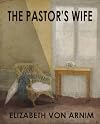
The Pastor's Wife
by Elizabeth von Arnim
On This Page
Description
Ingeborg Bullivant, the put-upon daughter of the Bishop of Redchester, suddenly becomes possessed by the demon Rebellion and takes a week's tour to Lucerne. Constantly in the company of a ponderous German pastor, she is put into a quandary when he proposes marriage. Faced with her father's wrath on her return, however, Ingeborg accepts her Herr Dremmel with simple relief. But the role of a pastor's wife in East Prussia is not as Ingeborg had imagined, for she has merely exchanged one set of show more rules for another . . . show lessTags
Recommendations









Member Recommendations
Member Reviews
English woman Ingeborg is a young bishop's daughter, charming and cheerful. The year is approximately 1910 or so. As the book opens Ingeborg is trundled off by her parents to London where she is supposed to get a toothache fixed, the country dental situation being not so good. She has a little wad of cash and will supposedly need a week for the dentistry and recovery. But instead of taking a week, her toothache is fixed fairly instantly, she feels utterly marvelous, so she starts wandering around town. And still, she doesn't have to be home for days and days. Intrigued by a sign advertising Dent's tours, she impulsively signs up for one and goes off to Lucerne for a few days with the tourist group. Along the way she meets Robert, a show more German pastor who is single and falls for her straight away. He manages to convince her to marry him, even though she's not really keen on the idea at first. Her parents are absolutely appalled, although her father does consent to perform their marriage ceremony. She promptly goes to Germany with her new husband, ready to settle in and start a family.
This is probably the longest and most detailed of the novels by Elizabeth von Arnim. The text dives quite deeply into Ingeborg's thoughts and feelings as she navigates the new life in Germany, takes care of her husband and small farm, and has six babies in seven years. (Only two survive, however.) The author's prose is utterly delicious most of the time.
The crux of the book has to do with what happens later as she is pursued by a dashing young and famous painter who visits one of the nearby minor nobility and meets her in passing. They strike up a friendship, all very above-board, and the man wants to paint her portrait. Will he manage to seduce her? Does she even know she's being seduced, and it's all not just friendly and brotherly?
Notes: I read the Girlebooks.com EPUB version, which is nicely formatted, based on the Project Gutenberg e-text, and has a few little internal illustrations. First published in 1914, the book is now in the public domain, so you can find it out there freely available, as well as in the nice Virago edition.
More Notes: I own a copy of the Virago edition and have had it on my shelf, along with a hard cover edition and every other von Arnim novel, too. But I put off reading this for several years, in part because I wasn't sure I wanted to tackle it right away, being a rather longer book than most of hers... And also because I haven't wanted to gobble all of the von Arnim novels too quickly, but really savor them over a period of decades. True story. show less
This is probably the longest and most detailed of the novels by Elizabeth von Arnim. The text dives quite deeply into Ingeborg's thoughts and feelings as she navigates the new life in Germany, takes care of her husband and small farm, and has six babies in seven years. (Only two survive, however.) The author's prose is utterly delicious most of the time.
The crux of the book has to do with what happens later as she is pursued by a dashing young and famous painter who visits one of the nearby minor nobility and meets her in passing. They strike up a friendship, all very above-board, and the man wants to paint her portrait. Will he manage to seduce her? Does she even know she's being seduced, and it's all not just friendly and brotherly?
Notes: I read the Girlebooks.com EPUB version, which is nicely formatted, based on the Project Gutenberg e-text, and has a few little internal illustrations. First published in 1914, the book is now in the public domain, so you can find it out there freely available, as well as in the nice Virago edition.
More Notes: I own a copy of the Virago edition and have had it on my shelf, along with a hard cover edition and every other von Arnim novel, too. But I put off reading this for several years, in part because I wasn't sure I wanted to tackle it right away, being a rather longer book than most of hers... And also because I haven't wanted to gobble all of the von Arnim novels too quickly, but really savor them over a period of decades. True story. show less
'every time she had asked leave of her father to do anything, it had been refused with bits of Bible, which was so silencing'
By sally tarbox on 29 May 2012
Format: Paperback
I ADORED this wonderful story of subjugated bishop's daughter Ingeborg, who finding herself at liberty in London for a few days, decides to go on a tour to Lucerne. Here she meets Herr Dremmel, a pastor from East Prussia, who proposes within the week.
Braving her family's disapproval, Ingeborg joins him in his very different world (although the characters are German, this area is now on the Polish/ Russian border.) At first she relishes her new found freedom, left to read what she likes and explore the local countryside while her husband focusses on his main interest show more in life- developing new fertilizers in his laboratory.
But her idyll is shortlived:
'Since their marriage he had instinctively left off calling her a lamb...He was glad he had been able to be so thoroughly in love. He was glad he had so promptly applied the remedy of marriage...She held the honourable position he had always known she would ultimately fill, the position next best in his life after the fertilisers.'
Ingeborg's married life, the choices she makes, form the bulk of this oh-so-unputdownable novel. show less
By sally tarbox on 29 May 2012
Format: Paperback
I ADORED this wonderful story of subjugated bishop's daughter Ingeborg, who finding herself at liberty in London for a few days, decides to go on a tour to Lucerne. Here she meets Herr Dremmel, a pastor from East Prussia, who proposes within the week.
Braving her family's disapproval, Ingeborg joins him in his very different world (although the characters are German, this area is now on the Polish/ Russian border.) At first she relishes her new found freedom, left to read what she likes and explore the local countryside while her husband focusses on his main interest show more in life- developing new fertilizers in his laboratory.
But her idyll is shortlived:
'Since their marriage he had instinctively left off calling her a lamb...He was glad he had been able to be so thoroughly in love. He was glad he had so promptly applied the remedy of marriage...She held the honourable position he had always known she would ultimately fill, the position next best in his life after the fertilisers.'
Ingeborg's married life, the choices she makes, form the bulk of this oh-so-unputdownable novel. show less
I'm not sure what to think of this book. Was it meant to be serious or a play on the absurd? Ditto the main character, Ingeborg. I loved von Arnim's The Enchanted April, but this is not a "lovely" book. The book is about a woman's place in society and ends with a "triumphant tragedy." This was also a commentary on "church" people who have absolutely no idea what it means to follow Christ, IMHO. So sad at all the heartache these good church people caused. This took place mostly in Prussia, but the "church" was no different in any of the settings. I found the book a bit tedious and too long! Although a novel, it is said to have been autobiographical. 497 pages
Virago - but where does Oakhill come in to it? extraordinarily moving - not least because of my father - and how i do love rye bread but oh how she suffered - is it any surprise so many of us are put off by the church?
Ratings
Members
- Recently Added By
Lists

Best Love Stories
107 works; 14 members

Books Read in 2016
4,666 works; 199 members
Author Information

47+ Works 8,096 Members
Some Editions
Series
Belongs to Publisher Series
Virago Modern Classics (258)
Work Relationships
Common Knowledge
- Canonical title
- The Pastor's Wife
- Original title
- The Pastor's Wife
- Original publication date
- 1914
- People/Characters
- Ingeborg Bullivant; Robert Dremmel
- Important places
- Redchester; Koekensee, East Prussia
- First words
- On that April afternoon all the wallflowers of the world seemed to her released body to have been piled up at the top of Regent Street so that she should walk in fragrance.
At the end of 1914, Elizabeth von Arnim wrote in her journal: 'So ends 1914 - it has been the happiest year of my life ...' (Introduction) - Last words
- (Click to show. Warning: May contain spoilers.)He had forgotten Ingeborg.
(Click to show. Warning: May contain spoilers.)They are a modest but fair definition of her literary achievement; only in The Pastor's Wife did she attempt something on a grander scale. (Introduction)
Classifications
Statistics
- Members
- 217
- Popularity
- 149,653
- Reviews
- 4
- Rating
- (3.90)
- Languages
- English, German, Italian
- Media
- Paper, Ebook
- ISBNs
- 22
- ASINs
- 10