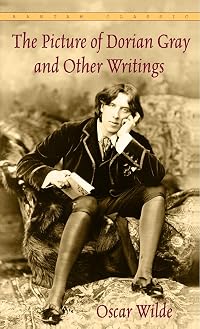
The Picture of Dorian Gray and Other Writings
by Oscar Wilde 
On This Page
Description
An exquisitely beautiful young man in Victorian England retains his youthful and innocent appearance over the years while his portrait reflects both his age and evil soul as he pursues a life of decadence and corruption.Tags
Recommendations








Member Reviews
[Reviewed as part of The Illustrated Book Club. Contains some mild spoilers]
It's taken so long to produce the cover (apologies), that my memory of the story has dimmed somewhat - I'll write the reviews straight after reading, from now on!
I enjoyed the book greatly. Wilde's trademark wit is evident in abundance, and the wonderful series of aphorisms that preface the book lay out the principles of his Aesthetic philosophy in sparkling fashion. It's interesting therefore that the book itself seems to stand apart from these principles, even to criticise them. The 19th century Aesthetic movement rejected artistic realism, and sought to emphasise surface beauty and artifice, divorced from moralising. As Wilde himself puts it: "There is no show more such thing as a moral or an immoral book. Books are well written, or badly written. That is all." And yet, Dorian Gray is undoubtedly a moral book: for all its wit, its style and surface beauty, it is - ironically - a cautionary tale concerning those who judge by appearances and take amoral delight in sensuality. This in itself seems to be a criticism of some of the worst excesses of Aestheticism - an example of the type of paradox that Wilde loved to delight in? Or perhaps a sign that Wilde was attempting to use his own art as a form of self-criticism? Not sure. But anyway, it makes the book more fascinating and worth (at some point, I'm certain) a re-reading - which is, ultimately, the test of any book. For as Wilde also said, "If one cannot enjoy reading a book over and over again, there is no use in reading it at all."
Gareth Southwell is a philosopher, writer and illustrator. show less
I recently re-read The Picture of Dorian Gray online (the book I have here on LibraryThing is back in the house we're trying to sell; thus I did not also re-read the Other Writings section) because my 8th grader son was reading it for class. I enjoyed re-visiting this novella and discussing it with my son.
There's a combination of things that makes this story so good: Wilde's version of the Faustian legend, the characters and his description of them, the conversation that they have which include many witty lines. Oscar Wilde indeed was known for his wit, which shows here and is mostly through the words of Lord Henry, Dorian's friend.
Some highlighted parts of this e-book (many of which I would not say I agree with, but liked how it was show more said):
"There is only one thing in the world worse than being talked about, and that is not being talked about".
"An artist should create beautiful things, but should put nothing of his own life in them. We live in an age when men treat art as if it were meant to be a form of autobiography. We have lost the abstract sense of beauty".
"Young men want to be faithful, and are not; old men want to be faithless and cannot".
"Nowadays people know the price of everything and the value of nothing".
"The moon hung low in the sky like a yellow skull. From time to time a huge misshapen cloud stretched a long arm across and hid it. The gas-lamps grew fewer, and the streets more narrow and gloomy".
"Anybody can be good in the country. There are no temptations there. That is the reason why people who live out of town are so absolutely uncivilized. Civilization is not by any means an easy thing to attain to. There are only two ways by which man can reach it. One is being cultured, the other is being corrupt. Country people have no opportunity of being either, so they stagnate."
"As for being poisoned by a book, there is no such thing as that. Art has no influence upon action. It annihilates the desire to act. It is superbly sterile. The books that the world calls immoral are books that show the world its own shame. That is all." show less
There's a combination of things that makes this story so good: Wilde's version of the Faustian legend, the characters and his description of them, the conversation that they have which include many witty lines. Oscar Wilde indeed was known for his wit, which shows here and is mostly through the words of Lord Henry, Dorian's friend.
Some highlighted parts of this e-book (many of which I would not say I agree with, but liked how it was show more said):
"There is only one thing in the world worse than being talked about, and that is not being talked about".
"An artist should create beautiful things, but should put nothing of his own life in them. We live in an age when men treat art as if it were meant to be a form of autobiography. We have lost the abstract sense of beauty".
"Young men want to be faithful, and are not; old men want to be faithless and cannot".
"Nowadays people know the price of everything and the value of nothing".
"The moon hung low in the sky like a yellow skull. From time to time a huge misshapen cloud stretched a long arm across and hid it. The gas-lamps grew fewer, and the streets more narrow and gloomy".
"Anybody can be good in the country. There are no temptations there. That is the reason why people who live out of town are so absolutely uncivilized. Civilization is not by any means an easy thing to attain to. There are only two ways by which man can reach it. One is being cultured, the other is being corrupt. Country people have no opportunity of being either, so they stagnate."
"As for being poisoned by a book, there is no such thing as that. Art has no influence upon action. It annihilates the desire to act. It is superbly sterile. The books that the world calls immoral are books that show the world its own shame. That is all." show less
An extraordinarily beautiful young man in Victorian England has his portrait painted, and makes an ardent wish that he never have to age. His wish is granted - his body remains ever young and beautiful, and his portrait shows the evidence of age and misdeeds - but at a price...
Oscar Wilde is always good for the quotes in his writing, and Dorian Gray is no exception. Particularly Henry Wotton, the aesthete who lures Dorian onto a hedonistic path, tears his fellow characters to pieces with witty epigrams and observations of society. There were chapters in the middle, though, where it seemed that Wilde let this tendency get in the way of actually telling his story about Dorian. This is a terrible shame because Dorian's life goes from show more bright and innocent to creepy and dark, a very Gothic tone to the story creeps in.
There is plenty of moral turpitude, fog, death, and paranoia to go around, which made this an excellent quick read curled up during a London winter. I was always drawn back to the text (though there are some boring parts where Wilde shows off his knowledge of fabrics and such), and although I knew the basic premise, I couldn't help but tear through the story to see how exactly it ended. I loved the small, hideous changes Dorian sees in the portrait and how terrifying it is to see such a record of his sins.
A creepy, fast read in a Gothic vein. A classic well worth reading (especially since it's so short).
More at my blog show less
Oscar Wilde is always good for the quotes in his writing, and Dorian Gray is no exception. Particularly Henry Wotton, the aesthete who lures Dorian onto a hedonistic path, tears his fellow characters to pieces with witty epigrams and observations of society. There were chapters in the middle, though, where it seemed that Wilde let this tendency get in the way of actually telling his story about Dorian. This is a terrible shame because Dorian's life goes from show more bright and innocent to creepy and dark, a very Gothic tone to the story creeps in.
There is plenty of moral turpitude, fog, death, and paranoia to go around, which made this an excellent quick read curled up during a London winter. I was always drawn back to the text (though there are some boring parts where Wilde shows off his knowledge of fabrics and such), and although I knew the basic premise, I couldn't help but tear through the story to see how exactly it ended. I loved the small, hideous changes Dorian sees in the portrait and how terrifying it is to see such a record of his sins.
A creepy, fast read in a Gothic vein. A classic well worth reading (especially since it's so short).
More at my blog show less
I really enjoyed Dorian Gray and generally love all of Oscar Wilde's work (especially The Importance of Being Ernest which is so ridiculous). This book had an element of horror in a way that I was completely drawn into. The character of Dorian Gray was completely well developed as we watch him start out from a place not unlike anyone else and spiral into the person that he becomes (beautiful on the outside but hideous on the inside). I definitely recommend this one for those that are interested in morality issues, the concept of a person wearing multiples masks, etc.
I remember reading "The Picture of Dorian Gray" in high school, but did not appreciate it as much as I do now. The decadence of the settings, the relationships, the atmosphere is both more obvious and intriguing to me than it was the first time I read it. The psychological aspect is reminiscent of Poe's "Telltale Heart" in some parts.
This edition also contains all of Wilde's plays. All the famous quotes attributed to Wilde are lines from his plays and not spontaneous quips given in conversation, as I had imagined. The plays are dated, but still have a certain charm.
This edition also contains all of Wilde's plays. All the famous quotes attributed to Wilde are lines from his plays and not spontaneous quips given in conversation, as I had imagined. The plays are dated, but still have a certain charm.
I had not read any Oscar Wilde before this book but knew him to be very witty from the various quotations I had read. I also knew about his imprisonment, mainly due to this NPR story: http://www.npr.org/2016/10/20/498715561/reading-gaol-where-oscar-wilde-was-impri...
Of The Picture of Dorian Gray, I only knew it was a story about a man whose portrait ages instead of his body. And I was not even aware of the plays in this collection (Salome, An Ideal Husband, and The Importance of Being Earnest [I had heard of this one but did not associate it with Wilde]). So this book was an education for me.
The Picture of Dorian Gray was both more and less than I expected. Less because it is shorter and simpler than I had anticipated - the story is show more easy to explain and has a fairly simple plot: the beautiful young man prays to have the portrait age rather than himself and his wish comes true. But more because I didn't realize that the portrait was not only a record of Gray's age but also a surrogate for his conscience; the first changes in the portrait are changes in character that reflect his sins, not his age. Dorian embarks on a life of sensual pleasure and intellectual investigation and pays no heed to any consequences of his actions. His portrait bears all the weight of his misdeeds.
I understand that there is a more recently published annotated version of the novel and I would like to read that someday. I felt that I missed a great deal by not being well versed in late 19th-Century culture, London geography, or all the classical stories Wilde mentions. There are some passages that might as well be written in another language for all I understand the cultural and artistic references. I'm clearly not as well-educated as I like to think! I was longing for annotations and footnotes! I believe I may have missed much of the depth and symbolism of the story.
The plays in the book were all new to me, and I found The Importance of Being Earnest to be the most entertaining of those. I would like to see that one especially, but all of them really, performed on stage; I'm sure that would give me greater appreciation of Wilde's facility with language.
The book ends with "The Ballad of Reading Gaol," which is a somber and beautiful study on life in prison. I was surprised to see so much serious religious reference in this work, as I would not have thought Wilde would be the religious sort, although I do not know enough about him to be confident in that opinion.
Overall, I am glad I read this collection but was not blown away by it. I understand Dorian Gray, particularly, had a great and controversial impact upon its release but it seems fairly tame and predictable today, as do the plays, with the exception of Salome. I appreciate the author's way with words and his wit, but will not list him among my favorite writers. show less
Of The Picture of Dorian Gray, I only knew it was a story about a man whose portrait ages instead of his body. And I was not even aware of the plays in this collection (Salome, An Ideal Husband, and The Importance of Being Earnest [I had heard of this one but did not associate it with Wilde]). So this book was an education for me.
The Picture of Dorian Gray was both more and less than I expected. Less because it is shorter and simpler than I had anticipated - the story is show more easy to explain and has a fairly simple plot: the beautiful young man prays to have the portrait age rather than himself and his wish comes true. But more because I didn't realize that the portrait was not only a record of Gray's age but also a surrogate for his conscience; the first changes in the portrait are changes in character that reflect his sins, not his age. Dorian embarks on a life of sensual pleasure and intellectual investigation and pays no heed to any consequences of his actions. His portrait bears all the weight of his misdeeds.
I understand that there is a more recently published annotated version of the novel and I would like to read that someday. I felt that I missed a great deal by not being well versed in late 19th-Century culture, London geography, or all the classical stories Wilde mentions. There are some passages that might as well be written in another language for all I understand the cultural and artistic references. I'm clearly not as well-educated as I like to think! I was longing for annotations and footnotes! I believe I may have missed much of the depth and symbolism of the story.
The plays in the book were all new to me, and I found The Importance of Being Earnest to be the most entertaining of those. I would like to see that one especially, but all of them really, performed on stage; I'm sure that would give me greater appreciation of Wilde's facility with language.
The book ends with "The Ballad of Reading Gaol," which is a somber and beautiful study on life in prison. I was surprised to see so much serious religious reference in this work, as I would not have thought Wilde would be the religious sort, although I do not know enough about him to be confident in that opinion.
Overall, I am glad I read this collection but was not blown away by it. I understand Dorian Gray, particularly, had a great and controversial impact upon its release but it seems fairly tame and predictable today, as do the plays, with the exception of Salome. I appreciate the author's way with words and his wit, but will not list him among my favorite writers. show less
I liked it. I know some people found Lord Henry pompous and overwhelming, but I enjoyed his (Wilde's) philosophical observations of human nature. I don't agree with all of them, but I found them intriguing and thought-provoking. While Basil was the artist who captured Dorian's physical image, Harry was the artist who created Dorian's soul. It was his influence on Dorian's much-vaunted innocence (a blank canvas, if you will) that provided the evil seeds that eventually sprouted into Dorian's twisted, degenerate soul.
Members
- Recently Added By
Lists

Philosophical Fiction
97 works; 26 members

Recommend the 20 best books you've read in the last five years
2,168 works; 608 members

Best Satire
188 works; 29 members

Best of Irish Literature
37 works; 7 members
Author Information

1,792+ Works 121,683 Members
Flamboyant man-about-town, Oscar Wilde had a reputation that preceded him, especially in his early career. He was born to a middle-class Irish family (his father was a surgeon) and was trained as a scholarship boy at Trinity College, Dublin. He subsequently won a scholarship to Magdalen College, Oxford, where he was heavily influenced by John show more Ruskin and Walter Pater, whose aestheticism was taken to its radical extreme in Wilde's work. By 1879 he was already known as a wit and a dandy; soon after, in fact, he was satirized in Gilbert and Sullivan's Patience. Largely on the strength of his public persona, Wilde undertook a lecture tour to the United States in 1882, where he saw his play Vera open---unsuccessfully---in New York. His first published volume, Poems, which met with some degree of approbation, appeared at this time. In 1884 he married Constance Lloyd, the daughter of an Irish lawyer, and within two years they had two sons. During this period he wrote, among others, The Picture of Dorian Gray (1891), his only novel, which scandalized many readers and was widely denounced as immoral. Wilde simultaneously dismissed and encouraged such criticism with his statement in the preface, "There is no such thing as a moral or an immoral book. Books are well written or badly written. That is all." In 1891 Wilde published A House of Pomegranates, a collection of fantasy tales, and in 1892 gained commercial and critical success with his play, Lady Windermere's Fan He followed this comedy with A Woman of No Importance (1893), An Ideal Husband (1895), and his most famous play, The Importance of Being Earnest (1895). During this period he also wrote Salome, in French, but was unable to obtain a license for it in England. Performed in Paris in 1896, the play was translated and published in England in 1894 by Lord Alfred Douglas and was illustrated by Aubrey Beardsley. Lord Alfred was the son of the Marquess of Queensbury, who objected to his son's spending so much time with Wilde because of Wilde's flamboyant behavior and homosexual relationships. In 1895, after being publicly insulted by the marquess, Wilde brought an unsuccessful slander suit against the peer. The result of his inability to prove slander was his own trial on charges of sodomy, of which he was found guilty and sentenced to two years of hard labor. During his time in prison, he wrote a scathing rebuke to Lord Alfred, published in 1905 as De Profundis. In it he argues that his conduct was a result of his standing "in symbolic relations to the art and culture" of his time. After his release, Wilde left England for Paris, where he wrote what may be his most famous poem, The Ballad of Reading Gaol (1898), drawn from his prison experiences. Among his other notable writing is The Soul of Man under Socialism (1891), which argues for individualism and freedom of artistic expression. There has been a revived interest in Wilde's work; among the best recent volumes are Richard Ellmann's, Oscar Wilde and Regenia Gagnier's Idylls of the Marketplace , two works that vary widely in their critical assumptions and approach to Wilde but that offer rich insights into his complex character. (Bowker Author Biography) show less
Oscar Wilde has a Legacy Library. Legacy libraries are the personal libraries of famous readers, entered by LibraryThing members from the Legacy Libraries group.
Some Editions
Awards and Honors
Notable Lists
BBC's Big Read (118)
Series
Belongs to Publisher Series
Work Relationships
Contains
Common Knowledge
- Canonical title
- The Picture of Dorian Gray and Other Writings
- Original publication date
- 1890 (The Picture of Dorian Gray) (The Picture of Dorian Gray)
- People/Characters
- Henry Wotton; Basil Hallward; Dorian Gray; Sibyl Vane; James Vane; Alan Campbell (show all 22); Lord Fermor; Victoria Wotton; John "Jack" Worthing; Algernon "Algy" Moncrieff; Augusta Fairfax; Gwendolen Fairfax; Cecily Cardew; Laetitia Prism; Frederick Chasuble; Lane; Merriman; Gribsby; Salome; Herod Antipas; Herodias; John
- Important places
- Paris, France
- First words
- The artist is the creator of beautiful things.
- Last words
- (Click to show. Warning: May contain spoilers.)"I never heard such nonsense in all my life."
Classifications
Statistics
- Members
- 2,733
- Popularity
- 6,791
- Reviews
- 23
- Rating
- (4.13)
- Languages
- 7 — Dutch, English, German, Polish, Romanian, Spanish, Portuguese (Portugal)
- Media
- Paper, Ebook
- ISBNs
- 32
- ASINs
- 19