On This Page
Description
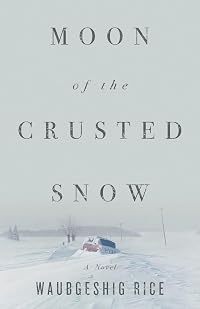
"With winter looming, a small northern Anishinaabe community goes dark. Cut off, people become passive and confused. Panic builds as the food supply dwindles. While the band council and a pocket of community members struggle to maintain order, an unexpected visitor arrives, escaping the crumbling society to the south. Soon after, others follow. The community leadership loses its grip on power as the visitors manipulate the tired and hungry to take control of the reserve. Tensions rise and, show more as the months pass, so does the death toll due to sickness and despair. Frustrated by the building chaos, a group of young friends and their families turn to the land and Anishinaabe tradition in hopes of helping their community thrive again. Guided through the chaos by an unlikely leader named Evan Whitesky, they endeavor to restore order while grappling with a grave decision."-- show lessTags
Recommendations








Member Recommendations
Member Reviews
Moon of the Crusted Snow, an apocalyptic tale by author Waubgeshig Rice, is divided into three sections based on seasons:
Autumn - the beginning as a northern Anishinaabe reserve in Canada loses all communication with the outside world
Winter - band struggles to survive as it becomes clear there will be no new supplies and what foodstuffs they have are dwindling
- some members become passive while others including Evan Whitesley do their best to keep the community together and safe
- a stranger arrives and quickly unsettles and divides the band
- deaths begin to mount
Spring - the remaining members of the band make plans to leave the reserve and seek a new safe home hopefully far away from whatever urban civilization if any still survives show more
Moon of the Crusted Snow is as much an allegory for colonization as it is an apocalyptic tale. As one elder of the band who still knows their history and keeps their culture alive says when the issue of apocalypse is raised:
Our world isn't ending. It already ended. It ended when the Zhaagnaash* came into our original home...and took it from us...[A]pocalypse. We've had that over and over. But we always survived. We're still here. And we'll still be here, even if the power and the radios don't come back on and we never see any white people again
This is a well-written story full of action, suspense, and tragedy. It also gives a different perspective on what apocalypse means to people who have experienced colonization and, as such, it ends on a surprisingly hopeful note. A definite high recommendation from me.
*white people
Thanks to Edelweiss+ and ECW Press for the opportunity to read this book in exchange for an honest review show less
Autumn - the beginning as a northern Anishinaabe reserve in Canada loses all communication with the outside world
Winter - band struggles to survive as it becomes clear there will be no new supplies and what foodstuffs they have are dwindling
- some members become passive while others including Evan Whitesley do their best to keep the community together and safe
- a stranger arrives and quickly unsettles and divides the band
- deaths begin to mount
Spring - the remaining members of the band make plans to leave the reserve and seek a new safe home hopefully far away from whatever urban civilization if any still survives show more
Moon of the Crusted Snow is as much an allegory for colonization as it is an apocalyptic tale. As one elder of the band who still knows their history and keeps their culture alive says when the issue of apocalypse is raised:
Our world isn't ending. It already ended. It ended when the Zhaagnaash* came into our original home...and took it from us...[A]pocalypse. We've had that over and over. But we always survived. We're still here. And we'll still be here, even if the power and the radios don't come back on and we never see any white people again
This is a well-written story full of action, suspense, and tragedy. It also gives a different perspective on what apocalypse means to people who have experienced colonization and, as such, it ends on a surprisingly hopeful note. A definite high recommendation from me.
*white people
Thanks to Edelweiss+ and ECW Press for the opportunity to read this book in exchange for an honest review show less
This is a story about what happens when the world... fails. Evan and his family and friends are living in a small northern Anishinaabe town when things begin to change. At first, the satellite TV stops working, then the phones stop, then the power. The band council tries to keep the residents calm but things slowly creep towards fear and paranoia.
There is no clear reveal about what happened in the world to make such huge changes come about. I read a lot of science fiction so I think there's a part of me that would have preferred to hear what caused all the modern conveniences to disappear. That being said, this story is really more about what happens to people when things change.
The author and the narrator both manage to convey a sense show more of creeping towards distrust and potential violence. At first, people are more than willing to assume that things will return to normal. But as lives get lost and there's no sign that things are returning to normal, people begin to crumble.
When the first interlopers arrive from the city, the community welcomes them even if it's nervously. But, new people have a way of changing the dynamics. With time, the original residents are influenced by the interlopers and begin to question the leadership.
Billy Merasty's great narration definitely adds to the atmosphere of this novel. I grew up in northern Alberta and Merasty's speech cadence and intonation were perfect for a book about a First Nation Community. I actually raised my review by one star because I so thoroughly enjoyed Merasty's narration. I'm a firm believer that the narrator can make or break an audiobook.
I really enjoyed the Ojibway language that was scattered throughout the novel. It sounded beautiful and I appreciated Rice's faith in his readers to learn and interpret as they went along. Merasty's pronunciation and the lovely sound of the language really enabled me to immerse myself in the culture.
I found the story to be a bit slow-moving. I think that Rice poses some great questions about what might happen if there was some type of apocalyptic event. I wasn't very satisfied with the way the changes were left almost completely unexplained...but then I suppose that's not what the book is about. This book is about change, traditional values, and survival. show less
There is no clear reveal about what happened in the world to make such huge changes come about. I read a lot of science fiction so I think there's a part of me that would have preferred to hear what caused all the modern conveniences to disappear. That being said, this story is really more about what happens to people when things change.
The author and the narrator both manage to convey a sense show more of creeping towards distrust and potential violence. At first, people are more than willing to assume that things will return to normal. But as lives get lost and there's no sign that things are returning to normal, people begin to crumble.
When the first interlopers arrive from the city, the community welcomes them even if it's nervously. But, new people have a way of changing the dynamics. With time, the original residents are influenced by the interlopers and begin to question the leadership.
Billy Merasty's great narration definitely adds to the atmosphere of this novel. I grew up in northern Alberta and Merasty's speech cadence and intonation were perfect for a book about a First Nation Community. I actually raised my review by one star because I so thoroughly enjoyed Merasty's narration. I'm a firm believer that the narrator can make or break an audiobook.
I really enjoyed the Ojibway language that was scattered throughout the novel. It sounded beautiful and I appreciated Rice's faith in his readers to learn and interpret as they went along. Merasty's pronunciation and the lovely sound of the language really enabled me to immerse myself in the culture.
I found the story to be a bit slow-moving. I think that Rice poses some great questions about what might happen if there was some type of apocalyptic event. I wasn't very satisfied with the way the changes were left almost completely unexplained...but then I suppose that's not what the book is about. This book is about change, traditional values, and survival. show less
Evan and his partner Nicole live on a reserve in northern Canada with their children. Their community is a tight-knit one, although there are problems like unemployment and addiction. Some of the community members have resumed living in a more traditional way, such as going out to hunt or learning about plant medicine.
When the reserve is suddenly cut off from the south, with no reception and no power while being almost snowed in, these traditional skills become more important than ever. But new challenges arise, especially when outsiders find their way in. As time goes by, the story becomes considerably darker and the danger grows.
In the beginning I found it a bit hard to connect to Evan and Nicole, but apart from that, I was show more captivated by this novel and read it straight through in two sittings. It is not only an extremely gripping and exciting read, but also a glimpse into life on a reserve and into Anishinaabe culture and history. The author weaves this together with shades of horror literature and Indigenous mythology in a skillful way.
I have already bought two more novels by Waubgeshig Rice and cannot wait to read them! show less
When the reserve is suddenly cut off from the south, with no reception and no power while being almost snowed in, these traditional skills become more important than ever. But new challenges arise, especially when outsiders find their way in. As time goes by, the story becomes considerably darker and the danger grows.
In the beginning I found it a bit hard to connect to Evan and Nicole, but apart from that, I was show more captivated by this novel and read it straight through in two sittings. It is not only an extremely gripping and exciting read, but also a glimpse into life on a reserve and into Anishinaabe culture and history. The author weaves this together with shades of horror literature and Indigenous mythology in a skillful way.
I have already bought two more novels by Waubgeshig Rice and cannot wait to read them! show less
This was a haunting cautionary tale! Set in northern Canada, MOON OF THE CRUSTED SNOW is a character-driven, slow-burn thriller about what happens in a remote Anishinaabe community when the unthinkable happens. Their power goes out, their phones quit working, and suddenly they’re cut off from the rest of the world. Winter is setting in, food supplies are low, and word from the south is that the chaos is widespread. When an outsider arrives seeking shelter, their precarious situation gets worse.
I’m not usually a fan of dystopian/post-apocalyptic fiction, BUT something about the premise of this book pulled me in. I’m so glad I took a chance and read it. The wonderfully tense, ominous atmosphere kept me glued to the pages. What a show more terrifying situation to be in, and I felt like I was a part of it, wondering what was coming next.
One of the most memorable moments was when main character Evan talked to an elder about the meaning of “apocalypse,” and how their world had already ended when they were forced off their land and had their children taken away.
If a dystopian novel can be realistic, then this was it. In the end, I was left with a lot of unanswered questions, but in an actual apocalypse, would you have all the answers? I just read that there will be a sequel coming out (next year, maybe), and I can’t wait to find out what happens next. show less
I’m not usually a fan of dystopian/post-apocalyptic fiction, BUT something about the premise of this book pulled me in. I’m so glad I took a chance and read it. The wonderfully tense, ominous atmosphere kept me glued to the pages. What a show more terrifying situation to be in, and I felt like I was a part of it, wondering what was coming next.
One of the most memorable moments was when main character Evan talked to an elder about the meaning of “apocalypse,” and how their world had already ended when they were forced off their land and had their children taken away.
If a dystopian novel can be realistic, then this was it. In the end, I was left with a lot of unanswered questions, but in an actual apocalypse, would you have all the answers? I just read that there will be a sequel coming out (next year, maybe), and I can’t wait to find out what happens next. show less
On a reserve in northwestern Ontario, the power goes out. Typical, the residents think. It’s going to take a while until the power comes back, because the South looks after its own first and doesn’t give much of a thought to the North. So a weekend without power is not a hardship. But the power stays out. No word comes from the South. Then two people arrive via snowmobile and spread the news: no power is coming, and no help either. The reserve residents are on their own.
This is an interesting apocalypse book because it doesn’t focus on the actual cause of the end of the world; it focuses on the aftermath and the conflicts that arise as the existing way of things gradually deteriorates. There are some heartwarming scenes involving show more Evan’s kids as they interact with their parents and grandparents, who try to keep things as normal for them as possible. An element of menace is introduced by Justin Scott, an obnoxious survivalist white guy who tries to position himself as a “saviour” and divides the residents’ allegiances. Overall, this is a well-written book. I did find the ending a bit rushed, but satisfying.
I’d recommend this for anyone looking to explore works by Indigenous writers, and people who like their post-apocalypse light on the gore (there is hardly any). show less
This is an interesting apocalypse book because it doesn’t focus on the actual cause of the end of the world; it focuses on the aftermath and the conflicts that arise as the existing way of things gradually deteriorates. There are some heartwarming scenes involving show more Evan’s kids as they interact with their parents and grandparents, who try to keep things as normal for them as possible. An element of menace is introduced by Justin Scott, an obnoxious survivalist white guy who tries to position himself as a “saviour” and divides the residents’ allegiances. Overall, this is a well-written book. I did find the ending a bit rushed, but satisfying.
I’d recommend this for anyone looking to explore works by Indigenous writers, and people who like their post-apocalypse light on the gore (there is hardly any). show less
As winter approaches, Anishinaabe reserve in northern Ontario lose power and cellular networks. Initially, no one is too concerned since outages are frequent, but as the days pass the community becomes restless. Then two younger members of the community return from college with news that loss of power and communications has also affected the Canadian cities to the south, and society is growing unstable. The community has fuel to power generators and food reserves but will they last until the spring? Tensions rise when a white man arrives requesting to shelter with the community. Should they trust the stranger with the resources for their own community already dwindling?
This is an excellent thriller about a community under distress. Most show more post-apocalyptic stories are set in cities or suburbs so it was interesting to see the story told from people who live in the most remote parts of the world. Thematically, this apocalypse also comments on how indigenous people in the American have survived very real apocalypses and genocide. The main point of view character, Evan Whitesky, an ordinary man who emerges as an unlikely reader is a terrifically well-realized protagonist. show less
This is an excellent thriller about a community under distress. Most show more post-apocalyptic stories are set in cities or suburbs so it was interesting to see the story told from people who live in the most remote parts of the world. Thematically, this apocalypse also comments on how indigenous people in the American have survived very real apocalypses and genocide. The main point of view character, Evan Whitesky, an ordinary man who emerges as an unlikely reader is a terrifically well-realized protagonist. show less
I See the Bad Moon Arising
Review of the ECW Press paperback (October 2018)
Moon of the Crusted Snow is a low-key post-apocalyptic novel which portrays the after-effects of a mysterious world-wide power and communications blackout on a fictional Anishnaabe First Nations community in Northern Ontario, Canada. I describe it as low-key in the sense that you never learn what is the cause of the blackout and how outside governments and forces react to it. That is left to your imagination. All that you see is how one remote community deals with its immediate effects. It therefore has the feel of a more "real" story and not some crazed zombie apocalypse.
The story centres on the young family of Ethan and Nicole and their 2 children. Ethan is a show more worker for the Band Council but also spends time hunting and fishing to feed his own family and his extended community. Ethan has developed his survival skills through the mentoring of his father, in contrast to his younger brother Cam who is a slacker playing video games and such. The power outage comes along suddenly and at first the community thinks it is just one of the regular infrastructure problems that it has dealt with in the past with the expectation that things will return to normal in a day or two. However, winter is coming and fuel and food reserves are in short supply.
Instead, many days go by without any restoration and soon everybody begins to realize that it may not come back at all. Due to the remoteness of the community no outside word arrives until two students from the nearest town breakout from their college to travel home via snowmobiles to say what has happened in the outside world. But then further outsiders arrive, bringing with them potential fatal consequences.
I found Moon of the Crusted Snow to be a totally engrossing story which had a very realistic feel to it. The book was published in 2018, but had a further resurgence of interest during the 2020 pandemic. That led to author Rice deciding to write a sequel Moon of the Turning Leaves (Random House - expected publication October 10, 2023) which picks up the story 10-years further into the future. I read the first book through being introduced to it at the recent 2023 Lakefield Literary Festival. I now eagerly anticipate the sequel.
See photo at https://scontent-ord5-2.xx.fbcdn.net/v/t39.30808-6/361271558_24345228475075942_2...
Author Waubgeshig Rice (centre) in discussion with moderator John Barber (left) and author Kai Thomas ([book:In the Upper Country|60880810] (2023)) at the 2023 Lakefield Literary Festival, Canada.
Trivia and Links
Author Waubgeshig Rice is interviewed about the book on the APTN Face to Face program which you can see on YouTube here.
You can read a teaser excerpt from the sequel novel Moon of the Turning Leaves at this CBC article Anishinaabe Inspired Vision for the Future, April 25, 2023.
In a bizarre turn of events, there was at least one real-life instance during the recent pandemic of a situation which paralleled some of the events in Moon of the Crusted Snow. The outcome was quite different however, as you can read at Quebec couple fleeing COVID-19 'endangered' Yukon First Nation, chief says CBC News, March 30, 2020. show less
Review of the ECW Press paperback (October 2018)
Moon of the Crusted Snow is a low-key post-apocalyptic novel which portrays the after-effects of a mysterious world-wide power and communications blackout on a fictional Anishnaabe First Nations community in Northern Ontario, Canada. I describe it as low-key in the sense that you never learn what is the cause of the blackout and how outside governments and forces react to it. That is left to your imagination. All that you see is how one remote community deals with its immediate effects. It therefore has the feel of a more "real" story and not some crazed zombie apocalypse.
The story centres on the young family of Ethan and Nicole and their 2 children. Ethan is a show more worker for the Band Council but also spends time hunting and fishing to feed his own family and his extended community. Ethan has developed his survival skills through the mentoring of his father, in contrast to his younger brother Cam who is a slacker playing video games and such. The power outage comes along suddenly and at first the community thinks it is just one of the regular infrastructure problems that it has dealt with in the past with the expectation that things will return to normal in a day or two. However, winter is coming and fuel and food reserves are in short supply.
Instead, many days go by without any restoration and soon everybody begins to realize that it may not come back at all. Due to the remoteness of the community no outside word arrives until two students from the nearest town breakout from their college to travel home via snowmobiles to say what has happened in the outside world. But then further outsiders arrive, bringing with them potential fatal consequences.
I found Moon of the Crusted Snow to be a totally engrossing story which had a very realistic feel to it. The book was published in 2018, but had a further resurgence of interest during the 2020 pandemic. That led to author Rice deciding to write a sequel Moon of the Turning Leaves (Random House - expected publication October 10, 2023) which picks up the story 10-years further into the future. I read the first book through being introduced to it at the recent 2023 Lakefield Literary Festival. I now eagerly anticipate the sequel.
See photo at https://scontent-ord5-2.xx.fbcdn.net/v/t39.30808-6/361271558_24345228475075942_2...
Author Waubgeshig Rice (centre) in discussion with moderator John Barber (left) and author Kai Thomas ([book:In the Upper Country|60880810] (2023)) at the 2023 Lakefield Literary Festival, Canada.
Trivia and Links
Author Waubgeshig Rice is interviewed about the book on the APTN Face to Face program which you can see on YouTube here.
You can read a teaser excerpt from the sequel novel Moon of the Turning Leaves at this CBC article Anishinaabe Inspired Vision for the Future, April 25, 2023.
In a bizarre turn of events, there was at least one real-life instance during the recent pandemic of a situation which paralleled some of the events in Moon of the Crusted Snow. The outcome was quite different however, as you can read at Quebec couple fleeing COVID-19 'endangered' Yukon First Nation, chief says CBC News, March 30, 2020. show less
Members
- Recently Added By
Lists

Recommend the 20 best books you've read in the last five years
2,168 works; 601 members

Native American / Indigenous Literature
172 works; 100 members

Books Set in Canada
80 works; 16 members

Mythical Monsters of the World
199 works; 79 members

Dystopian and Apocalyptic Literature
350 works; 74 members

Overdue Podcast
808 works; 9 members

Diverse Horror
262 works; 6 members

Speculative Fiction to Read
706 works; 32 members

Globe and Mail | Canadian Fiction: January 13, 2024
10 works; 1 member

Globe and Mail | Canadian Fiction: January 20, 2024
10 works; 1 member
Globe and Mail | Canadian Fiction: January 27, 2024
10 works; 1 member

Globe and Mail | Canadian Fiction: February 3, 2024
10 works; 1 member
Globe and Mail | Canadian Fiction: February 10, 2024
10 works; 1 member

Globe and Mail | Canadian Fiction: January 18, 2025
10 works; 1 member

Evergreen Award™ Winners and Nominees 2005–2024
200 works; 3 members

Globe and Mail | Canadian Fiction: November 16, 2024
10 works; 1 member

Globe and Mail | Canadian Fiction: December 23, 2023
10 works; 1 member
Canadian Historical Fiction 🇨🇦
157 works; 8 members

Globe and Mail | Canadian Fiction: July 26, 2025
10 works; 1 member

Globe and Mail | Canadian Fiction: August 23, 2025
10 works; 1 member

Globe and Mail | Canadian Fiction: Year End, 2023
10 works; 1 member

20 Books Off the Beaten Path
20 works; 2 members
Globe and Mail | Canadian Fiction: December 16, 2023
10 works; 1 member
Globe and Mail | Canadian Fiction: December 9, 2023
10 works; 1 member
Globe and Mail | Canadian Fiction: December 2, 2023
10 works; 1 member

Globe and Mail | Canadian Fiction: November 18, 2023
10 works; 1 member
Globe and Mail | Canadian Fiction: November 11, 2023
10 works; 1 member
Globe and Mail | Canadian Fiction: November 4, 2023
10 works; 1 member
Globe and Mail | Canadian Fiction: October 28, 2023
10 works; 1 member
Globe and Mail | Canadian Fiction: October 21, 2023
10 works; 1 member

Globe and Mail | Canadian Fiction: October 14, 2023
10 works; 1 member

At the Library
217 works; 1 member

Horror Spotlight Readalong
37 works; 2 members

Fiction: Crime, Detective, Mystery
350 works; 3 members

TBR - Older Books
92 works; 1 member

In the Wild Reading List
12 works; 3 members

Books Read in 2021
5,361 works; 113 members
Globe and Mail | Canadian Fiction: November 25, 2023
10 works; 1 member
Author Information

7+ Works 1,786 Members
Some Editions
Awards and Honors
Series

Common Knowledge
- Canonical title
- Moon of the Crusted Snow
- Original title
- Moon of the Crusted Snow
- Original publication date
- 2018
- People/Characters
- Evan Whitesky; Nicole McCloud; Justin Scott
- Important places
- Gaawaandagkoong First Nation
- Dedication
- To my son, Jiikwis, who shines a bright and beautiful light on our future.
- First words
- A crack echoed through the boreal landscape, a momentary chaos in the still afternoon air.
- Last words
- (Click to show. Warning: May contain spoilers.)They didn't look back.
- Blurbers
- Robinson, Eden; Hardcastle, Kevin; Cariou, Warren; Van Camp, Richard
- Original language
- English
- Canonical DDC/MDS
- 813.6
- Canonical LCC
- PS8635.I246
Classifications
Statistics
- Members
- 1,343
- Popularity
- 17,879
- Reviews
- 94
- Rating
- (3.77)
- Languages
- English, French, German
- Media
- Paper, Audiobook, Ebook
- ISBNs
- 11
- ASINs
- 7