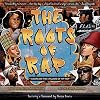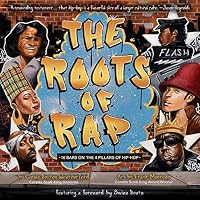
The Roots of Rap: 16 Bars on the 4 Pillars of Hip-Hop
by Carole Boston Weatherford
On This Page
Description
Presents the history of hip-hop including how it evolved from folktales, spirituals, and poetry, to the showmanship of James Brown, to the culture of graffiti art and breakdancing that formed around the art form.Tags
Recommendations

Member Reviews
Morrison’s illustrations set the stage for Weatherford’s rhythmic history in verse, breaking from hip-hop’s early influences to today’s global hip-hop takeover.
This celebration begins, appropriately, with the ancestors. An homage to Afro-descendent “folktales, street rhymes, and spirituals,” along with images of Langston Hughes and Paul Laurence Dunbar, is juxtaposed with a backpack-toting black male with a crisp fade and T-shirt emblazoned with the signature words of Notorious B.I.G.: “It was all a dream.” This slogan recalling the dream of Martin Luther King Jr. highlights how the art form has served a dual purpose for hip-hop heads to get down at the party as well as to unify on the streets. Weatherford demonstrates show more how James Brown’s funk matched with Jamaica’s dub was present in DJ Kool Herc’s Bronx block parties, at which hip-hop’s birth is formally credited. But Weatherford and Morrison don’t stop at the music. Graffiti artists on the subway lines of NYC, B-boys and B-girls on the cardboard dance floors, and the unforgettable hip-hop fashion are featured prominently, albeit with a heavy regionalist emphasis on its East Coast–reppin’ legends. Bronx-born superproducer Swizz Beatz provides the foreword, honoring the role models that paved the way to his flourishing artistic career. (There are relatively few artists from outside New York and New Jersey featured, though some come through in thumbnail biographies of both male and female artists in the backmatter.)
No way around it, this book is supa-dupa fly, with lush illustrations anchored in signature hip-hop iconography for the future of the global hip-hop nation.
-Kirkus Review show less
This celebration begins, appropriately, with the ancestors. An homage to Afro-descendent “folktales, street rhymes, and spirituals,” along with images of Langston Hughes and Paul Laurence Dunbar, is juxtaposed with a backpack-toting black male with a crisp fade and T-shirt emblazoned with the signature words of Notorious B.I.G.: “It was all a dream.” This slogan recalling the dream of Martin Luther King Jr. highlights how the art form has served a dual purpose for hip-hop heads to get down at the party as well as to unify on the streets. Weatherford demonstrates show more how James Brown’s funk matched with Jamaica’s dub was present in DJ Kool Herc’s Bronx block parties, at which hip-hop’s birth is formally credited. But Weatherford and Morrison don’t stop at the music. Graffiti artists on the subway lines of NYC, B-boys and B-girls on the cardboard dance floors, and the unforgettable hip-hop fashion are featured prominently, albeit with a heavy regionalist emphasis on its East Coast–reppin’ legends. Bronx-born superproducer Swizz Beatz provides the foreword, honoring the role models that paved the way to his flourishing artistic career. (There are relatively few artists from outside New York and New Jersey featured, though some come through in thumbnail biographies of both male and female artists in the backmatter.)
No way around it, this book is supa-dupa fly, with lush illustrations anchored in signature hip-hop iconography for the future of the global hip-hop nation.
-Kirkus Review show less
This ode to hip-hop culture nods at its history from poets like Langston Hughes to rap icons like Biggie Smalls.
This was one of those books that wasn't what I expected at all. Despite the subtitle which should have indicated I was getting an extended poem, for some reason I thought I would be looking at a book full of informational text in the straightforward manner of many children's nonfiction titles. While this book does contain some facts, the reader will glean most of those from the backmatter glossary and "who's who" of rap history rather than from the main text.
That all being said, this was an interesting read, even though it was not the one I was expecting. I admire the authors for giving children an introduction to rap, which show more is not a subject I've seen in children's literature before (at least not as the main focus). The poem is quite lovely and works well as a readaloud (as great poems do). The illustrations are top-notch, striking and colorful. show less
This was one of those books that wasn't what I expected at all. Despite the subtitle which should have indicated I was getting an extended poem, for some reason I thought I would be looking at a book full of informational text in the straightforward manner of many children's nonfiction titles. While this book does contain some facts, the reader will glean most of those from the backmatter glossary and "who's who" of rap history rather than from the main text.
That all being said, this was an interesting read, even though it was not the one I was expecting. I admire the authors for giving children an introduction to rap, which show more is not a subject I've seen in children's literature before (at least not as the main focus). The poem is quite lovely and works well as a readaloud (as great poems do). The illustrations are top-notch, striking and colorful. show less
SLJ said, "The author captures a complex art form in just a handful of short stanzas; the extensive back matter fills in any gaps." I ... disagree. I feel like the book did a lot of name-checking, but it didn't really explain its subject. Reading the illustrator's biographical note made me want a more focused story that talked about his life instead! (He was a graffiti artist and backup dancer for The Sugarhill Gang who visited the Louvre while on tour and was inspired to become a professional artist.) That said, the art is fantastic, and the book works okay if you view it not as a nonfiction text but as a poem about hip hop that could inspire readers to do their own research into the artists named.
Along with movies and pro-wrestling, one of my favorite forms of entertainment is music. As such, I wanted to have a book about one of my favorite genres be included in this list. One day at work, I found this book recently returned. I was surprised seeing a book on this topic for kids since rap’s recent popularity has not really translated into a greater literary presence (a fact Swizz Beatz also brings up in the beginning of the book). Given this book’s existence, for kids, they can now see how the genre has evolved over the years. Meanwhile, for myself, I was hoping to learn something that would make me even more appreciative of rap.
At the heart of this book are the artists that transformed rap. Admittedly, I knew the majority show more of them. Although my preference for rap music is in the 90s and later, I still recognized names from the golden age of hip-hop like Grandmaster Flash, Kurtis Blow, etc. I ended up finding out that writer Paul Lawrence Dunbar played a part in giving rap its poetic roots. If I had to change anything, however, it would have been to include a CD with the book. Even if Weatherford did not want to include explicit gangsta rap on it, she could have put Dunbar’s poems being read or some of the more innocuous hip-hop tracks from rap’s beginnings. That suggestion aside, readers can definitely tell care was put into this book and because of that, will surely enjoy reading it too. show less
At the heart of this book are the artists that transformed rap. Admittedly, I knew the majority show more of them. Although my preference for rap music is in the 90s and later, I still recognized names from the golden age of hip-hop like Grandmaster Flash, Kurtis Blow, etc. I ended up finding out that writer Paul Lawrence Dunbar played a part in giving rap its poetic roots. If I had to change anything, however, it would have been to include a CD with the book. Even if Weatherford did not want to include explicit gangsta rap on it, she could have put Dunbar’s poems being read or some of the more innocuous hip-hop tracks from rap’s beginnings. That suggestion aside, readers can definitely tell care was put into this book and because of that, will surely enjoy reading it too. show less
I strongly enjoyed this book. I say that for many reasons. First, the illustrations were outstanding in this story. They were highly detailed and clear for the readers view. Also, they were spot on with how the real artists actually look. This helped the reader enjoy the text even more. Secondly, the history in the story gives the reader some background knowledge. For instance, in the story it states, " The origins go way back-beyond old school. But it is the seventies that rapper start the rule.". The way the book grants us readers information that we might not know much on is helpful when reading. Lastly, I enjoyed that the book was written in a rhyming pattern. It made me almost sing the text, which was perfect because the story is show more about music. I believe the main idea is to give readers insight on the history of rap and how it has evolved to where it is today. show less
I think my expectations were off. I wanted information, not just general celebration. This book is going to raise more questions than it answers, and unfortunately, there aren’t many (any?) other children’s books on the topic for this whose interest is piqued. Please make a whole book out of the back matter. The artwork is fantastic.
The history of hip-hop as one long poem - scattered with onomatopoeia and playful rhythm. Hip-hop is introduced as at its root spoken word and communication - “folk tales, street rhymes, spirituals” - and is elaborated upon as a tradition of many formats. The founders and legends of hip hop are named. I loved the atmospheric illustrations.
Members
- Recently Added By
Author Information

86+ Works 9,715 Members
All Editions
Awards and Honors
Awards
Distinctions
Notable Lists
Classifications
- Genres
- Picture Books, Nonfiction
- DDC/MDS
- 782.42164909 — Arts & recreation Music Vocal Music, Singing Secular forms of vocal music Songs General principles and musical forms Traditions of secular songs {genres} Western popular songs Rap
- LCC
- ML3531 .W43 — Music Literature on music Literature on music History and criticism Popular music
- BISAC
Statistics
- Members
- 200
- Popularity
- 163,019
- Reviews
- 8
- Rating
- (4.13)
- Languages
- English
- Media
- Paper
- ISBNs
- 3