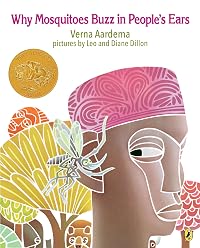
Why Mosquitoes Buzz in People's Ears
by Verna Aardema
On This Page
Description
Reveals the meaning of the mosquito's buzz.Tags
Recommendations





Member Recommendations
Member Reviews
I really like the art on this one (it's a Caldecott winner for a reason). I'm not the biggest fan of the folktale itself, since it's pretty grim for me - but folklore IS folklore. I'll never ask anyone to alter their culture and myths on my behalf. It DOES succeed at showing why mosquitoes do what they do and how annoying they're continually perceived to be - globally.
The grim aspects would just prevent me from having this be a favorite story or one I MUST have in my collection.
The grim aspects would just prevent me from having this be a favorite story or one I MUST have in my collection.
In my opinion this is an excellent Children’s book. There are many reasons why I believed it was a book worth reading. First, I liked the idea of having animals as the main characters. This turned a moral that was serious, into an engaging story that children would be interested in. Instead of having a person would lie in someone’s ear, they had a mosquito that lied and affected the entire animal community. The illustrations also made the story more compelling and true to its culture. The pictures had many colors, patterns, and shapes that resembled that of a West African culture. For example, when the animals come together for the council, the entire page was filled with an array of colors and geometric shapes that each represented show more a different creature. These made the animals seem animated. Another way the book made the characters animated was incorporating onomatopoeia throughout. For instance, instead of the snake just slithering, he went “wasuwusu, wasawusu”. Lastly, this book pushes readers to think about tough issues and broaden perspectives, which led to the main idea of the story. The main idea is that people should not lie because it can affect many other people besides yourself. Not only did the lying mosquito affect the iguana, but also every other creature in his or her community. show less
I loved this beautifully-illustrated folktale as a child, and have fond memories of poring over the Dillons' colorful mosaic-like artwork. The story of a chain reaction, in which a mosquito's careless words create a growing crisis, spreading fear and chaos throughout the forest, Why Mosquitoes Buzz in People's Ears is exactly the kind of progression-tale that makes for an entertaining story-hour.
Winner of the Caldecott Medal in 1975, this wonderful picture book is a classic of children's literature, treasured both for its story and illustrations. The Dillons' work is always beautiful, and Aardema is justly celebrated for her respectful folkloric adaptations. Recommended to all young folklore lovers, and to anyone who appreciates the show more harmonious meeting of word and image. show less
Winner of the Caldecott Medal in 1975, this wonderful picture book is a classic of children's literature, treasured both for its story and illustrations. The Dillons' work is always beautiful, and Aardema is justly celebrated for her respectful folkloric adaptations. Recommended to all young folklore lovers, and to anyone who appreciates the show more harmonious meeting of word and image. show less
When I started reading this book, I just wasn't feeling it at first. I was not sure of the direction that the book was taking. However, when I got to the end, I felt like this was such a clever Pourquoi tale to why mosquitos buzz in people's ear. This book is truly a unique and new experience for me, and the illustrations really bring this book home. Everything is so colorful and bright, despite the book being somwhat tragic.
Bright and colorful animal illustrations and the use of onomatopoeia add great interest in this retelling of a traditional african tale. In this pourquoi tale it is mosquito’s exaggeration that starts the chain of events that will lead to the death of an owlet, leaving the grief stricken mother owl unable to wake the Sun. The events will be tracked in reverse by King Lion and the animal council. They realize it is the mosquito who started it all, but he hides. Mother owl wakes the Sun. To this day, the mosquito’s guilty conscience has him whining (buzzing) in people’s ears to see if they are still angry with him.
Why Mosquitoes Buzz in People’s Ears is an African folktale based on the realistic consequences of telling a lie and the harmful effects it may have to others. Author, Verna Aardema, retells this tale in a playful tone, jerking the audience between dramatic and humorous aspects. The unique illustrations add spunk to the storyline; specfically due to the white outlines of the abstract animal illustrations. I adored the author’s efforts to recreate an entertaining story from a life lesson almost every individual will encounter. To reader’s warning, a child does pass away; making this not a choice of text for a sensitive audience. However, overall this is a great read for younger children, in presenting a serious lesson with a show more cheerful tone. show less
Patterned language evokes the original, oral form of this West African tale of the annoying mosquito, who caused a chain reaction resulting in darkness, as Owl refused to call to the sun. The animals sit in judgment as the story is revealed, and the mosquito is, rightly, blamed for starting it all. So even today, when one whines in our ear....smack!
Members
- Recently Added By
Lists

Caldecott Medal Books
91 works; 15 members

Honey For a Child's Heart
1,152 works; 25 members

A Child's Book Tour of West Africa ::: Côte d'Ivoire, Mali, Ghana, Nigeria
59 works; 5 members

Reading Rainbow
193 works; 10 members

Most Popular Books Tagged Africa
35 works; 3 members

SYES Library Wishlist
1,080 works; 4 members

Books Read in 2023
5,547 works; 145 members

Picture Books for the Library
72 works; 1 member

Children's Picture Books
188 works; 1 member

Favorite Picture Books
479 works; 160 members

Favorite Picture and Board Books
480 works; 1 member
Author Information

36+ Works 14,477 Members
Verna Aardema was born on June 6, 1911 in New Era Michigan. She received her B.A. degree from Michigan State College of Agriculture and Applied Sciences in 1934. She was a grade school teacher from 1934 to 1973 and staff correspondent for the Muskegon Chronicle from 1951 to 1972. Aardema started writing children's stories in the 1950's, and in show more 1960 she published her first books, Tales from the Story Hat and The Sky God Stories. She specializes in the modernization and adaptation of traditional African folktales. In the 1970s, Aardema joined illustrators Leo and Diane Dillon and produced three picture books. Why Mosquitoes Buzz in People's Ears received the Caldecott Medal in 1976 and the Brooklyn Art Books for Children Award in 1977. Who's in Rabbit's House? was the 1977 School Library Journal Best Book of the Year and a Lewis Carroll Shelf Award winner in 1978. Aardema received the Children's Reading Round Table Award in 1981, and several of her books have been selected as Notable Books by the American Library Association. Oh Kojo! How Could You! won the 1984 Parents' Choice Award for Literature. Verna Aardema died in 2000. show less
All Editions
Awards and Honors
Series
Belongs to Publisher Series
Common Knowledge
- Canonical title
- Why Mosquitoes Buzz in People's Ears
- Alternate titles
- Por que zumban los mosquitos en los oidos de la gente?
- Original publication date
- 1975
- People/Characters
- Mosquito; Iguana; Python; Rabbit; Crown; Monkey (show all 8); Mother Owl; Lion
- Important places
- The jungle; West Africa
- Related movies
- Why Mosquitoes Buzz in People's Ears (1984 | IMDb)
- Dedication
- For Marcia VanDuinen who heard this story first
- First words
- One morning a mosquito saw an iguana drinking at a waterhole.
- Quotations
- Is everyone still mad at me?
Mosquito told me such a big lie, I couldn't bear to listen to it. So I put sticks in my ears.
I'd rather be deaf than listen to such nonsense!
It was the mosquito's fault
The mosquito said, "I saw a farmer digging yams that were almost as big as I am."
"What's a mosquito compared to a yam?" snapped the iguana grumpily. - Last words
- (Click to show. Warning: May contain spoilers.)KPAO!
- Original language
- English
Classifications
Statistics
- Members
- 6,414
- Popularity
- 1,906
- Reviews
- 304
- Rating
- (4.11)
- Languages
- Chinese, English, Portuguese, Spanish
- Media
- Paper, Audiobook, Ebook
- ISBNs
- 54
- UPCs
- 2
- ASINs
- 23