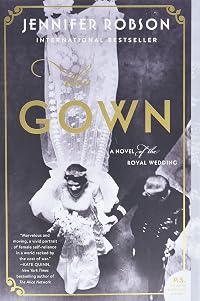
The Gown
by Jennifer Robson
On This Page
Description
London, 1947: Besieged by the harshest winter in living memory, burdened by onerous shortages and rationing, the people of postwar Britain are enduring lives of quiet desperation despite their nation's recent victory. Among them are Ann Hughes and Miriam Dassin, embroiderers at the famed Mayfair fashion house of Norman Hartnell. Together they forge an unlikely friendship, but their nascent hopes for a brighter future are tested when they are chosen for a once-in-a-lifetime honor: taking part show more in the creation of Princess Elizabeth's wedding gown. show lessTags
Recommendations



Member Reviews
If I say the word wedding gown, what do you think of? Do you think of a royal wedding gown like Princess Grace's, Princess Diana's, Duchess Catherine's, or Duchess Meghan's? If you are royal obsessed, you probably think of some of those much photographed gowns. What about Queen Elizabeth's wedding gown? Do you think of that one? If you were lucky enough to see the "Fashioning a Reign" exhibit at Buckingham Palace in 2016 like I was, you got to see the intricately embroidered gown in person and it is impressive indeed. It was the wedding gown of the future queen but what of the people who made it? Designer Norman Hartnell was credited with the gown but the numerous people who had a hand in its actual creation remain anonymous. Jennifer show more Robson's new novel, The Gown, focuses on two women who played a major part in the meticulous hand embroidery and on the granddaughter of one, who never knew about the important part her grandmother played in creating Princess Elizabeth's glamorous wedding gown.
Ann Hughes had worked in the embroidery room at Norman Hartnell's Mayfair studio for eleven years, creating beautiful embroidery that had graced the royals' and other wealthy patrons' clothing when Miriam Dassin, a Frenchwoman new to London, joined the atelier. The year was 1947, a year of continuing austerity after WWII The winter was brutally cold and food was scarce but at least Ann had a roof over her head, even if her beloved sister in law, her brother's widow, had moved to Canada, leaving her lonely and in search of a roommate. As Ann and Miriam worked together and got to know each other, Ann invited Miriam to move in. These two very different women became good friends as well as co-workers, sharing their secrets and their heartbreaks, the horrors of war and of life afterwards.
In 2016, in Toronto, journalist Heather Mackenzie is mourning the loss of her Nan. When she discovers several beautiful floral embroidery samples left to her by her grandmother, she decides to research her Nan's life before she moved to Canada, a life never discussed with her daughter or granddaughter. And when Heather discovers that the embroideries match those on Queen Elizabeth's wedding dress, she is more determined than ever to uncover the past her grandmother never shared, a past that will lead her to the celebrated artist Miriam Dassin and to the realization that her grandmother had a hand in the celebrated wedding gown.
There are three different narratives weaving together in this novel, Ann and Miriam in 1947 and Heather in 2016. Ann and Miriam's stories focus on the life of working class young women in the aftermath of the war, their growing friendship, and their dating lives while Heather's story centers mainly on her search to learn more about her late Nan, to uncover the mystery she left behind. Ann and Miriam's stories are a bit more engaging than Heather's, offering more tension and drama than the modern day narrative does. That the 1947 narratives offer a look into the lives of two women who gave their skill and their quiet, unquestionable loyalty in the making of the princess's wedding dress, women who are otherwise anonymous, makes for fascinating reading. Although the wedding gown is central to the story, and to Heather's discovery of information on her Nan, this is as much the story of the necessity of friendship as anything. It is their friendship that helps Miriam confront the nightmare of her past and it is their friendship that gives Ann the courage to do what she ultimately needs to do. It is also that friendship that opens doors and the future to Heather. Readers or Anglophiles looking for engrossing historical fiction, for a tale of women's friendship, or for well done multiple narratives will find this a quick and rewarding read. show less
Ann Hughes had worked in the embroidery room at Norman Hartnell's Mayfair studio for eleven years, creating beautiful embroidery that had graced the royals' and other wealthy patrons' clothing when Miriam Dassin, a Frenchwoman new to London, joined the atelier. The year was 1947, a year of continuing austerity after WWII The winter was brutally cold and food was scarce but at least Ann had a roof over her head, even if her beloved sister in law, her brother's widow, had moved to Canada, leaving her lonely and in search of a roommate. As Ann and Miriam worked together and got to know each other, Ann invited Miriam to move in. These two very different women became good friends as well as co-workers, sharing their secrets and their heartbreaks, the horrors of war and of life afterwards.
In 2016, in Toronto, journalist Heather Mackenzie is mourning the loss of her Nan. When she discovers several beautiful floral embroidery samples left to her by her grandmother, she decides to research her Nan's life before she moved to Canada, a life never discussed with her daughter or granddaughter. And when Heather discovers that the embroideries match those on Queen Elizabeth's wedding dress, she is more determined than ever to uncover the past her grandmother never shared, a past that will lead her to the celebrated artist Miriam Dassin and to the realization that her grandmother had a hand in the celebrated wedding gown.
There are three different narratives weaving together in this novel, Ann and Miriam in 1947 and Heather in 2016. Ann and Miriam's stories focus on the life of working class young women in the aftermath of the war, their growing friendship, and their dating lives while Heather's story centers mainly on her search to learn more about her late Nan, to uncover the mystery she left behind. Ann and Miriam's stories are a bit more engaging than Heather's, offering more tension and drama than the modern day narrative does. That the 1947 narratives offer a look into the lives of two women who gave their skill and their quiet, unquestionable loyalty in the making of the princess's wedding dress, women who are otherwise anonymous, makes for fascinating reading. Although the wedding gown is central to the story, and to Heather's discovery of information on her Nan, this is as much the story of the necessity of friendship as anything. It is their friendship that helps Miriam confront the nightmare of her past and it is their friendship that gives Ann the courage to do what she ultimately needs to do. It is also that friendship that opens doors and the future to Heather. Readers or Anglophiles looking for engrossing historical fiction, for a tale of women's friendship, or for well done multiple narratives will find this a quick and rewarding read. show less
If you like books about strong female friendships and/or British royalty (especially an interest in the wedding gowns worn by Diana, Kate, and Meghan) this is the book for you.
It is 1947 and Princess Elizabeth is to marry Prince Philip. Ann Hughes and Miriam Dassin are embroiderers for Norman Hartnell, designer for the royal family. Ann is alone after her brother is killed in the war and her sister-in-law moves to Canada. Ann becomes friends with Miriam, the mysterious new French girl at work and invites her to be her roommate. Miriam Dassin eventually reveals that she is Jewish and was imprisoned at Ravensbruck.
Toronto, 2016 – Heather Mackenzie is saddened over the death of her grandmother “Nan”. While going through her show more grandmother’s effects a box marked “To Heather” is found. Inside are three lovely embroidered pieces and a photo of some women gathered around a sewing frame. Heather realizes that neither she nor her mother know anything about Nan’s life before she came to Canada. They uncover a few more photos that reveal that Nan had apparently been friends with the well-known embroiderer Miriam Dassin. Thus begins Heather’s quest to learn about Nan and her secretive past.
I thoroughly loved this book. The characters emerged from the written page and came to life as I read. While being eager to get to each new chapter I also was compelled to set aside the book to look up elements from the story – close up photos of the actual wedding gown, other dresses designed by Norman Hartnell, the Chulily sculpture mentioned in the book. I could envision myself there in Hartnell’s workroom with the drawings and sketches pinned to the walls and fabric everywhere. The book has romance, it has villainy and glamour, but above all it has an amazing bond between two women. The premise of the book is well stated in a paraphrase from Heather: The story is about the gown and what it was like to create a wedding gown for a princess – and how it felt to receive no acknowledgement of their work.
This book filled me with a warmth and a sense of completion – a feeling of “this is how it should be”. There is so much more I would love to write about this book but I don’t want to give away too much of a story that you just must read for yourself. show less
It is 1947 and Princess Elizabeth is to marry Prince Philip. Ann Hughes and Miriam Dassin are embroiderers for Norman Hartnell, designer for the royal family. Ann is alone after her brother is killed in the war and her sister-in-law moves to Canada. Ann becomes friends with Miriam, the mysterious new French girl at work and invites her to be her roommate. Miriam Dassin eventually reveals that she is Jewish and was imprisoned at Ravensbruck.
Toronto, 2016 – Heather Mackenzie is saddened over the death of her grandmother “Nan”. While going through her show more grandmother’s effects a box marked “To Heather” is found. Inside are three lovely embroidered pieces and a photo of some women gathered around a sewing frame. Heather realizes that neither she nor her mother know anything about Nan’s life before she came to Canada. They uncover a few more photos that reveal that Nan had apparently been friends with the well-known embroiderer Miriam Dassin. Thus begins Heather’s quest to learn about Nan and her secretive past.
I thoroughly loved this book. The characters emerged from the written page and came to life as I read. While being eager to get to each new chapter I also was compelled to set aside the book to look up elements from the story – close up photos of the actual wedding gown, other dresses designed by Norman Hartnell, the Chulily sculpture mentioned in the book. I could envision myself there in Hartnell’s workroom with the drawings and sketches pinned to the walls and fabric everywhere. The book has romance, it has villainy and glamour, but above all it has an amazing bond between two women. The premise of the book is well stated in a paraphrase from Heather: The story is about the gown and what it was like to create a wedding gown for a princess – and how it felt to receive no acknowledgement of their work.
This book filled me with a warmth and a sense of completion – a feeling of “this is how it should be”. There is so much more I would love to write about this book but I don’t want to give away too much of a story that you just must read for yourself. show less
The Gown is set in post-World War II London where Ann Hughes and Miriam Dassin meet in the embroidery workroom of Norman Hartnell's famed fashion house. Ann is an English girl who began at Hartnell as an apprentice and risen through the ranks. Miriam has come from France, having survived the Holocaust, now seeking to put her prodigious embroidery skills to work. Though the hardship and scarcity of the war linger, the excitement of Princess Elizabeth's upcoming wedding finally gives the British people cause for celebration, and the gown will be made at Hartnell.
The historical tale was so rich, it hardly needed a modern day perspective of Ann's granddaughter unearthing her grandmother's long kept secrets, but the modern perspective didn't show more take away either. I loved this tale of friendship, its capturing of England's hesitant first steps away from the war, the setting of the fashion house, and the excitement of the wedding. The Gown is a beautifully told story of two friends and England's reawakening after the ravages of World War II. show less
The historical tale was so rich, it hardly needed a modern day perspective of Ann's granddaughter unearthing her grandmother's long kept secrets, but the modern perspective didn't show more take away either. I loved this tale of friendship, its capturing of England's hesitant first steps away from the war, the setting of the fashion house, and the excitement of the wedding. The Gown is a beautifully told story of two friends and England's reawakening after the ravages of World War II. show less
The Gown is ostensibly about Princess Elizabeth’s wedding gown – and yes, the book does spend some fair amount of time in the workroom of Norman Hartnell but this is really the story of two of the girls who worked on the dress. In the period after WWII England was still suffering from the aftereffects. Everything is rationed and it’s one of the coldest winters London has seen with little coal to be had for heat. The joy of a Royal Wedding is giving the country something to celebrate.
Ann is a senior embroiderer working for Mr. Hartnell. She loves her work adorning the dresses for the royal ladies and other wealthy clients. Miriam is a young woman from France who is escaping the horrors of the war and the loss of her family to the show more Nazis. She uses her determination and skills to land a job at Hartnell’s and soon becomes friends with Ann. The two of them are soon living together and find themselves selected to work on the princess’s wedding dress.
Soon after the royal wedding Ann leaves England for Canada and Miriam goes on to become a famous artist. Ann never speaks of her time at Hartnell’s with her family and none of them know of her history. It’s only when a box with her granddaughter Heather’s name on it is found after her death that the questions start being asked about Ann’s life before she came to Canada. Heather decides to go to England to find some answers.
I cannot write enough about how much I enjoyed this book. Usually when I read a dual timeline story I prefer one time’s tale to the other’s but in The Gown’s case I loved both. The bulk of the story was spent in the past with Ann and Miriam as is to be expected but Heather’s part of the story is quite interesting as well.
I was pulled into the story from the very beginning and I read the book in one day. It was hard to put it down and the only reason I did was to cook dinner. The portion that takes place in the present is perhaps one third of the book but it’s a vital part of the book and it pulls everything together. Given the premise, the heart of the story lies in the portion and Ms. Robson brought post WWII London alive in all of it’s gritty glory. She also develops her characters slowly and deftly so that as a reader you become invested in their lives.
Her descriptions of the Hartnell workshop were fascinating. I felt like I was there with the young women as they went to work every morning and lived their excitement when they learned they would be making a wedding dress for the Princess Elizabeth. In a world that is grey, crumbling and bitter cold the joy of a wedding is contagious.
The book is more than just the making of this iconic wedding dress, it is also the story of Ann and Miriam; of their friendship and of the relationships that move them into the future. Their friendship is a strong one and the women’s separate tales also make for fascinating reading. Miriam has been through so much as a Jewish woman in France; her family has disappeared and she has survivor’s guilt. Ann has lost family in the war and life is just hard for everyone in its aftermath.
Ms. Robson brings post war London alive in vivid detail so that I felt the bitter cold and could taste the weak tea. The stories were captivating in both eras. It’s a book than any history buff or fan of Queen Elizabeth II will love. show less
Ann is a senior embroiderer working for Mr. Hartnell. She loves her work adorning the dresses for the royal ladies and other wealthy clients. Miriam is a young woman from France who is escaping the horrors of the war and the loss of her family to the show more Nazis. She uses her determination and skills to land a job at Hartnell’s and soon becomes friends with Ann. The two of them are soon living together and find themselves selected to work on the princess’s wedding dress.
Soon after the royal wedding Ann leaves England for Canada and Miriam goes on to become a famous artist. Ann never speaks of her time at Hartnell’s with her family and none of them know of her history. It’s only when a box with her granddaughter Heather’s name on it is found after her death that the questions start being asked about Ann’s life before she came to Canada. Heather decides to go to England to find some answers.
I cannot write enough about how much I enjoyed this book. Usually when I read a dual timeline story I prefer one time’s tale to the other’s but in The Gown’s case I loved both. The bulk of the story was spent in the past with Ann and Miriam as is to be expected but Heather’s part of the story is quite interesting as well.
I was pulled into the story from the very beginning and I read the book in one day. It was hard to put it down and the only reason I did was to cook dinner. The portion that takes place in the present is perhaps one third of the book but it’s a vital part of the book and it pulls everything together. Given the premise, the heart of the story lies in the portion and Ms. Robson brought post WWII London alive in all of it’s gritty glory. She also develops her characters slowly and deftly so that as a reader you become invested in their lives.
Her descriptions of the Hartnell workshop were fascinating. I felt like I was there with the young women as they went to work every morning and lived their excitement when they learned they would be making a wedding dress for the Princess Elizabeth. In a world that is grey, crumbling and bitter cold the joy of a wedding is contagious.
The book is more than just the making of this iconic wedding dress, it is also the story of Ann and Miriam; of their friendship and of the relationships that move them into the future. Their friendship is a strong one and the women’s separate tales also make for fascinating reading. Miriam has been through so much as a Jewish woman in France; her family has disappeared and she has survivor’s guilt. Ann has lost family in the war and life is just hard for everyone in its aftermath.
Ms. Robson brings post war London alive in vivid detail so that I felt the bitter cold and could taste the weak tea. The stories were captivating in both eras. It’s a book than any history buff or fan of Queen Elizabeth II will love. show less
I am not a person who is enamored with British royals or with fancy wedding gowns, but I still very much enjoyed this tale of the creating of Princess Elizabeth's wedding gown. The story centers around the lives of two young embroiderers, Ann and Miriam. Though they come from radically different backgrounds, they become fast friends when they meet at the fashion house of Norman Hartnell. Expert artists with a needle, they create patterns of embroidery for the expensive gowns of important ladies. Eventually, they are chosen to create the embroidery for the wedding gown of Princess Elizabeth. Much of the story, though, concerns the harsh lives these two young women experienced during and after the war. The novel vacillates between 1947 show more with Ann and Miriam, and 2016, with the additional character of Ann’s granddaughter Heather. The mysteries of her grandmother’s past are finally exposed when Heather travels to England from Canada to see an exhibition of the famous gown. This novel is well written and extensively researched, and the fictionalized characters are so real, you might just forget they never really existed. If this fictional account has whetted your appetite for more information about the royals and that time period, the author has kindly included a list of suggested books for just that purpose. show less
4.5. Sweet story, and well-written historical fiction about women who did the custom embroidery work on (then) Princess Elizabeth’s wedding gown and veil in 1947. Ann Hughes was a single woman supporting herself by sewing at Hartnell’s. Miriam Dassin was a Jewish French emigre who survived the war and Ravensbruck and came to England highly recommended to Norman Hartnell. She and Ann become friends and co-workers and have significant roles in the embroidery on the dress. This part is all fiction, but well done, following the women through the post-war depression in England and their dating lives and what a pick-me-up the wedding was for the British People. The story switches to present-day Toronto, Canada and Heather Mackenzie whose show more grandmother has just died. She is given a set of elaborate embroidery samples and this opens a whole search for what she didn’t know about her grandmother, who turn out to be Ann. All the years in between get filled in with a love interest for Heather and what she learns about her family and its role in history make the entire story arc complete. Very enjoyable read with a lot to investigate later. show less
My favorite book of the year so far. I loved everything about it. Beautifully written historical fiction with characters that will linger with me, it tells not only the story of those whose skill made the wedding gown of Queen Elizabeth, but of life immediately following WW2 and the holocaust.
I listened to the audiobook and narration by Marisa Calin was excellent. This book is told from the viewpoint of three women across multiple generations, and was distinctly voiced and easy to distinguish. It made an excellent book stellar.
I look forward to reading other books by the author who I was not familiar with previously, but I see has written several books prior to this one.
I listened to the audiobook and narration by Marisa Calin was excellent. This book is told from the viewpoint of three women across multiple generations, and was distinctly voiced and easy to distinguish. It made an excellent book stellar.
I look forward to reading other books by the author who I was not familiar with previously, but I see has written several books prior to this one.
Members
- Recently Added By
Lists

Pop Sugar Reading Challenge
7 works; 1 member

Books Read in 2021
5,361 works; 114 members

Women's History Month picks
11 works; 1 member

History: England, Ireland, Scotland, Wales
94 works; 2 members
Author Information

10+ Works 3,346 Members
Jennifer Robson is an internationally acclaimed bestselling author of historical fiction. She studied French literature and modern history as an undergraduate at King's College at the University of Western Ontario. She then attended Saint Anthony's College at the University of Oxford, where she obtained her Doctorate in British economic and social show more history. Robson worked as an editor for a number of years, but is now lucky enough to consider herself a full-time writer. She is the author of the historical novels After the War Is Over and Somewhere in France. (Bowker Author Biography) show less
Some Editions
Awards and Honors
Common Knowledge
- Canonical title
- The Gown
- Original title
- The Gown
- Original publication date
- 2018-12-31
- People/Characters
- Elizabeth II, Queen of the United Kingdom (as Princess Elizabeth); Prince Philip, Duke of Edinburgh; Ann Hughes; Miriam Dassin; Heather Mackenzie
- Important places
- London, England, UK
- Important events
- Wedding of Queen Elizabeth II, 1947
- Epigraph
- Sleep serene, avoid the backward
Glance; go forward, dreams, and do not halt
(Behind you in the desert stands a token
Of doubt--a pillar of salt).
Sleep, the past, and wake, the future,
And walk out promptly th... (show all)rough the open door;
But you, my coward doubts, may go on sleeping,
You need not wake again-- not any more.
The New Year comes with bombs, it is too late
To dose the dead with honourable intentions:
If you have honour to spare, employ it on the living;
The dead are dead as Nineteen-Thirty-Eight.
Sleep to the noise of running water
To-morrow to be crossed, however deep;
This is no river of the dead or Lethe,
To-night we sleep
On the banks of the Rubicon--the die is cast;
There will be time to audit
The accounts later, there will be sunlight later
And the equation will come out at last.
--Louis MacNeice, Autumn Journal, Part XXIV - Dedication
- In memory of Regina Antonia Crespi 1933-2017 an immigrant, a seamstress, and a most beloved grandmother
- First words
- It was dark when Ann left work at a quarter to six, and darker still when she reached home.
- Last words
- (Click to show. Warning: May contain spoilers.)With my affectionate good wishes, Miriam
- Original language*
- English
*Some information comes from Common Knowledge in other languages. Click "Edit" for more information.
Classifications
Statistics
- Members
- 1,184
- Popularity
- 21,136
- Reviews
- 81
- Rating
- (3.96)
- Languages
- 6 — Dutch, English, German, Italian, Portuguese, Spanish
- Media
- Paper, Audiobook, Ebook
- ISBNs
- 21
- ASINs
- 5
