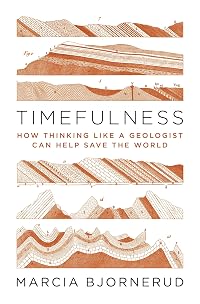
Timefulness: How Thinking Like a Geologist Can Help Save the World
by Marcia Bjornerud
On This Page
Description
Why an awareness of Earth's temporal rhythms is critical to our planetary survivalFew of us have any conception of the enormous timescales in our planet's long history, and this narrow perspective underlies many of the environmental problems we are creating for ourselves. The passage of nine days, which is how long a drop of water typically stays in Earth's atmosphere, is something we can easily grasp. But spans of hundreds of years-the time a molecule of carbon dioxide resides in the show more atmosphere-approach the limits of our comprehension. Our everyday lives are shaped by processes that vastly predate us, and our habits will in turn have consequences that will outlast us by generations. Timefulness reveals how knowing the rhythms of Earth's deep past and conceiving of time as a geologist does can give us the perspective we need for a more sustainable future.Marcia Bjornerud shows how geologists chart the planet's past, explaining how we can determine the pace of solid Earth processes such as mountain building and erosion and comparing them with the more unstable rhythms of the oceans and atmosphere. These overlapping rates of change in the Earth system-some fast, some slow-demand a poly-temporal worldview, one that Bjornerud calls "timefulness." She explains why timefulness is vital in the Anthropocene, this human epoch of accelerating planetary change, and proposes sensible solutions for building a more time-literate society.This compelling book presents a new way of thinking about our place in time, enabling us to make decisions on multigenerational timescales. The lifespan of Earth may seem unfathomable compared to the brevity of human existence, but this view of time denies our deep roots in Earth's history-and the magnitude of our effects on the planet. show lessTags
Recommendations





Member Reviews
In Timefulness, Marcia Bjornerud makes an impassioned and eloquent argument for developing a poly-temporal worldview of time. A concept she calls Timefulness. Bjornerud is cautious to avoid the trap timelessness that so many geologists fall into. She contends that timelessness falsely invokes a sense of permanency and sterile aspiration, when the Earth, in fact, is dynamic and in a constant never-ending state of change. That understanding timefulness better equips scientist to tackle the larger philosophical and practical questions posed by climate change. And that the practices of close reading and spatial visualization in geology provides material records that have documented many changes of our planet. Something that human beings are show more not been able to witness or experience. It is crucial that geologists take a more active role in public discourse to encourage the public to think more deeply about Earth’s multiple past and future iterations. She makes a compiling case that "fathoming deep is geology's greatest contribution to humanity".
It's a hopelessly romantic book, but If nothing else she has been able to articulate something I have found so difficult to explain. Rocks to a geologist aren't nouns they are verbs. They have stories to tell about the past and the future. show less
It's a hopelessly romantic book, but If nothing else she has been able to articulate something I have found so difficult to explain. Rocks to a geologist aren't nouns they are verbs. They have stories to tell about the past and the future. show less
This is outstanding. With 5 years studying geology and 44 more years practicing geology, this book does the best job of chronologically documenting the history of earth, and human's affect on it. Within this book you will find the history of earth's natural resources and the changes in their uses for humans and their changing availability, even sustainability. Going a step further you will also learn the changing sustainability and value of our resources based on data, not arm waving.
The book is enlightening, thoughtful and truly based on proven fact, collected over centuries, agreed on by all who have looked at and studied the data gathered by numerous organizations worldwide. The book is thorough in its geology, and well balanced on show more the changes seen, measured, and reported on, that are underway on our earth today. The author points out how wise resource planning, which incorporates the geological record and its changes, could greatly affect our future quality of life on out planet. show less
The book is enlightening, thoughtful and truly based on proven fact, collected over centuries, agreed on by all who have looked at and studied the data gathered by numerous organizations worldwide. The book is thorough in its geology, and well balanced on show more the changes seen, measured, and reported on, that are underway on our earth today. The author points out how wise resource planning, which incorporates the geological record and its changes, could greatly affect our future quality of life on out planet. show less
This reviews the audiobook, which is free on Audible. Narrator fine - it's not like non-fiction requires dramatic reading.
I listened to this after reading the New Yorker review of her current book, wanting to see if I'd like any of her other works. I do enjoy geology.
In a nutshell, geology gives you a sense of perspective and we should stop eating our donuts like there's no tomorrow. She recommends natural history reading/studies in schools. That should be tame enough for creationists and it's soothing to our existential angst. I dunno, this book revived my fears of our path of self-destruction in the desire for more and more stuff.
Hope this isn't a spoiler for anyone.
I listened to this after reading the New Yorker review of her current book, wanting to see if I'd like any of her other works. I do enjoy geology.
In a nutshell, geology gives you a sense of perspective and we should stop eating our donuts like there's no tomorrow. She recommends natural history reading/studies in schools. That should be tame enough for creationists and it's soothing to our existential angst. I dunno, this book revived my fears of our path of self-destruction in the desire for more and more stuff.
Hope this isn't a spoiler for anyone.
Well presented book on the history of the earth. This is presented in a manner that I wish my geology teachers had, with clearness and patience and fact. The reader may need an acquaintance with geology to fully understand this text, but even a high school or jr. high school class in earth science should be enough, Marcia Bjornerud has a comfortable style of writing that allows the reader to follow the thought. However, this is not a quick read, and is not recommended for beach reading. It is a think piece, and does requires the reader to pause and accept where the book has taken them.
An excellent book, and highly recommended for science buffs, public and school libraries, and general readers. Also for book clubs that like a review of show more the current science in a publicly available presentation.
I liked it. show less
An excellent book, and highly recommended for science buffs, public and school libraries, and general readers. Also for book clubs that like a review of show more the current science in a publicly available presentation.
I liked it. show less
reviews New Scientist
Ratings
Members
- Recently Added By
Lists

Top Five Books of 2020
982 works; 350 members

Geology
24 works; 2 members
Author Information

Marcia Bjornerud is professor of geology and environmental studies at Lawrence University. She is the author of Reading the Rocks: The Autobiography of the Earth and a contributing writer for Elements, the New Yorker's science and technology blog.
Awards and Honors
Awards
Distinctions
Notable Lists
Common Knowledge
- Original publication date
- 2018-09-11
- Publisher's editor
- Henney, Eric; Grundfest, Leslie; Werneck, Arthur; Rojas, Stephanie; Liguori, Barbara
- Blurbers
- DeFries, Ruth; Montgomery, David R.; Powell, James Lawrence; Lamb, Simon
Classifications
Statistics
- Members
- 275
- Popularity
- 117,620
- Reviews
- 5
- Rating
- (4.20)
- Languages
- 6 — Chinese, English, German, Russian, Spanish, Turkish
- Media
- Paper, Audiobook, Ebook
- ISBNs
- 16
- ASINs
- 4