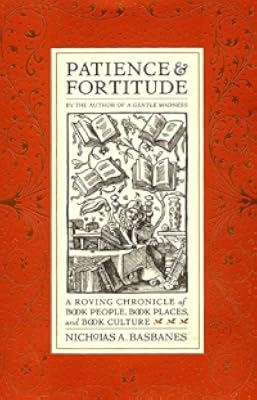
Patience & Fortitude: A Roving Chronicle of Book People, Book Places, and Book Culture
by Nicholas A. Basbanes
On This Page
Description
In his national bestseller, A Gentle Madness, Nicholas Basbanes explored the sweet obsession people feel to possess books. Now, Basbanes continues his adventures among the "gently mad" on an irresistible journey to the great libraries of the past -- from Alexandria to Glastonbury -- and to contemporary collections at the Vatican, Wolfenbüttel, and erudite universities. Along the way, he drops in on eccentric book dealers and regales us with stories about unforgettable collectors, such as show more the gentleman who bought a rare book in 1939 "by selling bottles of his own blood." Taking the book's grand title from the marble lions guarding the New York Public Library at 42nd Street, Basbanes both entertains and delights. And once again, as Scott Turow aptly noted, "Basbanes makes you love books, the collections he writes about, and the volume in your hand." show lessTags
Recommendations



























Member Reviews
It is fitting, perhaps, that my first review of 2007 is a book I should have read long, long ago. Nicholas Basbanes' Patience and Fortitude is the author's second book after the wonderful A Gentle Madness, and it does not disappoint. Basbanes, as always, covers a significant amount of ground in this volume, but I found it nearly impossible to set this book down even for a moment or two once I started reading.
Taking its name from the pair of stone lions who guard the entrance to the New York Public Library's main building, Patience and Fortitude shows through countless examples how those two virtures are essential to the selection, creation and maintenance of great libraries (in any form, although it must be noted that having a little show more money doesn't hurt either). Basbanes takes his reader on a marvelous tour through the great libraries of the past (Alexandria, Glastonbury, Pergamum) to those of the present day (Harvard, Library of Congress, British Library, etc.) with his characteristic style and wit. Through interviews with book people of all stripes, Basbanes brings the culture of books alive - who can resist the lure of the printed page when it is described by such a master?
The dramatis personae of this book are far too varied and numerous to list, although I found the sections on Barry Moser, Umberto Eco, and the many emigre booksellers who came to North America before and during the second world war most personally intriguing. Basbanes' treatment of the great San Francisco library controversy of the 1990s is focused and fair, and his discussion of the role that technology and digitization will play in the library of the future is among the best I've read. While I read it straight through from cover to cover, the organization of the book is such that you could easily read a section here or there as your interests led (but you'll be sucked in, of that I have little doubt).
As always, I will issue my perennial quibble that the notes are not indicated in the text, although they are excellent and accompany a tremendous bibliography (from which I've just made a list of a number of books that I need to read). But this is another great offering, and one any book-lover should not let sit on the "to be read" shelf any longer.
http://philobiblos.blogspot.com/2007/01/book-review-patience-and-fortitude.html show less
Taking its name from the pair of stone lions who guard the entrance to the New York Public Library's main building, Patience and Fortitude shows through countless examples how those two virtures are essential to the selection, creation and maintenance of great libraries (in any form, although it must be noted that having a little show more money doesn't hurt either). Basbanes takes his reader on a marvelous tour through the great libraries of the past (Alexandria, Glastonbury, Pergamum) to those of the present day (Harvard, Library of Congress, British Library, etc.) with his characteristic style and wit. Through interviews with book people of all stripes, Basbanes brings the culture of books alive - who can resist the lure of the printed page when it is described by such a master?
The dramatis personae of this book are far too varied and numerous to list, although I found the sections on Barry Moser, Umberto Eco, and the many emigre booksellers who came to North America before and during the second world war most personally intriguing. Basbanes' treatment of the great San Francisco library controversy of the 1990s is focused and fair, and his discussion of the role that technology and digitization will play in the library of the future is among the best I've read. While I read it straight through from cover to cover, the organization of the book is such that you could easily read a section here or there as your interests led (but you'll be sucked in, of that I have little doubt).
As always, I will issue my perennial quibble that the notes are not indicated in the text, although they are excellent and accompany a tremendous bibliography (from which I've just made a list of a number of books that I need to read). But this is another great offering, and one any book-lover should not let sit on the "to be read" shelf any longer.
http://philobiblos.blogspot.com/2007/01/book-review-patience-and-fortitude.html show less
I love books. I really do. And I love bookstores and libraries and book people in general. So, it makes sense that I would love this book.
Nicholas Basbanes also wrote A Gentle Madness, a book I stumbled upon in my public library a few years ago and fell in love with. So, I picked this one up and read it with glee. It’s over 20 years old and reading it for me was like a trip to my professional past as a librarian. The arguments librarians, their administrators, and the public had decades ago brought back so much angst for me.
I’m happy to say that some of these questions have been settled, sort of. Back then, some people saw the future of libraries in digital materials. They were ready to turn print lose to perish or thrive entirely show more in the wild. However, most people now realize that the demand for print books isn’t going away soon.
But libraries aren’t the only thing Basbanes discusses in this book. He talks about the people who collect rare books and the people who sell them. I don’t live with the kind of money he’s talking about, so I don’t keep up with the rare book market. But that doesn’t mean I don’t find it captivating as any self-respecting bibliophile would.
I admit to gushing a bit in this review. While reading about all these private, academic, and extensive public book collections was like a fairytale for me. It felt like reading Victoria magazine as a newlywed, setting up housekeeping, and dreaming of the possibilities. While I’ll never have room to store 50,000 volumes in my house, Basbanes has me dreaming of how that would look. And that’s almost as good as actually having it. show less
Nicholas Basbanes also wrote A Gentle Madness, a book I stumbled upon in my public library a few years ago and fell in love with. So, I picked this one up and read it with glee. It’s over 20 years old and reading it for me was like a trip to my professional past as a librarian. The arguments librarians, their administrators, and the public had decades ago brought back so much angst for me.
I’m happy to say that some of these questions have been settled, sort of. Back then, some people saw the future of libraries in digital materials. They were ready to turn print lose to perish or thrive entirely show more in the wild. However, most people now realize that the demand for print books isn’t going away soon.
But libraries aren’t the only thing Basbanes discusses in this book. He talks about the people who collect rare books and the people who sell them. I don’t live with the kind of money he’s talking about, so I don’t keep up with the rare book market. But that doesn’t mean I don’t find it captivating as any self-respecting bibliophile would.
I admit to gushing a bit in this review. While reading about all these private, academic, and extensive public book collections was like a fairytale for me. It felt like reading Victoria magazine as a newlywed, setting up housekeeping, and dreaming of the possibilities. While I’ll never have room to store 50,000 volumes in my house, Basbanes has me dreaming of how that would look. And that’s almost as good as actually having it. show less
As with Gentle Madness, this is a book that I read when it came out and have been rereading. It has a lot of engaging stories about book places and people. Not least of its appeal is nostalgia. I remember visiting the chaotic Serendipity Books in Berkeley in the mid 90s and Basbanes' description is pretty much in line with my recollections. The section on libraries is less enjoyable, including the Ken Dowlin debacle in San Francisco and other examples of contemporary librarians' ongoing war on books and scholarship.
I liked the content of this book, but the way the information is presented is very poor. The author jumps from discussions of one institution or person to another with little more than a double-space to let you know a change in course is taking place. It felt disjointed and abrupt, and did not make for a pleasurable reading experience. The topics that the author covered were interesting, and the sections on book collectors and sellers were particularly fun. Given that the material was good, I wish that the author had done a better job of presenting it to the reader.
Not as interesting, to me, as Basbanes's A Gentle Madness, but a nice diversion. Where A Gentle Madness mainly chronicled individual bibliophiles, bibliomaniacs, and even bibliokleptomaniacs, this covers places sacred to the history of the book, tells of book sellers and their bookstores, and libraries and librarians. Though I found many bits to be interesting, I found several others that were boring. The reading dragged in places.
Let us start with the cover: a magnificent work of art. The exquisite "wood-cut" and the wonderful organic illumination around it give this book an air of importance and prestige. And then, the text itself. Superbly researched with a wonderful quality of readability. Basbanes is a truly insightful character who enjoys books and the history surrounding them. This a great book for all book lovers.
Has vignettes of the first librarians bringing order out of chaos in collections of scrolls, illuminated texts, incunabula and books.
Inspired by this book, I am cataloguing my own manuscripts, articles, illuminations and books.
Inspired by this book, I am cataloguing my own manuscripts, articles, illuminations and books.
Members
- Recently Added By
Published Reviews
“An Exemplary Piece of Work … a rich feast … sheer pleasure … One dips into it, absorbs the many interwoven details, and comes away edified, enlightened, delighted and enriched … The tone, the pace, and the `weave' of Basbanes's prose have a cumulative effect. His journalistic background has taught him how to craft a good sentence, good paragraphs, and a captivating narrative line. show more His conversational style makes the reader acutely sympathetic to his intent; it makes us want to repay him with unflagging attention. His appreciation, even reverence, for all things bibliographic tells book lovers they are in the company of a kindred spirit. I'm looking forward to the completion of the trilogy.” show less
added by thebookpile
“Mr. Basbanes is a good writer with a loyal and growing readership. But he is also a writer enamored of books for their artifactual as well as intellectual value, for their beauty and uniqueness, and for the culture of the mind they embody and promote. This kind of love is not given to all writers. It doesn't just come with the talent. How fortunate a man to have such a passion. How show more fortunate his readers that he is willing to share.” show less
added by thebookpile
“Not only is Basbanes seriously obsessed with books, he's fascinated by libraries, spots where libraries once stood, bookstores, other bibliophiles, and, basically, anything else to do with books.”
added by thebookpile
Lists

Books about Books
149 works; 23 members
Author Information

20+ Works 9,049 Members
Nicholas A. Basbanes was literary editor of the Worcester Sunday Telegram from 1978 to 1991, and is a former president of the Friends of the Robert H. Goddard Library of Clark University.
Common Knowledge
- Original publication date
- 2001
- Epigraph
- Like all the men of the Library, in my younger days I traveled; I have journeyed in quest of a book, perhaps the catalog of catalogs. Now that my eyes can hardly make out what I myself have written, I am preparing to die, a f... (show all)ew leagues from the hexagon where I was born. When I am dead, compassionate hands will throw me over the railing; my tomb will be the unfathomable air, my body will sink for ages, and will decay and dissolve in the wind engendered by my fall, which shall be infinite. I declare that the Library is endless. —Jorge Luis Borges (1899–1986), "The Library of Babel"
- Dedication
- For CVB and the next quarter-century
- First words
- While probing the murky bottom of Alexandria's Eastern Harbor for fragments of Queen Cleopatra's sunken palace, French divers came across an ancient stele that had been shielded from the sunlight for sixteen centuries.
- Last words
- (Click to show. Warning: May contain spoilers.)"You may buy books at any time with money, but you cannot make a library like one that has been a century or two a-growing, though you had the whole national debt to do it with," Burton wrote in The Book-Hunter, and reinforced his conviction with words that embody the twin virtues of patience and fortitude: "A great library cannot be constructed—it is the growth of ages."
- Blurbers
- Winchester, Simon
Classifications
- Genres
- Nonfiction, General Nonfiction, History
- DDC/MDS
- 002.09 — Computer science, information & general works Computer science, knowledge & systems Books (Science and history of the book) Standard subdivisions Biography and History
- LCC
- Z4 .B395 — Bibliography, Library Science and Information Resources Books (General). Writing. Paleography History of books and bookmaking
- BISAC
Statistics
- Members
- 1,507
- Popularity
- 15,428
- Reviews
- 11
- Rating
- (4.08)
- Languages
- English
- Media
- Paper
- ISBNs
- 3
- ASINs
- 8