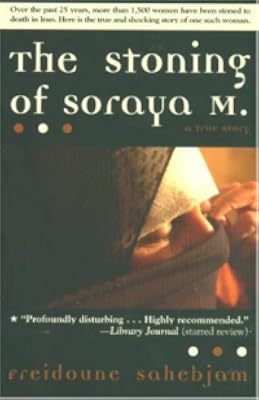
The Stoning of Soraya M.: A Story of Injustice in Iran
by Freidoune Sahebjam
On This Page
Description
Soraya M.'s husband, Ghorban-Ali, couldn't afford to marry another woman. Rather than returning Soraya's dowry, as custom required before taking a second wife, he plotted with four friends and a counterfeit mullah to dispose of her. Together, they accused Soraya of adultery. Her only crime was cooking for a friend's widowed husband. Exhausted by a lifetime of abuse and hardship, Soraya said nothing, and the makeshift tribunal took her silence as a confession of guilt. They sentenced her to show more death by stoning: a punishment prohibited by Islam but widely practiced. Day by day--sometimes minute by minute--Sahebjam deftly recounts these horrendous events, tracing Soraya's life with searing immediacy, from her arranged marriage and the births of her children to her husband's increasing cruelty and her horrifying execution, where, by tradition, her father, husband, and sons hurled the first stones. A stark look at the intersection between culture and justice, this is one woman's story, but it stands for the stories of thousands of women who suffered--and continue to suffer--the same fate. It is a story that must be told. show lessTags
Recommendations






Member Reviews
Just as Pat Tillman gave a face to the countless and needless military casualties in Afghanistan, Soraya's tragedy personalizes the stoning of over 1,500 women in Iran over the course of the last 25 years. Sahebjam's biography is a compelling account, but it is not, however, an easy read, as the violence is stark, gratuitous with the author leaving no detail unexamined.
Written in 1986, in the wake of the Islamic Revolution, this account of the brutal execution of an innocent woman illuminates, once more, the extent to which religious fervor, regardless of sect or creed, can be manipulated for personal gain and emptied of any moral integrity. Although Soraya was stoned, theoretically, in accordance to Islamic dictums, her aunt astutely show more notes that her fate is the outcome of "the law of men, the law that men make and say it is the law of God."
My only problem with this biography lies within the preface, as I would have preferred an update to the 2011 edition, detailing how the political climate and relative position of women in society has changed since the original manuscript. show less
Written in 1986, in the wake of the Islamic Revolution, this account of the brutal execution of an innocent woman illuminates, once more, the extent to which religious fervor, regardless of sect or creed, can be manipulated for personal gain and emptied of any moral integrity. Although Soraya was stoned, theoretically, in accordance to Islamic dictums, her aunt astutely show more notes that her fate is the outcome of "the law of men, the law that men make and say it is the law of God."
My only problem with this biography lies within the preface, as I would have preferred an update to the 2011 edition, detailing how the political climate and relative position of women in society has changed since the original manuscript. show less
This is the most heartbreaking book I can recall reading. To say it is difficult to read is an understatement as is saying it is a compelling read. It is a book once you begin to read you will be unable to put down and unable to forget. That it is a true story is horrifying. That there are at least 15 prisoners at risk of stoning today, (Amnesty International), is incomprehensible. Those 15 are in Iran. Iran is not the only country to have stoning happen.
In reading this story and imagining how Soraya must have felt it is not difficult to see why she was silent. She must have felt trapped because she had no way to defend herself. Whether or not the charges were justified or false the cards were stacked against her. I cannot imagine how show more she came to terms with her sentence. I cannot fathom what must have gone through her mind when she watched her father, her sons, pick up stones to throw at her.
The person I think I am most amazed at is Soraya's aunt. The only person to try to come to her aid. In thinking about that country and its treatment of women, Soraya's aunt stands out as a hero. She spoke out in Soraya's defense. She failed to stay quiet after the execution and it is from her that we hear Soraya's story. What an amazing amount of courage, love and strength that took. I would like to think I could be so strong. But in all honesty I am not certain. I do not think any of us who lived our entire lives free could say with absolute certainty that they could do what Soraya's aunt did.
The back cover of the book states, " It is a story that must be told." To that I add, it is a story that must be read. You cannot change anything in ignorance. Knowledge is power. Is it to say that by reading the book Iran will suddenly change its sentencing? No. We all know that is not realistic. But perhaps by becoming knowledgeable and passing that knowledge on we can eventually change things for the better. According to the author between 1979 to 1983 the Iranian government acknowledged that between 500 to 600 women were put to death by stoning. Today there are 15 at risk of stoning. That is a huge difference. Knowledge is power. I cannot imagine the strength of the Iranian people who have fought to change things for the better in their country. I am in awe of them as I am of those in countries around the world who fight against injustice; those who refuse to be silent in the face of death.
The Stoning of Soraya M. is a story that must be read. It is a story you will not forget. show less
In reading this story and imagining how Soraya must have felt it is not difficult to see why she was silent. She must have felt trapped because she had no way to defend herself. Whether or not the charges were justified or false the cards were stacked against her. I cannot imagine how show more she came to terms with her sentence. I cannot fathom what must have gone through her mind when she watched her father, her sons, pick up stones to throw at her.
The person I think I am most amazed at is Soraya's aunt. The only person to try to come to her aid. In thinking about that country and its treatment of women, Soraya's aunt stands out as a hero. She spoke out in Soraya's defense. She failed to stay quiet after the execution and it is from her that we hear Soraya's story. What an amazing amount of courage, love and strength that took. I would like to think I could be so strong. But in all honesty I am not certain. I do not think any of us who lived our entire lives free could say with absolute certainty that they could do what Soraya's aunt did.
The back cover of the book states, " It is a story that must be told." To that I add, it is a story that must be read. You cannot change anything in ignorance. Knowledge is power. Is it to say that by reading the book Iran will suddenly change its sentencing? No. We all know that is not realistic. But perhaps by becoming knowledgeable and passing that knowledge on we can eventually change things for the better. According to the author between 1979 to 1983 the Iranian government acknowledged that between 500 to 600 women were put to death by stoning. Today there are 15 at risk of stoning. That is a huge difference. Knowledge is power. I cannot imagine the strength of the Iranian people who have fought to change things for the better in their country. I am in awe of them as I am of those in countries around the world who fight against injustice; those who refuse to be silent in the face of death.
The Stoning of Soraya M. is a story that must be read. It is a story you will not forget. show less
I came across this book some years ago while researching the position of women in Iran. Written by an expatriate Iranian journalist who secretly returned to his country in 1986, The Stoning of Soraya M. uses one specific case to highlight the practice of stoning women to death. One of the most extreme form of human rights violation committed under Shariah legal systems, stoning is a sentence that can be given to either male or female "criminals," but is most frequently applied to women accused of adultery. Although far more common under the regime of the Ayatollah Khomeini, stoning remains a significant problem in Iran, as witnessed by a recent Amnesty International article, from January of this year (2008).
Sahebjam tells the story of a show more thirty-five-year old mother of nine, who, when her husband decides he would like to remarry, is falsely accused of infidelity. Despite the complete lack of evidence, Soraya M. was condemned by a corrupt local court, and stoned to death by a mob that included some of her own family members.
This is a very difficult book to read, and should incense any right-thinking person. The patent absurdity of the charges, the sheer hypocrisy of those involved, and the complicity of the victim's family, are all sickening to behold. The author's methodology has been criticized, in that he includes passages written from the victim's "perspective," despite the fact that he investigated after the fact, and never interviewed her. It is instructive to note however, that no significant challenge, as regards the actual facts of this case, has been put forward by Mr. Sahebjam's critics, which leads this reviewer to the conclusion the "controversy" surrounding the author's methodology is little more than a smokescreen for the benefit of apologists.
In sum: this is a tragic and very disheartening book, but well worth the reader's time.
Addendum: since writing the above review, in early 2008, I understand that a movie has been made of Soraya M.'s story. I have not seen the film, and cannot offer an opinion. The hideous practice of stoning, however, and the human rights campaign to end it, are ongoing, as seen in an April 2010 letter from Amnesty International. show less
Sahebjam tells the story of a show more thirty-five-year old mother of nine, who, when her husband decides he would like to remarry, is falsely accused of infidelity. Despite the complete lack of evidence, Soraya M. was condemned by a corrupt local court, and stoned to death by a mob that included some of her own family members.
This is a very difficult book to read, and should incense any right-thinking person. The patent absurdity of the charges, the sheer hypocrisy of those involved, and the complicity of the victim's family, are all sickening to behold. The author's methodology has been criticized, in that he includes passages written from the victim's "perspective," despite the fact that he investigated after the fact, and never interviewed her. It is instructive to note however, that no significant challenge, as regards the actual facts of this case, has been put forward by Mr. Sahebjam's critics, which leads this reviewer to the conclusion the "controversy" surrounding the author's methodology is little more than a smokescreen for the benefit of apologists.
In sum: this is a tragic and very disheartening book, but well worth the reader's time.
Addendum: since writing the above review, in early 2008, I understand that a movie has been made of Soraya M.'s story. I have not seen the film, and cannot offer an opinion. The hideous practice of stoning, however, and the human rights campaign to end it, are ongoing, as seen in an April 2010 letter from Amnesty International. show less
“Ebrahim made him understand that, no matter what, he could not advance beyond the white line, for that would be in defiance of God’s laws.”
― Freidoune Sahebjam, The Stoning of Soraya M.: A Story of Injustice in Iran
It is hard to believe something as barbaric an d horrific as this could happen.
This book is a true story and is about as brutal as it gets. It is Soraya's story, as told to the author by her beloved Aunt Zahra who was an incredible woman and a hero.
It isn't a pleasant read, that is putting it mildly. I am aware of these things happening but the writer really puts you right there and since you start the book knowing the outcome you feel helpless and I was just shocked anyway at the sheer venom and brutality of show more everything that happened.
In a way, this book is scarier then books like 'The Handmaid's tale" or "The Lottery" because this is one hundred percent true and it will make you infuriated as to how this brave and beautiful lady was treated.
Her husband and his friends hatched a scheme to accuse her of being unfaithful since the husband wanted a divorce but did not want to return the dowry. They framed her for adultery and the sentence passed was stoning. Her wonderful Aunt tried to help her. Not many other people did.
Indeed, many in the sleepy village including the Soraya' own father and sons took part in the stoning.
It is beastly and depraved and sickening. The back story of the men was not interesting to me since they are monsters and I had no interest in reading about them. In spite of this, I rated it a five since i t is important and shines a tragic light on barbaric practices that go on that many may not be aware of.
Read it but understand the book goes into graphic detail including the stoning..detail by detail. Not an easy read but one I will not forget. show less
― Freidoune Sahebjam, The Stoning of Soraya M.: A Story of Injustice in Iran
It is hard to believe something as barbaric an d horrific as this could happen.
This book is a true story and is about as brutal as it gets. It is Soraya's story, as told to the author by her beloved Aunt Zahra who was an incredible woman and a hero.
It isn't a pleasant read, that is putting it mildly. I am aware of these things happening but the writer really puts you right there and since you start the book knowing the outcome you feel helpless and I was just shocked anyway at the sheer venom and brutality of show more everything that happened.
In a way, this book is scarier then books like 'The Handmaid's tale" or "The Lottery" because this is one hundred percent true and it will make you infuriated as to how this brave and beautiful lady was treated.
Her husband and his friends hatched a scheme to accuse her of being unfaithful since the husband wanted a divorce but did not want to return the dowry. They framed her for adultery and the sentence passed was stoning. Her wonderful Aunt tried to help her. Not many other people did.
Indeed, many in the sleepy village including the Soraya' own father and sons took part in the stoning.
It is beastly and depraved and sickening. The back story of the men was not interesting to me since they are monsters and I had no interest in reading about them. In spite of this, I rated it a five since i t is important and shines a tragic light on barbaric practices that go on that many may not be aware of.
Read it but understand the book goes into graphic detail including the stoning..detail by detail. Not an easy read but one I will not forget. show less
I could barely finish The Stoning of Soraya M.and at the same time I found it difficult to put down. Essentially the book tells the story of what leads up to the barbaric stoning of Soraya M. under Islamic law in Iran. The portion of the book devoted to the stoning itself is graphic, but what leads up to the stoning is equally as graphic and difficult to withstand. Freidoune Sahebjam draws a stunning portrait of the oppression of an entire village, particularly its women, and the devastation that fundamentalist religion combined with the power of government has on any diversity of thought in Khomeini-era Iran. Simply put Soraya M. was murdered by her husband and her own village because their fundamentalist version of religion gave them show more permission to place women in positions of servitude, sexual slavery to be killed in the name of God when a husband demanded it. I cannot imagine being governed by Sharia law if this book contains an accurate portrait of it. show less
Let me begin by offering a quotation from the preface:
"After the shah was deposed and the fundamentalist regime headed by the Ayatollah Khomeini came to power in February 1979, many dubious elements of the population, including common-law criminals who had been jailed for good reason under the shah, were released from the country's prisons. Taking advantage of the religious fervor sweeping the land, a number of these people, especially those with at least a basic knowledge of the Koran and its tenets, donned clerics' garb, gave themselves the title of mullah, and roamed the country seeing opportunities for self-enrichment or, quite simply, to conceal their past from the authorities."
In 1986, the author was waiting in a small mountain show more village in Iran for a contact to take him over the border into Pakistan, when he was offered tea by an elderly woman. She then proceeded to tell him that two weeks earlier, her niece Soraya had been stoned to death for being unfaithful to her husband, and that she had been innocent of the charge. The author's contact showed up and he had to leave, but he promised the woman he'd be back, and he returned some six months later to hear her story, which ended up being the substance of this book. The book recalls a beyond-horrible crime instigated by one of these above-mentioned mullahs in cahoots with Soraya's husband. This mullah (Sheik Hassan) had been in prison and was running away from the regime that put him there. He had fled to a small village of about 250 people where he was able to quickly gain the trust of the village leaders and become the go-to guy for settling disputes, and he was able to profit monetarily from his position as well. The sheik's background is important, because he represents one of those people whose position allowed him to manipulate religious beliefs for his own gain, and in this particular case, vengeance.
The basic story is this. Soraya's parents had betrothed her to Ghorban-Ali whom she had known since childhood and whom she didn't like even then. He was an abusive husband and later father, who would beat his wife regularly and then start in on his children. He spent a great deal of time turning his two older children against their mother. When he wasn't in the village, he was involved in black-market and other illegal activities until the change in regime, when he became a prison guard and realized his potential for power over others. Once he got a taste for power and life in the city (and the gains he'd made financially and materially in his position as prison guard) he no longer wanted to be a peasant from the village, but instead wanted to live the life of Riley in the city complete with a 14 year old honey that he wanted to marry. The problem was his marriage to Soraya, and how to get rid of her; ultimately with no way out of the marriage, he turned to Sheik Hassan. And this is when Soraya's life went from one of abuse to one of utter horror.
There are a couple of things worth mentioning. First, there is no doubt that this event actually happened, and there is no doubt that stoning as a punishment for adultery is a reality among some Muslim fundamentalists in some areas. You can go to any human rights organization's website and find out all that you want to know about it there and to be fair, you can go to the website of Al-jazeera (an Islamic news organization) to read about recent developments about stoning as well. It is also an abominable practice that is beyond my scope of comprehension in the realm of human cruelty.
Second, there's no doubt in my mind that as far as the story this book tells, the stoning of Soraya M. a) reflects a plan conceived by a few misogynistic individuals who deliberately used the existing Sharia laws for their own personal gain and b) was allowed to happen as a result of an abuse of power in this small village.
To get the full story, you need to read the book. It is a difficult story but an eye-opening one that you will probably not soon forget. I know I won't. I don't think I need to see it on the big screen, though. This is a book that will keep you reading, even though you know things are not going to be good in the long run. A very tough account, but one that is very readable and will make you think. show less
"After the shah was deposed and the fundamentalist regime headed by the Ayatollah Khomeini came to power in February 1979, many dubious elements of the population, including common-law criminals who had been jailed for good reason under the shah, were released from the country's prisons. Taking advantage of the religious fervor sweeping the land, a number of these people, especially those with at least a basic knowledge of the Koran and its tenets, donned clerics' garb, gave themselves the title of mullah, and roamed the country seeing opportunities for self-enrichment or, quite simply, to conceal their past from the authorities."
In 1986, the author was waiting in a small mountain show more village in Iran for a contact to take him over the border into Pakistan, when he was offered tea by an elderly woman. She then proceeded to tell him that two weeks earlier, her niece Soraya had been stoned to death for being unfaithful to her husband, and that she had been innocent of the charge. The author's contact showed up and he had to leave, but he promised the woman he'd be back, and he returned some six months later to hear her story, which ended up being the substance of this book. The book recalls a beyond-horrible crime instigated by one of these above-mentioned mullahs in cahoots with Soraya's husband. This mullah (Sheik Hassan) had been in prison and was running away from the regime that put him there. He had fled to a small village of about 250 people where he was able to quickly gain the trust of the village leaders and become the go-to guy for settling disputes, and he was able to profit monetarily from his position as well. The sheik's background is important, because he represents one of those people whose position allowed him to manipulate religious beliefs for his own gain, and in this particular case, vengeance.
The basic story is this. Soraya's parents had betrothed her to Ghorban-Ali whom she had known since childhood and whom she didn't like even then. He was an abusive husband and later father, who would beat his wife regularly and then start in on his children. He spent a great deal of time turning his two older children against their mother. When he wasn't in the village, he was involved in black-market and other illegal activities until the change in regime, when he became a prison guard and realized his potential for power over others. Once he got a taste for power and life in the city (and the gains he'd made financially and materially in his position as prison guard) he no longer wanted to be a peasant from the village, but instead wanted to live the life of Riley in the city complete with a 14 year old honey that he wanted to marry. The problem was his marriage to Soraya, and how to get rid of her; ultimately with no way out of the marriage, he turned to Sheik Hassan. And this is when Soraya's life went from one of abuse to one of utter horror.
There are a couple of things worth mentioning. First, there is no doubt that this event actually happened, and there is no doubt that stoning as a punishment for adultery is a reality among some Muslim fundamentalists in some areas. You can go to any human rights organization's website and find out all that you want to know about it there and to be fair, you can go to the website of Al-jazeera (an Islamic news organization) to read about recent developments about stoning as well. It is also an abominable practice that is beyond my scope of comprehension in the realm of human cruelty.
Second, there's no doubt in my mind that as far as the story this book tells, the stoning of Soraya M. a) reflects a plan conceived by a few misogynistic individuals who deliberately used the existing Sharia laws for their own personal gain and b) was allowed to happen as a result of an abuse of power in this small village.
To get the full story, you need to read the book. It is a difficult story but an eye-opening one that you will probably not soon forget. I know I won't. I don't think I need to see it on the big screen, though. This is a book that will keep you reading, even though you know things are not going to be good in the long run. A very tough account, but one that is very readable and will make you think. show less
This is, quite possibly, the most disturbing book that I've ever read, and not an easy one to rate. I can't really say that I recommend it, for all that my fellow international affairs peeps kept telling me to read it, but it's definitely an important book. The details of what happened to Soraya are disturbing, and the author definitely didn't hold back in making sure the reader knows what happened. It's sickening, disturbing, heart-breaking, and utterly haunting, all at the same time. Read with caution, and with tissues nearby (and, yes, the movie, which I saw long before reading the book, is even better/worse on that note).
Members
- Recently Added By
Lists

Women in Islam
120 works; 8 members
Author Information
14 Works 187 Members
Some Editions
Classifications
- Genres
- Nonfiction, Biography & Memoir, General Nonfiction, History
- DDC/MDS
- 306.7360955 — Society, government, & culture Social sciences, sociology & anthropology Social Behavior - Dating, Marriage, Divorce Sexual relations General institutions Extramarital relations
- LCC
- HQ806 .S2413 — Social sciences The family. Marriage, Women and Sexuality The Family. Marriage. Women The family. Marriage. Home Adultery
- BISAC
Statistics
- Members
- 142
- Popularity
- 231,076
- Reviews
- 10
- Rating
- (4.28)
- Languages
- 7 — Dutch, English, French, German, Norwegian, Farsi/Persian, Swedish
- Media
- Paper, Ebook
- ISBNs
- 14
- ASINs
- 3