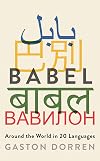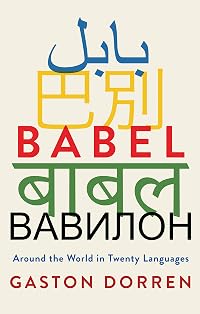
Babel: Around the World in Twenty Languages
by Gaston Dorren
On This Page
Description
English is the world language, except that 80 percent of the world doesn't speak it. Linguist Gaston Dorren calculates that to speak fluently with half of the world's people in their mother tongues, you'd need to know no fewer than twenty languages. In Babel, he sets out to explore these top twenty world languages, which range from the familiar (French, Spanish) to the surprising (Malay, Javanese, Bengali). Whisking readers along on a delightful journey, he traces how these languages rose to show more greatness while others fell away, and shows how speakers today handle the foibles of their mother tongues. Whether showcasing tongue-tying phonetics, elegant but complicated writing scripts, or mind-bending quirks of grammar, Babel vividly illustrates that mother tongues are like nations: each has its own customs and beliefs that seem as self-evident to those born into it as they are surprising to outsiders. Babel reveals why modern Turks can't read books that are a mere 75 years old, what it means in practice for Russian and English to be relatives, and how Japanese developed separate "dialects" for men and women. Dorren also shares his experiences studying Vietnamese in Hanoi, debunks ten myths about Chinese characters, and discovers the region where Swahili became the lingua franca. Witty and utterly fascinating, Babel will change how you look at and listen to the world. show lessTags
Recommendations
















Member Reviews
A truly fascinating look at the 20 most-spoken languages in the world, Babel is freewheeling, casual, and discursive, but not dumbed down or shallow—the kind of book Simon Garfield should be aiming for. The author is fluent in six languages and reads nine more. Because English is a learned language for him—his mother tongue is Limburgish, of all things, and I wish the format of the book had let him talk about that!—he has a perspective on it that I haven't encountered in books about language written by native speakers.
Each chapter examines a single language, or more precisely, examines either the linguistic features or the social history of the language's home culture. The close relation between some of the featured languages show more mean that not every chapter is actually about the language: there's not enough that's unique about Portuguese to fill a chapter in a book that also discusses Spanish, so the chapter on Portuguese is mostly about how languages spread through colonization. As a language geek--and who else would pick up this book--I would have preferred that the chapter discuss the variations in the several languages of the Iberian peninsula, and how only two became associated with political power. But that's just me. And there's certainly enough geeky linguistic detail (about cases, Japanese "women's language," and the importance of social status in Javanese speech, for example) to keep me happy.
Dorren refers to other rarefied books that I'm familiar with (The World's Writing Systems, edited by Daniels and Bright, and The Turkish Language Reform: a Catastrophic Success by Geoffrey Lewis), so he and I are of like mind. Perhaps because I find him so perceptive and discerning, I don't mind the liberties he takes, such as applying judgmental adjectives to certain language features or a slight tendency to glibness. Don't let me scare you: this is actually an easy read! The chapters are short and interesting, with much to learn on each page, and if you want to skip over the seven-page "dictionary" of Arabic roots or the chapter on Bengali (not that different from Hindi, from the perspective of one who is unlikely ever to learn either), it won't hurt a thing. This is also a fun book just to dip into. show less
Each chapter examines a single language, or more precisely, examines either the linguistic features or the social history of the language's home culture. The close relation between some of the featured languages show more mean that not every chapter is actually about the language: there's not enough that's unique about Portuguese to fill a chapter in a book that also discusses Spanish, so the chapter on Portuguese is mostly about how languages spread through colonization. As a language geek--and who else would pick up this book--I would have preferred that the chapter discuss the variations in the several languages of the Iberian peninsula, and how only two became associated with political power. But that's just me. And there's certainly enough geeky linguistic detail (about cases, Japanese "women's language," and the importance of social status in Javanese speech, for example) to keep me happy.
Dorren refers to other rarefied books that I'm familiar with (The World's Writing Systems, edited by Daniels and Bright, and The Turkish Language Reform: a Catastrophic Success by Geoffrey Lewis), so he and I are of like mind. Perhaps because I find him so perceptive and discerning, I don't mind the liberties he takes, such as applying judgmental adjectives to certain language features or a slight tendency to glibness. Don't let me scare you: this is actually an easy read! The chapters are short and interesting, with much to learn on each page, and if you want to skip over the seven-page "dictionary" of Arabic roots or the chapter on Bengali (not that different from Hindi, from the perspective of one who is unlikely ever to learn either), it won't hurt a thing. This is also a fun book just to dip into. show less
My interest in picking up this book was strictly light entertainment, particularly in regards to the foibles of English, though Dorren gives the same treatment to the other nineteen languages he examines. If there is a running theme below the mission of providing a snappy introduction into what makes each of these 20 languages interesting, it's how language can become a bone of contention. If you come away feeling that Dorren's treatment is too slight for your purposes, don't worry; he provides an extensive list of further reading.
he tour of the world's twenty largest languages doesn't pretend to be an exhaustive analysis or a detailed comparison. Rather, it looks at a striking feature of each language -- how it developed, for example, or who speaks it, or how it is written, or whatever. Some readers may object to this free and easy approach, but I found it both entertaining and informative. Terrific book for language mavens.
Wonderful descriptions of the world’s twenty most-used languages, with history about how they developed and comparisons of their grammars. As an idiot single-language speaker I’m still really interested in other languages and this was a treat.
Popular linguistics book, meaning it's not academic research but an interesting read with some insights into how languages are interconnected. Enjoyed the author's sense of humor and observations that some languages are quirky and the rules make no sense.
Not well organized
"Babel: Around the World in Twenty Languages" is a follow-up to "Mr. Dorren's 2015 "Lingo: Around Europe in Sixty Languages". You can see a theme here. I haven't read "Lingo" but it's said to be "breezy", an adjective I hardly associate with language.
Mr. Dorren begins with his failure to learn Vietnamese. Yes Vietnamese is a difficult language but people do learn it reasonably well and I kept wondering why a person who has studied so many languages had so much trouble with the structures. Pronunciation yes, the tones and all that, but why the structures when the language is written in a Latin script. A mystery.
People who study many languages learn each one faster than the one before if they have a good teacher and are show more motivated to learn. (I can't tell you how often I've played with French). Sir Richard Francis Burton the explorer, is said to have known 29 languages and could pick up a new one in a week. I'm not that good, but I can do a lot in 3 weeks immersion with a good teacher. I haven't tried Vietnamese though and so I'll give Mr. Dorren some leeway.
But how does he manage to make the stories of these languages so very dull? Language study is fascinating, whether you come at from linguistics, history, culture, or learning. As other reviewers have mentioned, Mr. Dorren tries to present them all in some measure, but the focus keeps changing and there is no good rhythm.
I received a review copy of "Babel: Around the World in Twenty Languages" by Gaston Dorren (Grove Atlantic) through NetGalley.com. show less
"Babel: Around the World in Twenty Languages" is a follow-up to "Mr. Dorren's 2015 "Lingo: Around Europe in Sixty Languages". You can see a theme here. I haven't read "Lingo" but it's said to be "breezy", an adjective I hardly associate with language.
Mr. Dorren begins with his failure to learn Vietnamese. Yes Vietnamese is a difficult language but people do learn it reasonably well and I kept wondering why a person who has studied so many languages had so much trouble with the structures. Pronunciation yes, the tones and all that, but why the structures when the language is written in a Latin script. A mystery.
People who study many languages learn each one faster than the one before if they have a good teacher and are show more motivated to learn. (I can't tell you how often I've played with French). Sir Richard Francis Burton the explorer, is said to have known 29 languages and could pick up a new one in a week. I'm not that good, but I can do a lot in 3 weeks immersion with a good teacher. I haven't tried Vietnamese though and so I'll give Mr. Dorren some leeway.
But how does he manage to make the stories of these languages so very dull? Language study is fascinating, whether you come at from linguistics, history, culture, or learning. As other reviewers have mentioned, Mr. Dorren tries to present them all in some measure, but the focus keeps changing and there is no good rhythm.
I received a review copy of "Babel: Around the World in Twenty Languages" by Gaston Dorren (Grove Atlantic) through NetGalley.com. show less
I wish every chapter had been its own book
Members
- Recently Added By
Lists

Travel
57 works; 1 member
Author Information

11 Works 1,080 Members
Awards and Honors
Notable Lists
Common Knowledge
- Canonical title*
- Babel
- Original title
- Babel: Around the World in Twenty Languages
- Original publication date
- 2018-11
- Epigraph
- Language is such an intimate possession, something that one possesses in the same measure that one is possessed by it. Language is bound up with the foundations of one's being, with memory and emotions, with the subtle str... (show all)uctures of the worlds in which one lives.
Alok Rai, Hindi Nationalism - Dedication
- [None]
- First words
- Counting the world's languages is as difficult as counting colours.
Introduction.
Around 75 million native Vietnamese speakers live in Vietnam, where it is the only official language; half a million in Cambodia.
20. Vietnamese, TIẾNG VIỆT, 85 million speakers.
[The chapters are nu... (show all)mbered from 20 to 1, for the smallest to the largest of the world's twenty largest languages]. - Last words
- (Click to show. Warning: May contain spoilers.)Try putting that in your Babel fish.
- Original language
- English; Dutch
*Some information comes from Common Knowledge in other languages. Click "Edit" for more information.
Classifications
Statistics
- Members
- 454
- Popularity
- 67,354
- Reviews
- 7
- Rating
- (3.95)
- Languages
- 8 — Chinese, Dutch, English, German, Italian, Polish, Russian, Spanish
- Media
- Paper, Audiobook, Ebook
- ISBNs
- 21
- ASINs
- 4