Sociolinguistics: an introduction
by Peter Trudgill
On This Page
Description
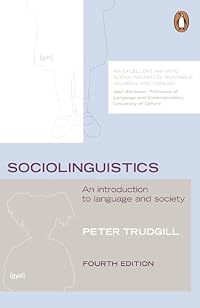
The way we talk is deeply influenced by our class, sex and ethnic background. It can also have a profound effect on how we are perceived by others. In this fully updated new edition of a classic text, Peter Trudgill explores the evidence - and the huge implications for social and educational policy . Why do men swear more than women? How do speech styles of most Black Americans, and whites growing up in 'Black areas' differ from those of other whites? Does it make sense to defend a language show more against 'contamination' from foreign words and phrases? Such questions illuminate many fascinatin g aspects of human communication, but they also lie at the heart of fierce political debates about how states should deal with their linguistic minorities, when teachers should correct their pupils' grammar and pronunciation, and whether language promotes racial and sexual stereotypes. Only sociolinguists can provide objective answers- their key conclusions are set out in this celebrated book. show lessTags
Recommendations






























Member Reviews
Ah, good old Trudgill. Reliable, though a little dated at the edges (even the most recent reissue talks about languages maybe not making it into the new millennium).
The book is a well-written introduction to the field, penned by a renowned expert who handles the subject matter with great confidence and experience. For a text dealing mainly with varieties of English, it features a balanced range of languages to draw examples from.
The organization is not always as tight as it could have been: several chapters do tend to meander a bit, and the selection and arrangement of information could have tended a little more towards the analytical. On the other hand, by not rigidly adhering to a structure, the book reads less as a textbook to be show more learnt by heart and more like an informed discussion of people's attitudes towards languages, dialects, and the people who speak them.
In all, this book serves eminently as a textbook for first year undergrads. I enjoyed teaching from it. show less
The book is a well-written introduction to the field, penned by a renowned expert who handles the subject matter with great confidence and experience. For a text dealing mainly with varieties of English, it features a balanced range of languages to draw examples from.
The organization is not always as tight as it could have been: several chapters do tend to meander a bit, and the selection and arrangement of information could have tended a little more towards the analytical. On the other hand, by not rigidly adhering to a structure, the book reads less as a textbook to be show more learnt by heart and more like an informed discussion of people's attitudes towards languages, dialects, and the people who speak them.
In all, this book serves eminently as a textbook for first year undergrads. I enjoyed teaching from it. show less
Sociolinguistics is the academic study of the relationship between language and society. That's a vast topic to say the least! Peter Trudgill, though, manages to offer us here a straightforward introduction to it all.
First of all, he tackles, simply, monolingual societies. He explains the differences between a language and a dialect, then dedicates a few concise chapters to show how who we are (social status, ethnic origin, gender) impacts on our speech; this not without having some repercussions upon how we are each perceived as individuals (education, politics...). He then expands his approach to bilingual and multilingual societies, introducing here other key concepts (lingua franca, pidgin, creole, diglossia…) that he defines show more through multiple examples. He finally concludes by demonstrating that if one of the main goals of language is to create social connections, this goal can be undermined by cultural differences, with, at times, bad political consequences.
Here's a simple book, full of clear cut explanations all illustrated by many examples coming from the four corners of the world. Peter Trudgill does more than introducing a whole field of study, he also invites us to reflect upon the implication of language -its use and perception. A perfect introduction. show less
First of all, he tackles, simply, monolingual societies. He explains the differences between a language and a dialect, then dedicates a few concise chapters to show how who we are (social status, ethnic origin, gender) impacts on our speech; this not without having some repercussions upon how we are each perceived as individuals (education, politics...). He then expands his approach to bilingual and multilingual societies, introducing here other key concepts (lingua franca, pidgin, creole, diglossia…) that he defines show more through multiple examples. He finally concludes by demonstrating that if one of the main goals of language is to create social connections, this goal can be undermined by cultural differences, with, at times, bad political consequences.
Here's a simple book, full of clear cut explanations all illustrated by many examples coming from the four corners of the world. Peter Trudgill does more than introducing a whole field of study, he also invites us to reflect upon the implication of language -its use and perception. A perfect introduction. show less
Interesting discussion of language use. The back cover blurb makes it seem like a “pop psychology” book – with questions like “Why do men swear more than women?” and “…is standard French ‘better’ than Québécois or High German ‘better; than Schweizerdeutsch?” However, inside it’s pretty technical, with terms like “nonprevocalic /r/” and “affinitive affix”. Individual chapters discuss language and social class (author Peter Trudgill is English; he notes two English people who have never met before will discuss the weather – not because they are interested in meteorology but so each can determine the other’s social class); language and ethnic group (in the former Yugoslavia, people from Croatia call show more their language Croatian, people from Serbia call it Serbian, and now that Bosnia is independent people there speak Bosnian – but it’s all the same language; language and sex (in English and Hungarian, it’s possible to write a novel in the first person without a linguistic way of determining if the narrator is male or female, but other languages have gender differences in adjectives, verbs and pronouns and in some women’s language is very different from men’s). (And to answer the question on the back cover, women from many cultures use “better” language than men, the exception being cultures where women are denied education). Further chapters discuss language and context, language and nation, language and geography, language and contact, and language and humanity.
I found this a relatively easy read, despite the technical details. There are graphs and tables that show things like language difference between social classes and ethnic groups. No footnotes, but a “Suggestions for further reading” at the end. show less
I found this a relatively easy read, despite the technical details. There are graphs and tables that show things like language difference between social classes and ethnic groups. No footnotes, but a “Suggestions for further reading” at the end. show less
Read it for class. I know Trudgill is supposed to be top of the field, but but unless this is your thing, the writing is very dense and like listening to stuffed shirts pick apart the minutia of language.
Linguistics Society
Ratings
Members
- Recently Added By
Author Information

38+ Works 1,729 Members
Peter Trudgill is Professor of Sociolinguistics at the University of Agder, Kristiansand, Norway.
Series
Belongs to Publisher Series
Common Knowledge
- Canonical title
- Sociolinguistics: an introduction
- Original publication date
- 2001
Classifications
- Genres
- Sociology, Nonfiction, General Nonfiction, Anthropology
- DDC/MDS
- 306.44 — Society, Government, and Culture Social sciences, sociology & anthropology Social Behavior - Dating, Marriage, Divorce Specific aspects of culture Language
- LCC
- P40 .T75 — Language and Literature Philology. Linguistics General
- BISAC
Statistics
- Members
- 517
- Popularity
- 57,676
- Reviews
- 5
- Rating
- (3.71)
- Languages
- Chinese, English, Japanese, Swedish
- Media
- Paper, Ebook
- ISBNs
- 10
- ASINs
- 5