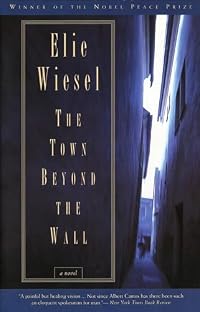
The Town Beyond the Wall
by Elie Wiesel
On This Page
Description
Story based on Wiesel's own life in which a young Holocaust survivor returns to his hometown, seeking to understand the mystery of those who stood by and watched.Tags
Recommendations



















Member Reviews
Once again, in The Town Beyond the Wall, Elie Wiesel has brought us a novel in which he infuses pieces of himself within the pages, through the narrator, named Michael.
Michael is a Jew, and he is a survivor of the Holocaust. He is haunted by the past, by memories that he tries to hold on to, holding on literally for survival. He is in constant search for validation and the meaning of life. He questions and questions, not always finding answers.
The novel questions whether you can return to where your life began, to where you spent the first youthful formative years of your life, to where your life as you knew it ended, and not feel some form of pain or suffering. To do so would be to blot out those who came before you.
Wiesel implies that show more suffering is man’s worst nightmare, where cowardice and courage can’t blend together with a firm, peaceful or true resolution. It is either one or the other, but not both. He is masterful in his writing, and leaves us to ponder much. I have never read a book by Elie Wiesel that I didn’t like, and The Town Beyond the Wall is no different. show less
Michael is a Jew, and he is a survivor of the Holocaust. He is haunted by the past, by memories that he tries to hold on to, holding on literally for survival. He is in constant search for validation and the meaning of life. He questions and questions, not always finding answers.
The novel questions whether you can return to where your life began, to where you spent the first youthful formative years of your life, to where your life as you knew it ended, and not feel some form of pain or suffering. To do so would be to blot out those who came before you.
Wiesel implies that show more suffering is man’s worst nightmare, where cowardice and courage can’t blend together with a firm, peaceful or true resolution. It is either one or the other, but not both. He is masterful in his writing, and leaves us to ponder much. I have never read a book by Elie Wiesel that I didn’t like, and The Town Beyond the Wall is no different. show less
I'm sure the book is brilliant, but there is a lot I don't understand, especially the ending.
A quote I liked, which is followed by mention of Elisha ben Avuya and the the story of the four who entered the garden:
" ... Of the roads that lead to truth there is never more than one. For each man there is only one. In that sense the atheist and the mystic are alike: they both proceed directly to the goal without turning aside. At the goal, of course, they meet. But if their paths cross on the way, they run the risk of canceling each other out. Do you understand, my boy? You can't be inside and outside at the same time. Man is too weak, his imagination too poor, to enter the garden and yet remain beyond the wall. ..."
A quote I liked, which is followed by mention of Elisha ben Avuya and the the story of the four who entered the garden:
" ... Of the roads that lead to truth there is never more than one. For each man there is only one. In that sense the atheist and the mystic are alike: they both proceed directly to the goal without turning aside. At the goal, of course, they meet. But if their paths cross on the way, they run the risk of canceling each other out. Do you understand, my boy? You can't be inside and outside at the same time. Man is too weak, his imagination too poor, to enter the garden and yet remain beyond the wall. ..."
Ratings
Members
- Recently Added By
Lists

Jewish Books
367 works; 24 members
Author Information

130+ Works 49,977 Members
Eliezer "Elie" Wiesel was born in Sighet, Romania on September 30, 1928. In 1944, he and his family were deported along with other Jews to the Nazi death camp Auschwitz. His mother and his younger sister died there. He loaded stones onto railway cars in a labor camp called Buna before being sent to Buchenwald, where his father died. He was show more liberated by the United States Third Army on April 11, 1945. After the war ended, he learned that his two older sisters had also survived. He was placed on a train of 400 orphans that was headed to France, where he was assigned to a home in Normandy under the care of a Jewish organization. He was educated at the Sorbonne and supported himself as a tutor, a Hebrew teacher and a translator. He started writing for the French newspaper L'Arche. In 1948, L'Arche sent him to Israel to report on that newly founded state. He also became the Paris correspondent for the daily Yediot Ahronot. In this capacity, he interviewed the novelist Francois Mauriac, who urged him to write about his war experiences. The result was La Nuit (Night). After the publication of Night, Wiesel became a writer, literary critic, and journalist. His other books include Dawn, The Accident, The Gates of the Forest, The Jews of Silence: A Personal Report on Soviet Jewry, and Twilight. He received a numerous awards and honors for his literary work including the William and Janice Epstein Fiction Award in 1965, the Jewish Heritage Award in 1966, the Prix Medicis in 1969, and the Prix Livre-International in 1980. He received the Nobel Peace Prize in 1986 for his work in combating human cruelty and in advocating justice. He had a leading role in the creation of the United States Holocaust Memorial Museum in Washington, D. C. He died on July 2, 2016 at the age of 87. (Bowker Author Biography) show less
Awards and Honors
Awards
Series
Belongs to Publisher Series
ספריה לעם (67)
Common Knowledge
- Canonical title
- The Town Beyond the Wall
- Original publication date
- 1962
- People/Characters
- Michael
- Important places*
- Auschwitz, Klein-Polen, Polen
- Epigraph
- I have a plan---to go mad Dostoevski
- First words
- Outside, twilight swooped down on the city like a vandal's hand: suddenly, without warning.
- Last words
- (Click to show. Warning: May contain spoilers.)The other bore the Biblical name of Eliezer, which means God has granted my prayer. [p. 189]
(Click to show. Warning: May contain spoilers.)As the liberation of the one was bound to the liberation of the other, they renewed the ancient dialogue whose echoes come to us in the night, charged with hatred, with remorse, and most of all, with infinite yearning. - Original language
- French
*Some information comes from Common Knowledge in other languages. Click "Edit" for more information.
Classifications
Statistics
- Members
- 381
- Popularity
- 81,872
- Reviews
- 2
- Rating
- (4.04)
- Languages
- 6 — Dutch, English, French, Italian, Norwegian (Bokmål), Spanish
- Media
- Paper, Ebook
- ISBNs
- 13
- ASINs
- 9