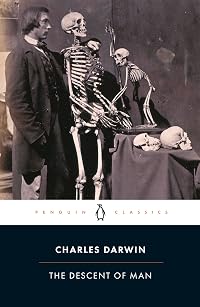
The Descent of Man, and Selection in Relation to Sex
by Charles Darwin 
On This Page
Description
In his introduction, Darwin reveals that for many years he had no intention of publishing his notes on this topic, 'as I thought that I should thus only add to the prejudices against my views'. By 1871, he felt that his fellow scientists would show a greater openness of mind to his arguments, even when taken to their logical conclusion and applied to the descent of man from the apes - the aspect of his theory which had been so widely mocked since the notorious question asked by Bishop show more Wilberforce at the Oxford debate of 1860: was it through his grandmother or his grandfather that Thomas Huxley, Darwin's champion, considered himself descended from a monkey? However, the book's focus on the area of sexual selection and the evolutionary importance of secondary sexual characteristics across the animal kingdom meant that the book was received without the public outrage that Darwin had feared. show lessTags
Recommendations



















Member Reviews
When Charles Darwin in 1859 finally made public his theory of evolution by natural selection in “On the Origin of Species”, he avoided writing about human evolution, except for saying that “Light will be thrown on the origin of man and his history.”
But by the early 1870s he felt confident enough to openly discuss the evolution of humans from animals. He did this in “The Descent of Man” (1871) and in “The Expression of Emotions in Man and Animals” (1872).
The full title of this book is “The Descent of Man, and Selection in Relation to Sex”, and this shows the double purpose that Darwin had in writing it. Firstly, he produces evidence to show that humans are the “modified descendants” of animal ancestors. Secondly, show more he explains the importance of sexual selection in nature, as an important adjunct to his theory of natural selection.
Alfred Russel Wallace had come up with the idea of natural selection independently of Darwin, although he had done so, as he himself acknowledged, twenty years after Darwin first thought of the idea. Wallace had become a friend and scientific colleague of Darwin, but now he had let the side down by ending up believing in spiritualism and arguing that the human brain/mind could not have evolved. Darwin, on the other hand, stuck to his guns and showed how even the “higher” intellectual and moral capacities of humans could have arisen as a result of evolution.
Wallace and Darwin also disagreed over sexual selection. Wallace did not agree that it was the important factor that Darwin asserted it was. Darwin may have taken his argument too far when he claimed that sexual selection was the prime factor in producing “racial” differences in humans, but overall his case for sexual selection is well made in this book.
I am a great fan of Charles Darwin, but not an uncritical one. One problem is that, despite having developed the revolutionary (and correct) theory of natural selection as the mechanism for evolutionary change, Darwin mistakenly allowed a subsidiary role for the Lamarckian idea of the inheritance of acquired characteristics. This book is unfortunately full of examples of this latter idea.
I also have to point out that there are some things in this book that make for uncomfortable reading. Here I am talking about some of Darwin’s views on class, race, nationality and gender, which reflect the prejudices of a rich, white, European male of his time.
We can’t hold Darwin responsible for the worst excesses of later eugenicists or for all those various attempts by Social Darwinists of one sort or another to justify the horrible inequalities inherent in the capitalist system by claiming that those inequalities are “natural”. But in this book we can see that Darwin himself was influenced by eugenic theories and that he himself held some of the views that would later be called “Social Darwinism”.
For example, it is embarrassing to read that Darwin thought that men had “greater intellectual vigour and power of invention” than women. And, in probably the worst passage that I’ve ever read by Darwin, he favourably quotes another writer’s dreadful racist stereotype of the Irish.
On the other hand, Darwin was always a strong opponent of slavery, and he rightly argued that all humans, whatever their “race”, belonged to a single species and were descended from a single common ancestor. (Some of the worst racists of the time were claiming that the “superior” Europeans and the “inferior” Africans and other races were descended from separate species.)
Stephen Jay Gould summed up Darwin as being “radical in his scientific ideas, liberal in his political and social views, and conservative in personal lifestyle...”
Darwin’s ideas have given us a real understanding of nature. But we must not fall into the trap of thinking that social problems and inequalities can also be explained by Darwinism. show less
But by the early 1870s he felt confident enough to openly discuss the evolution of humans from animals. He did this in “The Descent of Man” (1871) and in “The Expression of Emotions in Man and Animals” (1872).
The full title of this book is “The Descent of Man, and Selection in Relation to Sex”, and this shows the double purpose that Darwin had in writing it. Firstly, he produces evidence to show that humans are the “modified descendants” of animal ancestors. Secondly, show more he explains the importance of sexual selection in nature, as an important adjunct to his theory of natural selection.
Alfred Russel Wallace had come up with the idea of natural selection independently of Darwin, although he had done so, as he himself acknowledged, twenty years after Darwin first thought of the idea. Wallace had become a friend and scientific colleague of Darwin, but now he had let the side down by ending up believing in spiritualism and arguing that the human brain/mind could not have evolved. Darwin, on the other hand, stuck to his guns and showed how even the “higher” intellectual and moral capacities of humans could have arisen as a result of evolution.
Wallace and Darwin also disagreed over sexual selection. Wallace did not agree that it was the important factor that Darwin asserted it was. Darwin may have taken his argument too far when he claimed that sexual selection was the prime factor in producing “racial” differences in humans, but overall his case for sexual selection is well made in this book.
I am a great fan of Charles Darwin, but not an uncritical one. One problem is that, despite having developed the revolutionary (and correct) theory of natural selection as the mechanism for evolutionary change, Darwin mistakenly allowed a subsidiary role for the Lamarckian idea of the inheritance of acquired characteristics. This book is unfortunately full of examples of this latter idea.
I also have to point out that there are some things in this book that make for uncomfortable reading. Here I am talking about some of Darwin’s views on class, race, nationality and gender, which reflect the prejudices of a rich, white, European male of his time.
We can’t hold Darwin responsible for the worst excesses of later eugenicists or for all those various attempts by Social Darwinists of one sort or another to justify the horrible inequalities inherent in the capitalist system by claiming that those inequalities are “natural”. But in this book we can see that Darwin himself was influenced by eugenic theories and that he himself held some of the views that would later be called “Social Darwinism”.
For example, it is embarrassing to read that Darwin thought that men had “greater intellectual vigour and power of invention” than women. And, in probably the worst passage that I’ve ever read by Darwin, he favourably quotes another writer’s dreadful racist stereotype of the Irish.
On the other hand, Darwin was always a strong opponent of slavery, and he rightly argued that all humans, whatever their “race”, belonged to a single species and were descended from a single common ancestor. (Some of the worst racists of the time were claiming that the “superior” Europeans and the “inferior” Africans and other races were descended from separate species.)
Stephen Jay Gould summed up Darwin as being “radical in his scientific ideas, liberal in his political and social views, and conservative in personal lifestyle...”
Darwin’s ideas have given us a real understanding of nature. But we must not fall into the trap of thinking that social problems and inequalities can also be explained by Darwinism. show less
Obviously problematic in reference to race, but scientifically and historically it is a good place to start if you want to see the beginnings of Darwin's ideas on sexual selection. I think it is also a good idea to read *because* of the racism. We like to think that if we are just more educated or more this or that, then we will be less racist, but racism is something we are raised with and is much more difficult to overcome. A reminder that Darwin was a very intelligent man and intelligence does not save us from white supremacy.
Very interesting to read, and definitely a very important work of science, though nowadays somewhat outdated...
I do very much enjoy and appreciate Darwin's writings. He is very thorough and really delved into his subject. Sometimes this makes the reading a bit difficult because there's so much information, but mainly it greatly strengthens his theories. He also relates his ideas to the findings of other scientists and gives elaborate descriptions of examples, observations, and readings.
I do feel that this book is less 'strong' than his 'On the Origin of Species'.
One important part from a modern perspective is his ideas on inheritance and his theory of pangenesis. As we now know this theory to be incorrect - and scientifically speaking show more not to be able to explain the issues he discusses - this actually weakens his argument. In 'On the Origin of Species' he leaves the system of inheritance somewhat in the dark. He acknowledges that this is problematic, but this admittance of the problem works better than an incorrect theory - again, from a modern perspective. I do understand that he felt a need to provide this theory, since evolution doesn't work without some theory of inheritance, but the incorrectness of his theories makes this book less convincing.
Furthermore, I found the build-up of this book somewhat less structured than 'On the Origin of Species'. There, Darwin takes you by the hand and leads you along all the evidence he has collected, making for a coherent, logical whole. The problem with 'The Descent of Man', I think, is the fact that he is really writing about two things, namely the origins of the human species and sexual selection. He discusses both ideas pretty much separately, which means the book is less of a whole. It might have been nicer had he split up the subjects and discussed both more extensively in separate volumes.
Aside from these issues, it is still a great pleasure to read, full of interesting facts and great descriptions. show less
I do very much enjoy and appreciate Darwin's writings. He is very thorough and really delved into his subject. Sometimes this makes the reading a bit difficult because there's so much information, but mainly it greatly strengthens his theories. He also relates his ideas to the findings of other scientists and gives elaborate descriptions of examples, observations, and readings.
I do feel that this book is less 'strong' than his 'On the Origin of Species'.
One important part from a modern perspective is his ideas on inheritance and his theory of pangenesis. As we now know this theory to be incorrect - and scientifically speaking show more not to be able to explain the issues he discusses - this actually weakens his argument. In 'On the Origin of Species' he leaves the system of inheritance somewhat in the dark. He acknowledges that this is problematic, but this admittance of the problem works better than an incorrect theory - again, from a modern perspective. I do understand that he felt a need to provide this theory, since evolution doesn't work without some theory of inheritance, but the incorrectness of his theories makes this book less convincing.
Furthermore, I found the build-up of this book somewhat less structured than 'On the Origin of Species'. There, Darwin takes you by the hand and leads you along all the evidence he has collected, making for a coherent, logical whole. The problem with 'The Descent of Man', I think, is the fact that he is really writing about two things, namely the origins of the human species and sexual selection. He discusses both ideas pretty much separately, which means the book is less of a whole. It might have been nicer had he split up the subjects and discussed both more extensively in separate volumes.
Aside from these issues, it is still a great pleasure to read, full of interesting facts and great descriptions. show less
This is a difficult book to read in some ways. The main one being that it is so dense, the amount of information, observations, and evidence presented to the reader is staggering, all of it with the purpose of supporting the central theories of the book. These being that sexual selection plays a part in evolution as well as natural selection, with the former being a specific mechanism of the latter. The book is about man, and his evolution, but the majority of the examples are from other species, which support homologous principles in human evolution. There are quite a few pictures, which aren't bad. Some readers may be put off by the authors regard of different races of people, which will be considered "non p.c" by many, though it is show more really just scientific observation, despite it getting some geneticists into trouble to this day. The main problem is that this book is very long, and the evidence in support of the theory is greatly in excess to what would have been sufficient. At the time the theories were not things which were going to be readily accepted, and this is probably why the book goes into so much detail. I would struggle to recommend this book to anyone, as it seems so long and unnecessary, and does not make fascinating reading, as you can tell where a chapter is going when you start reading it, and then it seems like a painful slog to finish it. I have no doubt that this book made good reading when first published, but today it just seems like flogging a dead horse to read it as we don't need convincing of the theories. Maybe an evolutionary sceptic would enjoy it much more than I. show less
This is Darwin's final major book with a focus on man. The primary focus is on man's origin in Part I, and sexual selection in Parts II & III. I found the discussion of moral sense and social instincts to be particularly enlightening with his focus on "sympathy" and "habit" as discussed by the Scottish philosophers (cf. Adam Smith, The Theory of Moral Sentiments). Notably he rejects God as the source of conscience. The bulk of the text, however, contains detail examples and discussion of the process of sexual selection.
Science
Inscribed “Feb 28, 99, C. L. Diven from Mamma(?) and Mary”
Members
- Recently Added By
Lists

The Road to Freedom (Will Durant's 100 Best Books for an Education)
100 works; 8 members

Western World's Greatest Books - Project Gutenberg
295 works; 15 members

10 Books that Screwed Up the World (And 5 Others that Didn't Help)
15 works; 1 member

Folio Society
831 works; 53 members

How to Read a Book's Recommended Reading List
309 works; 10 members

Recommended Reading : 600 Classics Reviewed, Editors of Salem Press, 2015
634 works; 6 members

Books cited in Progress by Samuel McDonald
160 works; 1 member

In Our Time books
4,934 works; 2 members

Books Cited in Blueprint by Nicholas Christakis
261 works; 1 member
Author Information

346+ Works 32,724 Members
Charles Robert Darwin, born in 1809, was an English naturalist who founded the theory of Darwinism, the belief in evolution as determined by natural selection. Although Darwin studied medicine at Edinburgh University, and then studied at Cambridge University to become a minister, he had been interested in natural history all his life. His show more grandfather, Erasmus Darwin, was a noted English poet, physician, and botanist who was interested in evolutionary development. Darwin's works have had an incalculable effect on all aspects of the modern thought. Darwin's most famous and influential work, On the Origin of Species, provoked immediate controversy. Darwin's other books include Zoology of the Voyage of the Beagle, The Variation of Animals and Plants Under Domestication, The Descent of Man, and Selection in Relation to Sex. Charles Darwin died in 1882. (Bowker Author Biography) show less
Charles Darwin has a Legacy Library. Legacy libraries are the personal libraries of famous readers, entered by LibraryThing members from the Legacy Libraries group.
Some Editions
Awards and Honors
Series
Belongs to Publisher Series
Limited Editions Club (S:39.01)
Work Relationships
Is contained in
The Darwin Compendium: Voyage of the Beagle, The Origin of Species / Descent of Man and Selection in Relation to Sex / Expression of the Emotions in Humans and Animals / Autobiography by Charles Darwin
Contains
Is abridged in
Is replied to in
Common Knowledge
- Canonical title
- The Descent of Man, and Selection in Relation to Sex
- Original title
- The Descent of Man, and Selection in Relation to Sex
- Original publication date
- 1871-02-24
- First words
- He who wishes to decide whether man is the modified descendant of some pre-existing form, would probably first enquire whether man varies, however slightly, in bodily structure and in mental faculties; and if so, whether the ... (show all)variations are transmitted to his offspring in accordance with the laws which prevail with the lower animals.
- Quotations*
- False facts are highly injurious to the progress of science, for they often endure long; but false views, if supported by some evidence, do little harm, for every one takes a salutary pleasure in proving their falseness.
- Last words
- (Click to show. Warning: May contain spoilers.)We must, however, acknowledge, as it seems to me, that man with all his noble qualities, with sympathy which feels for the most debased, with benevolence which extends not only to other men but to the humblest living creature, with his god-like intellect which has penetrated into the movements and constitution of the solar system - with all these exalted powers - Man still bears in his bodily frame the indelible stamp of his lowly origin.
- Original language
- English
- Disambiguation notice*
- Gratis te downloaden: http://darwindownloads.nieuwezijds.nl...
*Some information comes from Common Knowledge in other languages. Click "Edit" for more information.
Classifications
Statistics
- Members
- 1,841
- Popularity
- 11,845
- Reviews
- 15
- Rating
- (3.89)
- Languages
- 16 — Catalan, Czech, Dutch, English, Estonian, Finnish, French, German, Italian, Russian, Serbian, Spanish, Swedish, Turkish, Yiddish, Portuguese (Portugal)
- Media
- Paper, Audiobook, Ebook
- ISBNs
- 121
- UPCs
- 1
- ASINs
- 75