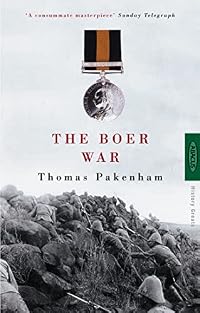
The Boer War
by Thomas Pakenham
On This Page
Description
Comprehensive history of the Boer War, a war precipitated by greed and marked by blundering and brutalities.Tags
Recommendations
















Member Recommendations


Member Reviews
If someone wants to read a single volume about the Boer War, this would be it. Pakenham has an incredible economy of style where he crams loads of information in a short space. Each page feels like 5, and not in a bad way. At the same time, the reading is enjoyable.
A point he repeatedly asserts is that the war was started partially for the rich gold miners to pay their black workers less. I can see the evidence that they encouraged the war. Maybe they wanted to be under British Dominion for other reasons. The Boers had a much lower opinion of black labor than the Brits. They literally broke away so they could maintain slaves after the Brits declared slavery illegal. Why would the mines be able to pay less under British rulership? That show more point was never made clearly.
In 2014 I did a study on WW1. As I read through this book, many names were eerily familiar - French, Haig, Hamilton, Allenby, Rawlinson, and of course Kitchener, among others. What's amazing is how the Brits had no ability to properly evaluate their generals. Kitchener was generally great strategically, but absolutely incompetent tactically and as a staff officer. It was all evident in the Boer War and even Sudan. All the other generals generally lacked imagination. Everything in WW1 was present here in a smaller scale. The Brits should never have been surprised that any of these incompetents would lose 40000 or 50000 men on a single day in a suicidal charge against entrenched positions. They did it on a smaller scale here. Repeatedly. These were the 1st generation of Sandhurst that actually earned their commissions. I guess the entitled, inbred classes had set the bar so low any moron qualified. After reading this, I can't help but feel the Brits received everything they deserved in WW1. show less
A point he repeatedly asserts is that the war was started partially for the rich gold miners to pay their black workers less. I can see the evidence that they encouraged the war. Maybe they wanted to be under British Dominion for other reasons. The Boers had a much lower opinion of black labor than the Brits. They literally broke away so they could maintain slaves after the Brits declared slavery illegal. Why would the mines be able to pay less under British rulership? That show more point was never made clearly.
In 2014 I did a study on WW1. As I read through this book, many names were eerily familiar - French, Haig, Hamilton, Allenby, Rawlinson, and of course Kitchener, among others. What's amazing is how the Brits had no ability to properly evaluate their generals. Kitchener was generally great strategically, but absolutely incompetent tactically and as a staff officer. It was all evident in the Boer War and even Sudan. All the other generals generally lacked imagination. Everything in WW1 was present here in a smaller scale. The Brits should never have been surprised that any of these incompetents would lose 40000 or 50000 men on a single day in a suicidal charge against entrenched positions. They did it on a smaller scale here. Repeatedly. These were the 1st generation of Sandhurst that actually earned their commissions. I guess the entitled, inbred classes had set the bar so low any moron qualified. After reading this, I can't help but feel the Brits received everything they deserved in WW1. show less
A fast-paced and gripping account of a major war which is now forgotten, but from which we have much to learn: concentration camps, globalism, ethnic cleansing, imperialism, the subordination of military goals to political headlines, the manipulation of political processes by international capital to achieve military ends, the predominance of the defending side in the new modern warfare, the importance of mobility and popular support in guerrilla warfare. The war concluded in 1902, and huge chunks of the century which would follow are laid out here. The are pertinent lessons here for the First World War, the Second, Vietnam, and Iraq, all of which were ignored. The book is strewn with astounding facts: eg, the concentration camp at show more Mafeking, to hold Boer woman and children, achieved an annual death rate of 173% at its worst. And bear in mind this was a camp run by the winning side, with an incredible advantage in material, men, and communications, with the intent of keeping its captors alive. It puts the camps of a crumbling Nazi Germany, forty years later, into perspective. Pakenham's books concentrate in a slightly gossipy way on the military personalities, and there are some he likes and some he doesn't. Redvers Bullers is portrayed as a good general badly done by (probably true); many other British generals, and Kitchener especially, get harsh treatment. The book also glides over certain things, without explanation. Buller's third attempt to cross the Tugela, for example, is barely mentioned. Another thing which is missing, but which in fairness is missing from all British history since the Second World War, is the fact the drive to war came not wholly from the three British white men Milner, Rhodes and Chamberlain: the financiers of the Rand gold mines were surely a driving and connecting force. The Boer War was a war for international capital, perhaps of the most obvious kind - but I fear all educated readers know what happens when we pull on that particular thread of history. A masterful book, much overlooked on its publication in 1979, for reasons which are not doubt entirely related to its content. For those who want to look history more or less square in the face it is a compelling account which you will race through. My first introduction to the Pakenham family. Surely they can't all be like this? show less
Fascinating book about a fascinating subject, probably not terribly well-know these days. Pakenham to some extent is telling a wider story about the British Empire, colonialism in Africa, the specific history of South Africa, using this war as a way to structure his story. It's very well told and and well-written, and I found it quite absorbing.
For those who care about such things, Pakenham quite obviously has his own opinions, and he is very much pro-Buller, anti-"Bobs" and anti-Kitchener. As I said, if you care about such things you'll know what I mean.
Not academic history, so if you're predisposed to dislike traditional narrative "popular" history you won't like this For the rest of us normal humans it's a great read.
For those who care about such things, Pakenham quite obviously has his own opinions, and he is very much pro-Buller, anti-"Bobs" and anti-Kitchener. As I said, if you care about such things you'll know what I mean.
Not academic history, so if you're predisposed to dislike traditional narrative "popular" history you won't like this For the rest of us normal humans it's a great read.
I am happy to own this book. The conflict itself is covered in sufficient detail, and the military and political machinations are covered very well. the work appears to be relatively unbiased, and the covering of the effect of the war on racial relations is quite good. The prose moves well, and the characters of the principal players explores their motivations wisely. It is a fit companion to the author's other book, "the Scramble for Africa, completed twelve years later. The maps are disappointing, as the publisher went for the type of map that plonks down the principal towns and a few rivers, and leaves the rest of the map a flat wasteland, removing the terrain features that direct so much of military planning. It is cheaper, I show more suppose....but it reduces the amount of real information the purchaser, and hopefully reader, could obtain. But well worth the perusal. show less
This three inch book of 650 pages is printed in what – to my tired old eyes – seems to be an eight point font, or less, and I struggled to read the closely packed history at first. But I persevered, gradually focusing on the facts and not the font, and found the extra effort well rewarded. In fact, by the second day, I could not put this impressive magnum opus down. The Boer War (1899 – 1902) was to be the most costly, in terms of blood and treasure, in the hundred years of Queen Victoria’s “little wars” period, and was a true forecast of the butchery that smokeless rifles fired from trenches would effect in the slaughter of WWI.
Thomas Pakenham is in fact the 8th Earl of Longford, and his grandfather fought the Boers in show more South Africa, and was seriously wounded in a typical ‘last stand’ affair where 80 of his fellow troops were killed. The author, besides being a respected and prize winning historian (perhaps best known for his The Scramble for Africa (http://www.librarything.com/work/22396) is also a noted arborist.
The book offers great insights – several of which are detailed here for the first time- into the politics of the war, both in Cape Town and the government parliaments and leaders, that were behind the campaigns and battles. A drum roll of famous characters thunders through this work, Kitchener, Roberts (“Bobs”), Kipling, Botha, Jan Smuts, Chamberlain … names that echo still.
I thoroughly recommend this book for history lovers and for those seeking the widest picture of a complicated, tortuous and very political war – A.J.P. Taylor added to his recommend that ”…the reader turns each page with increasing fascination and admiration”. I certainly did. show less
Thomas Pakenham is in fact the 8th Earl of Longford, and his grandfather fought the Boers in show more South Africa, and was seriously wounded in a typical ‘last stand’ affair where 80 of his fellow troops were killed. The author, besides being a respected and prize winning historian (perhaps best known for his The Scramble for Africa (http://www.librarything.com/work/22396) is also a noted arborist.
The book offers great insights – several of which are detailed here for the first time- into the politics of the war, both in Cape Town and the government parliaments and leaders, that were behind the campaigns and battles. A drum roll of famous characters thunders through this work, Kitchener, Roberts (“Bobs”), Kipling, Botha, Jan Smuts, Chamberlain … names that echo still.
I thoroughly recommend this book for history lovers and for those seeking the widest picture of a complicated, tortuous and very political war – A.J.P. Taylor added to his recommend that ”…the reader turns each page with increasing fascination and admiration”. I certainly did. show less
1740 The Boer War, by Thomas Pakenham (read 19 Sep 1982) This is a 1979 book by the eldest son of the Earl of Longford. It is excellent, though it has a different than normal view. It says Buller was an able and good general and that Roberts and Kitchener could hardly do anything right! And I think the author makes a good case for his views. It was an awful war, and of course should not have been . But I could not help but be 'for' the British, of course. A very good book, but I probably have read enough on the Boer War.
Excellent book, Very rich in detail. This makes the battles sometimes incomprehensible, but this could be because english is not my mothertongue or because the exact manouevres are not of particular interest to me.
I am dutch, and therefore have a natural sympathy for the boers. I found Pakenham unbiased although he does focus primarily on the english side of the war which is too bad. This is probably because the availabe sources are primarily of english origins.
Nevertheless, good book, could recommend it to anyoen interested in (british)military history or the boers.
I am dutch, and therefore have a natural sympathy for the boers. I found Pakenham unbiased although he does focus primarily on the english side of the war which is too bad. This is probably because the availabe sources are primarily of english origins.
Nevertheless, good book, could recommend it to anyoen interested in (british)military history or the boers.
Members
- Recently Added By
Published Reviews
Lost to the annals of history, the Boer War has failed to resonate in the hearts and minds of many. Perhaps the reason for Britain's collective failed memory is the fact that a band of ill equipped South African farmers were able to beat one of the most powerful empires.
added by John_Vaughan
Lists

Top Five Books of 2016
795 works; 228 members

r/AskHistorians' Recommended Books
1,068 works; 17 members
Author Information

16+ Works 4,436 Members
Thomas Pakenham's Remarkable Trees of the World received international acclaim
Awards and Honors
Awards
Distinctions
Work Relationships
Has as a reference guide/companion
Common Knowledge
- Original publication date
- 1979
- People/Characters
- Herbert Kitchener
- Important places
- Africa; South Africa
- Important events
- Second Boer War (1899-10-11 | 1902-05-31)
- Epigraph
- "Look back over the pages of history; consider the feelings with which we now regard wars that our forefathers in their time supported...see how powerful and deadly are the fascinations of passion and of pride." - W.F. Gladst... (show all)one, 26 November 1879, condeming the first annexation of the Transvaal.
- Dedication
- For Val, in gratitude once again, And to the memory of the war veterans who told me what it was like to be there.
- First words
- Johannesburg was not ready.
- Last words
- (Click to show. Warning: May contain spoilers.)But, whatever it was, and whatever it was for, it was over.
Classifications
Statistics
- Members
- 1,141
- Popularity
- 21,989
- Reviews
- 8
- Rating
- (4.10)
- Languages
- Afrikaans, English
- Media
- Paper, Ebook
- ISBNs
- 21
- UPCs
- 1
- ASINs
- 14