
Ian Knight
Author of Rorke's Drift 1879: 'Pinned Like Rats in a Hole'
About the Author
Ian Knight is one of the best-known authorities on the Anglo-Zulu War. As well as lecturing and writing articles on the subject for journals and magazines, he has compile museum catalogues and acted as a consultant for television documentaries produced by the BBC and the History Channel. His many show more books include Brave Men's Blood: The Anatomy of the Zulu Army, The National Army Museum Book of the Zulu War and a biography of the Prince Imperial. He is also vice-president of the Anglo-Zulu War Historical Society. Ian Knight lives in Sussex. show less
Series
Works by Ian Knight
Marching to the Drums: Eyewitness Accounts of War from the Kabul Massacre to the Siege of Mafikeng (1999) 42 copies
Tagged
Common Knowledge
- Birthdate
- 1956
- Gender
- male
- Awards and honors
- Royal Geographical Society (Fellow)
- Nationality
- England
UK
Members
Reviews
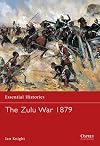
The Anglo-Zulu War of 1879 remains among the most famous conflicts of the “age of empire,” largely because of the defeat suffered by the British at the battle of Isandlwana. As Ian Knight demonstrates, however, the battle is of a piece with other elements that make it a dramatic example of imperial hubris. As Knight explains, the war was the brainchild of Sir Henry Bartle Frere, a colonial administrator who, as High Commissioner for Southern Africa, was determined to crush a Zulu kingdom show more that posed an obstacle to British plans for an Imperial Confederation. Instead of a campaign spent pursuing evasive Zulus, however, the British commander, Lord Chelmsford, was humiliated by the defeat of his main force, which panicked the settlers and forced him to withdraw. What followed was a war of retribution, one in which all sides emerged from the struggle greatly diminished. Though Knight's story that has been told by many authors, with its selection of photographs and maps his book is hard to better for anyone seeking a concise overview of one of the most enduring of Britain’s colonial wars. show less
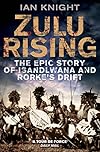
Ian Knight has authored a plethora of books about the Zulu wars. This book shows his mastery of the subject and is an exhaustive study of the battles of Isandlwana and Rorke’s Drift, presenting the background, the key players on both sides and the action in minute details.
The British failed to heed to old Roman lesson of always strongly fortifying the camp while fighting against tribes. A fortified camp manned by professionals can resist large numbers of blunt attackers. The Zulus achieved show more a Pyrrhic victory over the British that cost them too many casualties to sustain the fight. I wonder whether the British would have renewed the war if Rorke’s Drift had not happened. Its heroic defense offered enormous propaganda value while a Zulu incursion into British territory would have affected tiny numbers of settlers. Highly recommended. show less
The British failed to heed to old Roman lesson of always strongly fortifying the camp while fighting against tribes. A fortified camp manned by professionals can resist large numbers of blunt attackers. The Zulus achieved show more a Pyrrhic victory over the British that cost them too many casualties to sustain the fight. I wonder whether the British would have renewed the war if Rorke’s Drift had not happened. Its heroic defense offered enormous propaganda value while a Zulu incursion into British territory would have affected tiny numbers of settlers. Highly recommended. show less
Great book, only disappointments being an occasional tendency to bog down in logistics, and there being only one rather cursory chapter devoted to Rorke's Drift, despite being mentioned in the book's subtitle. But a terriffic read nevertheless. I hadnt really understood previously how an army equipped only with spears could have defeated and destroyed the might of Britain's Imperial forces armed with modern rifles, cannon and cavalry, but Knight makes very clear the level of bungling, show more second-guessing, ego-tripping and sheer stupidity which led to this happening, not to mention the bravery and tactical skill of the Zulu themselves which the British severely underestimated. Top quality read. show less
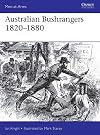
Like the highwaymen of Restoration England and the outlaws of the American Old West, “bushrangers” in Australia became mythologized cultural heroes. They included “Bold Jack” Donohue (supposedly the prototype for the “Wild Colonial Boy” of song), Martin Cash (who behaved courteously toward his victims), “Mad” Dan Morgan (who didn’t), and, of course, Ned Kelly, inventor of homemade armor plate for himself and his gang (and who created something of a stir in Australia when he show more was portray by Mick Jagger in a film).
This is part of the Osprey “Men at Arms” series, which mostly portrays military personnel in uniform through the ages for military gaming enthusiasts. As a nod to that, the color illustrations also show typical military and police who pursued the bushrangers – including native (Aboriginal) troopers. show less
This is part of the Osprey “Men at Arms” series, which mostly portrays military personnel in uniform through the ages for military gaming enthusiasts. As a nod to that, the color illustrations also show typical military and police who pursued the bushrangers – including native (Aboriginal) troopers. show less
You May Also Like


Associated Authors
Statistics
- Works
- 46
- Members
- 1,606
- Popularity
- #16,050
- Rating
- 3.7
- Reviews
- 11
- ISBNs
- 102
- Languages
- 2
- Favorited
- 1