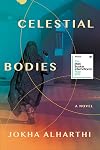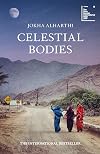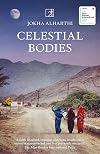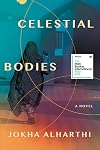
Celestial Bodies
by Jokha Alharthi
On This Page
Description
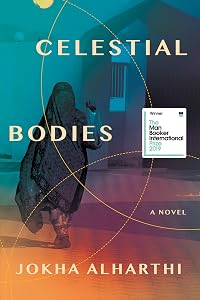
Fiction. Literature. In the village of al-Awafi in Oman, we encounter three sisters: Mayya, who marries after a heartbreak; Asma, who marries from a sense of duty; and Khawla, who chooses to refuse all offers and await a reunion with the man she loves, who has emigrated to Canada. These three women and their families, their losses and loves, unspool beautifully against a backdrop of a rapidly changing Oman, a country evolving from a traditional, slave-owning society into its complex present. show more Through the sisters, we glimpse a society in all its degrees, from the very poorest of the local slave families to those making money through the advent of new wealth. The first novel originally written in Arabic to ever win the Man Booker International Prize, and the first book by a female Omani author to be translated into English, Celestial Bodies marks the arrival in the United States of a major international writer. show lessTags
Recommendations













Member Reviews
As it seems to be the case for most readers, I came to this book because of the Man Booker International Prize, and for its depiction of Oman, a country I hadn't previously read a book from.
I was under the spell of this book from the beginning. Alharthi starts with three sisters as her focal point, but we get their POVs and SO many others -- suitors, husbands, neighbors, until it manages to take in so many different social classes, positions, ideologies. People embracing the social changes happening in Oman and those resisting it. Promotors of traditional values who treat women well, espousers of "modern" values who are misogynists and abusers behind closed doors.
I couldn't possibly sum up the plot or even the cast of characters. This show more unfolds non-linearly with flashbacks, broken memories, and dreams. Not for everyone, but I was entranced. show less
I was under the spell of this book from the beginning. Alharthi starts with three sisters as her focal point, but we get their POVs and SO many others -- suitors, husbands, neighbors, until it manages to take in so many different social classes, positions, ideologies. People embracing the social changes happening in Oman and those resisting it. Promotors of traditional values who treat women well, espousers of "modern" values who are misogynists and abusers behind closed doors.
I couldn't possibly sum up the plot or even the cast of characters. This show more unfolds non-linearly with flashbacks, broken memories, and dreams. Not for everyone, but I was entranced. show less
Having no familiarity with Oman’s history, I enjoyed learning about how traditions, and issues of class and gender informed these characters lives. Alharthi is especially revealing when depicting how these characters make decisions and live their lives when their individual values conflict with societally assigned ones, and how the latter have changed over generations. While I liked Celestial Bodies, I do feel it is a work betrayed by its structure, and I would love to play with that.
I would love to have read it this way: combining all the chapters for one character, retaining their titles but organized chronologically. For example, there are 22 short chapters called "Abdallah" interspersed throughout the book's 58 chapters. Abdullah show more is arguably, if not functionally the main character--at least by dint of the fact that he has the most chapters. His chapters are also the only ones in first person, making it unclear who is telling the other stories. show less
I would love to have read it this way: combining all the chapters for one character, retaining their titles but organized chronologically. For example, there are 22 short chapters called "Abdallah" interspersed throughout the book's 58 chapters. Abdullah show more is arguably, if not functionally the main character--at least by dint of the fact that he has the most chapters. His chapters are also the only ones in first person, making it unclear who is telling the other stories. show less
I really wish publishers would stop messing about with the titles of books in translation. The Arabic title of this is literally translated as "Ladies of The Moon" which makes a lot more sense - given the importance of a relationship between one of the main characters and a Bedouin girl he refers to as his "moon", his shining light, his muse. Celestial Bodies carries none of the same overtones, and means hardly anything in English.
That rant over with, this really is very good. But don't expect a neat, plot driven narrative. And regardless of the blurb, this is not really about the three sisters Mayya, Asma and Khawla that its claimed to be. What it is is a multi generational tale, told from multiple points of view, of the approach of show more modernity to rural Oman. This is the story of the pull of the city from the village, the pull of other countries from one's own and what that means for identity, the pull of modern values over traditional ones and, most poignantly, what freedom from slavery actually means in a rigid, patriarchal society.
And being set, mainly, in the village of al-Awafi, it is also about rumour, gossip, innuendo and the breath of scandal. Mayya, Asma and Khawla represent changes to the fabric of village life; Mayya dutifully marries, but her act of rebellion is to name her daughter "London" , to the confusion of all. London has all the opportunities of a modern education and outlook. But does it make her happier? Asma agrees to marriage and moves to Muscat, where here life becomes surprisingly traditional despite the modern environment. Khawla waits patiently for the return from Canada of her feckless teenage love. When he finally returns she does not get the life she expects.
But there are multiple other voices and stories being told here, skipping decades and generations every few pages. Some are more compelling than others; the former slave Zarifa and her family is probably the most compelling. This fragmented structure initially can be confusing , and the reader finds himself frequently consulting the helpful family tree at the beginning of the book. The problem with this is that the family tree reveals relationships that the narrative has yet to reveal. Ah well.
Also, don't expect every narrative thread to be resolved; some relatively important ones are not, at least not definitively. And on a much less important note, I still don't why Salim was being chased through the streets of Muscat by a dude in a Porsche.
But all in all I found it a very interesting narrative well worth the investment of time. As anyone who has visited Oman will know, its a fascinating country and this book is recommended as a way to start to understand some of the stories of its people show less
That rant over with, this really is very good. But don't expect a neat, plot driven narrative. And regardless of the blurb, this is not really about the three sisters Mayya, Asma and Khawla that its claimed to be. What it is is a multi generational tale, told from multiple points of view, of the approach of show more modernity to rural Oman. This is the story of the pull of the city from the village, the pull of other countries from one's own and what that means for identity, the pull of modern values over traditional ones and, most poignantly, what freedom from slavery actually means in a rigid, patriarchal society.
And being set, mainly, in the village of al-Awafi, it is also about rumour, gossip, innuendo and the breath of scandal. Mayya, Asma and Khawla represent changes to the fabric of village life; Mayya dutifully marries, but her act of rebellion is to name her daughter "London" , to the confusion of all. London has all the opportunities of a modern education and outlook. But does it make her happier? Asma agrees to marriage and moves to Muscat, where here life becomes surprisingly traditional despite the modern environment. Khawla waits patiently for the return from Canada of her feckless teenage love. When he finally returns she does not get the life she expects.
But there are multiple other voices and stories being told here, skipping decades and generations every few pages. Some are more compelling than others; the former slave Zarifa and her family is probably the most compelling. This fragmented structure initially can be confusing , and the reader finds himself frequently consulting the helpful family tree at the beginning of the book. The problem with this is that the family tree reveals relationships that the narrative has yet to reveal. Ah well.
Also, don't expect every narrative thread to be resolved; some relatively important ones are not, at least not definitively. And on a much less important note, I still don't why Salim was being chased through the streets of Muscat by a dude in a Porsche.
But all in all I found it a very interesting narrative well worth the investment of time. As anyone who has visited Oman will know, its a fascinating country and this book is recommended as a way to start to understand some of the stories of its people show less
I didn't love this, I just couldn't quite get fully into it really. I kept getting confused between the different generations and having to refer to the family tree, but even that is somewhat confusing. The structure of the novel is a little odd with some chapters by an authorial voice, and others by Abdallah. Having said that I enjoyed the writing, I liked learning a little more about Oman, and liked the contrasts of the difficulties faced by the different classes and generations of women. I suppose I felt it was trying to cover too much.
Celestial bodies is a fascinating read that explores recent Omani history by moving backward and forward in time to tell the stories of three sisters and the husband of the eldest of these three. The structure allows the reader to piece individual narratives together gradually, which allows time to consider the impact of single events of particular characters. I know next to nothing about Omani history or current Omani social issues, and having the chance to see the recent social changes the country has experienced through the eyes of Omani women is truly an opportunity. We see the different ways the sisters use or struggle against traditional practices in order to build the lives they want—and travel even closer into the present by show more looking at the lives of some of their children. The single male perspective provides interesting balance, letting us see the commonalities and differences across gendered experience. This book definitely deserved the Mann Booker International Prize. It functions as a beautiful, challenging piece of literature as well as an introduction to a culture that will be unfamiliar to most English-language readers. show less
An insight into village life in Oman.
I loved this book! But I was, sadly, the only one in my book group who did. While I can see why others were less keen, for me, it was just so atmospheric. I should add that I was listening to the audio by Laurence Bouvard and I think this version truly enhanced the book.
It does skip in time (a lot) and this can be pretty confusing. It may have helped that I listened over a few days; I'm sure if I'd taken a break in the middle, I'd have forgotten half of the characters, of which there are many. The book version has a family tree at the beginning, I could really have done with that, but obviously this would not have been compatible with the audio format.
The narrative is basically a bird's eye view of show more the life of a small community in Al Alwafi, Oman. It covers three generations. The grandparents' generation own slaves and think it quite normal. Their offspring's generation is living in amongst the slaves but no longer owns them. They may work for the family, but they are technically free. By the time we get to the most recent generation, about 40 years ago, many of the slaves have moved off to seek their fortunes, in a very similar way to some of the offspring of the villagers.
Muscat, the capital of Oman, is growing and causing a 'pull' to many of the younger villagers. It offers little by today's standards, but it's considerably more than what is available back home.
Village life is a microcosm, virtually closed to non Arabic speakers, and this book was a wonderful insight into the way people lived and how they saw the world. While travelling in Oman, I have had the occasional opportunity to join with an Omani family for coffee or breakfast, and this book opened up the hidden world behind my fleeting glimpses. Already the concrete dwellings are showing signs of age, but the vacated mud brick houses are washing back into the soil and returning to the dust whence they came.
As well as an insight into village life, I learned about a war that took place in Buraimi (now just over the Omani border from Al Ain, in the UAE). And another that took place on Jebel Aktar, a mountain range currently enjoyed by hikers, climbers and holiday makers to Oman.
I highly recommend the audio version of this book for the spoken Arabic (which I would have just skimmed) and the way the narrator enhances the characters.
Wonderful. show less
I loved this book! But I was, sadly, the only one in my book group who did. While I can see why others were less keen, for me, it was just so atmospheric. I should add that I was listening to the audio by Laurence Bouvard and I think this version truly enhanced the book.
It does skip in time (a lot) and this can be pretty confusing. It may have helped that I listened over a few days; I'm sure if I'd taken a break in the middle, I'd have forgotten half of the characters, of which there are many. The book version has a family tree at the beginning, I could really have done with that, but obviously this would not have been compatible with the audio format.
The narrative is basically a bird's eye view of show more the life of a small community in Al Alwafi, Oman. It covers three generations. The grandparents' generation own slaves and think it quite normal. Their offspring's generation is living in amongst the slaves but no longer owns them. They may work for the family, but they are technically free. By the time we get to the most recent generation, about 40 years ago, many of the slaves have moved off to seek their fortunes, in a very similar way to some of the offspring of the villagers.
Muscat, the capital of Oman, is growing and causing a 'pull' to many of the younger villagers. It offers little by today's standards, but it's considerably more than what is available back home.
Village life is a microcosm, virtually closed to non Arabic speakers, and this book was a wonderful insight into the way people lived and how they saw the world. While travelling in Oman, I have had the occasional opportunity to join with an Omani family for coffee or breakfast, and this book opened up the hidden world behind my fleeting glimpses. Already the concrete dwellings are showing signs of age, but the vacated mud brick houses are washing back into the soil and returning to the dust whence they came.
As well as an insight into village life, I learned about a war that took place in Buraimi (now just over the Omani border from Al Ain, in the UAE). And another that took place on Jebel Aktar, a mountain range currently enjoyed by hikers, climbers and holiday makers to Oman.
I highly recommend the audio version of this book for the spoken Arabic (which I would have just skimmed) and the way the narrator enhances the characters.
Wonderful. show less
Set in a village near Muscat, Oman, this novel is a saga of two families related by marriage over multiple decades. It focuses on three sisters and their mostly unhappy marriages, and on Abdullah, husband of one of the sisters. Eldest sister Mayya agrees to marry a man selected by her parents. Middle sister Asma marries in order to pursue her education. Youngest sister Khawla refuses to marry anyone but the man she loves, who has gone to Canada. Abdullah is Mayya’s husband. He is haunted by a traumatic childhood punishment meted out by his father.
The story is told via multiple points of view in a nonlinear sequence of fragmented scenes. Topics include the changing views of marriage, class distinctions, and emerging educational show more opportunities for women. It provides a look at the culture and traditions in Oman, and the manner in which they have changed. Slavery was abolished in 1970, and the traditional views about slavery play a role in the story. It also references folklore and rituals. It requires the reader’s close attention, as well as a bit of patience for the many shifts among characters and timelines.
I always appreciate learning more about our world, and it is refreshing to find a story set in Oman by an Omani author. I enjoyed the included poetry excerpts and elements of the country’s history embedded into the narrative. I was less enthused about the fragmented structure, which made it more difficult to feel fully immersed in the storyline. I read the English translation from the original Arabic. It has inspired me to seek out non-fiction to learn more about Oman’s history. show less
The story is told via multiple points of view in a nonlinear sequence of fragmented scenes. Topics include the changing views of marriage, class distinctions, and emerging educational show more opportunities for women. It provides a look at the culture and traditions in Oman, and the manner in which they have changed. Slavery was abolished in 1970, and the traditional views about slavery play a role in the story. It also references folklore and rituals. It requires the reader’s close attention, as well as a bit of patience for the many shifts among characters and timelines.
I always appreciate learning more about our world, and it is refreshing to find a story set in Oman by an Omani author. I enjoyed the included poetry excerpts and elements of the country’s history embedded into the narrative. I was less enthused about the fragmented structure, which made it more difficult to feel fully immersed in the storyline. I read the English translation from the original Arabic. It has inspired me to seek out non-fiction to learn more about Oman’s history. show less
Members
- Recently Added By
Lists

Books Read in 2019
4,052 works; 110 members

Kirkus Starred Fiction Reviews of Books Published in 2019
411 works; 12 members

Books Read in 2021
5,361 works; 113 members

Arab and Arab Diaspora Literature We Recommend
112 works; 53 members

Patriarchy and white supremacy de-programming
69 works; 1 member

Muslim Women Write: A Year of Fiction
12 works; 1 member

2026
20 works; 1 member
Author Information

4 Works 865 Members
Some Editions
Awards and Honors
Awards
Distinctions
Common Knowledge
- Canonical title
- Celestial Bodies
- Original title
- Sayyidat al-qamar
- Original publication date
- 2010; 2018-06-21 (English translation) (English translation)
- Important places
- Oman
- Dedication
- To my mother
- First words
- Mayya, forever immersed in her Singer sewing machine, seemed lost to the outside world.
- Last words
- (Click to show. Warning: May contain spoilers.)And I came out of the water dry.
- Original language
- Arabic
Classifications
- Genres
- General Fiction, Fiction and Literature
- DDC/MDS
- 892.7 — Literature & rhetoric Literatures of other languages Afro-Asiatic literatures Arabic (Egypt, Lebanon, Palestine, Saudi Arabia, Sudan)
- LCC
- PJ7928 .R58 .S2913 — Language and Literature Oriental languages and literatures Oriental philology and literature Arabic Arabic literature Individual authors or works
- BISAC
Statistics
- Members
- 722
- Popularity
- 39,304
- Reviews
- 28
- Rating
- (3.33)
- Languages
- 8 — Arabic, Catalan, English, French, Italian, Polish, Portuguese (Portugal), Turkish
- Media
- Paper, Audiobook, Ebook
- ISBNs
- 36
- ASINs
- 9