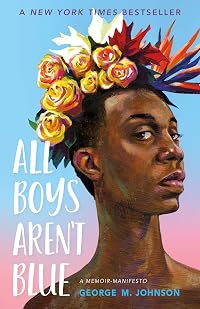
All Boys Aren't Blue: A Memoir-Manifesto
by George M. Johnson
On This Page
Description
In a series of personal essays, prominent journalist and LGBTQIA+ activist George M. Johnson explores his childhood, adolescence, and college years in New Jersey and Virginia. From the memories of getting his teeth kicked out by bullies at age five, to flea marketing with his loving grandmother, to his first sexual relationships, this young-adult memoir weaves together the trials and triumphs faced by Black queer boys.Both a primer for teens eager to be allies as well as a reassuring show more testimony for young queer men of color, All Boys Aren't Blue covers topics such as gender identity, toxic masculinity, brotherhood, family, structural marginalization, consent, and Black joy. Johnson's emotionally frank style of writing will appeal directly to young adults. show lessTags
Recommendations






Member Reviews
A very different book than what I expected, and with a much lighter tone to it overall than I would have thought from this type of memoir. I thought it worked very well as a YA memoir, imparting lessons that are important for teens to know without feeling it it was talking down to them or dumbing down the language. The calls for LGBTQ youth to get the same chances to explore dating/sex at the same time as their peers, and with equal sex education, were especially important. I hope that part of the book can empower queer teens to keep themselves safe and listen to their own wants and needs.
I really appreciated hearing about the other queer people Johnson knew throughout their life. We're truly not alone out there, even if it might seem show more that way.
I did get a bit of a sense that the author was looking at some things with the rose tinted glasses of adulthood, focusing less on how they might have felt at the time, and it made some things seem a little less genuine. At the same time, it does contribute to the overall hopeful tone of the book and the message that no period of time is permanent. show less
I really appreciated hearing about the other queer people Johnson knew throughout their life. We're truly not alone out there, even if it might seem show more that way.
I did get a bit of a sense that the author was looking at some things with the rose tinted glasses of adulthood, focusing less on how they might have felt at the time, and it made some things seem a little less genuine. At the same time, it does contribute to the overall hopeful tone of the book and the message that no period of time is permanent. show less
This hit close to home for me in many ways with myself being queer in the South. NOW George's life on top of that - Black - he wrote so eloquently with the aim of this memoir-manifesto being available to young adults to understand they ARE NOT ALONE. Very clear, easy to read (in terms of writing and messages coming across), very hard to read because of the pain we, humans, put on another due to society's outdated norms, heart tugging.
Recommend, 100% even if you're a homophobe.
Mwah.
Recommend, 100% even if you're a homophobe.
Mwah.
Centers the experiences, desires, and agency of a queer Black boy navigating his evolving selfhood and the challenges of society’s conditional love for his truthful existence.
Queer Black existence has been here forever, and yet rarely has that experience been spotlighted within literature aimed at Black boyhood. This is the context in which this “memoir-manifesto” begins, as Johnson, a still relatively young 33-year-old journalist and activist, debuts his unfolding life story within a vacuum of representation. These stories wrestle with “joy and pain...triumph and tragedy” across many heavy topics—gender policing, sexual abuse, institutional violence—but with a view to freedom on the horizon. Through the witnessing of show more Johnson’s intimate accounts, beginning with his middle-class New Jersey childhood and continuing through his attendance at a historically Black university in Virginia, readers are invited on their own paths to healing, self-care, and living one’s truth. Those who see themselves outside the standpoint of being Black and queer are called in toward accountability, clarifying an understanding of the history, language, and actions needed to transform the world—not in pity for the oppressed but in the liberation of themselves. This title opens new doors, as the author insists that we don’t have to anchor stories such as his to tragic ends: “Many of us are still here. Still living and waiting for our stories to be told—to tell them ourselves.”
A critical, captivating, merciful mirror for growing up Black and queer today. (Memoir. 14-adult)
- Kirkus Starred Review show less
Queer Black existence has been here forever, and yet rarely has that experience been spotlighted within literature aimed at Black boyhood. This is the context in which this “memoir-manifesto” begins, as Johnson, a still relatively young 33-year-old journalist and activist, debuts his unfolding life story within a vacuum of representation. These stories wrestle with “joy and pain...triumph and tragedy” across many heavy topics—gender policing, sexual abuse, institutional violence—but with a view to freedom on the horizon. Through the witnessing of show more Johnson’s intimate accounts, beginning with his middle-class New Jersey childhood and continuing through his attendance at a historically Black university in Virginia, readers are invited on their own paths to healing, self-care, and living one’s truth. Those who see themselves outside the standpoint of being Black and queer are called in toward accountability, clarifying an understanding of the history, language, and actions needed to transform the world—not in pity for the oppressed but in the liberation of themselves. This title opens new doors, as the author insists that we don’t have to anchor stories such as his to tragic ends: “Many of us are still here. Still living and waiting for our stories to be told—to tell them ourselves.”
A critical, captivating, merciful mirror for growing up Black and queer today. (Memoir. 14-adult)
- Kirkus Starred Review show less
George M. Johnson reflects on growing up a closeted gay Black boy, telling stories of his family, school, and going to college. Through it all, he encourages teens to be themselves, find a strong support group, and learn from his mistakes.
This was one of the top 10 most banned books in 2021. It's a memoir of a young man not much younger than me, whose formative experiences were very different from my own. I enjoy reading that kind of thing. It's not written to me - it's meant for young people, and he writes directly to them, often addressing advice to teens at the end of a chapter. He writes matter-of-factly about sexual abuse he experienced and sexual encounters in college. Johnson's young enough that he can remember and reflect on his show more mixed feelings about his identity and the awkwardness of coming out, and his love for his family really shines through. Probably my favorite part to read was his letters to different family members: his Nanny, his father, mother, and trans cousin Hope among them. Definitely recommended for high school and college age readers with an interest in memoirs. show less
This was one of the top 10 most banned books in 2021. It's a memoir of a young man not much younger than me, whose formative experiences were very different from my own. I enjoy reading that kind of thing. It's not written to me - it's meant for young people, and he writes directly to them, often addressing advice to teens at the end of a chapter. He writes matter-of-factly about sexual abuse he experienced and sexual encounters in college. Johnson's young enough that he can remember and reflect on his show more mixed feelings about his identity and the awkwardness of coming out, and his love for his family really shines through. Probably my favorite part to read was his letters to different family members: his Nanny, his father, mother, and trans cousin Hope among them. Definitely recommended for high school and college age readers with an interest in memoirs. show less
Centers the experiences, desires, and agency of a queer Black boy navigating his evolving selfhood and the challenges of society’s conditional love for his truthful existence.
Queer Black existence has been here forever, and yet rarely has that experience been spotlighted within literature aimed at Black boyhood. This is the context in which this “memoir-manifesto” begins, as Johnson, a still relatively young 33-year-old journalist and activist, debuts his unfolding life story within a vacuum of representation. These stories wrestle with “joy and pain...triumph and tragedy” across many heavy topics—gender policing, sexual abuse, institutional violence—but with a view to freedom on the horizon. Through the witnessing of show more Johnson’s intimate accounts, beginning with his middle-class New Jersey childhood and continuing through his attendance at a historically Black university in Virginia, readers are invited on their own paths to healing, self-care, and living one’s truth. Those who see themselves outside the standpoint of being Black and queer are called in toward accountability, clarifying an understanding of the history, language, and actions needed to transform the world—not in pity for the oppressed but in the liberation of themselves. This title opens new doors, as the author insists that we don’t have to anchor stories such as his to tragic ends: “Many of us are still here. Still living and waiting for our stories to be told—to tell them ourselves.”
A critical, captivating, merciful mirror for growing up Black and queer today. (Memoir. 14-adult)
- Kirkus Starred Review show less
Queer Black existence has been here forever, and yet rarely has that experience been spotlighted within literature aimed at Black boyhood. This is the context in which this “memoir-manifesto” begins, as Johnson, a still relatively young 33-year-old journalist and activist, debuts his unfolding life story within a vacuum of representation. These stories wrestle with “joy and pain...triumph and tragedy” across many heavy topics—gender policing, sexual abuse, institutional violence—but with a view to freedom on the horizon. Through the witnessing of show more Johnson’s intimate accounts, beginning with his middle-class New Jersey childhood and continuing through his attendance at a historically Black university in Virginia, readers are invited on their own paths to healing, self-care, and living one’s truth. Those who see themselves outside the standpoint of being Black and queer are called in toward accountability, clarifying an understanding of the history, language, and actions needed to transform the world—not in pity for the oppressed but in the liberation of themselves. This title opens new doors, as the author insists that we don’t have to anchor stories such as his to tragic ends: “Many of us are still here. Still living and waiting for our stories to be told—to tell them ourselves.”
A critical, captivating, merciful mirror for growing up Black and queer today. (Memoir. 14-adult)
- Kirkus Starred Review show less
All Boys Aren’t Blue is George M. Johnson’s manifesto and coming-of-age memoir about growing up Black and queer. Even as a small child, George felt different. They didn’t feel like a typical boy so they thought maybe they were a girl. They didn’t see a place for an effeminate male in their culture. They spent recess with the girls, double Dutch jump roping until one day they accidentally discovered they were a naturally good football player and that they liked to play football as much as they liked jumping rope. Then George was even more confused. As George got older, they figured out that they weren’t sexually attracted to girls but they weren’t ready to admit to themselves that they were attracted to boys.
Teenagers going show more through the same struggles as Johnson will appreciate their unflinchingly honest perspective. Their recounting of an episode of sexual abuse they experienced as a child was particularly brave. This is actually one of the excerpts that the parent groups trying to get this book banned have taken out of context and circulated. The fact that these groups would equate this scene with pornography makes it clear to me that they have not read the book. It’s not erotic at all and they should be ashamed of themselves for cheapening Johnson’s experience with their ignorance.
The other passage parents are upset about is when Johnson shares about losing their virginity – in college by the way. How many YA books feature young, white straight people losing their virginity or just plain out having sex repeatedly? Where’s the outcry? Judy Blume’s Forever, anyone? And again, this is not porn. This is a person being vulnerable and sharing an experience that teenagers will read and know that they are not alone in being scared and unsure. I can only imagine the impact it has on LGBTQ youth to read George’s story and know that not only are they not the only one who has struggled and been confused but that someone who went through it came out the other side a successful adult person. Representation matters.
Straight teens (and adults) should read this book too. It’s important to read about other people’s experiences and be able to see the world through a different lens. Books like this one can be powerful tools to build empathy and break down barriers.
Highly recommended. show less
Teenagers going show more through the same struggles as Johnson will appreciate their unflinchingly honest perspective. Their recounting of an episode of sexual abuse they experienced as a child was particularly brave. This is actually one of the excerpts that the parent groups trying to get this book banned have taken out of context and circulated. The fact that these groups would equate this scene with pornography makes it clear to me that they have not read the book. It’s not erotic at all and they should be ashamed of themselves for cheapening Johnson’s experience with their ignorance.
The other passage parents are upset about is when Johnson shares about losing their virginity – in college by the way. How many YA books feature young, white straight people losing their virginity or just plain out having sex repeatedly? Where’s the outcry? Judy Blume’s Forever, anyone? And again, this is not porn. This is a person being vulnerable and sharing an experience that teenagers will read and know that they are not alone in being scared and unsure. I can only imagine the impact it has on LGBTQ youth to read George’s story and know that not only are they not the only one who has struggled and been confused but that someone who went through it came out the other side a successful adult person. Representation matters.
Straight teens (and adults) should read this book too. It’s important to read about other people’s experiences and be able to see the world through a different lens. Books like this one can be powerful tools to build empathy and break down barriers.
Highly recommended. show less
I picked up this book because the Gov. of Iowa is trying to ban it. I just want to say that I LOVE that so many people are fighting this book. Each person that comes out against it, makes dozens more pick it up. So fight your fight Gov. Kim Reynolds, make this book a best seller for YEARS to come.
Because it deserves it. It deserves to be placed in the hands of ever lost teenager, every student that feels like they are alone and scared and has no idea what to do with all the feels they are experiencing. Had I had this book decades ago, it would have been life changing.
But you don't need to be that person to appreciate this book. It doesn't need to be written for you, to be able to sit back and listen to how someone experiences life. show more
Maybe if as a society, we stop one starring books because they don't represent us, and instead five star them because we learned something about life that we didn't know, we wouldn't still be fighting this same tired fight.
I cried so many times throughout this story, and am so thankful that George took the chance on writing this book. It spoke to me in ways I didn't expect, about being true to myself, and living the life that is authentically me. He laid out his trauma, fears and hopes in such raw honesty. I can't even fathom the courage it took to push the publish button on this one.
Read it. Even if you aren't apart of the LGBTQIA community, read it even if you don't think you could relate to it at all. Everyone's life story is worth telling. Slip into someone else's shoes and experience life from their point of view. It's worth the ride. show less
Because it deserves it. It deserves to be placed in the hands of ever lost teenager, every student that feels like they are alone and scared and has no idea what to do with all the feels they are experiencing. Had I had this book decades ago, it would have been life changing.
But you don't need to be that person to appreciate this book. It doesn't need to be written for you, to be able to sit back and listen to how someone experiences life. show more
Maybe if as a society, we stop one starring books because they don't represent us, and instead five star them because we learned something about life that we didn't know, we wouldn't still be fighting this same tired fight.
I cried so many times throughout this story, and am so thankful that George took the chance on writing this book. It spoke to me in ways I didn't expect, about being true to myself, and living the life that is authentically me. He laid out his trauma, fears and hopes in such raw honesty. I can't even fathom the courage it took to push the publish button on this one.
Read it. Even if you aren't apart of the LGBTQIA community, read it even if you don't think you could relate to it at all. Everyone's life story is worth telling. Slip into someone else's shoes and experience life from their point of view. It's worth the ride. show less
Members
- Recently Added By
Lists

ALA's Top 10 Most Challenged Books of 2021
10 works; 1 member

LGBTQ Memoir/Biography
52 works; 4 members

Relationships: LGTBQ
40 works; 2 members

Black Authors
386 works; 32 members

Can't Wait Books of 2020
12 works; 1 member

Sexuality & Gender
160 works; 3 members

Biographies or Memoirs
36 works; 1 member

Banned Books
40 works; 2 members

Queer Nonfiction (Owned TBR)
25 works; 1 member

Transgender Awareness Week 2025
33 works; 1 member

Our Favorite Banned Books
138 works; 122 members

Books recommended by Calgary Public Library staff
1,588 works; 4 members

Books Read in 2020
4,379 works; 124 members

Virginia Banned Books 2023
68 works; 3 members

Florida
366 works; 3 members

Pride Wishlist
54 works; 1 member

VBL YA
49 works; 1 member

Florida's Book Bans and Challenges
311 works; 4 members
Banned or Challenged Books
402 works; 43 members
Kansas Book Ban List
29 works; 1 member
The Best LGBTQ Nonfiction
222 works; 73 members
Author Information

Some Editions
Awards and Honors
Awards
Distinctions
Notable Lists
Common Knowledge
- Original publication date
- 2020
- First words
- The story of how I entered the world was a foreshadowing.
- Last words
- (Click to show. Warning: May contain spoilers.)Whether this book is a bestseller or a flop, if one person is helped by my story, then it was all worth it.
Classifications
- Genres
- LGBTQ+, Biography & Memoir, Teen, Nonfiction
- DDC/MDS
- 306.76 — Society, government, & culture Social sciences, sociology & anthropology Social Behavior - Dating, Marriage, Divorce Sexual relations Sexual orientation, transgender identity, intersexuality
- LCC
- HQ76.27 .A37 .J644 — Social sciences The family. Marriage, Women and Sexuality The Family. Marriage. Women Sexual life
- BISAC
Statistics
- Members
- 1,495
- Popularity
- 15,609
- Reviews
- 53
- Rating
- (4.13)
- Languages
- English, French, Italian
- Media
- Paper, Audiobook, Ebook
- ISBNs
- 14
- ASINs
- 3