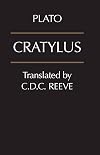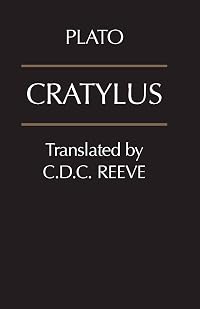
Cratylus [Translation]
by Plato
On This Page
Description
Plato's Cratylus is a brilliant but enigmatic dialogue. It bears on a topic, the relation of language to knowledge, which has never ceased to be of central philosophical importance, but tackles it in ways which at times look alien to us. In this reappraisal of the dialogue, Professor Sedley argues that the etymologies which take up well over half of it are not an embarrassing lapse or semi-private joke on Plato's part. On the contrary, if taken seriously as they should be, they are the key show more to understanding both the dialogue itself and Plato's linguistic philosophy more broadly. The book's main argument is so formulated as to be intelligible to readers with no knowledge of Greek, and will have a significant impact both on the study of Plato and on the history of linguistic thought. show lessTags
Recommendations




















Member Reviews
Did ancient Greek have prepositions? Yes. Of course it did. For a while, I was having my doubts while reading Cratylus, one of Plato’s middle dialogues that is devoted to a consideration of the correspondence between words (especially nouns) and the world.
As many of the dialogues are, this one is engaging and readable. It begins with Hermogenes talking with Socrates, incredulous that his friend Cratylus would claim that his name is not Hermogenes, “even if everyone calls [him] that.” The reason is that it cannot be a true name for he is not born of (genes) Hermes as his name implies. The name does not correspond to a truth and cannot be a true name. Socrates sets off from here.
As these dialogues go, this one starts with show more consideration of popular opinion or easily obtained viewpoints that are (often without cause) taken as common knowledge. In short order, the speakers throw out the relativistic notion that words mean only what they mean to us because, as Protagoras says, “man is the measure of all things that are that they are and that are not that they are not.” This leads to a notion of a private language but then also a corresponding public language that we use for interacting with others and that may or may not overlap with a private language. Also thrown out is the idea that the meaning in words is all convention or what we collectively agree they are. If whims changes and the conventions follow then this would suggest that there are no true names and words are potentially disconnected from the world that they reference or “imitate” in this work.
Socrates and Hermogenes start to make progress on a different kind of correspondence theory of word meanings by taking a cue from Prodicus of Ceos to consider etymology. Here, words can be traced back to roots in older Greek words and to words from other languages brought to Greece. The discussion is fascinating in showing how words trace back through words that lead closer to actual observations of the world, to first principles, or what Aristotle will come to call first philosophy, the metaphysics, being, categories, cosmology. This is the tether to reality through a long etymological chain that comes to the present day in a word. Evidence of that chain may be in word stems or in (remarkably!) single letters. Socrates’ extemporaneous etymological work is a little over the top, but the point is an interesting one. And there is a degree to which this argument still makes sense, even with words of modern coinage that trace, if not a direct history then at least an indirect one to other words through various generative, neologistic ways. The idea is that words all bottom out in reality at some point. They imitate reality as a painting imitates reality — so the argument goes.
Maybe in principle this is the case but it certainly can’t be true that we are aware of the etymological history of words when we use them, especially if the only trace of that etymological history is (as Socrates claims) a single letter. So, here I think Hermogenes might have been right to begin with: convention is important because words means what they do in how they are invoked, how they are used. And usages of words, invoked over time, pointing to conventional meaning will maintain a connection to an inherited sense of a word. The language is living and changing and I thought that the dialogue was going to go here when Heraclitus came up and his observation about change being a constant. This is why dead languages no longer maintain their currency in that the words and concept do not float on the current of renewable experience. Experience as it is embodied in that language ceased when the use of the language ceased.
Fascinating dialogue with big implications for the suitability of language for doing any kind of science or philosophy that attempts to say something about reality. If there is no correspondence then how do we talk about the world at all? I think that this argument will also figure into some of the later philosophy of language, especially when broader consideration is given to functional language. show less
As many of the dialogues are, this one is engaging and readable. It begins with Hermogenes talking with Socrates, incredulous that his friend Cratylus would claim that his name is not Hermogenes, “even if everyone calls [him] that.” The reason is that it cannot be a true name for he is not born of (genes) Hermes as his name implies. The name does not correspond to a truth and cannot be a true name. Socrates sets off from here.
As these dialogues go, this one starts with show more consideration of popular opinion or easily obtained viewpoints that are (often without cause) taken as common knowledge. In short order, the speakers throw out the relativistic notion that words mean only what they mean to us because, as Protagoras says, “man is the measure of all things that are that they are and that are not that they are not.” This leads to a notion of a private language but then also a corresponding public language that we use for interacting with others and that may or may not overlap with a private language. Also thrown out is the idea that the meaning in words is all convention or what we collectively agree they are. If whims changes and the conventions follow then this would suggest that there are no true names and words are potentially disconnected from the world that they reference or “imitate” in this work.
Socrates and Hermogenes start to make progress on a different kind of correspondence theory of word meanings by taking a cue from Prodicus of Ceos to consider etymology. Here, words can be traced back to roots in older Greek words and to words from other languages brought to Greece. The discussion is fascinating in showing how words trace back through words that lead closer to actual observations of the world, to first principles, or what Aristotle will come to call first philosophy, the metaphysics, being, categories, cosmology. This is the tether to reality through a long etymological chain that comes to the present day in a word. Evidence of that chain may be in word stems or in (remarkably!) single letters. Socrates’ extemporaneous etymological work is a little over the top, but the point is an interesting one. And there is a degree to which this argument still makes sense, even with words of modern coinage that trace, if not a direct history then at least an indirect one to other words through various generative, neologistic ways. The idea is that words all bottom out in reality at some point. They imitate reality as a painting imitates reality — so the argument goes.
Maybe in principle this is the case but it certainly can’t be true that we are aware of the etymological history of words when we use them, especially if the only trace of that etymological history is (as Socrates claims) a single letter. So, here I think Hermogenes might have been right to begin with: convention is important because words means what they do in how they are invoked, how they are used. And usages of words, invoked over time, pointing to conventional meaning will maintain a connection to an inherited sense of a word. The language is living and changing and I thought that the dialogue was going to go here when Heraclitus came up and his observation about change being a constant. This is why dead languages no longer maintain their currency in that the words and concept do not float on the current of renewable experience. Experience as it is embodied in that language ceased when the use of the language ceased.
Fascinating dialogue with big implications for the suitability of language for doing any kind of science or philosophy that attempts to say something about reality. If there is no correspondence then how do we talk about the world at all? I think that this argument will also figure into some of the later philosophy of language, especially when broader consideration is given to functional language. show less
The Cratylus is not one of Plato’s most read dialogues. It’s kind of a shame, because it addresses two fundamental questions:
What is the relationship between language and reality?
Is reality constant and unchanging or is it in constant flux (the position attributed to Heraclitus, and represented in the dialogue by Cratylus)?
The original date of the dialogue is in some dispute, and also the order in which it fits in Plato’s “middle dialogues”. The maturity of Plato’s thoughts seem to definitely place it well before The Republic, also one of the middle dialogues.
The dialogue opens with opposing positions taken by Socrates’ two companions here, Cratylus and Hermogenes. Hermogenes states Cratylus’ position, “Cratylus says, show more Socrates, that there is a correctness of name for each thing, one that belongs to it by nature.” Hermogenes’ own position is a contrary one, “I believe that any name you give a thing is its correct name.” “No name,” he says, “belongs to a particular thing by nature, but only because of the rules and usage of those who establish the usage and call it by that name.”
That gives us the crux of the argument to come. Call it conventionalism vs. essentialism.
Socrates’ first move in the dialogue is to establish that things do have natures. It’s a quick argument, a rebuttal to Protagoras’ relativism, which Hermogenes defends. The argument turns on whether there can be facts of the matter, e.g., that there are wise men and foolish men, as opposed to everything being left to the judgement of each individual. You could object that the argument is too quick, that that formulation of Protagoras’ relativism is extreme and that other positions are possible.
There will be other arguments in favor of essentialism as the dialogue goes on. I don’t think that everything depends on this rejection of Protagoras’ relativism.
Socrates goes on to argue that speaking, like other things, has a nature, and that it is possible to distinguish speaking correctly, i.e., according to its nature, from speaking incorrectly. Speaking correctly is speaking truly.
I’ll skip a bit ahead, since I imagine you can see the direction of the argument. Speaking correctly will imply speaking truly of the natures of things, in particular naming them in accordance with their natures. Socrates says, “We cannot name things as we choose; rather, we must name them in the natural way for them to be named and with the natural tool for naming them.”
The “tools” Socrates invokes here are rules for naming things. “Name-givers” as Socrates will call those who name things, are in a sense legislators, “rule-setters” for how things will be spoken of.
Socrates draws an analogy between name-givers and craftsmen in general, saying that name-givers are a rare sort of craftsman, but like other craftsmen, they are skilled at their trade. In particular they “know how to embody in sounds and syllables the name naturally suited to each thing.”
Also, just as a blacksmith may fashion drills that differ in their details, so long as the drills they make are made correctly, i.e., in accord with the nature of drills, so might different name-givers, working in different languages, fashion different names for the same things, so long as they accord with the natures of the things they name. This accounts for differences in names from language to language.
The next question Socrates takes up is what it means for a name to accord with the nature of the thing it names. He does this through a long series of etymological arguments, tracing back from the names of gods, human virtues and vices, truth, and knowledge (the translator, C.D.C. Reeve gives a nice summary of the categories of names Socrates covers in his introduction to the book).
But before going on to that, note that what Plato (via Socrates) treats as a “name” is a broader category than what we would call a name. “Names’ include proper nouns, like names of people or places or gods, but also common nouns, names for objects, actions, and attributes. It may also include adjectives, like “good.”
A couple of examples helps. The word for gods, “theos”, derives from “thein”, meaning to run, because the gods (originally likely the planets, sky, and earth) were in constant motion. “Daimons”, the name for the first humans, derives from “daimon”, denoting wisdom.
Often Socrates notes that the original names for such things have changed over time, having been “covered over” with embellishments or “to make them sound good in the mouth.” Those changes amount to corruptions of the original names, and a loss of the wisdom contained in those original names. Etymologies like the ones he demonstrates here can uncover those original names.
The names themselves are not just neutral tags for the things they name, they contain descriptive content, e.g., that the gods are constantly in motion. As another example, Socrates says of the name for the good, “[The good] always does away with (luei) any attempt to let motion end, making it unceasing and immortal. In my view, it is for this reason that the good is said to be ‘lusiteloun’, because it does away with (luon) an end (telos) to motion.”
When we unpack the “meanings” of names etymologically we understand better what the things, e.g., the good, are. So the etymologies aren’t just historical reconstructions, they are uncoverings of wisdom contained in the “original names” of things.
This is at least somewhat borne out by what Socrates says about the name for names themselves. He says, “Well , onoma (‘name’) seems to be a compressed statement which says: ‘this is a being for which there is a search.’” He then goes on to connect this notion of a search to the etymologies of truth (Aletheia), falsehood (Pseudos), and being (on or ousia).
But there is a tension here. If these names are well chosen by the name-givers, they will contain wisdom about the nature of the things they are names for. If they are well-chosen. And although Socrates speaks reverently of the name-givers, he doesn’t grant them infallibility.
That tension will come to a head toward the end of the dialogue. So far, the etymologies have traced names to other names, the name for gods to the name for running, etc. But etymology has to come to an end someplace, with some names that are elemental or primary.
Plato finds the relationship between these primary names and what they name in “imitation.” “It seems to follow that a name is a vocal imitation of what it imitates, and that someone who imitates something with his voice names what he imitates.”
But it’s not just any kind of imitating — it is imitation of the “essence” of the thing (e.g., not an imitation of the sound it makes or its shape). Naming seems to consist in imitating the being or essence of things via letters and syllables.
Now the job becomes one of describing in turn what the imitation consists in, how letters and syllables can imitate the essences of things (and whether or not they do so well or correctly). Since these primary names are the basis for all other derivative ones, the correctness of those primary names is the basis for the correctness (and embedded wisdom) of all names.
As an example, Socrates presents the letter “r” as a name-giver’s tool for copying (or imitating) motion, as in “rhoe" (“flow”) and in other examples of words naming motion.
It seems to be both the sound of the letter and the way it is produced by the tongue that are the basis for the imitating. “He [the name-giver] saw, I suppose, that the tongue was most agitated and least at rest in pronouncing this letter, and that’s probably why he used it in these names.” He repeats the same point about the motion of the tongue to describe how other letters (“i”, “d”, . . . ) are apt tools to imitate other qualities, like smallness or smoothness or a blowing outwards of something.
This brings us back to the tension I mentioned above. If the correctness of these primary names provides the basis for the correctness of all other (driver or compound) names, and if that correctness consists in their properly imitating the nature of the things they name, are those primary names in fact correct?
Socrates rightly points out that the name-givers must have had knowledge of the things they named independently of their names. They had to know the things in order to create names for them in the first place. So they knew them directly, foreshadowing the direct knowledge of Forms he develops in The Republic.
Did the name-givers create correct primary names?
I think the dialogue actually ends with that question still open. Cratylus never gives up his defense of Heraclitus, finding evidence in the prevalence of primary names that connote (or really, “imitate”) motion or change. Socrates offers one final argument against Heraclitus. He argues, among other points, that knowledge in an Heraclitean world would be impossible, because as soon as we gained knowledge of something, it would have changed, and our knowledge would no longer be of the thing. What’s more the thing would no longer be itself. It gets downright Parmenidean at this point, although it does foreshadow again arguments that Plato will make about knowledge and Forms in later dialogues.
The dialogue closes with the promise of future conversations. Socrates gets no final “Certainly so, Socrates” from Cratylus.
To go back to the two fundamental questions:
What is the relationship between language and reality?
Plato’s answer here is really a theory of “names”, where that category is a broad one. But he doesn’t explicitly provide what we would call, in contemporary philosophy, a theory of meaning or even a theory of reference per se. His theory is more one of the history and origin of names. And there his interesting claim is that names “imitate” the things they name, more specifically they imitate the “nature” of those things. Plato doesn’t fully explain what he means by their “nature” here — that’s going to wait for a more fully developed treatment of his theory of Forms, e.g., in The Republic.
The imitation that binds names to things, if they are correctly named, is a likeness between that nature of a thing and the qualities of letters and syllables, the sounds of letters but also even the feel of the letters and syllables in the mouth and on the tongue.
Given this “likeness” between names and the things they name, we can come to know things by knowing their names. However, to do so is to both count on the things being correctly named (i.e., truly imitating the nature of things) and to know things indirectly, rather than directly knowing the natures of things (again something to be developed in Plato’s theory of knowledge and the Forms).
Is reality constant and unchanging or is it in constant flux (the position attributed to Heraclitus, and represented in the dialogue by Cratylus)?
Here I don’t think we get a full answer. As I said, Cratylus leaves the conversation still holding to a Heraclitean position. Socrates has presented several arguments, but he hasn’t proven his case against Cratylus and Heraclitus. The “primary names” give mixed results, some conveying a Heraclitean emphasis on motion and change and others a stop to change (associated with a "d" rather than "r" sound and feel). Both, though, as I said above, are fallible, as the name-givers may have or may not have named the primary things correctly.
Aristotle reports in his Metaphysics that Plato learned about Heraclitus’ thoughts from the real-life Cratylus. So the relationship portrayed in the dialogue has some validity, as may the open question at the end of the dialogue.
Plato’s later development of his theory of Forms and his theory of knowledge (especially in the Theatetus and The Republic) combines Heraclitean insights with his own essentialism, so the open-endedness of the discussion here isn’t all that surprising. It’s like a rehearsal of arguments and positions to come. show less
What is the relationship between language and reality?
Is reality constant and unchanging or is it in constant flux (the position attributed to Heraclitus, and represented in the dialogue by Cratylus)?
The original date of the dialogue is in some dispute, and also the order in which it fits in Plato’s “middle dialogues”. The maturity of Plato’s thoughts seem to definitely place it well before The Republic, also one of the middle dialogues.
The dialogue opens with opposing positions taken by Socrates’ two companions here, Cratylus and Hermogenes. Hermogenes states Cratylus’ position, “Cratylus says, show more Socrates, that there is a correctness of name for each thing, one that belongs to it by nature.” Hermogenes’ own position is a contrary one, “I believe that any name you give a thing is its correct name.” “No name,” he says, “belongs to a particular thing by nature, but only because of the rules and usage of those who establish the usage and call it by that name.”
That gives us the crux of the argument to come. Call it conventionalism vs. essentialism.
Socrates’ first move in the dialogue is to establish that things do have natures. It’s a quick argument, a rebuttal to Protagoras’ relativism, which Hermogenes defends. The argument turns on whether there can be facts of the matter, e.g., that there are wise men and foolish men, as opposed to everything being left to the judgement of each individual. You could object that the argument is too quick, that that formulation of Protagoras’ relativism is extreme and that other positions are possible.
There will be other arguments in favor of essentialism as the dialogue goes on. I don’t think that everything depends on this rejection of Protagoras’ relativism.
Socrates goes on to argue that speaking, like other things, has a nature, and that it is possible to distinguish speaking correctly, i.e., according to its nature, from speaking incorrectly. Speaking correctly is speaking truly.
I’ll skip a bit ahead, since I imagine you can see the direction of the argument. Speaking correctly will imply speaking truly of the natures of things, in particular naming them in accordance with their natures. Socrates says, “We cannot name things as we choose; rather, we must name them in the natural way for them to be named and with the natural tool for naming them.”
The “tools” Socrates invokes here are rules for naming things. “Name-givers” as Socrates will call those who name things, are in a sense legislators, “rule-setters” for how things will be spoken of.
Socrates draws an analogy between name-givers and craftsmen in general, saying that name-givers are a rare sort of craftsman, but like other craftsmen, they are skilled at their trade. In particular they “know how to embody in sounds and syllables the name naturally suited to each thing.”
Also, just as a blacksmith may fashion drills that differ in their details, so long as the drills they make are made correctly, i.e., in accord with the nature of drills, so might different name-givers, working in different languages, fashion different names for the same things, so long as they accord with the natures of the things they name. This accounts for differences in names from language to language.
The next question Socrates takes up is what it means for a name to accord with the nature of the thing it names. He does this through a long series of etymological arguments, tracing back from the names of gods, human virtues and vices, truth, and knowledge (the translator, C.D.C. Reeve gives a nice summary of the categories of names Socrates covers in his introduction to the book).
But before going on to that, note that what Plato (via Socrates) treats as a “name” is a broader category than what we would call a name. “Names’ include proper nouns, like names of people or places or gods, but also common nouns, names for objects, actions, and attributes. It may also include adjectives, like “good.”
A couple of examples helps. The word for gods, “theos”, derives from “thein”, meaning to run, because the gods (originally likely the planets, sky, and earth) were in constant motion. “Daimons”, the name for the first humans, derives from “daimon”, denoting wisdom.
Often Socrates notes that the original names for such things have changed over time, having been “covered over” with embellishments or “to make them sound good in the mouth.” Those changes amount to corruptions of the original names, and a loss of the wisdom contained in those original names. Etymologies like the ones he demonstrates here can uncover those original names.
The names themselves are not just neutral tags for the things they name, they contain descriptive content, e.g., that the gods are constantly in motion. As another example, Socrates says of the name for the good, “[The good] always does away with (luei) any attempt to let motion end, making it unceasing and immortal. In my view, it is for this reason that the good is said to be ‘lusiteloun’, because it does away with (luon) an end (telos) to motion.”
When we unpack the “meanings” of names etymologically we understand better what the things, e.g., the good, are. So the etymologies aren’t just historical reconstructions, they are uncoverings of wisdom contained in the “original names” of things.
This is at least somewhat borne out by what Socrates says about the name for names themselves. He says, “Well , onoma (‘name’) seems to be a compressed statement which says: ‘this is a being for which there is a search.’” He then goes on to connect this notion of a search to the etymologies of truth (Aletheia), falsehood (Pseudos), and being (on or ousia).
But there is a tension here. If these names are well chosen by the name-givers, they will contain wisdom about the nature of the things they are names for. If they are well-chosen. And although Socrates speaks reverently of the name-givers, he doesn’t grant them infallibility.
That tension will come to a head toward the end of the dialogue. So far, the etymologies have traced names to other names, the name for gods to the name for running, etc. But etymology has to come to an end someplace, with some names that are elemental or primary.
Plato finds the relationship between these primary names and what they name in “imitation.” “It seems to follow that a name is a vocal imitation of what it imitates, and that someone who imitates something with his voice names what he imitates.”
But it’s not just any kind of imitating — it is imitation of the “essence” of the thing (e.g., not an imitation of the sound it makes or its shape). Naming seems to consist in imitating the being or essence of things via letters and syllables.
Now the job becomes one of describing in turn what the imitation consists in, how letters and syllables can imitate the essences of things (and whether or not they do so well or correctly). Since these primary names are the basis for all other derivative ones, the correctness of those primary names is the basis for the correctness (and embedded wisdom) of all names.
As an example, Socrates presents the letter “r” as a name-giver’s tool for copying (or imitating) motion, as in “rhoe" (“flow”) and in other examples of words naming motion.
It seems to be both the sound of the letter and the way it is produced by the tongue that are the basis for the imitating. “He [the name-giver] saw, I suppose, that the tongue was most agitated and least at rest in pronouncing this letter, and that’s probably why he used it in these names.” He repeats the same point about the motion of the tongue to describe how other letters (“i”, “d”, . . . ) are apt tools to imitate other qualities, like smallness or smoothness or a blowing outwards of something.
This brings us back to the tension I mentioned above. If the correctness of these primary names provides the basis for the correctness of all other (driver or compound) names, and if that correctness consists in their properly imitating the nature of the things they name, are those primary names in fact correct?
Socrates rightly points out that the name-givers must have had knowledge of the things they named independently of their names. They had to know the things in order to create names for them in the first place. So they knew them directly, foreshadowing the direct knowledge of Forms he develops in The Republic.
Did the name-givers create correct primary names?
I think the dialogue actually ends with that question still open. Cratylus never gives up his defense of Heraclitus, finding evidence in the prevalence of primary names that connote (or really, “imitate”) motion or change. Socrates offers one final argument against Heraclitus. He argues, among other points, that knowledge in an Heraclitean world would be impossible, because as soon as we gained knowledge of something, it would have changed, and our knowledge would no longer be of the thing. What’s more the thing would no longer be itself. It gets downright Parmenidean at this point, although it does foreshadow again arguments that Plato will make about knowledge and Forms in later dialogues.
The dialogue closes with the promise of future conversations. Socrates gets no final “Certainly so, Socrates” from Cratylus.
To go back to the two fundamental questions:
What is the relationship between language and reality?
Plato’s answer here is really a theory of “names”, where that category is a broad one. But he doesn’t explicitly provide what we would call, in contemporary philosophy, a theory of meaning or even a theory of reference per se. His theory is more one of the history and origin of names. And there his interesting claim is that names “imitate” the things they name, more specifically they imitate the “nature” of those things. Plato doesn’t fully explain what he means by their “nature” here — that’s going to wait for a more fully developed treatment of his theory of Forms, e.g., in The Republic.
The imitation that binds names to things, if they are correctly named, is a likeness between that nature of a thing and the qualities of letters and syllables, the sounds of letters but also even the feel of the letters and syllables in the mouth and on the tongue.
Given this “likeness” between names and the things they name, we can come to know things by knowing their names. However, to do so is to both count on the things being correctly named (i.e., truly imitating the nature of things) and to know things indirectly, rather than directly knowing the natures of things (again something to be developed in Plato’s theory of knowledge and the Forms).
Is reality constant and unchanging or is it in constant flux (the position attributed to Heraclitus, and represented in the dialogue by Cratylus)?
Here I don’t think we get a full answer. As I said, Cratylus leaves the conversation still holding to a Heraclitean position. Socrates has presented several arguments, but he hasn’t proven his case against Cratylus and Heraclitus. The “primary names” give mixed results, some conveying a Heraclitean emphasis on motion and change and others a stop to change (associated with a "d" rather than "r" sound and feel). Both, though, as I said above, are fallible, as the name-givers may have or may not have named the primary things correctly.
Aristotle reports in his Metaphysics that Plato learned about Heraclitus’ thoughts from the real-life Cratylus. So the relationship portrayed in the dialogue has some validity, as may the open question at the end of the dialogue.
Plato’s later development of his theory of Forms and his theory of knowledge (especially in the Theatetus and The Republic) combines Heraclitean insights with his own essentialism, so the open-endedness of the discussion here isn’t all that surprising. It’s like a rehearsal of arguments and positions to come. show less
"If you can add even a little to a little, it’s worthwhile. So, if you can add even a little more, don’t shrink from the labor, but assist Socrates—and assist me, too." 428a
SUMMARY: Socrates is invited into a discussion to settle a dispute between Hermogenes and Cratylus. They are discussing how to tell if a name is correct and true, if anything important or useful can be learned from etymology, and the studying of names, and if so, what exactly can be learned. You can think of names as being similar to what we would call language, and words, but this isn't exact. Socrates employs his distinctive dialectical philosophy of the Socratic method, by systematically asking questions to both Hermogenes and Cratylus. Socrates starts with show more Hermogenes, asking him questions until Hermogenes is able to plainly state the core of his view of names. In summary, Hermogenes view is that the sound, form, and spelling assigned to anything of meaning (name/word/language) is an arbitrary and made up process, where all methods of language assigned to a particular meaning is correct due to convention and collective agreement, and where language changing is a normal thing. Looking at commentaries, and from my own reading, I gather that it is unclear if Socrates agrees or disagrees with Hermogenes, but this seems to be along the same principles that etymologists, linguists, and philologists think through today when examining language, but I will add that the experts in this field have advanced a lot since Plato's writings, and isn't a direct development from Plato to today. After going through Hermogenes positions, Socrates moves on to Cratylus positions. Cratylus has a hierarchical view of reality, where he believes that there was a first cause, and whatever that first cause was, must be divine. This is an argument for intelligent design, using language and names as evidence. Cratylus believes that the names of things are inherently related to this first cause, and therefore if you can trace the origins of the name and language we use to represent meaning for something, then you can find philosophical or divine truth. In this view, studying names is a necessary component of understanding reality. Socrates induces a reductio ad absurdum, which is Latin for reducing an argument to absurdity, making quick work of Cratylus positions by pointing out the flaws of logic in intelligent design, and shows that their are serious challenges to tracking the development and origins of language, making this way of learning a futile effort, and an impossibility. Socrates finishes by calling attention to the fact that learning and experiencing philosophical and divine truth is not exclusive to learning about names, and states his own position that it is better to learn from truth itself, and things representing truth, than things that imitate the likeness of meaning and truth. How I understand what that means, is that it is better, more productive, and often more informative to learn from things as they are, what exists, and reality itself, than from abstract, non-tangible, untestable concepts, such as the origin of names, and the divine.
One of the last classes I took before I dropped out of college was Greek, and full disclosure, I failed out of Greek. All that to say, I am quite surprised how much use, the little Greek that I know, came in use while reading Cratylus. I think any proper translation makes not knowing Greek necessary, but the discussion of how the Greek language works is inherent to the arguments made in Cratylus, so even having an introduction to Greek is enlightening.
"SOCRATES: I think people have lots of mistaken opinions about the power of this god and are unduly afraid of him. They are afraid because once we are dead we remain in his realm forever. They are terrified because the soul goes there stripped of the body. But I think that all these things, together with the name and office of the god, point in the same direction. HERMOGENES: How so? SOCRATES: I’ll tell you how it looks to me. But first answer me this: Of the shackles that bind a living being and keep him in a place, which is stronger, force or desire? HERMOGENES: Desire is far stronger, Socrates. SOCRATES: Don’t you think then that many people would escape from Hades, if he didn’t bind those who come to him with the strongest of shackles? HERMOGENES: Clearly. SOCRATES: So, if he is to bind them with the strongest of shackles, rather than holding them by force, he must, it seems, bind them with some sort of desire. HERMOGENES: Evidently. SOCRATES: Now, there are lots of desires, aren’t there? HERMOGENES: Yes. SOCRATES: So, if he is really going to hold them with the greatest shackles, he has to bind them with the greatest desire. HERMOGENES: Yes." 403b-d - I did not expect to find ruminations on what develops later on in history into determinism, and a commentary on a lack of free will on some level in my readings of Plato, but here it is.
"As far as I’m concerned, nothing I’ve said is set in stone. I have simply been saying what seems right to me as a result of my investigations with Hermogenes. So, don’t hesitate to speak, and if your views are better than mine, I’ll gladly accept them. And it wouldn’t surprise me if they were better, for you’ve both investigated these matters for yourself and learned about them from others. So, if indeed you do happen to have something better to offer, you may sign me up as a student in your course on the correctness of names." 428a - a pattern of thought I am regularly thinking through, that seems to break the brain of most people in my life when I don't accept their claims on account of their age, and not because an account of good evidence. People often struggle to comprehend when you agree in part, and not in whole, or that their conclusion is valid, but their evidence is not. Or when they think I should just be agreeable when one of us gets emotional (usually they can get emotional, but I can't) and let emotions dictate truth and evidence. (I do strongly believe that empathy is an incredible tool for understanding, but this way of understanding is often not charitably reflected back at me) Here is a simple model I generally follow in my thoughts.
1. Understand that my own knowledge and wisdom has limits. Being wrong is good, it is how to learn, and become more correct. There is hardly ever such a thing as being right, only being wrong, and less wrong, or less accurate and more accurate.
2. Know what the limits of my knowledge and wisdom is.
3. Don't make claims or assumptions beyond my own limits of knowledge and wisdom.
4. If I am working beyond my limits of knowledge and wisdom, hold whatever claim or assumption I make very loosely.
5. Be charitable
6. Know what others have knowledge and wisdom in.
7. When you come across a gap in your own understanding, defer to those who have more knowledge and wisdom than you, whether it is in the areas you already have some knowledge or wisdom of, or in areas where you have no knowledge or wisdom in.
8. If someone is making claims or assumptions beyond their knowledge or wisdom, hold their claims and assumptions very lightly.
9. Be charitable.
10. If someone does not meet the very basic criteria for knowing or expertise in a certain area, their 'knowledge' and 'wisdom' is not 'knowledge' and 'wisdom', only conjecture, hearsay, assuming, trolling, power dynamics, worship, or some other nefarious relational dynamic, and interacting with these people should be limited or avoided.
I despise gatekeepers with the utmost passion, but for some things, like knowledge and wisdom, there is a certain minimum threshold that must be met, before you can go through the gate. You either have knowledge and wisdom, or you do not. If you do know put in the basic work to obtain knowledge or wisdom in a certain area, you do not get to enter the community and comment on such things in good faith. There is nothing wrong with not meeting the certain threshold and not being able to demonstrate knowledge or wisdom. If anything, it is a privilege to to be humble and learn from those who are farther along than you in a certain area, but just because someone is more knowledgeable or wise in one area, does not mean they are knowledgeable or wise in another area. This is something I have to regularly be aware of, and be more than ready to be humble at any given time because I do not have a bachelor's degree. Sure, there are a number of economic factors and assortment of things that prevented me from getting my degree when I was in school, both that was in my control and not in my control. While yes all of those things are very important, that still does not provide valid reasoning to say I 'have a degree in spirit, just not in reality'. In a proper educational environment, your knowledge is regularly being reviewed as you develop your area of expertise and critical thinking skills. I am on my own, outside of an educational environment, developing my own area of expertise and critical thinking skills, without review of a peer or professor. While yes, I have passed the threshold of exposing myself to knowledge, and objective things, I have not passed the threshold of having my thoughts be reviewed in community to make sure my logic of how I interpret knowledge and objective things is correct. So I can comment upon knowledge I have been exposed to, up to a certain point, but I have to be very aware of just how easily my interpretation of these things can be very wrong. I have enough trust in my own perspective to know truth when I come across it, and to know how to interpret truth, I just have to be very very careful in platforming myself because the logic of my perspective has not been checked and validated by a proper authority, which is a function of what a college degree provides.
"But surely that’s no defense, Cratylus. The name-giver might have made a mistake at the beginning and then forced the other names to be consistent with it. There would be nothing strange in that. Geometrical constructions often have a small unnoticed error at the beginning with which all the rest is perfectly consistent." 436c-d - Socrates breaks down why divine intelligent design is not a valid model for proving the existence of the divine. A system will always be consistent with itself, even if there are flaws in the beginning of the system's implementation. A flaw in the beginning, causes the rest to be flawed, and those agents within the system will have no way of understanding the flaws of the system, because their existence is only possible within the current system, and not independent of the current system. If another system existed, all of the agents and variables that can exist in that system, do exist in that system because it is the only possibility within that system, due to the nature of how systems and logic works. A watch can still work with tiny imperfections, whether it is in the metals that make it impure, or something wrong with the gears. Sometimes the watch still works because the logic of the system of the watch still allow it to work, other times the watch does not work because the imperfections go too far. In both cases, the watch exists in a larger logical system we call reality, and adheres to the rules of reality, allowing for the existence of both states when certain conditions are met. The argument that If reality had a 0.01 percent difference would cause all of existence to unfold into chaos, and all that we would know would be destroyed, so it is too large of a coincidence that material reality is not created with some sort of higher metaphysical entity or purpose is an intuitively a cool idea, but logically does not follow. Reality is a dialogical process, and I think this is incredibly apparent in the process of biological evolution, where entities and agents within an environment, exist only because they are adapted to their environment. If they were not adapting to their environment, they do not exist. If these same agents and entities were then placed in another environment, they then self correct to become consistent with rules of their new environment. Sometimes, the rules of their new environment only allow for living entities to not exist, so the process of an animal from Earth dying when it is exposed to the desert wasteland of the Mars atmosphere, is the only possible outcome. But if we were to find life on Mars, that life would be adapted to the conditions that exist on Mars, to which animals from Earth are not adapted for. If then, we were to take the life on Mars, and expose it to an environment from Earth, it is very likely that it will not survive, because it was only adapted for its conditions on Mars.
"SOCRATES: So if it’s really the case that one can learn about things through names and that one can also learn about them through themselves, which would be the better and clearer way to learn about them? Is it better to learn from the likeness both whether it itself is a good likeness and also the truth it is a likeness of? Or is it better to learn from the truth both the truth itself and also whether the likeness of it is properly made? CRATYLUS: I think it is certainly better to learn from the truth." 439a-b
"How to learn and make discoveries about the things that are is probably too large a topic for you or me. But we should be content to have agreed that it is far better to investigate them and learn about them through themselves than to do so through their names." 439b - The conclusion for Cratylus is synthesized in this quote. When they are talking about names they are talking about the actual names and language we use to communicate, which is very specific. I am adjusting this quote for more broad application in todays world. I say, it is better to learn from things that exist as they are, than it is to learn from the tools, boxes and lenses we use to organize our reality from. In saying this, I do not mean to drive a wedge between theory and experiment. In fact, most of my attention goes towards theoretical ideas. I absolutely believe that both theory and experiment are necessary for knowledge acquisition, but when experiment diverges from theory, it means we have to adjust our theory to be more correct with reality. If a new phenomena appears, it is better to study the phenomena itself and adjust our theories, instead of adjusting reality to match our theories. I feel like this is more important than ever when it comes to culture and sociological phenomena. If a 'new' class of person begins to appear in society, we don't say that they are delusional and they don't exist, without first having a prolonged and deep exposure to this phenomena. If the conditions are such that it allows for a phenomena to happen, that means the phenomena does happen given a long enough time span or large enough population, and if a phenomena does happen, that means the phenomena exists, despite some theories and models saying otherwise. Let me shorten it. If something can happen, it does happen, and if it does happen, then it exists.
"SOCRATES:...Can we correctly say of it first that it is this, and then that it is such and such? Or, at the very instant we are speaking, isn’t it inevitably and immediately becoming a different thing and altering and no longer being as it was? CRATYLUS: It is. SOCRATES: Then if it never stays the same, how can it be something? After all, if it ever stays the same, it clearly isn’t changing—at least, not during that time; and if it always stays the same and is always the same thing, so that it never departs from its own form, how can it ever change or move? CRATYLUS: There’s no way. SOCRATES: Then again it can’t even be known by anyone. For at the very instant the knower-to-be approaches, what he is approaching is becoming a different thing, of a different character, so that he can’t yet come to know either what sort of thing it is or what it is like—surely, no kind of knowledge is knowledge of what isn’t in any way." 439d-440a"
(HOW) METHODS OF COMPREHENSION: Primary reading was with Plato: Complete Works, edited by John M. Cooper, and with Cratylus in this collection being translated by C.D.C. Reeve. I read through this translation, highlighting things that I resonated with, or thought was important, to which I have copied my highlights to my reflection and review section. After I read through the first time, I went to supplementary resources, which included David Sedley's commentary of Cratylus, which I skimmed through. I also viewed The Wikipedia article on Cratylus, where I payed specific attention to the sources used to backup the article. I also skimmed through the Stanford Encyclopedia of Philosophy's entry on Cratylus, and chapter 20 Plato’s Philosophy of Language, in the Oxford Handbook of Plato.
Plato: Complete Works: Edited by John M. Cooper.
https://www.goodreads.com/book/show/9...
Plato's Cratylus: Commentary by David Sedley
http://assets.cambridge.org/052158/49...
Wikipedia
https://en.wikipedia.org/wiki/Cratylu...
Stanford Encyclopedia of Philosophy
https://plato.stanford.edu/entries/pl...
The Oxford Handbook of Plato
https://www.goodreads.com/book/show/3..."
(WHAT) TITLE: Cratylus
(WHAT) SERIES: Platonic Dialogues
(WHAT) Order: 1
(WHO) AUTHOR/EDITOR: Plato
RECORDS OF NOTE:
(WHAT) GENRE / SUBJECT: Philosophy, Greek, Dialectic
PAGES: 77
(WHERE) OWNED / PLATFORM: EPUB
EXCITEMENT: 7
RATING: 8
(WHY) HOW DID I HEAR ABOUT IT?: In Plato: Complete works, edited by John M. Cooper
FINISHED: Yes
(WHEN) READ OVER THE COURSE OF?: 2 days
(WHEN) DATE FINISHED: Tue, Sep 30, 2025
(WHY) REASON FINISHED: I am wanting to read through Plato's works. Learn more about the foundations of western philosophy. I want to read through all the major works in Dialectics, Dialectical Materialism, and Dialogic.
(WHY) REASON DROPPED:
EXPECTATIONS: Exceeded
PACING FEEL: Too Long
STYLYE: Dialogue
WORTH MY TIME: Yes show less
SUMMARY: Socrates is invited into a discussion to settle a dispute between Hermogenes and Cratylus. They are discussing how to tell if a name is correct and true, if anything important or useful can be learned from etymology, and the studying of names, and if so, what exactly can be learned. You can think of names as being similar to what we would call language, and words, but this isn't exact. Socrates employs his distinctive dialectical philosophy of the Socratic method, by systematically asking questions to both Hermogenes and Cratylus. Socrates starts with show more Hermogenes, asking him questions until Hermogenes is able to plainly state the core of his view of names. In summary, Hermogenes view is that the sound, form, and spelling assigned to anything of meaning (name/word/language) is an arbitrary and made up process, where all methods of language assigned to a particular meaning is correct due to convention and collective agreement, and where language changing is a normal thing. Looking at commentaries, and from my own reading, I gather that it is unclear if Socrates agrees or disagrees with Hermogenes, but this seems to be along the same principles that etymologists, linguists, and philologists think through today when examining language, but I will add that the experts in this field have advanced a lot since Plato's writings, and isn't a direct development from Plato to today. After going through Hermogenes positions, Socrates moves on to Cratylus positions. Cratylus has a hierarchical view of reality, where he believes that there was a first cause, and whatever that first cause was, must be divine. This is an argument for intelligent design, using language and names as evidence. Cratylus believes that the names of things are inherently related to this first cause, and therefore if you can trace the origins of the name and language we use to represent meaning for something, then you can find philosophical or divine truth. In this view, studying names is a necessary component of understanding reality. Socrates induces a reductio ad absurdum, which is Latin for reducing an argument to absurdity, making quick work of Cratylus positions by pointing out the flaws of logic in intelligent design, and shows that their are serious challenges to tracking the development and origins of language, making this way of learning a futile effort, and an impossibility. Socrates finishes by calling attention to the fact that learning and experiencing philosophical and divine truth is not exclusive to learning about names, and states his own position that it is better to learn from truth itself, and things representing truth, than things that imitate the likeness of meaning and truth. How I understand what that means, is that it is better, more productive, and often more informative to learn from things as they are, what exists, and reality itself, than from abstract, non-tangible, untestable concepts, such as the origin of names, and the divine.
One of the last classes I took before I dropped out of college was Greek, and full disclosure, I failed out of Greek. All that to say, I am quite surprised how much use, the little Greek that I know, came in use while reading Cratylus. I think any proper translation makes not knowing Greek necessary, but the discussion of how the Greek language works is inherent to the arguments made in Cratylus, so even having an introduction to Greek is enlightening.
"SOCRATES: I think people have lots of mistaken opinions about the power of this god and are unduly afraid of him. They are afraid because once we are dead we remain in his realm forever. They are terrified because the soul goes there stripped of the body. But I think that all these things, together with the name and office of the god, point in the same direction. HERMOGENES: How so? SOCRATES: I’ll tell you how it looks to me. But first answer me this: Of the shackles that bind a living being and keep him in a place, which is stronger, force or desire? HERMOGENES: Desire is far stronger, Socrates. SOCRATES: Don’t you think then that many people would escape from Hades, if he didn’t bind those who come to him with the strongest of shackles? HERMOGENES: Clearly. SOCRATES: So, if he is to bind them with the strongest of shackles, rather than holding them by force, he must, it seems, bind them with some sort of desire. HERMOGENES: Evidently. SOCRATES: Now, there are lots of desires, aren’t there? HERMOGENES: Yes. SOCRATES: So, if he is really going to hold them with the greatest shackles, he has to bind them with the greatest desire. HERMOGENES: Yes." 403b-d - I did not expect to find ruminations on what develops later on in history into determinism, and a commentary on a lack of free will on some level in my readings of Plato, but here it is.
"As far as I’m concerned, nothing I’ve said is set in stone. I have simply been saying what seems right to me as a result of my investigations with Hermogenes. So, don’t hesitate to speak, and if your views are better than mine, I’ll gladly accept them. And it wouldn’t surprise me if they were better, for you’ve both investigated these matters for yourself and learned about them from others. So, if indeed you do happen to have something better to offer, you may sign me up as a student in your course on the correctness of names." 428a - a pattern of thought I am regularly thinking through, that seems to break the brain of most people in my life when I don't accept their claims on account of their age, and not because an account of good evidence. People often struggle to comprehend when you agree in part, and not in whole, or that their conclusion is valid, but their evidence is not. Or when they think I should just be agreeable when one of us gets emotional (usually they can get emotional, but I can't) and let emotions dictate truth and evidence. (I do strongly believe that empathy is an incredible tool for understanding, but this way of understanding is often not charitably reflected back at me) Here is a simple model I generally follow in my thoughts.
1. Understand that my own knowledge and wisdom has limits. Being wrong is good, it is how to learn, and become more correct. There is hardly ever such a thing as being right, only being wrong, and less wrong, or less accurate and more accurate.
2. Know what the limits of my knowledge and wisdom is.
3. Don't make claims or assumptions beyond my own limits of knowledge and wisdom.
4. If I am working beyond my limits of knowledge and wisdom, hold whatever claim or assumption I make very loosely.
5. Be charitable
6. Know what others have knowledge and wisdom in.
7. When you come across a gap in your own understanding, defer to those who have more knowledge and wisdom than you, whether it is in the areas you already have some knowledge or wisdom of, or in areas where you have no knowledge or wisdom in.
8. If someone is making claims or assumptions beyond their knowledge or wisdom, hold their claims and assumptions very lightly.
9. Be charitable.
10. If someone does not meet the very basic criteria for knowing or expertise in a certain area, their 'knowledge' and 'wisdom' is not 'knowledge' and 'wisdom', only conjecture, hearsay, assuming, trolling, power dynamics, worship, or some other nefarious relational dynamic, and interacting with these people should be limited or avoided.
I despise gatekeepers with the utmost passion, but for some things, like knowledge and wisdom, there is a certain minimum threshold that must be met, before you can go through the gate. You either have knowledge and wisdom, or you do not. If you do know put in the basic work to obtain knowledge or wisdom in a certain area, you do not get to enter the community and comment on such things in good faith. There is nothing wrong with not meeting the certain threshold and not being able to demonstrate knowledge or wisdom. If anything, it is a privilege to to be humble and learn from those who are farther along than you in a certain area, but just because someone is more knowledgeable or wise in one area, does not mean they are knowledgeable or wise in another area. This is something I have to regularly be aware of, and be more than ready to be humble at any given time because I do not have a bachelor's degree. Sure, there are a number of economic factors and assortment of things that prevented me from getting my degree when I was in school, both that was in my control and not in my control. While yes all of those things are very important, that still does not provide valid reasoning to say I 'have a degree in spirit, just not in reality'. In a proper educational environment, your knowledge is regularly being reviewed as you develop your area of expertise and critical thinking skills. I am on my own, outside of an educational environment, developing my own area of expertise and critical thinking skills, without review of a peer or professor. While yes, I have passed the threshold of exposing myself to knowledge, and objective things, I have not passed the threshold of having my thoughts be reviewed in community to make sure my logic of how I interpret knowledge and objective things is correct. So I can comment upon knowledge I have been exposed to, up to a certain point, but I have to be very aware of just how easily my interpretation of these things can be very wrong. I have enough trust in my own perspective to know truth when I come across it, and to know how to interpret truth, I just have to be very very careful in platforming myself because the logic of my perspective has not been checked and validated by a proper authority, which is a function of what a college degree provides.
"But surely that’s no defense, Cratylus. The name-giver might have made a mistake at the beginning and then forced the other names to be consistent with it. There would be nothing strange in that. Geometrical constructions often have a small unnoticed error at the beginning with which all the rest is perfectly consistent." 436c-d - Socrates breaks down why divine intelligent design is not a valid model for proving the existence of the divine. A system will always be consistent with itself, even if there are flaws in the beginning of the system's implementation. A flaw in the beginning, causes the rest to be flawed, and those agents within the system will have no way of understanding the flaws of the system, because their existence is only possible within the current system, and not independent of the current system. If another system existed, all of the agents and variables that can exist in that system, do exist in that system because it is the only possibility within that system, due to the nature of how systems and logic works. A watch can still work with tiny imperfections, whether it is in the metals that make it impure, or something wrong with the gears. Sometimes the watch still works because the logic of the system of the watch still allow it to work, other times the watch does not work because the imperfections go too far. In both cases, the watch exists in a larger logical system we call reality, and adheres to the rules of reality, allowing for the existence of both states when certain conditions are met. The argument that If reality had a 0.01 percent difference would cause all of existence to unfold into chaos, and all that we would know would be destroyed, so it is too large of a coincidence that material reality is not created with some sort of higher metaphysical entity or purpose is an intuitively a cool idea, but logically does not follow. Reality is a dialogical process, and I think this is incredibly apparent in the process of biological evolution, where entities and agents within an environment, exist only because they are adapted to their environment. If they were not adapting to their environment, they do not exist. If these same agents and entities were then placed in another environment, they then self correct to become consistent with rules of their new environment. Sometimes, the rules of their new environment only allow for living entities to not exist, so the process of an animal from Earth dying when it is exposed to the desert wasteland of the Mars atmosphere, is the only possible outcome. But if we were to find life on Mars, that life would be adapted to the conditions that exist on Mars, to which animals from Earth are not adapted for. If then, we were to take the life on Mars, and expose it to an environment from Earth, it is very likely that it will not survive, because it was only adapted for its conditions on Mars.
"SOCRATES: So if it’s really the case that one can learn about things through names and that one can also learn about them through themselves, which would be the better and clearer way to learn about them? Is it better to learn from the likeness both whether it itself is a good likeness and also the truth it is a likeness of? Or is it better to learn from the truth both the truth itself and also whether the likeness of it is properly made? CRATYLUS: I think it is certainly better to learn from the truth." 439a-b
"How to learn and make discoveries about the things that are is probably too large a topic for you or me. But we should be content to have agreed that it is far better to investigate them and learn about them through themselves than to do so through their names." 439b - The conclusion for Cratylus is synthesized in this quote. When they are talking about names they are talking about the actual names and language we use to communicate, which is very specific. I am adjusting this quote for more broad application in todays world. I say, it is better to learn from things that exist as they are, than it is to learn from the tools, boxes and lenses we use to organize our reality from. In saying this, I do not mean to drive a wedge between theory and experiment. In fact, most of my attention goes towards theoretical ideas. I absolutely believe that both theory and experiment are necessary for knowledge acquisition, but when experiment diverges from theory, it means we have to adjust our theory to be more correct with reality. If a new phenomena appears, it is better to study the phenomena itself and adjust our theories, instead of adjusting reality to match our theories. I feel like this is more important than ever when it comes to culture and sociological phenomena. If a 'new' class of person begins to appear in society, we don't say that they are delusional and they don't exist, without first having a prolonged and deep exposure to this phenomena. If the conditions are such that it allows for a phenomena to happen, that means the phenomena does happen given a long enough time span or large enough population, and if a phenomena does happen, that means the phenomena exists, despite some theories and models saying otherwise. Let me shorten it. If something can happen, it does happen, and if it does happen, then it exists.
"SOCRATES:...Can we correctly say of it first that it is this, and then that it is such and such? Or, at the very instant we are speaking, isn’t it inevitably and immediately becoming a different thing and altering and no longer being as it was? CRATYLUS: It is. SOCRATES: Then if it never stays the same, how can it be something? After all, if it ever stays the same, it clearly isn’t changing—at least, not during that time; and if it always stays the same and is always the same thing, so that it never departs from its own form, how can it ever change or move? CRATYLUS: There’s no way. SOCRATES: Then again it can’t even be known by anyone. For at the very instant the knower-to-be approaches, what he is approaching is becoming a different thing, of a different character, so that he can’t yet come to know either what sort of thing it is or what it is like—surely, no kind of knowledge is knowledge of what isn’t in any way." 439d-440a"
(HOW) METHODS OF COMPREHENSION: Primary reading was with Plato: Complete Works, edited by John M. Cooper, and with Cratylus in this collection being translated by C.D.C. Reeve. I read through this translation, highlighting things that I resonated with, or thought was important, to which I have copied my highlights to my reflection and review section. After I read through the first time, I went to supplementary resources, which included David Sedley's commentary of Cratylus, which I skimmed through. I also viewed The Wikipedia article on Cratylus, where I payed specific attention to the sources used to backup the article. I also skimmed through the Stanford Encyclopedia of Philosophy's entry on Cratylus, and chapter 20 Plato’s Philosophy of Language, in the Oxford Handbook of Plato.
Plato: Complete Works: Edited by John M. Cooper.
https://www.goodreads.com/book/show/9...
Plato's Cratylus: Commentary by David Sedley
http://assets.cambridge.org/052158/49...
Wikipedia
https://en.wikipedia.org/wiki/Cratylu...
Stanford Encyclopedia of Philosophy
https://plato.stanford.edu/entries/pl...
The Oxford Handbook of Plato
https://www.goodreads.com/book/show/3..."
(WHAT) TITLE: Cratylus
(WHAT) SERIES: Platonic Dialogues
(WHAT) Order: 1
(WHO) AUTHOR/EDITOR: Plato
RECORDS OF NOTE:
(WHAT) GENRE / SUBJECT: Philosophy, Greek, Dialectic
PAGES: 77
(WHERE) OWNED / PLATFORM: EPUB
EXCITEMENT: 7
RATING: 8
(WHY) HOW DID I HEAR ABOUT IT?: In Plato: Complete works, edited by John M. Cooper
FINISHED: Yes
(WHEN) READ OVER THE COURSE OF?: 2 days
(WHEN) DATE FINISHED: Tue, Sep 30, 2025
(WHY) REASON FINISHED: I am wanting to read through Plato's works. Learn more about the foundations of western philosophy. I want to read through all the major works in Dialectics, Dialectical Materialism, and Dialogic.
(WHY) REASON DROPPED:
EXPECTATIONS: Exceeded
PACING FEEL: Too Long
STYLYE: Dialogue
WORTH MY TIME: Yes show less
Another solid Platonic dialogue.
100 PLAT 8
Sócrates cumple la función de mediador y concluye que es posible que el nombre se originara como imitación al objeto, y con el uso el nombre evolucionara, agregando o quitando sílabas y variando su significado, además de ser cambiante de acuerdo en el medio que sea utilizado.
Derecho natural: doctrina sobre el derecho ideal, derecho que se deriva, según la teoría de la razón y de la naturaleza ,estás teorías fueron expuestas por Sócrates, Platón entre otros.
La gran cualidad de la dialéctica utilizada es la guía que ofrece al lector, conduciéndolo de la mano en búsqueda de la definición del lenguaje en su esencia, utilizando los principios de las palabras para darnos a entender que el lenguaje es usado a diario y no lo show more valoramos por ser un producto histórico e inherente al hombre. ² Además, el lector se hace partícipe de la obra, se cuestiona y toma posiciones a medida que avanza, es como si Sócrates estuviera cuestionando al lector con sus preguntas y deducciones. show less
Derecho natural: doctrina sobre el derecho ideal, derecho que se deriva, según la teoría de la razón y de la naturaleza ,estás teorías fueron expuestas por Sócrates, Platón entre otros.
La gran cualidad de la dialéctica utilizada es la guía que ofrece al lector, conduciéndolo de la mano en búsqueda de la definición del lenguaje en su esencia, utilizando los principios de las palabras para darnos a entender que el lenguaje es usado a diario y no lo show more valoramos por ser un producto histórico e inherente al hombre. ² Además, el lector se hace partícipe de la obra, se cuestiona y toma posiciones a medida que avanza, es como si Sócrates estuviera cuestionando al lector con sus preguntas y deducciones. show less
Jun 25, 2007Spanish
Αριστούργημα!
Sep 13, 2012Greek
Members
- Recently Added By
Author Information

2,722+ Works 100,555 Members
Plato was born c. 427 B.C. in Athens, Greece, to an aristocratic family very much involved in political government. Pericles, famous ruler of Athens during its golden age, was Plato's stepfather. Plato was well educated and studied under Socrates, with whom he developed a close friendship. When Socrates was publically executed in 399 B.C., Plato show more finally distanced himself from a career in Athenian politics, instead becoming one of the greatest philosophers of Western civilization. Plato extended Socrates's inquiries to his students, one of the most famous being Aristotle. Plato's The Republic is an enduring work, discussing justice, the importance of education, and the qualities needed for rulers to succeed. Plato felt governors must be philosophers so they may govern wisely and effectively. Plato founded the Academy, an educational institution dedicated to pursuing philosophic truth. The Academy lasted well into the 6th century A.D., and is the model for all western universities. Its formation is along the lines Plato laid out in The Republic. Many of Plato's essays and writings survive to this day. Plato died in 347 B.C. at the age of 80. (Bowker Author Biography) show less
Some Editions
Series
Belongs to Publisher Series
Work Relationships
Common Knowledge
- Canonical title
- Cratylus [Translation]
- Original publication date
- c. 360 B.C.
Classifications
Statistics
- Members
- 230
- Popularity
- 141,156
- Reviews
- 8
- Rating
- (3.68)
- Languages
- 15 — Czech, Dutch, English, Finnish, French, German, Greek (Ancient), Greek, Hungarian, Italian, Multiple languages, Polish, Portuguese, Spanish, Turkish
- Media
- Paper, Audiobook, Ebook
- ISBNs
- 44
- UPCs
- 1
- ASINs
- 3