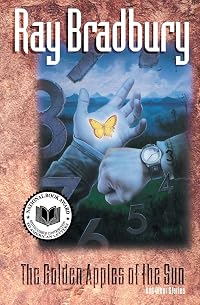
The Golden Apples of the Sun
by Ray Bradbury
On This Page
Description
Ray Bradbury is a modern cultural treasure. His disarming simplicity of style underlies a towering body of work unmatched in metaphorical power by any other American storyteller. And here, presented in a new trade edition, are thirty-two of his most famous tales-prime examples of the poignant and mysterious poetry which Bradbury uniquely uncovers in the depths of the human soul, the otherwordly portraits of outre fascination which spring from the canvas of one of the century's great men of show more imagination. From a lonely coastal lighthouse to a sixty-million-year-old safari, from the pouring rain of Venus to the ominous silence of a murder scene, Ray Bradbury is our sure-handed guide not only to surprising and outrageous manifestations of the future but also to the wonders of the present that we could never have imagined on our own. Ray Bradbury is a modern cultural treasure. His disarming simplicity of style underlies a towering body of work unmatched in metaphorical power by any other American storyteller. And here, presented in a new trade edition, are thirty-two of his most famous tales-prime examples of the poignant and mysterious poetry which Bradbury uniquely uncovers in the depths of the human soul, the otherwordly portraits of outre fascination which spring from the canvas of one of the century's great men of imagination. From a lonely coastal lighthouse to a sixty-million-year-old safari, from the pouring rain of Venus to the ominous silence of a murder scene, Ray Bradbury is our sure-handed guide not only to surprising and outrageous manifestations of the future but also to the wonders of the present that we could never have imagined on our own. show lessTags
Recommendations


















Member Reviews
Bradbury on the sea:
And although he writes of a beast of a hundred miles and a million years below who comes to the horn, to love it, I recalled it as I grew older as a whale and with this one story as child I was able to be horrified by the terrible, terrible things we do to the sea and its inhabitants. Does that matter? I think so. If everybody in the world had read this story as a child, we'd treat those things with the care and respect they deserve.
I cannot begin to say how wrong the people are who think that Ray Bradbury doesn't count, that he is for some period where we believed in things that we don't any more. He makes things important without proseltysing. It was a story about something that can't even exist and yet!
Bradbury explained his influence on kids like me thus:
Sorry. I want to say how amazing he is, again! He IS!!! show less
show more
"One day many years ago a man walked along and stood in the sound of the ocean on a cold sunless shore and said "We need a voice to call across the water, to warn ships; I'll make one. I'll make a voice that is like an empty bed beside you all night long, and like an empty house when you open the door, and like the trees in autumn with no leaves. A sound like the birds flying south, crying, and a sound like November wind and the sea on the hard, cold shore. I'll make a sound that's so alone that no one can miss it, that whoever hears it will weep in their souls, and to all who hear it in the distant towns. I'll make me a sound and an apparatus and they'll call it a Fog Horn and whoever hears it will know the sadness
of eternity and the briefness of life."
And although he writes of a beast of a hundred miles and a million years below who comes to the horn, to love it, I recalled it as I grew older as a whale and with this one story as child I was able to be horrified by the terrible, terrible things we do to the sea and its inhabitants. Does that matter? I think so. If everybody in the world had read this story as a child, we'd treat those things with the care and respect they deserve.
I cannot begin to say how wrong the people are who think that Ray Bradbury doesn't count, that he is for some period where we believed in things that we don't any more. He makes things important without proseltysing. It was a story about something that can't even exist and yet!
Bradbury explained his influence on kids like me thus:
Do you know why teachers use me? Because I speak in tongues. I write metaphors. Every one of my stories is a metaphor you can remember. The great religions are all metaphor. We appreciate things like Daniel and the lion’s den, and the Tower of Babel. People remember these metaphors because they are so vivid you can’t get free of them and that’s what kids like in school. They read about rocket ships and encounters in space, tales of dinosaurs. All my life I’ve been running through the fields and picking up bright objects. I turn one over and say, Yeah, there’s a story. And that’s what kids like. Today, my stories are in a thousand anthologies. And I’m in good company. The other writers are quite often dead people who wrote in metaphors: Edgar Allan Poe, Herman Melville, Washington Irving, Nathaniel Hawthorne. All these people wrote for children. They may have pretended not to, but they did.
Sorry. I want to say how amazing he is, again! He IS!!! show less
There are twenty two short stories in this collection and it’s probably fair to say that each is, in its own way, a masterpiece. If some seem stronger than others, this is more likely the result of the subject, theme or message of the story having particular resonance with the individual reader. Bradbury is an undoubted master of the short story form but it’s one thing to know it, quite another to witness it.
The opening story is a case in point. ‘The fog horn’ manages, in seven pages, to introduce believable and sympathetic characters, quickly establish and then build on suspense and result in a satisfying climax with just that right, light, artist’s touch of something strange.
These are stories that never leave you, even if show more you think you have forgotten them, they will return when something, such as the plaintive wail of a fog horn far out at sea, or the sight of a rubbish lorry, or a poster for a dinosaur exhibition, triggers the memory. You’ll smile recollecting how good the story was while shuddering at implications for the characters in the stories.
Other stories might be the subject of much more frequent recollection. Anyone who has walked alone late at night along a deserted street will know how odd the sensation can be, of being the only person in the world (for some reason, I think this is a sensation most usually encountered by dog walkers, possibly because nobody wants to stop and say hello to anyone who might be carrying a plastic bag of poo). There’s a particular sensation when walking the world when everyone is at home behind tightly draws curtains, watching the flickering blue glow in the corner of the room, a mixture of peace and loneliness which, in ‘The Pedestrian’, Bradbury captures perfectly.
Without doubt, the story with the most everyday resonance, at least for anyone who commutes, who owns an electronic device marketed as ‘digital’ or, God help them, ‘smart’ or who has to put up with anyone else who does, is the sublime ‘The Murderer’. Here, Bradbury has given voice to the voiceless millions who have to put up with the vocal tens of millions who have embraced communications technology that would be the stuff of science fiction fifty years ago, of witchcraft two hundred years ago and miraculous in any age and who pollute the air and the airwaves with their ceaseless, senseless bloody babble. In ‘The Murderer’ we meet a man driven to violence by constant inconsequential chatter on public transport and with technology that seeks to anticipate his needs. This constant, banal torrent of intrusion is, Bradbury is quite clear, enough to make anyone reach for the axe rather than the remote.
Bradbury writes stories set in space, on space ships and between planets as well as stories set very much here on Earth, some stories set closer to home than others. Stories set in the past, the present, a different present and the future, close and far. There are stories of great charm to be found here and of tenderness and care, especially in the tenderness and care that the characters can show towards one another. Whatever the setting, Bradbury never lets the landscape, even though it be interstellar space, overwhelm the characters.
These are all strong stories. Some will appear exceptionally so and others still the reader will finish thinking ‘I have just read a classic’. ‘The sound of thunder’ is just such a story. That there can be a story about time travel and that time travel not be the main issue of the story, that the time travel be a means to an end and that end is a prehistoric safari and that still not be the main issue of the story, is staggering. The matter at hand is the way in which people treat one another and the consequences of our actions.
So perfectly are the stories formed that one is not even sorry when they are over, as these are stories that will repay re-reading. Even if the story is the same, the reader will have changed and so will take away something new, again, to remember in an unexpected moment. show less
The opening story is a case in point. ‘The fog horn’ manages, in seven pages, to introduce believable and sympathetic characters, quickly establish and then build on suspense and result in a satisfying climax with just that right, light, artist’s touch of something strange.
These are stories that never leave you, even if show more you think you have forgotten them, they will return when something, such as the plaintive wail of a fog horn far out at sea, or the sight of a rubbish lorry, or a poster for a dinosaur exhibition, triggers the memory. You’ll smile recollecting how good the story was while shuddering at implications for the characters in the stories.
Other stories might be the subject of much more frequent recollection. Anyone who has walked alone late at night along a deserted street will know how odd the sensation can be, of being the only person in the world (for some reason, I think this is a sensation most usually encountered by dog walkers, possibly because nobody wants to stop and say hello to anyone who might be carrying a plastic bag of poo). There’s a particular sensation when walking the world when everyone is at home behind tightly draws curtains, watching the flickering blue glow in the corner of the room, a mixture of peace and loneliness which, in ‘The Pedestrian’, Bradbury captures perfectly.
Without doubt, the story with the most everyday resonance, at least for anyone who commutes, who owns an electronic device marketed as ‘digital’ or, God help them, ‘smart’ or who has to put up with anyone else who does, is the sublime ‘The Murderer’. Here, Bradbury has given voice to the voiceless millions who have to put up with the vocal tens of millions who have embraced communications technology that would be the stuff of science fiction fifty years ago, of witchcraft two hundred years ago and miraculous in any age and who pollute the air and the airwaves with their ceaseless, senseless bloody babble. In ‘The Murderer’ we meet a man driven to violence by constant inconsequential chatter on public transport and with technology that seeks to anticipate his needs. This constant, banal torrent of intrusion is, Bradbury is quite clear, enough to make anyone reach for the axe rather than the remote.
Bradbury writes stories set in space, on space ships and between planets as well as stories set very much here on Earth, some stories set closer to home than others. Stories set in the past, the present, a different present and the future, close and far. There are stories of great charm to be found here and of tenderness and care, especially in the tenderness and care that the characters can show towards one another. Whatever the setting, Bradbury never lets the landscape, even though it be interstellar space, overwhelm the characters.
These are all strong stories. Some will appear exceptionally so and others still the reader will finish thinking ‘I have just read a classic’. ‘The sound of thunder’ is just such a story. That there can be a story about time travel and that time travel not be the main issue of the story, that the time travel be a means to an end and that end is a prehistoric safari and that still not be the main issue of the story, is staggering. The matter at hand is the way in which people treat one another and the consequences of our actions.
So perfectly are the stories formed that one is not even sorry when they are over, as these are stories that will repay re-reading. Even if the story is the same, the reader will have changed and so will take away something new, again, to remember in an unexpected moment. show less
What can one say about another collection of short stories from the Master? It's clear that Bradbury isn't 'just' a SF writer, we have pure art here....
There are many reasons to read Bradbury, even at this relatively late date. For one, you can't deny his originality; he was amost always there very early, if not exactly first, whether thematically (e.g., the plight of the immigrant, "I See You Never") or conceptually (e.g., the perils of irresponsible time travel, "A Sound of Thunder.") Then, there is his range: from folk tale ("Invisible Boy") to satire ("Sun and Shadow") to comic suspense ("The Fruit at the Bottom of the Bowl"). Primarily, though, there is Bradbury's inimitable use of language: a curious amalgam of plain-spokenness with imprecision that results, if you're reading quickly, which he usually cons you into doing, with a vaguely unsettling sense that you're in an odd show more world where the dots don't connect. Consider an early sentence in the first story of this collection ("The Fog Horn"), where the narrator is describing the lighthouse where he works -- "And if they did not see our light, then there was always our Voice, the great deep cry of our Fog Horn shuddering through the rigs of mist to startle gulls away like packs of scattered cards and make the waves turn high and foam." While we are likely to pause and appreciate the comparison of frightened sea birds to scattered playing cards, we're subtly discouraged to linger and ask how exactly the sound of a foghorn can make waves rise or foam. Bradbury doesn't want us to ask that question; he is setting us up. He can usually get us every time. show less
This collection of thirty-three short stories includes an assortment of science fiction, fantasy, and realism. As in most of these types of collections, I liked some stories more than others. One of my favorites is The Murderer (which is not about murder). It is about a man who is annoyed by the intrusion of electronic devices. It includes a wrist radio, which is similar in concept to the modern cell phone and was written in 1953. The protagonist questions the value of these technological advances and has taken to destroying them. I can only imagine what he would have thought of today’s social media! Another favorite is Frost and Fire, which tells of a civilization in which people live an entire lifetime in eight days. Overall, I show more found this collection well-written and creative, and particularly enjoyed the science fiction entries.
The Foghorn – 3 stars
The April Witch – 3
The Wilderness – 3.5
The Fruit at the Bottom of the Bowl – 3.5
The Flying Machine – 3
The Murderer – 5
The Golden Kite, The Silver Wind – 3
I See You Never –3
Embroidery – 2
The Big Black and White Game – 1
The Great Wide World Over There – 3
Powerhouse – 4
En la Noche – 3.5
Sun and Shadow – 4
The Meadow – 3
The Garbage Collector – 3
The Great Fire – 3
Hail and Farewell – 3
The Golden Apples of the Sun – 4
R is for Rocket – 4
The End of the Beginning – 4
The Rocket – 4
The Rocket Man – 4
A Sound of Thunder – 3.5
The Long Rain – 4
The Exiles – 4
Here There Be Tygers – 2
The Strawberry Window – 3
The Dragon – 3.5
Frost and Fire – 5
Uncle Einar – 4
The Time Machine – 3.5
The Sound of Summer Running – 3.5 show less
The Foghorn – 3 stars
The April Witch – 3
The Wilderness – 3.5
The Fruit at the Bottom of the Bowl – 3.5
The Flying Machine – 3
The Murderer – 5
The Golden Kite, The Silver Wind – 3
I See You Never –3
Embroidery – 2
The Big Black and White Game – 1
The Great Wide World Over There – 3
Powerhouse – 4
En la Noche – 3.5
Sun and Shadow – 4
The Meadow – 3
The Garbage Collector – 3
The Great Fire – 3
Hail and Farewell – 3
The Golden Apples of the Sun – 4
R is for Rocket – 4
The End of the Beginning – 4
The Rocket – 4
The Rocket Man – 4
A Sound of Thunder – 3.5
The Long Rain – 4
The Exiles – 4
Here There Be Tygers – 2
The Strawberry Window – 3
The Dragon – 3.5
Frost and Fire – 5
Uncle Einar – 4
The Time Machine – 3.5
The Sound of Summer Running – 3.5 show less
I have always thought of Ray Bradbury of a science fiction author, but based on this collection I have been thinking of him much too narrowly. Some of the stories are fantasy, some horror, some straight fiction, some in fact sci-fi.
One story that stood out is "The Murderer", because it was science fiction in 1953, when the collection was published, but would seem to have much more resonance now.
One story that stood out is "The Murderer", because it was science fiction in 1953, when the collection was published, but would seem to have much more resonance now.
Golden Apples of the Sun collects several early Ray Bradbury stories into one volume. It is a delight to read. I had first read it in the early 1970's as a sort of escape from the heavier reading of my college coursework and decided recently to give it another read since so much time had passed since my first reading of it. I was surprised to see that at least two of the stories had been so powerful that I recalled them well even across all those years.
Before reading Bradbury in the 70's, I was a sort of literary snob about only spending time reading the classics and other high quality work. To me, Science Fiction did not fit that criteria, being escapist reading at best. But my exposure to Bradbury changed that juvenile perception and show more judgment and opened up an entirely new area of writing to read, enjoy and even learn from. From this experience, I think I largely overcame my snob's approach to reading and learned that the real definition of a good book is that it is one that keeps the reader engaged, makes him want to see what the next word is, what the next chapter holds and where the story leads. It is a book that causes the reader to sigh when the last page is read, opening the hope that the next book will be just as good.
FromThe Golden Apples, Bradbury went on to write many wonderful books and his influence went on to open me to works that would have escaped m notice had I not started with the best. show less
Before reading Bradbury in the 70's, I was a sort of literary snob about only spending time reading the classics and other high quality work. To me, Science Fiction did not fit that criteria, being escapist reading at best. But my exposure to Bradbury changed that juvenile perception and show more judgment and opened up an entirely new area of writing to read, enjoy and even learn from. From this experience, I think I largely overcame my snob's approach to reading and learned that the real definition of a good book is that it is one that keeps the reader engaged, makes him want to see what the next word is, what the next chapter holds and where the story leads. It is a book that causes the reader to sigh when the last page is read, opening the hope that the next book will be just as good.
FromThe Golden Apples, Bradbury went on to write many wonderful books and his influence went on to open me to works that would have escaped m notice had I not started with the best. show less
Members
- Recently Added By
Lists

Best Science Fiction Novels
816 works; 430 members

Favorite Childhood Books
1,651 works; 519 members

Books Read in 2016
4,666 works; 199 members

Top Five Books of 2017
757 works; 231 members
Author Information

942+ Works 168,829 Members
Ray Bradbury was born in Waukegan, Illinois on August 22, 1920. At the age of fifteen, he started submitting short stories to national magazines. During his lifetime, he wrote more than 600 stories, poems, essays, plays, films, television plays, radio, music, and comic books. His books include The Martian Chronicles, Fahrenheit 451, The show more Illustrated Man, Dandelion Wine, Something Wicked This Way Comes, and Bradbury Speaks. He won numerous awards for his works including a World Fantasy Award for Life Achievement in 1977, the 2000 National Book Foundation Medal for Distinguished Contribution to American Letters, the 2004 National Medal of Arts, and the 2007 Pulitzer Prize Special Citation. He wrote the screen play for John Huston's classic film adaptation of Moby Dick, and was nominated for an Academy Award. He adapted 65 of his stories for television's The Ray Bradbury Theater, and won an Emmy for his teleplay of The Halloween Tree. The film The Wonderful Ice Cream Suit was written by Ray Bradbury and was based on his story The Magic White Suit. He was the idea consultant and wrote the basic scenario for the United States pavilion at the 1964 World's Fair, as well as being an imagineer for Walt Disney Enterprises, where he designed the Spaceship Earth exhibition at Walt Disney World's Epcot Center. He died after a long illness on June 5, 2012 at the age of 91. (Bowker Author Biography) show less
Some Editions
Series
Belongs to Publisher Series
ハヤカワ・SF・シリーズ (3032)
Présence du futur (14)
Work Relationships
Is contained in
Contains
Has as a commentary on the text
Common Knowledge
- Canonical title*
- Geh nicht zu Fuß durch stille Straßen
- Original title
- The Golden Apples of the Sun
- Original publication date
- 1953 (Collection) (Collection)
- People/Characters
- Cecy Elliott
- Important places
- China; Green Town, Illinois, USA; Illinois, USA; Independence, Missouri, USA; Lonesome Bay; Missouri, USA (show all 9); USA; Wisconsin, USA; Mars
- Epigraph
- ...And pluck till time and times are done
The silver apples of the moon,
The golden apples of the sun.
- W. B. Yeats - Dedication
- And this one, with love, is for Neva,
daughter of Glinda
the Good Witch of the South - First words
- Out there in the cold water, far from land, we waited every night for the coming of the fog, and it came, and we oiled the brass machinery and lit the fog light up in the stone tower. ("The fog horn")
To enter out into that silence that was the city at eight o'clock of a misty evening in November, to put your feet upon that buckling concrete walk, to step over grassy seams and make your way, hands in pockets, through the s... (show all)ilences, that was what Mr. Leonard Mead most dearly loved to do. ("The pedestrian")
Into the air, over the valleys, under the stars, above a river, a pond, a road, flew Cecy. ("The April witch")
"Oh, the Good Time has come at last -" ("The wilderness")
William Acton rose to his feet. ("The fruit at the bottom of the bowl")
She took the great iron spoon and the mummified frog and gave it a bash and made dust of it, and talked to the dust while she ground it in her stony fists quickly. ("Invisible boy")
In the year A.D. 400, the Emperor Yuan held his throne by the Great Wall of China, and the land was green with rain, readying itself toward the harvest, at peace, the people in his dominion neither too happy nor too sad. ("Th... (show all)e flying machine")
Music moved through the white halls. ("The murderer")
"In the shape of a pig?" cried the Mandarin. ("The golden kite, the silver wind")
The soft knock came at the kitchen door, and when Mrs. O'Brian opened it, there on the back porch were her best tenant, Mr. Ramirez, and two police officers, one on each side of him. ("I see you never")
The dark porch air in the late afternoon was full of needle flashes, like a movement of gathered silver insects in the light. ("Embroidery")
The people filled the stands behind the wire screen, waiting. ("The big black and white game")
The sign on the wall seemed to quaver under a film of sliding warm water. ("A sound of thunder")
It was a day to be out of bed, to pull curtains and fling open windows. ("The great wide world over there")
The horses moved gently to a stop, and the man and his wife gazed down into a dry, sandy valley. ("Powerhouse")
All night Mrs. Alvarez moaned, and these moans filled the tenement like a light turned on in every room so no one could sleep. ("En la noche")
The camera clicked like an insect. ("Sun and shadow")
A wall collapses, followed by another and another; with dull thunder, a city falls into ruin. ("The meadow")
This is how his work was: he got up at five in the cold dark morning and washed his face with warm water if the heater was working and cold water if the heater was not working. ("The garbage collector")
The morning the great fire started, nobody in the house could put it out. ("The great fire")
But of course he was going away, there was nothing else to do, the time was up, the clock had run out, and he was going very far away indeed. ("Hail and farewell")
"South," said the captain. ("The golden apples of the sun") - Quotations
- "Oh, the sea's full." McDunn puffed his pipe nervously, blinking. He had been nervous all day and hadn't said why. "For all our engines and so-called submarines, it'll be ten thousand centuries before we set foot on the real ... (show all)bottom of the sunken lands, in the fairy kingdoms there, and know real terror. Think of it, it's still the year 300,000 Before Christ down under there. While we've paraded around with trumpets, lopping off each other's countries and heads, they have been living beneath the sea twelve miles deep and cold in a time as old as the beard of a comet."
I saw it all, I knew it all - the million years of waiting alone, for someone to come back who never came back. The million years of isolation at the bottom of the sea, the insanity of time there, while the skies cleared of r... (show all)eptile-birds, the swamps dried on the continental lands, the sloths and saber-tooths had their day and sank in tar pits, and men ran like white ants upon the hills.
"That's life for you," said McDunn. "Someone always waiting for someone who never comes home. Always someone loving some thing more than that thing loves them. And after a while you want to destroy whatever that thing is, so ... (show all)it can't hurt you no more."
TIME SAFARI, INC.
SAFARIS TO ANY YEAR IN THE PAST.
YOU NAME THE ANIMAL.
WE TAKE YOU THERE.
YOU SHOOT IT. - Last words
- (Click to show. Warning: May contain spoilers.)I sat there wishing there was something I could say. ("The fog horn")
(Click to show. Warning: May contain spoilers.)The car moved down the empty river-bed streets and off away, leaving the empty streets with the empty sidewalks, and no sound and no motion all the rest of the chill November night. ("The pedestrian")
(Click to show. Warning: May contain spoilers.)And he did not even stir or notice when a blackbird, faintly, wondrously, beat softly for a moment against the clear moon crystals of the windowpane, then, fluttering quietly, stopped and flew away toward the east, over the sleeping earth. ("The April witch")
(Click to show. Warning: May contain spoilers.)And she decided, as sleep assumed the dreaming for her, that yes, yes indeed, very much so, irrevocably, this was as it had always been and would forever continue to be. ("The wilderness")
(Click to show. Warning: May contain spoilers.)On the way out of the house Acton polished the front doorknob with his handkerchief and slammed it in triumph! ("The fruit at the bottom of the bowl")
(Click to show. Warning: May contain spoilers.)And Charlie followed her all the way, really invisible now, so she couldn't see him, just hear him, like a pine cone dropping or a deep underground stream trickling, or a squirrel clambering a bough; and over the fire at twilight she and Charlie sat, him so invisible, and her feeding him bacon he wouldn't take, so she ate it herself, and then she fixed some magic and fell asleep with Charlie, made out of sticks and rags and pebbles, but still warm and her very own son, slumbering and nice in her shaking mother arms...and they talked about golden things in drowsy voices until dawn made the fire slowly, slowly wither out... ("Invisible boy")
(Click to show. Warning: May contain spoilers.)"Oh," said the Emperor, closing his eyes, "look at the birds, look at the birds!" ("The flying machine")
(Click to show. Warning: May contain spoilers.)And he went on quietly this way through the remainder of a cool, air-conditioned, and long afternoon: telephone, wrist radio, intercom, telephone, wrist radio, intercom, telephone, wrist radio, intercom, telephone, wrist radio, intercom, telephone, wrist radio, intercom, telephone, wrist radio... ("The murderer")
(Click to show. Warning: May contain spoilers.)"So be it," said the Mandarin in front of his silken screen. ("The golden kite, the silver wind")
(Click to show. Warning: May contain spoilers.)"I just realized," said Mrs. O'Brian - she put her hand to her face - "I'll never see Mr. Ramirez again." ("I see you never")
(Click to show. Warning: May contain spoilers.)For now, yes now! it was plucking at the white embroidery of her flesh, the pink thread of her cheeks, and at last it found her heart, a soft red rose sewn with fire, and it burned the fresh, embroidered petals away, one by delicate one... ("Embroidery")
(Click to show. Warning: May contain spoilers.)Just before I slept I heard those last strains again -
"- gonna dance out both of my shoes,
When they play those Jelly Roll Blues;
Tomorrow night at the Dark Town Strutters' Ball!"
("The big black and white game")
(Click to show. Warning: May contain spoilers.)There was a sound of thunder. ("A sound of thunder")
(Click to show. Warning: May contain spoilers.)And in all the years that followed she never passed the fallen mailbox without stooping aimlessly to fumble inside and take her hand out with nothing in it before she wandered on again into the fields. ("The great wide world over there")
(Click to show. Warning: May contain spoilers.)And as they rode on into town she was humming, humming a strange soft tune, and he glanced over and listened to it, and it was the sound you would expect to hear from sun-warmed railroad ties on a hot summer day when the air rises in a shimmer, flurried and whorling; a sound in one key, one pitch, rising a little, falling a little, humming, humming, but constant, peaceful, and wondrous to hear. ("Powerhouse")
(Click to show. Warning: May contain spoilers.)The silence was like a cool hand, stroking her to sleep. ("En la noche")
(Click to show. Warning: May contain spoilers.)On his way home up the hill he shook hands with the dog that had watered the wall. ("Sun and shadow")
(Click to show. Warning: May contain spoilers.)And then there is only the wind. ("The meadow")
(Click to show. Warning: May contain spoilers.)"You're just in time." ("The garbage collector")
(Click to show. Warning: May contain spoilers.)The heat in the room being excessive, according to the wall calendar, everyone moved out onto the cool porch while Marianne sat looking at her orange juice. ("The great fire")
(Click to show. Warning: May contain spoilers.)Then, as the sun was rising, he began to walk very fast, so as to keep warm, down into the new town. ("Hail and farewell")
(Click to show. Warning: May contain spoilers.)And they all smiled, as if a wind had come up suddenly in the middle of a hot afternoon. ("The golden apples of the sun") - Canonical DDC/MDS
- 813.54
- Canonical LCC
- PS3503.R167
*Some information comes from Common Knowledge in other languages. Click "Edit" for more information.
Classifications
Statistics
- Members
- 2,332
- Popularity
- 8,463
- Reviews
- 39
- Rating
- (3.93)
- Languages
- 13 — Catalan, Danish, Dutch, English, French, German, Hungarian, Italian, Japanese, Portuguese, Slovak, Spanish, Swedish
- Media
- Paper, Audiobook, Ebook
- ISBNs
- 50
- ASINs
- 54