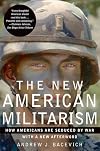
The New American Militarism: How Americans Are Seduced by War
by Andrew Bacevich
On This Page
Description
Examines how an America once possessed with a disdain for the use of force has come to embrace the military as the only means of securing a stable world order. This work shows how American militarism emerged as a reaction to the Vietnam War. It warns of a dangerous dual obsession that has taken hold of Americans, conservatives, and liberals alike.Tags
Recommendations
























Member Reviews
I picked up "The New American Militarism" because I wanted a way to navigate around the odd mixture of obsequiousness, guilt and genuine respect that I've detected around so many discussions of the American military lately. Bacevich, does, after a fashion, mention this element of civilian-military relations, but his focus is deeply historical and his analysis is very acute. The book describes, explains, and examines the changes that have taken place in the American military since Vietnam, some of which have taken place pretty much out of public view. The author covers the birth of the all-volunteer military, the enormous growth of the military budget, the compromises involved in foreign policy's determination to avoid another Vietnam, show more the ways that high technology has changed the military and the foreign policy establishment the birth of the neo-conservative movement, and more. The last of these is particularly useful: Bacevich, something of a lapsed conservative himself, provides a succinct history of a term that has, in the past decade, become more of an insult than a meaningful political designation and explains what sets them apart from older conservatives. He also charts the continual expansion of America's foreign policy responsibilities, particularly in the Middle East, where he considers America to be waging a decades-long, strategically vital global conflict, and and argues that these more-or-less commit Americans to a more militarized foreign policy and a more military-friendly society.
Bacevich is a good writer and struck me as having a strong command of his ideas -- unsurprisingly, since he used to align himself with many of the intellectuals he criticizes here and is a former officer himself. He's also cognizant of what he presents as a series of sad ironies: how, for example, the military's understandable desire to avoid casualties may have kept it from completing foreign policy objectives, therefore setting the stage for future wars with casualties of their own, or the gigantic human costs of being seduced by the promise of a technologically advanced form of warfare. He also seems to care deeply about preserving what he sees as both the integrity of the military and the most important facets of American democracy. A book that, though it was published ten years ago, still seems necessary and important. show less
Bacevich is a good writer and struck me as having a strong command of his ideas -- unsurprisingly, since he used to align himself with many of the intellectuals he criticizes here and is a former officer himself. He's also cognizant of what he presents as a series of sad ironies: how, for example, the military's understandable desire to avoid casualties may have kept it from completing foreign policy objectives, therefore setting the stage for future wars with casualties of their own, or the gigantic human costs of being seduced by the promise of a technologically advanced form of warfare. He also seems to care deeply about preserving what he sees as both the integrity of the military and the most important facets of American democracy. A book that, though it was published ten years ago, still seems necessary and important. show less
Status quo, according to an old joke, is Latin for “the mess we’re in.” Andrew Bacevich—a retired U. S. Army colonel turned historian of international relations—dissects the status quo in this wide-ranging, erudite book and concludes that we are, as a nation, very deep in a very serious mess of our own making.
The mess has been decades in the making, and both political parties—along the public—bear a measure of responsibility for it. It is rooted in the Wilsonian ideal of using American power to remake the world in America’s image, reinforced by Americans’ embrace of a lifestyle based on the availability of cheap oil, exacerbated by the shift from an army with a large percentage of draftees to one composed solely of show more volunteers, and sustained by the rise of a pathological “national security culture” that magnifies the influence of the military-industrial complex over the president while diminishing that of Congress. Bacevich outlines these and other contributing causes, one-by-one, in a series of crisply written, clearly argued, and thoroughly documented chapters. His primary goal is to advance an argument, but in the course of doing so he offers a surprisingly comprehensive meta-analysis of American foreign policy since 1917.
Bacevich’s principal goal is to define a problem, rather than offer a solution, and the book is, accordingly, longer on analysis than on policy prescriptions. Dissatisfying on one level—this is not a reassuring book—it is true to the material and the conclusions that the Bacevich draws from it. The mess we’re in is a complex, tightly knotted problem: decades in the making and likely to be decades in the undoing. The value of The New American Militarism lies in its insistence on that complexity, and its warning that anyone proffering quick and easy solutions, or blaming The Other Party, is missing the point. show less
The mess has been decades in the making, and both political parties—along the public—bear a measure of responsibility for it. It is rooted in the Wilsonian ideal of using American power to remake the world in America’s image, reinforced by Americans’ embrace of a lifestyle based on the availability of cheap oil, exacerbated by the shift from an army with a large percentage of draftees to one composed solely of show more volunteers, and sustained by the rise of a pathological “national security culture” that magnifies the influence of the military-industrial complex over the president while diminishing that of Congress. Bacevich outlines these and other contributing causes, one-by-one, in a series of crisply written, clearly argued, and thoroughly documented chapters. His primary goal is to advance an argument, but in the course of doing so he offers a surprisingly comprehensive meta-analysis of American foreign policy since 1917.
Bacevich’s principal goal is to define a problem, rather than offer a solution, and the book is, accordingly, longer on analysis than on policy prescriptions. Dissatisfying on one level—this is not a reassuring book—it is true to the material and the conclusions that the Bacevich draws from it. The mess we’re in is a complex, tightly knotted problem: decades in the making and likely to be decades in the undoing. The value of The New American Militarism lies in its insistence on that complexity, and its warning that anyone proffering quick and easy solutions, or blaming The Other Party, is missing the point. show less
Bacevich's consideration of how republic congeals into empire is a useful examination of the roots of the current intractable situation the United States finds itself in: That of applying more and more force to resolve our security commitments for seemingly less result and at greater cost. This being in the wake of explaining how the reasonable agendas of rebuilding the US military after Vietnam and securing the American way of life have played out in dysfunctional ways. That Bacevich says upfront about his own values that he considers himself a Catholic conservative is apparently his way of observing that he has little use for imaginings of American special providence as a basis for determining American policy.
If there is a special show more virtue to this book it's that Bacevich has no particular villain that he wants to excoriate, though the Army officer corps, defense intellectuals, Hollywood, evangelical political activists, Reagan, and Clinton all come in for some pointed analysis. The current administration is almost an afterthought here; mostly the unfortunate recipients of thirty years of policy making gone wrong. Their sin being to believe that more of the same will achieve results.
The policy proposals that Bacevich enunciates are also doable, with the hardest part being that this society is going to have to come to the consensus that indefinite hegemony is not a viable policy goal. In fact, one might say that a big part of the overarching theme here is that lack of collective sacrifice put us in our current situation and that a certain measure of collective sacrifice will be needed to keep the ship of state off the rocks.
Finally, I find it ironic that Jimmy Carter is something of the pivot of this book. First for being the last president to try demanding sacrifice from American society; the rejection setting the tone for the next generation. Secondly for being the man who basically started World War IV; a term which Bacevich reserves for the struggle to maintain the world order needed to uphold the prosperity Americans have come to demand as their just entitlement, with particular attention to the Middle East. show less
If there is a special show more virtue to this book it's that Bacevich has no particular villain that he wants to excoriate, though the Army officer corps, defense intellectuals, Hollywood, evangelical political activists, Reagan, and Clinton all come in for some pointed analysis. The current administration is almost an afterthought here; mostly the unfortunate recipients of thirty years of policy making gone wrong. Their sin being to believe that more of the same will achieve results.
The policy proposals that Bacevich enunciates are also doable, with the hardest part being that this society is going to have to come to the consensus that indefinite hegemony is not a viable policy goal. In fact, one might say that a big part of the overarching theme here is that lack of collective sacrifice put us in our current situation and that a certain measure of collective sacrifice will be needed to keep the ship of state off the rocks.
Finally, I find it ironic that Jimmy Carter is something of the pivot of this book. First for being the last president to try demanding sacrifice from American society; the rejection setting the tone for the next generation. Secondly for being the man who basically started World War IV; a term which Bacevich reserves for the struggle to maintain the world order needed to uphold the prosperity Americans have come to demand as their just entitlement, with particular attention to the Middle East. show less
Sobering view of how the military and the government has evolved over the years. And the status quo seems quite depressing. The cycle of war seems never ending. Bacevich had a lot to say in the book. Found it dense reading. But love his insights. As to how to fix it? Thats a bit tougher.
Prof. Bacevich offers coherent, systematic insights into why American citizens accept every larger defense expenditures as well as wars (by any other name) that are not in defense of the nation. He also offers ten suggestions about approaches to remedying our fascination with all things military. Essential reading, I believe.
Nobody escapes criticism in this historical look at how the military came to play such a large role in American foreign policy, and how the military has drifted increasing further away from American society.
Every time I attend a public event with yet another flyover, I think of this book. At the very least, read James Webb's review [which used to be found] here: www.jameswebb.com/amsch.htm
Members
- Recently Added By
Author Information

32+ Works 3,003 Members
Andrew Bacevich was born in Normal Illinois. He was a graduate of West Point in 1969 and served in the U.S. Army during the Vietnam War. He later held posts in Germany and the Persian Gulf up until his retirement from service in the early 1990's. He has a PhD in American Diplomatic History from Princeton University and has taught at West Point and show more Johns Hopkins University before joining the faculty at Boston University in 1998 and becoming Professor of International Relations. He has been a critic of the U.S. occupation of Iraq calling the conflict a catastrophic failure. He wrote several books including American Empire: The Realities and Consequences of U.S. Diplomacy and Washington Rules. (Bowker Author Biography) show less
Awards and Honors
Notable Lists
Classifications
- Genres
- Nonfiction, History, General Nonfiction, Politics and Government
- DDC/MDS
- 355.02130973 — Society, government, & culture Public administration & military science The Military - Land, Air & Sea / Warfare War Topics Militarism
- LCC
- UA23 .B14 — Military Science Armies: Organization, distribution, military situation Armies: Organization, distribution, military situation By region or country
- BISAC
Statistics
- Members
- 429
- Popularity
- 71,778
- Reviews
- 7
- Rating
- (4.17)
- Languages
- English, French
- Media
- Paper, Ebook
- ISBNs
- 10
- UPCs
- 1
- ASINs
- 3