Carl and the Meaning of Life
by Deborah Freedman
On This Page
Description
When a field mouse asks Carl the earthworm why he tunnels through the dirt, Carl doesn't have an answer, so he sets off to find out.Tags
Recommendations















Member Reviews
Picture-book creator Deborah Freedman returns to the form in this seventh title that she has written and illustrated, this time exploring the role of earthworms in the larger ecosystem. Carl is constantly tunneling under the ground, digesting and then casting leaves and dirt, creating a rich fluffy soil. But when a field mouse asks him why he does what he does, and he has no answer, his search for the solution leads to natural disaster. Searching here and there, asking all of the animals what his purpose is, Carl neglects the soil, which soon hardens becoming incapable of supporting life. Eventually realizing what he is meant to do, he gets back to work, creating the rich earth that everyone around him depends upon...
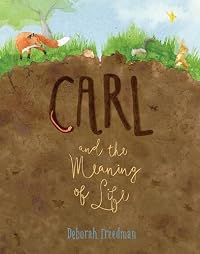
Although not my show more favorite, of Freedman's books - that honor belongs to her lovely This House, Once - I found Carl and the Meaning of Life an engaging and thought-provoking picture-book. Framed in a philosophical light, the story explores the interdependence of all the creatures and plants in a given ecosystem, and highlights the all-important role of a very small and seemingly humble creature: the earthworm. I appreciated the message implicit in the story, while enjoying the story itself, and imagine that many young children will as well. The artwork, done in pencil, watercolor and colored pencil, is lovely. Unsurprisingly, my favorite figure was the beautiful red fox, who can be seen on the cover. Recommended to anyone looking for picture-books with an ecological theme, that explore the interdependence of all life. show less
Although not my show more favorite, of Freedman's books - that honor belongs to her lovely This House, Once - I found Carl and the Meaning of Life an engaging and thought-provoking picture-book. Framed in a philosophical light, the story explores the interdependence of all the creatures and plants in a given ecosystem, and highlights the all-important role of a very small and seemingly humble creature: the earthworm. I appreciated the message implicit in the story, while enjoying the story itself, and imagine that many young children will as well. The artwork, done in pencil, watercolor and colored pencil, is lovely. Unsurprisingly, my favorite figure was the beautiful red fox, who can be seen on the cover. Recommended to anyone looking for picture-books with an ecological theme, that explore the interdependence of all life. show less
I have a series of art programs based on different authors, We Explore Art, and after reading this book I decided that we absolutely need a new one on Deborah Freedman!
The endpapers are a swathe of green hues, which shift to the washed purples and whites of the title page, showing a small worm peering up at the sky. Soft, watery colors introduce the various creatures of his world until we meet Carl, an earthworm, digging deep in the earth. The words run up and down, just as Carl digs up and down in the dirt, day after day. Until one day a mouse asks a question. "Why?"
Carl sets out to find the answer, asking each creature why they do what they do along the way. Each animal has a reason for what they do; to support their family, to hunt show more for food, to plant trees... but none know why Carl does what he does. As Carl travels farther and farther, he hardly notices the changes in the earth around him as it grows dry and barren. The animals begin to leave and soon there is no one left to ask "why?" It's only then that Carl finds the answer to his question and returns to his purpose. His "why" is to support all the other animals, keeping the earth rich and fertile, allowing the seeds to grow, the animals to thrive, and each of them to fulfill their purpose.
A final author's note reflects on the importance of connections and asks readers how they help the earth that Carl and his friends live on and in.
Freedman's watercolors are soft and, well, watery. But they're still beautiful, catching the soft greens of the earth and the spreading dry browns after Carl sets out on his journey. Shades of color and tiny details, like leaves mixed into the soil, a tiny spider's web, and a collection of nuts, dot the pages, rewarding close readers with little surprises throughout the story.
Verdict: This reflective story will appeal to preschool and up; pair it with a storytime on worms, compost, or gardening and encourage them all to think of the little ways they can help the earth around them and to marvel at the many ways that the creatures on earth work together.
ISBN: 9780451474988; Published April 2019 by Viking; Review copy provided by the publisher; Donated to the library show less
The endpapers are a swathe of green hues, which shift to the washed purples and whites of the title page, showing a small worm peering up at the sky. Soft, watery colors introduce the various creatures of his world until we meet Carl, an earthworm, digging deep in the earth. The words run up and down, just as Carl digs up and down in the dirt, day after day. Until one day a mouse asks a question. "Why?"
Carl sets out to find the answer, asking each creature why they do what they do along the way. Each animal has a reason for what they do; to support their family, to hunt show more for food, to plant trees... but none know why Carl does what he does. As Carl travels farther and farther, he hardly notices the changes in the earth around him as it grows dry and barren. The animals begin to leave and soon there is no one left to ask "why?" It's only then that Carl finds the answer to his question and returns to his purpose. His "why" is to support all the other animals, keeping the earth rich and fertile, allowing the seeds to grow, the animals to thrive, and each of them to fulfill their purpose.
A final author's note reflects on the importance of connections and asks readers how they help the earth that Carl and his friends live on and in.
Freedman's watercolors are soft and, well, watery. But they're still beautiful, catching the soft greens of the earth and the spreading dry browns after Carl sets out on his journey. Shades of color and tiny details, like leaves mixed into the soil, a tiny spider's web, and a collection of nuts, dot the pages, rewarding close readers with little surprises throughout the story.
Verdict: This reflective story will appeal to preschool and up; pair it with a storytime on worms, compost, or gardening and encourage them all to think of the little ways they can help the earth around them and to marvel at the many ways that the creatures on earth work together.
ISBN: 9780451474988; Published April 2019 by Viking; Review copy provided by the publisher; Donated to the library show less
When a field mouse asks Carl the earthworm, "Why do you do that?" - that being tunneling through the dirt - Carl stops what he's doing and goes off to find out why he does what he does, by asking the other animals what they do and why. Meanwhile, the ground dries up. and the other animals leave. Then Carl realizes that making the soil fluffy is his work, and when he starts doing it again, the other animals return.
An author's note points out, "Everything is connected - including you!" The beautiful illustrations were made with watercolor, pencil, colored pencil, and Photoshop.
*
Re-read March 2022
*
Re-read May/June 2023
An author's note points out, "Everything is connected - including you!" The beautiful illustrations were made with watercolor, pencil, colored pencil, and Photoshop.
*
Re-read March 2022
*
Re-read May/June 2023
Carl and the Meaning of Life was very interesting and fun to read as the watercolor pictures were captivating and the text was positioned like an earthworm’s movements on certain pages. The question repeated multiple times in the story was “why do I do what I do?” The question is one that most people do not think of and Carl the earthworm was troubled by not knowing the answer. Over the course of the book, the setting changed from a flourishing land to one that was barren and empty. It never occurred to me why until Carl had an aha! moment and knew what to do. The book never explicitly says what Carl figured out or why he does what he does, but instead it is left up to the reader to figure it out the answer. Between the setting show more and the unsaid answer, the book was very enjoyable to read. show less
All hail the mighty earthworm!
This picture book does a pretty good job of summarizing in a fraction of the pages the equally well-done The Earth Moved: On the Remarkable Achievements of Earthworms. Read this then join me in singing "Circle of Life" at the top of your lungs.
This picture book does a pretty good job of summarizing in a fraction of the pages the equally well-done The Earth Moved: On the Remarkable Achievements of Earthworms. Read this then join me in singing "Circle of Life" at the top of your lungs.
Carl and the Meaning of Life follows this darling little earthworm as he wiggles, burrows, and softens his through the world. One day it dawned on him that he himself didn't actually understand why he does what he does, this sets Carl off to discover who he his and what makes him special.
Top 100 Favorite because:
-Striking watercolor illustrations
-Rich, juicy vocabulary, especially when describing Carl's activities & experiences.
-'Know thyself' theme; Discovering who you are and what you like: The age old question everyone eventually asks themselves and others-relatable
-'Big things come in small packages' (my own personal motto as well)
-Ties to science: the role of Earthworms in the life cycle and environmental conservation
-Everything is connected- on a spiritual and physical sense- each animal plays a part in keeping the Earth healthy
-Author's note, asks question "How do You help the Earth?" prompts vigilance and taking care of the world around us
Different from many of my other favorites, yet it sets itself apart show more anyway. It still brings a certain meaningfullness I find myself now looking when choosing my favorites. show less
-Striking watercolor illustrations
-Rich, juicy vocabulary, especially when describing Carl's activities & experiences.
-'Know thyself' theme; Discovering who you are and what you like: The age old question everyone eventually asks themselves and others-relatable
-'Big things come in small packages' (my own personal motto as well)
-Ties to science: the role of Earthworms in the life cycle and environmental conservation
-Everything is connected- on a spiritual and physical sense- each animal plays a part in keeping the Earth healthy
-Author's note, asks question "How do You help the Earth?" prompts vigilance and taking care of the world around us
Different from many of my other favorites, yet it sets itself apart show more anyway. It still brings a certain meaningfullness I find myself now looking when choosing my favorites. show less
Members
- Recently Added By
Author Information
13+ Works 1,176 Members
Awards and Honors
Awards
Distinctions
Common Knowledge
- Original publication date
- 2019
- People/Characters
- Carl the earthworm; Charles Darwin [Charles Robert: 1809-1882]
- Epigraph
- It may be doubted whether there are many other animals which have played so important a part in the history of the world, as have these lowly organized creatures. -- Charles Darwin, The Formation of Vegetable Mould, throug... (show all)h the Action of Worms, 1883
- Dedication
- Kendra levin and Stephen Barr -- for doing what you do --
- First words
- Carl was not a bird.
- Last words
- (Click to show. Warning: May contain spoilers.)Well, why not ask Carl?
- Original language
- English
Classifications
Statistics
- Members
- 162
- Popularity
- 201,464
- Reviews
- 10
- Rating
- (4.23)
- Languages
- English
- Media
- Paper, Audiobook, Ebook
- ISBNs
- 8
- ASINs
- 1