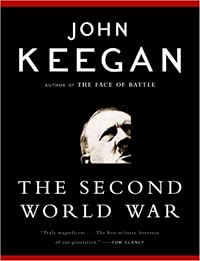
The Second World War
by John Keegan
On This Page
Description
Examines each theater of the war, focusing on five crucial battles and offering new insights into the distinctive methods and motivations of modern warfare.Tags
Recommendations







Member Recommendations

Member Reviews
Excellent one-volume military history of World War II. The author is a well-known military historian who taught at Royal Military Academy Sandhurst. He acknowledges learning from colleagues who were veterans of the war, and from his students; I sense the voice of someone who had a lot of experience teaching this material.
A strong point of this book is its organization, first by time, then by place, then by topic. This makes such a vast topic much more accessible. The writing is clear and readable, and at its best moments (such as the account of the battle of Kursk on the Eastern front) it sparkles and thunders. There are several good maps, and evocative photographs. Within each section, there is a high-level discussion of the strategic show more issues, looking by turn at the perspective of each of the commanders – Hitler, Tojo, Churchill, Stalin, and Roosevelt; and a focused look at a selected battle that illuminates the evolution of war-making and its machinery.
I struggled with the book’s perspective, not so much that it’s British (Keegan actually tries very hard to look from all sides of the conflict, and has some of his toughest critique for Britain’s strategic aerial bombing of German cities), but that it’s so much a military discussion, focused on strategy, military decision making, the evolution of war-making and its machinery, and battles that proved to be turning points. How can you write a book on World War II and say so little about the Holocaust? Keegan was not unaware of political and humanitarian issues; he discusses them tellingly, but not at great length or much detail here. So, highly recommended and I hope it isn’t the only book you read about this period. show less
A strong point of this book is its organization, first by time, then by place, then by topic. This makes such a vast topic much more accessible. The writing is clear and readable, and at its best moments (such as the account of the battle of Kursk on the Eastern front) it sparkles and thunders. There are several good maps, and evocative photographs. Within each section, there is a high-level discussion of the strategic show more issues, looking by turn at the perspective of each of the commanders – Hitler, Tojo, Churchill, Stalin, and Roosevelt; and a focused look at a selected battle that illuminates the evolution of war-making and its machinery.
I struggled with the book’s perspective, not so much that it’s British (Keegan actually tries very hard to look from all sides of the conflict, and has some of his toughest critique for Britain’s strategic aerial bombing of German cities), but that it’s so much a military discussion, focused on strategy, military decision making, the evolution of war-making and its machinery, and battles that proved to be turning points. How can you write a book on World War II and say so little about the Holocaust? Keegan was not unaware of political and humanitarian issues; he discusses them tellingly, but not at great length or much detail here. So, highly recommended and I hope it isn’t the only book you read about this period. show less
A good introductory Book on the Global Catastrophe. Everything is included, the proportion of coverage is good for an English Language Book, and there is acknowledgement that the Soviet Army killed the bulk of the German one. The maps are not the best feature but the ones on the air war are good as I've seen.
Keegan's book is a very clear explanation of the conduct of the Second World War however because it a road very well traveled there were stretches where I was reading through information I had already encountered. However when Keegan switches to such topics as an evaluation of the effectiveness of the various resistance movements in the occupied countries as opposed to the role played by signals intelligence especially the code breakers in Bletchly, he makes some very interesting points. Keegan assesses and evaluates traditional viewpoints well and it was a book I was glad to read
There is no easy way to write about WWII, obviously you can't cover everything. Someone else used best introduction and overview, I think that works well. I would believe with the least amount of effort I came away with the most and greatest understanding of the war in this book. Although he is much to politically correct and kind to the horrid mistakes made in the war, this left me wondering what else was avoided. I will read on.
Great overview of WWII. The analysis was enlightening and conservative.
This book was awesome! Really well written and very informative. I never in my life thought I would want to read a book about WWII, in the past the subject bored me to death..this book completely changed the way I look at military history altogether. I'm actually excited to read more about the events surrounding WWII.
Publisher's blurb aside, this IS actually the best one-volume introduction to World War II. An excellent overview of the grand strategy, with the details of different kinds of fighting handled in separate chapters on air warfare (Battle of Britain), parachute operations (Battle of Crete), etc. Also includes an excellent list of suggestions for further reading.
Members
- Recently Added By
Published Reviews
ThingScore 100
John Keegan's "The Second World War" (1989) is the Apollonian counterpoint to Max Hastings "Inferno" (2011). Mr. Keegan purges much of the blood and guts from the story: The million who died in the siege of Leningrad are a dependent clause. But he delivers a narrative of such intelligence, clarity and grace that the reader leaves the book with an elevated understanding of what happened and show more why. Mr. Keegan, the author of "The Face of Battle" and other books in the military canon, is superb on the war lords. "Hitler's attitude towards Russia," he observes, ". . . was suffused by ideology drawn from many sources—racial, economic, historical—and fermented by his own rancours and ambitions into a self-intoxicating potency." Contrasting FDR with "the devious, double-dealing and treacherous" Stalin and Churchill, "transparently a patriot, a romantic and an imperialist," Mr. Keegan writes: "Roosevelt had dozens of attitudes and a few deeply held values, which were precisely those of Americans of his class and his time: He believed in human dignity and freedom, in economic opportunity and in political compromise; . . . he had few policies, either for peace or for war, while war itself he found utterly distasteful." An elegant, seamless account of the strategic, military and industrial dimensions of the war, with penetrating analysis of its leading figures. show less
added by Stbalbach
Lists

r/AskHistorians' Recommended Books
1,068 works; 19 members

KIB Non-Fiction Book Cloud
41 works; 1 member
Author Information

60+ Works 22,266 Members
John Keegan, May 15, 1934 - August 2, 2012 John Keegan was born in London, England on May 15, 1934. He received a degree in history from Balliol College, Oxford in 1953. After graduation, he went to the United States on a grant to study the Civil War. When he returned to London, he wrote political reports for the United States Embassy and in 1960 show more was appointed as a lecturer at the Royal Military Academy at Sandhurst, England, a post he held for 25 years. During this time he also held visiting professorships at Princeton University and Vassar College. In 1997, he began working for the Daily Telegraph as a defense correspondent and then military affairs editor. He also contributed to the American website National Review Online. During his lifetime, he wrote more than 20 books about military history, the majority of which focus on warfare from the 14th to the 21st centuries. His works included Barbarossa: Invasion of Russia, The Face of Battle, A History of Warfare, Who Was Who in World War II, The Second World War, The American Civil War, The Mask of Command, and The Iraq War. He was knighted in 2000. He died on August 2, 2012 at age of 78. (Bowker Author Biography) show less
Awards and Honors
Distinctions
Series
Belongs to Publisher Series
Work Relationships
Common Knowledge
- Original title
- The Second World War
- Original publication date
- 1989
- Important events
- World War II (1939 | 1945)
- Dedication
- To my pupils at the Royal Military Academy Sandhurst, 1960-1986
- First words
- 'The First [World] War explains the second and, in fact, caused it, in so far as one event causes another,' wrote A.J.P. Taylor in his "Origins of the Second World War".
- Last words
- (Click to show. Warning: May contain spoilers.)That, nevertheless, may have been its abiding effect.
- Blurbers
- Clancy, Tom
- Original language
- English
- Disambiguation notice
- Don't combine with the Illustrated edition of Keegan's Second World War (ISBN 0670823597).
Classifications
Statistics
- Members
- 1,497
- Popularity
- 15,496
- Reviews
- 12
- Rating
- (3.95)
- Languages
- 6 — English, Estonian, French, German, Hungarian, Italian
- Media
- Paper, Ebook
- ISBNs
- 21
- UPCs
- 1
- ASINs
- 11