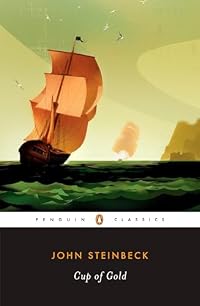
Cup of Gold
by John Steinbeck
On This Page
Description
The first novel from American literary great John Steinbeck (Grapes of Wrath) tells the fictionalized story of the illustrious 17th century pirate Captain Henry Morgan Henry Morgan is a young boy growing up in a small town in Wales. One day, a sailor returns to regale Henry with tales of the West Indies, and the glory that awaits those adventuresome enough to go. Henry, dazzled, quickly finds a place aboard a ship heading to the islands, thus setting himself on the path to becoming the show more brutal and fearsome pirate Captain Morgan. The portrait Steinbeck paints of Morgan (with some artistic license taken) is of a complex, lustful, and largely unhappy man, set in evocative locales that are laced with traces of magical realism. Though Morgan's life was filled with blood and violence, Steinbeck portrays him as a thoughtful and intelligent commander of men, whose tragic flaw is an unquenchable lust for great accomplishments combined with a misunderstanding of what great accomplishments actually are. Through his cunning he repeatedly attains the ever-grander victories he seeks-but he quickly discovers what so many before and after him have discovered: that achievement is not always as satisfying as the quest to achieve. Publisher's Note: Originally published in 1929, Cup of Gold is a literary work that reflects the time in which it was published-both its good and its ill. The original text contains wording and terminology that represent outdated cultural beliefs regarding race and ethnicity. In the interest of preserving and documenting both the faults and highlights of literary history-an instrumental, crucial function of works entering the public domain-this text is unedited and uncensored in this audiobook recording. Please proceed with discretion. show lessTags
Recommendations






























Member Recommendations
Member Reviews
Hear 'a pirate adventure by John Steinbeck' and you're immediately on board, so it's disappointing that Cup of Gold proves to be of limited appeal to both Steinbeck fans and to readers of adventure stories. Steinbeck, who was experimental in his fiction throughout his career, also takes risks here, in his first novel, and unfortunately he doesn't yet have the chops to pull it off.
It is difficult to diagnose: Steinbeck indulges the romance and the action of piracy, but both seem to vanish into mist somewhere between the page and the reader's brain. The storytelling is perfunctory, skimming over exciting moments, as is the characterisation. The plot progression does not put in the groundwork to make the story move, so we lurch from Henry show more Morgan the young boy to Henry Morgan the pirate captain to Henry Morgan the sober knight without any of those changes feeling earned. Often, the reader is left up the creek without a paddle, anticipating a scene of action or adventure, or even of dialogue, only to find that Steinbeck has already moved on. The Spanish Main during the Golden Age of Piracy is a ripe setting for a storyteller – perhaps the ripest – but, strangely, Steinbeck has no desire to roam.
One can occasionally see the author's intentions – such as refocusing Morgan's story from one of romantic adventure to one that is thematically heavy and concerned with directionless lust – but for the most part they do not succeed. Even at this young age, Steinbeck is capable with language and with sentence structure, but sometimes even words like 'gold' and 'fire' struggle to leap off the page. Though never a great read, the strange alliance of John Steinbeck and pirate adventure means Cup of Gold is always interesting, even if it remains a curiosity that gives little hint of Steinbeck's own glories to come. show less
It is difficult to diagnose: Steinbeck indulges the romance and the action of piracy, but both seem to vanish into mist somewhere between the page and the reader's brain. The storytelling is perfunctory, skimming over exciting moments, as is the characterisation. The plot progression does not put in the groundwork to make the story move, so we lurch from Henry show more Morgan the young boy to Henry Morgan the pirate captain to Henry Morgan the sober knight without any of those changes feeling earned. Often, the reader is left up the creek without a paddle, anticipating a scene of action or adventure, or even of dialogue, only to find that Steinbeck has already moved on. The Spanish Main during the Golden Age of Piracy is a ripe setting for a storyteller – perhaps the ripest – but, strangely, Steinbeck has no desire to roam.
One can occasionally see the author's intentions – such as refocusing Morgan's story from one of romantic adventure to one that is thematically heavy and concerned with directionless lust – but for the most part they do not succeed. Even at this young age, Steinbeck is capable with language and with sentence structure, but sometimes even words like 'gold' and 'fire' struggle to leap off the page. Though never a great read, the strange alliance of John Steinbeck and pirate adventure means Cup of Gold is always interesting, even if it remains a curiosity that gives little hint of Steinbeck's own glories to come. show less
51. Cup of Gold : A Life of Sir Henry Morgan, Buccaneer, with Occasional Reference to History by John Steinbeck
introduction Susan F. Beegel
published: 1929
format: 227-page Penguin Classics paperback, published 2008
acquired: 2020
read: Sep 21 – Oct 23
time reading: 8:34, 2.3 mpp
rating: 3
locations: 17th-century Wales, Caribbean, Panama
about the author: 1902-1968, born in Salinas, CA
What an odd first novel. There some more serious themes and some very striking prose here and there, but they are woven into a kind of adventure story. The mixture is messy; readable, but very awkward.
Sir Henry Morgan was a famous Welsh pirate with unofficial government blessing. He put together huge fleets for major raids on fortified Spanish towns in the show more Americas in the 1660's, most famously raiding, in 1671, the central city in Panama where all the gold and silver from Pacific side Spanish mines was held, before transfer across the Isthmus to the Caribbean. He was called to trial in England when his raids continued despite a Spanish-English treaty, then, when the treaty collapsed, awarded a governorship in the Caribbean and knighted by Charles II. He was the subject of a contemporary biography that characterized him as a one-time indentured servant who turned himself into an infamous ruthless pirate, horribly treating the Spanish and his own men. He sued for libel and won, but the mythology has stuck. (He was likely navy sailor with connections. He had two uncles with successful military careers, and one was an English governor in the Caribbean. He married that uncle's daughter, his first cousin.)
Steinbeck is writing fiction, taking characters from his own life and putting them into this pirate story. But he pointedly ties to the real history and the mythology. This is such an odd book. There is a sort of druid priest, a dreamy lonely landlord of indentured and permanent slaves lost in this deep reading, a sort of fierce Spanish heroin who defeats our pirate with a pin used in place of a sword, and sends him into spiraling uncertainty. And this pirate, who conquers his slave owner, women, the economic barriers, and the ruthless recruits, still spirals into doubt. It's just odd. I was struck by the sense of reading a really arrogant author, like male-arrogant. It's not the kind of thing I would expect of a future Nobel Prize winner, but it is maybe revealing in ways his later works don't show.
Unlike Filostrato, this comes with a terrific introduction, which I read afterward. [[Susan F. Beegel]] goes into where Steinbeck was coming from with this novel, what his influences and inspirations were, what this determined author was doing in writing his first novel, and why it came out this awkward way. I think I found this better than the book. It's here I learned that this is essentially an allegory of some dark aspects of American capitalism, the 1920's robber barons being the contemporary pirates (and it was published a two months before the stock market crash).
While I'm happy to recommend Beegel's intro, I can't recommend the book. It's not terrible, but it was disappointing for me. I was toying with reading through Steinbeck's work. But I'm not sure I like the author who wrote this, and I'm not sure I will do that now.
2021
https://www.librarything.com/topic/333774#7640921 show less
introduction Susan F. Beegel
published: 1929
format: 227-page Penguin Classics paperback, published 2008
acquired: 2020
read: Sep 21 – Oct 23
time reading: 8:34, 2.3 mpp
rating: 3
locations: 17th-century Wales, Caribbean, Panama
about the author: 1902-1968, born in Salinas, CA
What an odd first novel. There some more serious themes and some very striking prose here and there, but they are woven into a kind of adventure story. The mixture is messy; readable, but very awkward.
Sir Henry Morgan was a famous Welsh pirate with unofficial government blessing. He put together huge fleets for major raids on fortified Spanish towns in the show more Americas in the 1660's, most famously raiding, in 1671, the central city in Panama where all the gold and silver from Pacific side Spanish mines was held, before transfer across the Isthmus to the Caribbean. He was called to trial in England when his raids continued despite a Spanish-English treaty, then, when the treaty collapsed, awarded a governorship in the Caribbean and knighted by Charles II. He was the subject of a contemporary biography that characterized him as a one-time indentured servant who turned himself into an infamous ruthless pirate, horribly treating the Spanish and his own men. He sued for libel and won, but the mythology has stuck. (He was likely navy sailor with connections. He had two uncles with successful military careers, and one was an English governor in the Caribbean. He married that uncle's daughter, his first cousin.)
Steinbeck is writing fiction, taking characters from his own life and putting them into this pirate story. But he pointedly ties to the real history and the mythology. This is such an odd book. There is a sort of druid priest, a dreamy lonely landlord of indentured and permanent slaves lost in this deep reading, a sort of fierce Spanish heroin who defeats our pirate with a pin used in place of a sword, and sends him into spiraling uncertainty. And this pirate, who conquers his slave owner, women, the economic barriers, and the ruthless recruits, still spirals into doubt. It's just odd. I was struck by the sense of reading a really arrogant author, like male-arrogant. It's not the kind of thing I would expect of a future Nobel Prize winner, but it is maybe revealing in ways his later works don't show.
Unlike Filostrato, this comes with a terrific introduction, which I read afterward. [[Susan F. Beegel]] goes into where Steinbeck was coming from with this novel, what his influences and inspirations were, what this determined author was doing in writing his first novel, and why it came out this awkward way. I think I found this better than the book. It's here I learned that this is essentially an allegory of some dark aspects of American capitalism, the 1920's robber barons being the contemporary pirates (and it was published a two months before the stock market crash).
While I'm happy to recommend Beegel's intro, I can't recommend the book. It's not terrible, but it was disappointing for me. I was toying with reading through Steinbeck's work. But I'm not sure I like the author who wrote this, and I'm not sure I will do that now.
2021
https://www.librarything.com/topic/333774#7640921 show less
Nem vagyok oda a kalózokért. Hallottam olyan értelmezést, hogy ezek a pacákok a szabadság faragatlan zászlóvivői, sótól cserzett arcuk a láthatárt kémleli: ostorai ők az urbánus kötöttségeknek, no meg az eltunyult merkantilista szemléletnek. Nekem viszont csak a pocsék szájhigiénia jut róluk eszembe, no meg az, hogy tutira felgyújtanák a könyvesboltomat. Viszont megértem, miért választotta őket Steinbeck első regényének témájául. Írónk ugyanis akkoriban egy behavazott tanyát őrzött tök egyedül fél éven át, nyilván jól esett neki pihenésképp a trópusokra képzelni magát, ahogy újvilági spanyol városok üszkös romjai között bóklászik. Sajnos az is látszik, hogy az ominózus show more tanyán csak egy Stevenson-összes és pár kalózos ponyva állt rendelkezésére, nagyjából ez az a két forrás ugyanis, ami nyomott hagyott a szövegen. Amit írt, az mindazonáltal Stevenson-regénynek gyenge, bár ponyvának – mondjuk – megjárja.
Választott hőse létező személy, maga a nagy Henry Morgan, akit a legnagyobb tisztesség ért, ami kalózt csak érhet: rumot neveztek el róla. Persze Steinbeck nem ragaszkodik rigorózusan a történelmi tényekhez - e téren alig szuperál jobban, mint a Karib-tenger kalózai c. mozi -, de ez nem akkora baj, ezt még megbocsátanám. A baj az, hogy ismerve Steinbeck későbbi munkásságát, megdöbbentően felületes ez a regény. Pedig izgalmas elképzelés, hogy gyerekkorától kísérjük figyelemmel Morgant, és látjuk, miből lesz a cserebogár, ám úgy fest, az írónak ekkor még nem volt meg az eszköztára ahhoz, hogy ezt a nehéz feladatot – az összetett jellemrajz felépítését – kielégítően elvégezze. Megtudjuk persze, hogy az ifjú Morgan ambiciózus fiatalember, aki tengerre vágyik, aztán rabszolga lesz, majd kalózkapitány, végül kormányzó. A cél az volna, hogy lássuk, hogyan alakul át könyörtelen rablóvezérré – de nincs igazi átalakulás. Egyszerűen csak az lesz, kész, pont. Biztos akarta Steinbeck érzékeltetni az emberi vívódást (látszik a törekvés rá), csak éppen nem sikerült. A motivációk nem komplexek, nagyjából kimerülnek abban, hogy „kalóz akarok lenni, mert hatalom és pénz, és ágyúval bumm-bumm”. Igaz, a szerző az utolsó harmadra beemel valami szerelmi szál szerűt, de hát az meg tényleg ilyen:
(Köszönöm, Agymosás magazin.)
Persze értem én a tanulságot: a hatalom korrumpál, a korlátlan hatalom meg korlátlanul korrumpál, de önmaga elől mégse menekül az ember. De ez a tanulság már azelőtt tök nyilvánvalóvá válik, hogy Morgan egyáltalán elindul a szénporos Wales-ből az óceán túlpartjára. Szóval felesleges volt miatta kinyírni a fél spanyol flottát. Összegezve: egynek elment a könyv. De meg nem mondtam volna róla, hogy Steinbeck. És ha nem Steinbeck, akkor sose adják ki. És nem vesztettünk volna semmit.
Ui.: És igenis szeretem a hajós regényeket. Ugyanakkor azt is látni kell, hogy Steinbeck nem hajós regényt írt, "csak" egy morális elmélkedést némi kardozással. Le merném fogadni, azt se tudja, mi az a tatvitorla, meg a kreuzolás, viszont nagyon okosan el is kerüli, hogy említenie kelljen őket. show less
Választott hőse létező személy, maga a nagy Henry Morgan, akit a legnagyobb tisztesség ért, ami kalózt csak érhet: rumot neveztek el róla. Persze Steinbeck nem ragaszkodik rigorózusan a történelmi tényekhez - e téren alig szuperál jobban, mint a Karib-tenger kalózai c. mozi -, de ez nem akkora baj, ezt még megbocsátanám. A baj az, hogy ismerve Steinbeck későbbi munkásságát, megdöbbentően felületes ez a regény. Pedig izgalmas elképzelés, hogy gyerekkorától kísérjük figyelemmel Morgant, és látjuk, miből lesz a cserebogár, ám úgy fest, az írónak ekkor még nem volt meg az eszköztára ahhoz, hogy ezt a nehéz feladatot – az összetett jellemrajz felépítését – kielégítően elvégezze. Megtudjuk persze, hogy az ifjú Morgan ambiciózus fiatalember, aki tengerre vágyik, aztán rabszolga lesz, majd kalózkapitány, végül kormányzó. A cél az volna, hogy lássuk, hogyan alakul át könyörtelen rablóvezérré – de nincs igazi átalakulás. Egyszerűen csak az lesz, kész, pont. Biztos akarta Steinbeck érzékeltetni az emberi vívódást (látszik a törekvés rá), csak éppen nem sikerült. A motivációk nem komplexek, nagyjából kimerülnek abban, hogy „kalóz akarok lenni, mert hatalom és pénz, és ágyúval bumm-bumm”. Igaz, a szerző az utolsó harmadra beemel valami szerelmi szál szerűt, de hát az meg tényleg ilyen:
(Köszönöm, Agymosás magazin.)
Persze értem én a tanulságot: a hatalom korrumpál, a korlátlan hatalom meg korlátlanul korrumpál, de önmaga elől mégse menekül az ember. De ez a tanulság már azelőtt tök nyilvánvalóvá válik, hogy Morgan egyáltalán elindul a szénporos Wales-ből az óceán túlpartjára. Szóval felesleges volt miatta kinyírni a fél spanyol flottát. Összegezve: egynek elment a könyv. De meg nem mondtam volna róla, hogy Steinbeck. És ha nem Steinbeck, akkor sose adják ki. És nem vesztettünk volna semmit.
Ui.: És igenis szeretem a hajós regényeket. Ugyanakkor azt is látni kell, hogy Steinbeck nem hajós regényt írt, "csak" egy morális elmélkedést némi kardozással. Le merném fogadni, azt se tudja, mi az a tatvitorla, meg a kreuzolás, viszont nagyon okosan el is kerüli, hogy említenie kelljen őket. show less
Cup of Gold is John Steinbeck's retelling of the life of notorious 17th century British pirate Henry Morgan, taking us from his farmboy beginnings to his triumphant plunderings of the Spanish main and his docile end back in England. Steinbeck's premise is that Morgan prevailed because he studied his targets, developed a plan of attack for each raid, and established and maintained strict discipline over his crews. His seizure of Panama—the Cup of Gold—was no naval operation, rather a land war. He pursues the fabled La Santa Roja—is she the woman of his dreams?—driving his men across the isthmus. Yes, he captures her, and, yeah, you won't believe what happens next.
Cup of Gold is a decent, easy read, at just under 200 pages. The show more most notable features: it's Steinbeck's first novel, published in 1928, and his only historical novel. I enjoyed it, had no trouble sticking with it, but there's many another seafaring novel I'd recommend before this one.
Why did I read it? I was sorting and cataloging the books on my shelves, consolidating my Steinbacks from various locations. Cup of Gold was in my hands, didn't seem at all familiar, didn't seem it'd be a task to read, so I read. No regrets. show less
Cup of Gold is a decent, easy read, at just under 200 pages. The show more most notable features: it's Steinbeck's first novel, published in 1928, and his only historical novel. I enjoyed it, had no trouble sticking with it, but there's many another seafaring novel I'd recommend before this one.
Why did I read it? I was sorting and cataloging the books on my shelves, consolidating my Steinbacks from various locations. Cup of Gold was in my hands, didn't seem at all familiar, didn't seem it'd be a task to read, so I read. No regrets. show less
I honestly expected to absolutely hate Steinbeck's first published novel. I've heard several warnings about how terrible it is. Perhaps these warnings only buoyed my opinion.
Cup of Gold certainly is far from the author's greatest works, but it's probably not his worst. In fact, this one gets off to a decent start as young Henry must grapple with his desire for adventure. His conflict with his parents regarding his future and the subsequent life of servitude were the novel's highlights. It's when "the adventure begins" that the pacing gets wonky and the story starts to drag.
Cup of Gold certainly is far from the author's greatest works, but it's probably not his worst. In fact, this one gets off to a decent start as young Henry must grapple with his desire for adventure. His conflict with his parents regarding his future and the subsequent life of servitude were the novel's highlights. It's when "the adventure begins" that the pacing gets wonky and the story starts to drag.
this is steinbeck's first published book and from this early on he was already a really good writer. i enjoyed this book quite a lot. as there are some references to history, it was also interesting (and elucidated a couple of other books recently read) to read about the british colonization of places like jamaica and the west indies. i also didn't know just how much pirates in that time (the mid 1600's) were considered heroes and were knighted for their pillaging/plundering/destruction of cities rather than being tried for heinous war crimes like they would be today. it was more than respectable, no matter how cruel they were.
the only part of this book that bothered me at all was when (spoiler in the rest of this paragraph) morgan was show more face to face with la santa roja, and she said she was disgusted by gentleness, that "I dreamed that you would come to me one day, armed with a transcendent, silent lust, and force my body with brutality. I craved a wordless, reasonless brutality. ... I wanted force - blind, unreasoning force - and love not for my soul or for some imagined beauty of my mind, but for the white fetish of my body." it was the only part of the book that rang untrue for me, and was an unfortunate decision on steinbeck's part.
barring that, this book is a great read, especially if you're a fan of steinbeck. show less
the only part of this book that bothered me at all was when (spoiler in the rest of this paragraph) morgan was show more face to face with la santa roja, and she said she was disgusted by gentleness, that "I dreamed that you would come to me one day, armed with a transcendent, silent lust, and force my body with brutality. I craved a wordless, reasonless brutality. ... I wanted force - blind, unreasoning force - and love not for my soul or for some imagined beauty of my mind, but for the white fetish of my body." it was the only part of the book that rang untrue for me, and was an unfortunate decision on steinbeck's part.
barring that, this book is a great read, especially if you're a fan of steinbeck. show less
Steinbeck's first published novel; about the life of Sir Captain Henry Morgan. It's an interesting novel, a bit slow and ponderous at times with some narrative side-bars that don't fit into the whole of the novel. You can definitely tell it's his first novel in it's pacing, construction, and tones; but you can certainly see the skill level of Steinbeck and see the aspects of the future 'Of Mice and Men', 'East of Eden', 'Grapes of Wrath', author in there. You also get to see him play around with Merlin and his love for Arthur/Arthurian tales and some of his narrative themes.
Members
- Recently Added By
Lists

Reading LIst
648 works; 1 member
Author Information

In recent years Steinbeck has been elevated to a more prominent status among American writers of his generation. If not quite at the world-class artistic level of a Hemingway or a Faulkner, he is nonetheless read very widely throughout the world by readers of all ages who consider him one of the most "American" of writers. Born in Salinas County, show more California on February 27, 1902, Steinbeck was of German-Irish parentage. After four years as a special student at Stanford University, he went to New York, where he worked as a reporter and as a hod carrier. Returning to California, he devoted himself to writing, with little success; his first three books sold fewer than 3,000 copies. Tortilla Flat (1935), dealing with the paisanos, California Mexicans whose ancestors settled in the country 200 years ago, established his reputation. In Dubious Battle (1936), a labor novel of a strike and strike-breaking, won the gold medal of the Commonwealth Club of California. Of Mice and Men (1937), a long short story that turns upon a melodramatic incident in the tragic friendship of two farm hands, written almost entirely in dialogue, was an experiment and was dramatized in the year of its publication, winning the New York Drama Critics Circle Award. It brought him fame. Out of a series of articles that he wrote about the transient labor camps in California came the inspiration for his greatest book, The Grapes of Wrath (1939), the odyssey of the Joad family, dispossessed of their farm in the Dust Bowl and seeking a new home, only to be driven on from camp to camp. The fiction is punctuated at intervals by the author's voice explaining this new sociological problem of homelessness, unemployment, and displacement. As the American novel "of the season, probably the year, possibly the decade," it won the Pulitzer Prize in 1940. It roused America and won a broad readership by the unusual simplicity and tenderness with which Steinbeck treated social questions. Even today, The Grapes of Wrath remains alive as a vivid account of believable human characters seen in symbolic and universal terms as well as in geographically and historically specific ones. Ma Joad is one of the most memorable characters in twentieth-century American fiction. It is her courage that sustains the family. Steinbeck's best and most ambitious novel after The Grapes of Wrath is East of Eden (1952), a saga of two American families in California from before the Civil War through World War I. Cannery Row (1945), The Wayward Bus (1947), and Sweet Thursday (1955) are lighter works that find Steinbeck returning to the lighthearted tone of Tortilla Flat as he recounts picaresque adventures of modern-day picaros. The Winter of Our Discontent (1961) struck some reviewers as being appropriately titled because of its despairing treatment of humanity's fall from grace in a wasteland world where money is king. Steinbeck also wrote important nonfiction, including Russian Journal (1948) in collaboration with the photographer Robert Capa; Once There Was a War (1958) and America and Americans (1966), which features pictures by 55 leading photographers and a 70-page essay by Steinbeck. His interest in marine biology led to two books primarily about sea life, Sea of Cortez (1941) (with Edward F. Ricketts) and The Log from the Sea of Cortez (1951). Travels with Charley (1962) is an engaging account of his journey of rediscovery of America, which took him through approximately 40 states. Steinbeck was married three times and died in New York City on December 20, 1968 of heart disease and congestive heart failure. He was 66, and had been a life-long smoker. (Bowker Author Biography) show less
Some Editions
Series
Belongs to Publisher Series
Common Knowledge
- Canonical title*
- Een handvol goud
- Original title
- Cup of Gold : A Life of Sir Henry Morgan, Buccaneer, with Occasional Reference to History
- Original publication date
- 1929
- People/Characters
- Henry Morgan; Charles II, King of England, Scotland, and Ireland
- Important places
- Wales, UK; Panama
- Important events
- 17th century
- First words
- All afternoon the wind sifted out of the black Welsh glens, crying notice that Winter was come sliding down over the world from the Pole; and riverward there was the faint moaning of new ice.
- Last words
- (Click to show. Warning: May contain spoilers.)For a moment, Henry was conscious of the deep, mellow pulsation of the Tone.
- Original language
- English
*Some information comes from Common Knowledge in other languages. Click "Edit" for more information.
Classifications
- Genres
- Fiction and Literature, General Fiction, Historical Fiction
- DDC/MDS
- 813.52 — Literature & rhetoric American literature in English American fiction in English 1900-1999 1900-1945
- LCC
- PS3537 .T3234 .C8 — Language and Literature American literature American literature Individual authors 1900-1960
- BISAC
Statistics
- Members
- 1,199
- Popularity
- 20,654
- Reviews
- 24
- Rating
- (3.36)
- Languages
- 16 — Czech, Danish, Dutch, English, French, German, Greek, Hungarian, Italian, Norwegian (Bokmål), Polish, Portuguese, Russian, Spanish, Swedish, Turkish
- Media
- Paper, Audiobook, Ebook
- ISBNs
- 60
- ASINs
- 54